Minimum Share Capital in Switzerland: 2026 Guide
Discover what is minimum share capital in Switzerland for 2026. Learn the requirements for a GmbH and an AG, and how to plan your share structure.

Swiss companies must meet minimum share capital requirements: CHF 20,000 fully paid for a GmbH and CHF 100,000 with only CHF 50,000 paid upfront for an AG. The GmbH offers simplicity and transparency but requires public shareholder disclosure, while the AG provides flexible share issuance, appealing to larger or investor-backed enterprises. Proper planning of share structure and capital needs at formation can prevent costly restructuring and support future growth.
Minimum share capital is defined as the legally required minimum amount of equity that shareholders must contribute when forming a company, establishing the financial foundation the law demands before a business can operate. For entrepreneurs forming a company in Switzerland, understanding what is minimum share capital is not optional. The Swiss Code of Obligations sets firm capital thresholds for both the GmbH (limited liability company) and the AG (corporation), and failing to meet them blocks registration entirely. The two structures differ significantly in their capital amounts, payment timing, and share structure, and choosing the wrong one can affect your cash flow, investor appeal, and privacy from day one.
What is minimum share capital for a Swiss GmbH?#
The minimum share capital for a Swiss GmbH is CHF 20,000, and every franc of it must be fully paid at formation. There is no partial payment option. The Swiss Code of Obligations requires full liberation of capital before the commercial register accepts the application. That means you need CHF 20,000 sitting in a blocked bank account before your company legally exists.
GmbH shares are called Stammanteile. The nominal value of a Stammanteil must be greater than zero, and since the 2023 revision of Swiss company law it may be set below one Rappen. Older guides still cite a CHF 100 floor, which no longer applies. That flexibility matters when you want to bring in multiple investors or create a more granular equity structure.
The GmbH structure suits small and medium enterprises and founder-operated businesses well. Its governance is simpler than an AG, and the lower capital threshold keeps the entry cost manageable. The tradeoff is transparency: every GmbH shareholder's name appears publicly in the Swiss commercial register. For entrepreneurs comfortable with that disclosure, the GmbH delivers a cost-effective path to Swiss incorporation.
Key features of the Swiss GmbH capital structure:
- Minimum capital: CHF 20,000
- Payment timing: 100% paid up front at formation
- Minimum share par value: Greater than zero, and it may be below one Rappen
- Shareholder disclosure: Names published in the commercial register
- Governance: Managing director(s) required; simpler structure than AG
If you plan to bring in co-founders or early investors, map out your share structure before formation. Plan the split early to avoid costly restructuring later.
What are the minimum share capital requirements for a Swiss AG?#
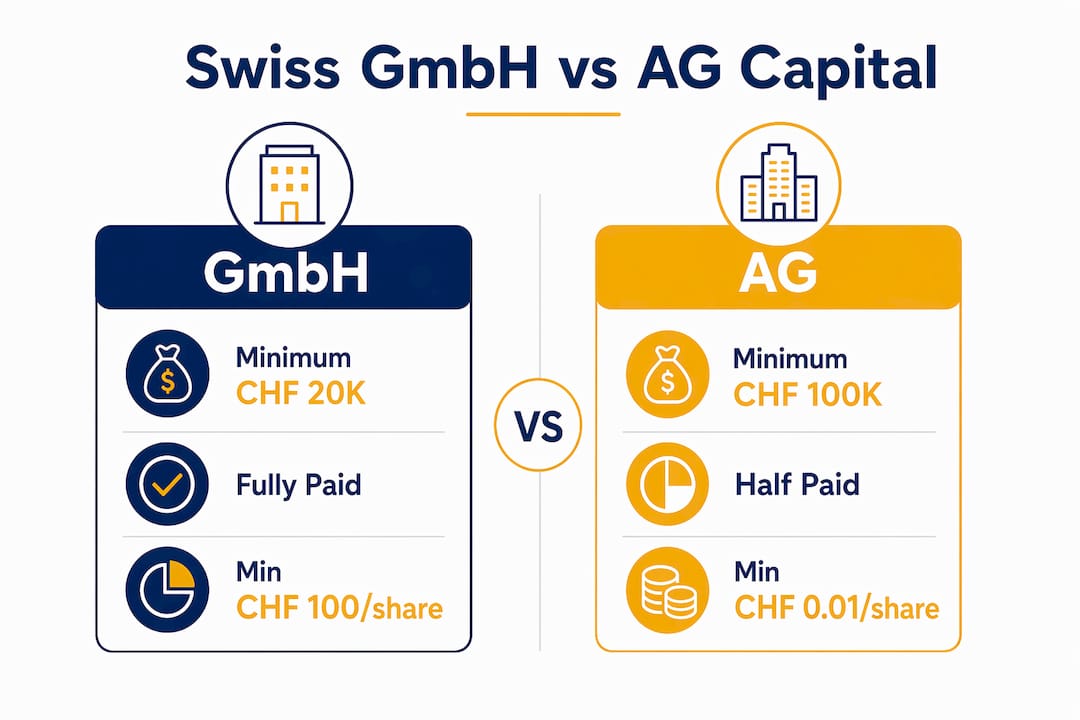
The Swiss AG requires a minimum share capital of CHF 100,000, but only CHF 50,000 must be paid in at incorporation. The remaining CHF 50,000 stays as a receivable on the company's balance sheet. The board of directors can call in that outstanding amount at any time after formation, without a formal capital increase. That flexibility is a genuine structural advantage for companies that want to preserve cash in the early months.
AG shares can carry a par value as low as CHF 0.01. That near-zero floor allows for highly granular share issuance, which matters enormously when structuring employee stock option plans, bringing in venture capital, or preparing for a future IPO. A company with CHF 100,000 in capital and CHF 0.01 par value shares can issue up to 10 million shares.
AG shareholders' names are not published in the commercial register. Combined with the flexible capital structure, that makes the AG a common choice for larger enterprises, investor-backed startups, and any company considering a future public listing.
Key features of the Swiss AG capital structure:
- Minimum capital: CHF 100,000
- Payment timing: At least CHF 50,000 paid at formation; remainder callable later
- Minimum share par value: CHF 0.01 per share
- Shareholder disclosure: Names not published in the commercial register
- Governance: Board of directors required; the company must be able to be represented by a person resident in Switzerland
A common misconception is that the AG requires CHF 100,000 up front. It does not. You need CHF 50,000 in a blocked account at formation. The remaining CHF 50,000 is a legal obligation the board can call in later, giving you real breathing room during the startup phase.
How do capital rules affect governance and shareholder disclosure?#
The gap between GmbH and AG governance goes deeper than just capital amounts. The Swiss Code of Obligations ties governance structure directly to company type, and the capital thresholds reflect those structural differences. Getting this right at formation prevents compliance problems that are expensive to fix later.
For the GmbH, shareholder transparency is a legal requirement. Every owner's name, address, and share count appears in the public commercial register. That level of disclosure affects how you negotiate with business partners and how visible your ownership structure is to competitors.
The AG differs on this point. Because shareholders are not listed in public records, the AG creates a cleaner separation between ownership and the public register entry. This matters for holding structures and for founders who operate across multiple jurisdictions. It is a matter of what the register publishes, not a shield: beneficial ownership still has to be disclosed to the company itself under the reporting rules, and to banks during onboarding.
Governance obligations also differ by structure:
- GmbH: Managed by one or more managing directors; the company must be able to be represented by a person resident in Switzerland
- AG: Governed by a board of directors; the company must be able to be represented by a person resident in Switzerland
- Audit obligations: Both structures face audit thresholds tied to revenue and headcount, but the AG's larger capital base often triggers these requirements sooner
- Capital band: Since 2023, the capital band allows an AG to adjust capital within predefined limits without a full shareholder vote, improving agility for growing companies. There is no equivalent for the GmbH
The residency requirement for representation is a practical compliance point that catches many foreign founders off guard. RPCS provides Swiss resident director services that satisfy this requirement without requiring founders to relocate.
What practical decisions should entrepreneurs make about share capital?#
Share capital is not just a legal checkbox. It directly affects your startup budget, your ability to attract investors, and your company's financial flexibility from the first day of operation. Entrepreneurs who treat it as a formality often face formation delays or structural problems that require expensive legal fixes.

The CHF 20,000 GmbH threshold is accessible for most founders, but the full upfront payment requirement means that money is locked in a blocked account until registration completes. You need to budget for that capital being unavailable during the formation period, on top of notary fees, registration costs, and any professional service fees.
For the AG, the CHF 50,000 minimum payment at formation is higher, but the structure pays back in investor flexibility. Venture capital firms and institutional investors often prefer the AG because of its familiar share structure and the ability to issue shares at granular par values. If you plan to raise equity financing within the first two years, forming as an AG from the start avoids a costly conversion later.
Practical considerations when choosing your capital structure:
- Cash flow: CHF 20,000 fully blocked for GmbH; CHF 50,000 blocked for AG at formation
- Investor readiness: AG share structure is well suited to equity rounds and option pools
- Disclosure: The AG does not publish shareholder names; the GmbH publishes all of them
- Future growth: The capital band gives the AG more flexibility post-formation
- Ongoing compliance: Both structures require accounting services and annual reporting; the AG typically carries higher administrative costs
Do not choose your company type based on capital amount alone. A GmbH costs less to form, but if you plan to raise outside capital the AG's higher entry cost pays for itself quickly. Model your 24-month capital needs before you decide.
Key takeaways#
Swiss company formation requires meeting strict minimum share capital thresholds under the Swiss Code of Obligations, with the GmbH requiring CHF 20,000 fully paid and the AG requiring CHF 100,000 with at least CHF 50,000 paid at formation.
| Point | Details |
|---|---|
| GmbH capital requirement | CHF 20,000 must be fully paid at formation; no partial payment is allowed. |
| AG capital requirement | CHF 100,000 minimum; only CHF 50,000 is required at incorporation. |
| Share par value difference | A GmbH share must simply exceed zero; AG shares can be as low as CHF 0.01. |
| Shareholder disclosure | AG shareholders are not listed in the commercial register; GmbH shareholders are. |
| Capital band | Since 2023, an AG can adjust capital within set limits without a full shareholder vote. |
Choosing the right capital structure#
The single most common mistake is entrepreneurs choosing the GmbH purely because CHF 20,000 feels more manageable than CHF 100,000. That logic is understandable, but it often creates a bigger problem 18 months later when they want to bring in investors or restructure equity.
The GmbH is genuinely the right choice for founder-operated businesses, consulting firms, and small enterprises that do not plan to raise outside capital. Its simpler governance and lower cost make it efficient for that use case. But the moment you introduce a second investor class or an option pool, the GmbH starts working against you.
The capital band that took effect in 2023 is a meaningful improvement that many entrepreneurs still do not know about. An AG can now adjust its capital within predefined limits without convening a full shareholder meeting. That flexibility reduces one of the traditional arguments against the AG's higher capital requirement.
Treat the CHF 50,000 AG formation payment not as a cost but as a deposit into a structure that will serve you for a decade. The GmbH vs AG comparison is worth studying carefully before you commit. Get the structure right at formation, and everything else becomes easier.
How RPCS supports Swiss company formation#
Setting up a Swiss company means navigating capital requirements, notarisation, commercial register filings, and banking setup at the same time.
RPCS handles Swiss company formation for international entrepreneurs, covering both GmbH and AG structures. Services include Swiss resident director placement, registered office provision, and ongoing accounting to keep your company compliant after formation. Whether you need CHF 20,000 cleared for a GmbH or CHF 50,000 deposited for an AG, RPCS coordinates the process so you avoid delays and compliance gaps.
Frequently asked
01What is the minimum share capital for a Swiss GmbH?
The minimum share capital for a Swiss GmbH is CHF 20,000, and it must be fully paid at the time of formation. No partial payment is permitted under the Swiss Code of Obligations.
02Does a Swiss AG require the full CHF 100,000 at formation?
No. A Swiss AG requires at least CHF 50,000 paid at incorporation. The remaining CHF 50,000 is a receivable that the board of directors can call in at any time after formation.
03Are AG shareholders' names publicly available in Switzerland?
AG shareholders' names are not published in the Swiss commercial register. GmbH shareholders, by contrast, are listed publicly.
04What is the minimum share par value for a Swiss AG?
Swiss AG shares can carry a par value as low as CHF 0.01, enabling highly granular share allocation for option pools, venture capital rounds, and future public listings.
05Can share capital be adjusted after a Swiss company is formed?
Yes. Since 2023, the capital band allows a Swiss AG to adjust its share capital within predefined limits without a full shareholder vote, giving growing businesses more financial flexibility.
Sources
Information verified as of 20 August 2026.
- Minimum share capital of a Swiss GmbH
- When a GmbH's share capital must be paid in
kmu.admin.ch, verified 20 August 2026
- Minimum share capital of a Swiss AG
- Minimum share capital paid in at AG incorporation
kmu.admin.ch, verified 20 August 2026
The content on this website is provided for general information purposes only and is general in nature. It does not constitute legal, tax or financial advice and is not a substitute for individual advice in a specific case. No warranty is given as to the accuracy, completeness or currency of the information, and any liability is excluded to the extent permitted by law. Use of this website or contacting us does not create any client, mandate or advisory relationship. For your specific situation we recommend obtaining individual advice from a qualified professional.
Related reading
Choosing a Domicile Canton for a New Swiss Company
A canton's headline corporate tax rate is rarely the rate you pay. Most multiply a base rate by a Steuerfuss set separately by canton, commune and year.
Read article
AG vs GmbH: Choosing the Right Structure
How a Swiss AG and GmbH actually differ: share capital, what gets published in the Commercial Register, and which one fits a foreign-owned company better.
Read article
Setting Up a GmbH in Switzerland
A practical guide to forming a Swiss GmbH: the share capital rule, what incorporation involves, the registration timeline and audit thresholds that follow.
Read article