What Is a Company Secretary? Roles and Duties Explained
Discover what a company secretary is and why the role matters for legal compliance, governance and the smooth running of your business.

A company secretary ensures a company's legal compliance, record-keeping, and governance support. Their role prevents penalties, protects directors, and maintains the company's good standing with regulators.
A company secretary is a senior corporate officer responsible for ensuring a company meets its legal, regulatory, and governance obligations. The role sits at the intersection of law, administration, and board advisory. Business owners who overlook this position often discover the cost of that decision when filing deadlines pass, statutory registers fall out of date, or regulators come knocking. Whether you are forming a private limited company or scaling a public entity, understanding the company secretary role is one of the clearest steps you can take toward sound corporate governance.
What is a company secretary and why does the role matter?#
A company secretary is defined as the officer responsible for a company's statutory compliance, governance records, and board communications. The role is not clerical. It is a governance function that protects the company, its directors, and its shareholders from procedural and legal failures.

The Corporate Governance Institute describes the secretary as essential to aligning leadership on compliance and strategic decisions. That alignment matters because directors carry fiduciary duties they cannot fulfill without accurate, timely information flowing through the right channels.
The role also carries personal accountability. Company secretaries hold personal liability for compliance failures, even though they do not share the same fiduciary duties as directors. That distinction makes the appointment consequential, not optional, for any company serious about governance.
For entrepreneurs setting up a company in Switzerland, the UK, or India, the secretary is often the first professional who touches every compliance deadline, every board resolution, and every statutory filing. Getting this appointment right from day one prevents problems that compound quickly.
What are the main duties of a company secretary?#
The work of a company secretary spans four core areas: statutory record-keeping, meeting management, regulatory filing, and board advisory.
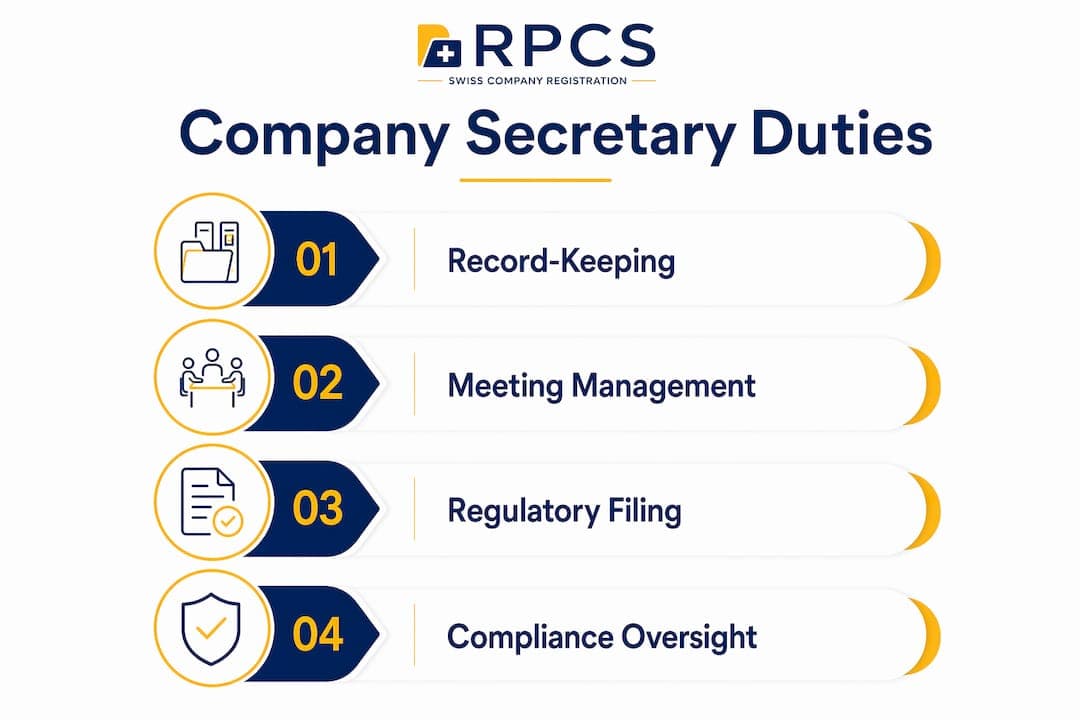
Maintaining statutory registers is a foundational duty in all common law jurisdictions. These registers include records of members, directors, and charges, and they must stay current with every change in company structure or ownership.
Beyond records, the secretary organizes board meetings and shareholder meetings, prepares agendas, and takes minutes. Accurate minutes are not a formality. They are the legal record of every board decision and protect directors if a resolution is ever challenged.
The regulatory filing function covers annual returns, confirmation statements, and event-driven filings such as changes to directors or share capital. Missing these deadlines triggers automatic fines in most jurisdictions and, in serious cases, risks the company being struck off the register.
The advisory function is where the role earns its strategic value. Norman Consultants note that company secretaries ensure governance machinery functions properly, prevent procedural failures, and serve as trusted consultants to the board and chair. That is a different job description than filing paperwork.
Key duties at a glance:
- Maintaining registers of members, directors, and charges
- Organizing and minuting board and shareholder meetings
- Filing annual returns, confirmation statements, and event-driven forms
- Advising the board on corporate law and governance obligations
- Managing communication between the board, executives, and external stakeholders
- Acting as the primary contact for auditors and regulators
Set calendar reminders for every statutory filing deadline on the day you incorporate. Missing the first confirmation statement is the most common compliance error new business owners make, and the fine arrives before most founders realize the deadline existed.
How is a company secretary appointed?#
Appointment procedures vary by jurisdiction, but the process follows a consistent pattern: board resolution, formal notification to the registrar, and ongoing compliance with qualification requirements where they apply.
-
Board resolution. The board passes a formal resolution appointing the secretary and recording the decision in the minutes.
-
Registrar notification. In the UK, notification must be filed within 14 days using Form AP03. In India, the equivalent form is DIR-12, and the deadline is 30 days.
-
Qualification check. In India, companies with paid-up capital of Rs 10 crores or more must appoint a full-time company secretary who holds membership of the Institute of Company Secretaries of India (ICSI). The role also carries Key Managerial Personnel status under Section 2(24) of the Companies Act 2013.
-
Public vs. private distinction. Under the Companies Act 2006, Section 273, public limited companies must appoint a qualified secretary, while private limited companies may do so voluntarily.
-
Ongoing compliance. The secretary must update the registrar whenever their details change, and the company must maintain a record of all past and present secretaries.
Failing to notify the registrar within the required window is itself a compliance breach. The fine may be modest, but the pattern it sets is not.
What practical benefits does a qualified company secretary bring?#
The clearest benefit is prevention. Without a dedicated company secretary, directors often miss filing deadlines, leading to fines and the risk of deregistration. That risk is called compliance drift, and it accelerates when directors absorb secretary duties on top of their operational responsibilities.
A qualified secretary acts as the gatekeeper for every regulatory deadline. They track confirmation statement dates, capital change filings, and meeting notice requirements simultaneously. No director managing a growing business can reliably do the same without dedicated focus.
The advisory benefit compounds over time. A secretary who understands corporate law can flag governance risks before they become legal problems. They brief the board on regulatory changes, structure resolutions correctly, and ensure that decisions made in the boardroom are legally defensible.
For foreign entrepreneurs, the value is even more direct. Outsourcing company secretary functions to professionals with local knowledge reduces the complexity of navigating unfamiliar filing systems and statutory requirements. A foreign business owner setting up a Swiss GmbH or AG faces documentation requirements, notarization steps, and registration procedures that differ substantially from their home jurisdiction. A local secretary handles that complexity.
Key practical benefits:
- Prevents compliance drift and automatic penalties
- Protects directors by maintaining accurate minutes and records
- Keeps the company in good standing with the registrar
- Provides governance advice that reduces board-level legal risk
- Reduces administrative burden for foreign entrepreneurs unfamiliar with local law
Outsourcing the company secretary function to a professional firm is a proven practice for smaller companies and foreign-owned entities. The cost is predictable, the expertise is immediate, and the compliance risk drops to near zero from day one.
How does the company secretary role differ across jurisdictions?#
The scope, qualifications, and legal weight of the role vary significantly between the UK, India, and Switzerland. Business owners operating across borders need to understand these differences before they appoint or outsource.
| Jurisdiction | Mandatory for private companies? | Qualification required? | Key filing form | Deadline to notify registrar |
|---|---|---|---|---|
| United Kingdom | No (voluntary) | Yes, for public companies | Form AP03 | 14 days |
| India | Yes (above Rs 10 crore capital) | Yes (ICSI membership) | Form DIR-12 | 30 days |
| Switzerland | Not separately mandated | No formal certification | Commercial Register filing | Per cantonal rules |
In the UK, private companies can operate without a secretary, but the governance risk of doing so is real. In India, the role carries statutory weight as Key Managerial Personnel, and non-compliance with ICSI membership requirements triggers penalties under the Companies Act 2013.
Switzerland takes a different approach. The company secretary role in Switzerland is not separately mandated by statute in the same way as the UK or India, but the governance and administrative functions the role covers are still required. Those duties typically fall to a director, a legal advisor, or a professional services firm. For foreign entrepreneurs forming a Swiss GmbH or AG, working with a local provider who covers Swiss corporate compliance is the practical equivalent of appointing a qualified secretary.
Jurisdictions vary widely in whether they require formal professional certification. India mandates it. The UK requires it only for public companies. Switzerland does not specify it but expects the underlying compliance functions to be performed correctly regardless of who holds the title.
Key Takeaways#
A company secretary is the governance officer who keeps a company legally compliant, its records accurate, and its board properly advised. Neglecting this role creates compounding compliance risk that no director can afford to ignore.
| Point | Details |
|---|---|
| Core definition | A company secretary ensures statutory compliance, maintains records, and advises the board on governance. |
| Mandatory in some jurisdictions | UK public companies and Indian companies above Rs 10 crore capital must appoint a qualified secretary. |
| Filing deadlines are strict | UK notification requires Form AP03 within 14 days; India requires Form DIR-12 within 30 days. |
| Compliance drift is a real risk | Directors who absorb secretary duties routinely miss filings, triggering fines and deregistration risk. |
| Outsourcing works for foreign owners | Professional firms with local knowledge handle complex filing requirements and reduce administrative burden. |
Why I think most business owners underestimate this role#
Most founders treat the company secretary as a box to check during incorporation. That is the wrong frame entirely.
The secretary is the person who makes sure the board's decisions are legally valid, the records are defensible in court, and the company stays on the right side of the registrar without anyone having to think about it. When that function is missing or delegated to a distracted director, the company accumulates small compliance failures that eventually become expensive ones.
I have seen foreign entrepreneurs set up Swiss companies with genuine care for the product and the market, then lose months of momentum untangling filing errors that a competent secretary would have prevented on day one. The cost is never just the fine. It is the management time, the legal fees, and the distraction from the actual business.
The strategic value of a good secretary is harder to quantify but just as real. A secretary who understands corporate governance fundamentals will flag a governance gap before it becomes a board liability. That kind of early warning is worth more than the salary or service fee.
My honest recommendation: treat the secretary appointment with the same seriousness you give to your accountant or legal counsel. For foreign entrepreneurs especially, outsource it to a firm with deep local knowledge. The compliance infrastructure you build in the first year shapes how the company operates for a decade.
How RPCS supports Swiss company compliance and governance#
RPCS works with international entrepreneurs and investors who need Swiss corporate infrastructure built correctly from the start. The team covers the full setup process, from Swiss company formation including GmbH and AG structures, to registered address services, notarization, and ongoing administrative support.
For business owners who need ongoing compliance support, RPCS provides accounting services and governance administration that cover the functions a company secretary would typically manage. Foreign founders who lack local knowledge of Swiss cantonal rules, Commercial Register requirements, and statutory deadlines get a single point of contact who handles it all. Contact RPCS directly to discuss what your Swiss company structure requires.
Frequently asked
01What is a company secretary in simple terms?
A company secretary is the corporate officer responsible for legal compliance, statutory record-keeping, and governance support. The role ensures the company meets its regulatory obligations and that the board operates within the law.
02Is a company secretary required by law?
Requirements depend on jurisdiction. UK public companies must appoint a qualified secretary under the Companies Act 2006. In India, companies above Rs 10 crore in paid-up capital must appoint a full-time ICSI member. Swiss law does not separately mandate the title but requires the underlying compliance functions to be performed.
03What does a company secretary do day to day?
Day-to-day work includes maintaining statutory registers, preparing board meeting agendas and minutes, filing confirmation statements and event-driven forms, and advising the board on governance and legal obligations.
04Can a director also serve as company secretary?
In many jurisdictions, a sole director cannot also act as company secretary. The UK Companies Act 2006 prohibits this for public companies. For private companies, the rules are more flexible, but combining the roles increases compliance risk significantly.
05What happens if a company has no secretary?
Without a dedicated secretary, directors absorb the compliance workload and frequently miss filing deadlines. This leads to automatic fines, potential deregistration, and a pattern of compliance drift that becomes harder to correct over time.
Sources
Information verified as of 20 August 2026.
- Appointment of the secretary of a Swiss AG board
kmu.admin.ch, verified 20 August 2026
The content on this website is provided for general information purposes only and is general in nature. It does not constitute legal, tax or financial advice and is not a substitute for individual advice in a specific case. No warranty is given as to the accuracy, completeness or currency of the information, and any liability is excluded to the extent permitted by law. Use of this website or contacting us does not create any client, mandate or advisory relationship. For your specific situation we recommend obtaining individual advice from a qualified professional.
Related reading

What Is Corporate Compliance? A Guide for Executives
Discover what corporate compliance is, and learn how an effective programme protects your business from fines, liability and reputational damage.
Read article
Nonprofit Board of Directors: Roles and Responsibilities
Discover the essential nonprofit board of directors roles and responsibilities, including the fiduciary duties that underpin good governance.
Read article
Switzerland Substance Requirements: A Business Guide
Discover what substance requirements in Switzerland mean for a business, and what it takes to show the company genuinely operates here.
Read article