How to Obtain Swiss Residence for Business
How to obtain Swiss residence for business: the prerequisites, the application steps, the common challenges and what the process actually requires.

Establishing Swiss residence for business can be complex for foreign investors and entrepreneurs. Navigating cantonal regulations, documentation requirements, and legal prerequisites often feels overwhelming without clear guidance. This guide clarifies requirements and procedures step by step, helping international entrepreneurs secure Swiss residence efficiently. You will learn what prerequisites matter most, how to submit applications correctly, common pitfalls to avoid, and how to verify your residency status once approved. Whether you are launching a startup or expanding operations into Europe, understanding this process is essential for success.
Key Takeaways#
| Point | Details |
|---|---|
| Understand prerequisites | Entrepreneurs must meet immigration and business criteria, with cantonal variations but common elements including a viable business plan and sufficient financial resources. |
| Stepwise application | Follow a fixed sequence including registering the company, submitting the permit application with documents, and potential interviews to improve approval chances. |
| Common pitfalls | Missing documentation and misunderstandings about legal requirements frequently cause delays or rejections. |
| Post approval compliance | After approval, you must maintain residency requirements and comply with Swiss laws and ongoing regulatory obligations. |
Understanding prerequisites for Swiss residence through business#
Before submitting your application, you must understand what Swiss authorities require from foreign entrepreneurs seeking residence. Entrepreneurs must meet specific immigration and business criteria to qualify for Swiss residence permits. These prerequisites vary by canton but share common elements across Switzerland.
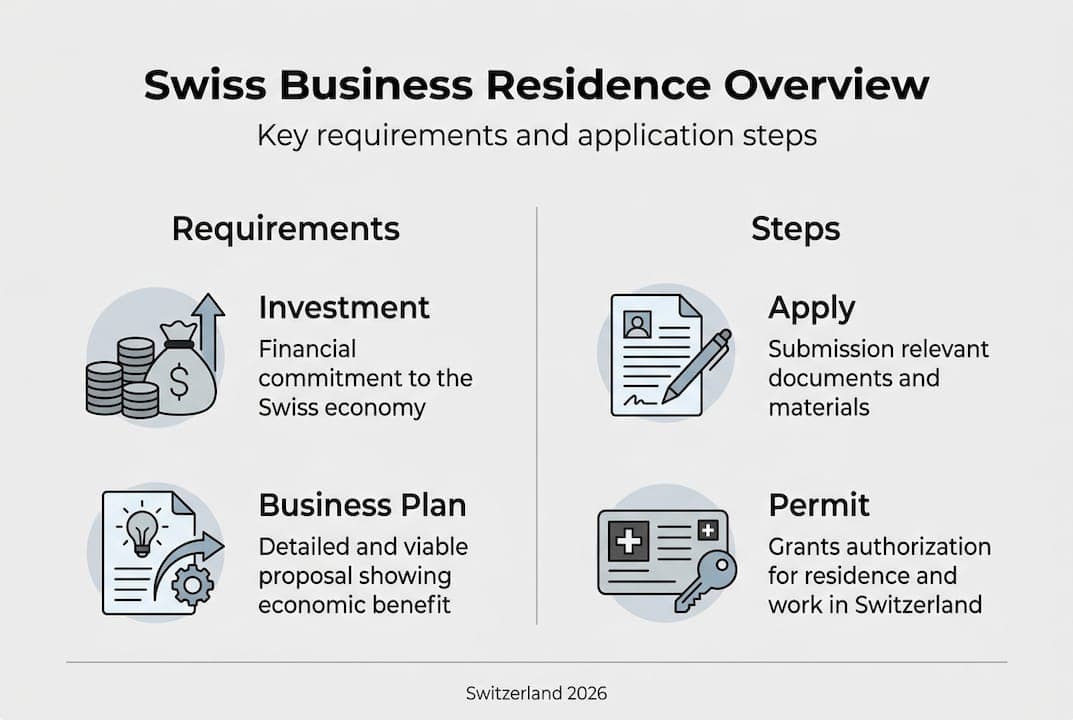
First, immigration categories for business residence typically include permits for company founders, investors, and senior executives. Each category has distinct eligibility thresholds. You need a viable business plan demonstrating economic benefit to Switzerland, proof of sufficient financial resources to support yourself and any dependents, and evidence of your qualifications or track record in your industry.
Financial requirements are substantial. Most cantons require entrepreneurs to invest a minimum capital amount in their Swiss company, often starting at CHF 100,000 or higher depending on the business type and location. You must also show personal funds covering living expenses for at least one year without relying on social assistance. Background checks are mandatory, including criminal record clearances from your home country and any nation where you have resided recently.
| Document Type | Purpose | Typical Requirements |
|---|---|---|
| Business plan | Demonstrates viability | Market analysis, financial projections, job creation potential |
| Financial proof | Shows self-sufficiency | Bank statements, investment capital, income sources |
| Personal documents | Verifies identity and background | Passport, birth certificate, criminal record clearance |
| Qualifications | Establishes expertise | Diplomas, professional certifications, work references |
Key preparatory steps include:
- Researching cantonal requirements specific to your target location
- Drafting a comprehensive business plan tailored to Swiss market needs
- Gathering all personal and financial documentation well in advance
- Consulting with immigration and business formation specialists
- Securing initial legal and tax advice on structuring your Swiss entity
Pro Tip: Engage early consultation with legal experts specializing in business immigration Switzerland 2026 guide to avoid common pitfalls like insufficient capital documentation or weak business justifications. Many applications fail because entrepreneurs underestimate the thoroughness Swiss authorities demand. Understanding requirements to move to Switzerland for entrepreneurs before starting saves months of delays. If you plan to serve as a company director, familiarize yourself with Swiss residency rules for directors to ensure compliance.
Step-by-step application process for Swiss business residence#
Once you have prepared all prerequisites, the actual application process follows a structured sequence. Following a precise stepwise process significantly improves approval chances for Swiss business residence permits. Each canton manages its own immigration procedures, but the overall framework remains consistent.
-
Choose your canton and register your company. Your business must be officially registered before you can apply for residence. This involves notarizing articles of association, depositing share capital, and completing commercial register entries.
-
Submit your residence permit application to the cantonal migration office. Include your business registration documents, personal identification, financial proof, and detailed business plan. Some cantons require translations into German, French, or Italian depending on the region.
-
Attend an interview if requested. Migration authorities may ask you to explain your business model, financial projections, and integration plans. Prepare to answer questions about how your venture benefits the Swiss economy.
-
Undergo background and security checks. Authorities verify your criminal record, financial history, and compliance with Swiss laws. This stage can take several weeks.
-
Receive preliminary approval and fulfill any additional conditions. You may need to provide supplementary documents or clarifications before final approval.
-
Obtain your residence permit card. Once approved, you receive a biometric permit card allowing you to live and work in Switzerland under business residence status.
-
Register with local authorities and fulfill ongoing obligations. Within 14 days of arrival, register at your municipal office and comply with tax, social security, and insurance requirements.
| Permit Type | Eligibility | Duration | Key Benefits |
|---|---|---|---|
| L Permit (Short-term) | Temporary business projects | Up to 1 year | Quick processing, renewable |
| B Permit (Residence) | Active business owners and managers | 1-5 years, renewable | Full work rights, family reunification |
| C Permit (Permanent) | Long-term residents after 5-10 years | Indefinite | Maximum stability, minimal restrictions |
Pro Tip: Prepare documents carefully to expedite processing. Use certified translations, organize files logically, and provide clear explanations for any unusual financial transactions. Small errors or missing pages can delay your application by months. The Swiss business visa step-by-step resource offers detailed checklists to ensure nothing is overlooked.
Timing varies significantly by canton. Urban centers like Zurich and Geneva often process applications faster due to higher volumes and streamlined systems, while smaller cantons may take longer but offer more personalized service. Budget three to six months from initial submission to permit issuance in most cases.
Understanding Swiss business permits for foreign founders helps you choose the right permit category from the start. If your business requires specific licenses or regulatory approvals, consult the Swiss business license guide to coordinate those processes with your residence application.
Troubleshooting common challenges and verifying Swiss residency status#
Even well-prepared applications encounter obstacles. Many applicants face challenges like incomplete paperwork and misunderstandings about legal compliance requirements that delay Swiss residence approval. Recognizing these issues early allows you to address them proactively.
Common mistakes include:
- Submitting outdated or improperly certified documents
- Underestimating required investment capital or personal funds
- Failing to demonstrate sufficient economic benefit to Switzerland
- Misunderstanding cantonal differences in requirements and procedures
- Neglecting to secure proper business licenses before applying for residence
- Providing vague or unrealistic business plans without market research
If your application is delayed or rejected, request detailed feedback from the migration office. Swiss authorities typically provide specific reasons for refusals, allowing you to correct deficiencies and reapply. In some cases, you can appeal decisions or provide additional evidence without starting over completely.
Verifying your residence permit status is straightforward once approved. Your permit card displays your authorization type, validity dates, and any special conditions. You can also check your status online through cantonal portals or by contacting the migration office directly. Keep digital and physical copies of all correspondence and approvals for future reference.
Swiss residence permits come with ongoing obligations. Failing to renew on time, neglecting tax filings, or ceasing active business operations can result in permit revocation. Always maintain compliance with cantonal and federal regulations throughout your stay.
Ongoing legal compliance means filing annual tax returns, maintaining valid health insurance, and keeping your business operationally active. If you change business activities significantly or move to a different canton, notify authorities promptly. Residence permits are tied to your declared business purpose, so material changes require approval.
Renewal procedures begin several months before your permit expires. Gather updated financial statements, business performance reports, and personal documents to demonstrate continued eligibility. Most renewals are straightforward if you have maintained compliance and your business remains viable. Understanding residency rules for directors is especially important if your role evolves over time.
Benefits of obtaining Swiss residence for business#
Securing Swiss residence through business offers substantial advantages beyond simply living in Switzerland. Switzerland offers attractive tax optimization opportunities and strategic access to European markets for business residents. These benefits make the effort and investment worthwhile for serious entrepreneurs.
Tax advantages are significant. Switzerland features competitive corporate tax rates, especially in certain cantons, and an extensive network of double taxation treaties with over 100 countries. As a Swiss resident operating a Swiss company, you can structure operations to minimize global tax burdens legally. Cantonal tax regimes vary widely, allowing you to choose locations that align with your financial strategy.

Strategic market access is another major benefit. Switzerland sits at the heart of Europe with excellent transport infrastructure and trade agreements. Your Swiss base facilitates business throughout the European Union and beyond. Clients and partners often view Swiss operations as a mark of credibility and stability, opening doors that might remain closed to businesses based elsewhere.
Quality of life in Switzerland ranks among the highest globally. You gain access to world-class healthcare, education systems, and public services. Political stability, low crime rates, and stunning natural environments make Switzerland an ideal place to live and raise a family while building your business.
Key business and personal incentives include:
- Access to highly skilled multilingual workforce
- Strong intellectual property protections and legal frameworks
- Advanced financial services and banking infrastructure
- Proximity to major European business hubs
- Excellent international schools and universities
- High personal safety and low corruption
- Stable currency and economy resistant to global shocks
For entrepreneurs focused on growth, Switzerland provides an ecosystem that supports innovation and international expansion. The combination of favorable business conditions and exceptional living standards creates an environment where you can thrive both professionally and personally. Exploring the Swiss business tax optimization guide reveals specific strategies to maximize these advantages once you establish residence.
Why choose RPCS for your Swiss business residence needs?#
Navigating Swiss residence requirements becomes simpler with expert support. RPCS specializes in helping international entrepreneurs establish and manage Swiss companies efficiently. Our Swiss company formation services handle every step from initial planning through commercial register entry, ensuring your business foundation meets all legal requirements for residence applications.
We also provide comprehensive banking setup support, guiding you through how to open a Swiss bank account despite increasingly strict requirements for foreign entrepreneurs. Establishing your official business and company address in Switzerland through our services ensures compliance with cantonal regulations while providing a professional presence. Our accounting and ongoing administrative support keeps your business compliant, freeing you to focus on growth rather than paperwork. With RPCS, you gain a trusted partner who understands both Swiss regulations and the unique challenges international entrepreneurs face.
Frequently asked
01What are the typical processing times for Swiss business residence permits?
Processing times vary by canton but generally range from three to six months from initial submission to final permit issuance. Urban cantons with streamlined systems may process applications faster, while smaller regions might take longer. Starting early and providing complete, accurate documentation significantly reduces delays and improves approval chances.
02Can I apply for Swiss residence before establishing a business?
Generally, you must establish your business or present a credible, detailed business plan before applying for residence. Some cantons accept preliminary applications if you demonstrate strong investment intent and financial capacity, but most require proof of company registration. Consult with cantonal migration offices about specific timing requirements for your situation.
03What types of Swiss residence permits are available for foreign entrepreneurs?
Permits include L permits for short-term business projects lasting up to one year, B permits for active business owners and managers valid for one to five years and renewable, and C permits for permanent residence after five to ten years of continuous legal residence. Eligibility and benefits vary based on business scope, investment level, and duration of stay.
04Do I need a local Swiss partner or director to obtain residence?
Local partners are not always necessary, but requirements depend on your business entity type and canton. Some structures benefit from having Swiss residents on the board, while others allow full foreign ownership and management. Residence permits are typically linked to active management roles, so demonstrating your operational involvement is essential regardless of partner arrangements.
Sources
Information verified as of 20 August 2026.
- Admission of third-country nationals to the Swiss labour market
sem.admin.ch, verified 20 August 2026
The content on this website is provided for general information purposes only and is general in nature. It does not constitute legal, tax or financial advice and is not a substitute for individual advice in a specific case. No warranty is given as to the accuracy, completeness or currency of the information, and any liability is excluded to the extent permitted by law. Use of this website or contacting us does not create any client, mandate or advisory relationship. For your specific situation we recommend obtaining individual advice from a qualified professional.
Related reading

Multilingual Support in Swiss Business: A Guide
Explore the role of multilingual support in Swiss business, and discover what it takes to reach customers across all four language regions.
Read article
Swiss Cross-Border Operations Explained
Understand Swiss cross-border operations. This guide explains the permits, payroll treatment and regulations that apply when staff cross a border.
Read article
Swiss Residency for Entrepreneurs: A Guide
Discover how to obtain Swiss residency as an entrepreneur. Learn the essential steps, the requirements, and what launching here involves.
Read article