
Workflow for relocating a company to Switzerland
- May 17
- 10 min read

TL;DR:
Switzerland’s complex relocation process requires careful planning of legal, operational, and compliance steps to avoid delays and penalties.
Building credible substance through real addresses, integrated data systems, and early banking arrangements ensures operational readiness and regulatory compliance.
Switzerland does not forgive improvisation. The workflow for relocating company to Switzerland spans legal filings, notarized documents, blocked bank accounts, canton-level tax decisions, and cross-border compliance rules that are actively tightening in 2026. Miss one step and your Commercial Register application bounces back, your bank account opening stalls, or your employees unknowingly trigger tax exposure across borders. This guide gives you the exact sequence international entrepreneurs and corporate clients need to execute a clean, compliant Swiss relocation without expensive backtracking.
Table of Contents
Executing the Swiss company formation and registration process
Coordinating banking and administrative onboarding for operational readiness
Managing cross-border compliance and workforce integration in relocation workflows
Rethinking company relocation: substance over form and integrated governance
Streamline your Swiss company relocation with RPCS Solutions
Key Takeaways
Point | Details |
Choose canton and address wisely | Selecting the right canton and having a physical, credible business address is critical for tax benefits and operational acceptance. |
Meet director residency rules | At least one Swiss resident director or nominee is legally required to satisfy formation and banking requirements. |
Sequence bank and registration steps | Deposit share capital early and obtain bank confirmation before commercial register application to avoid delays. |
Integrate workforce data for compliance | Cross-border telework and travel data must be unified across HR and payroll for accurate reporting under 2026 Swiss rules. |
Substance outweighs form | Building a genuine Swiss presence and integrated governance reduces onboarding friction and regulatory risks. |
Understanding prerequisites and preparing for relocation
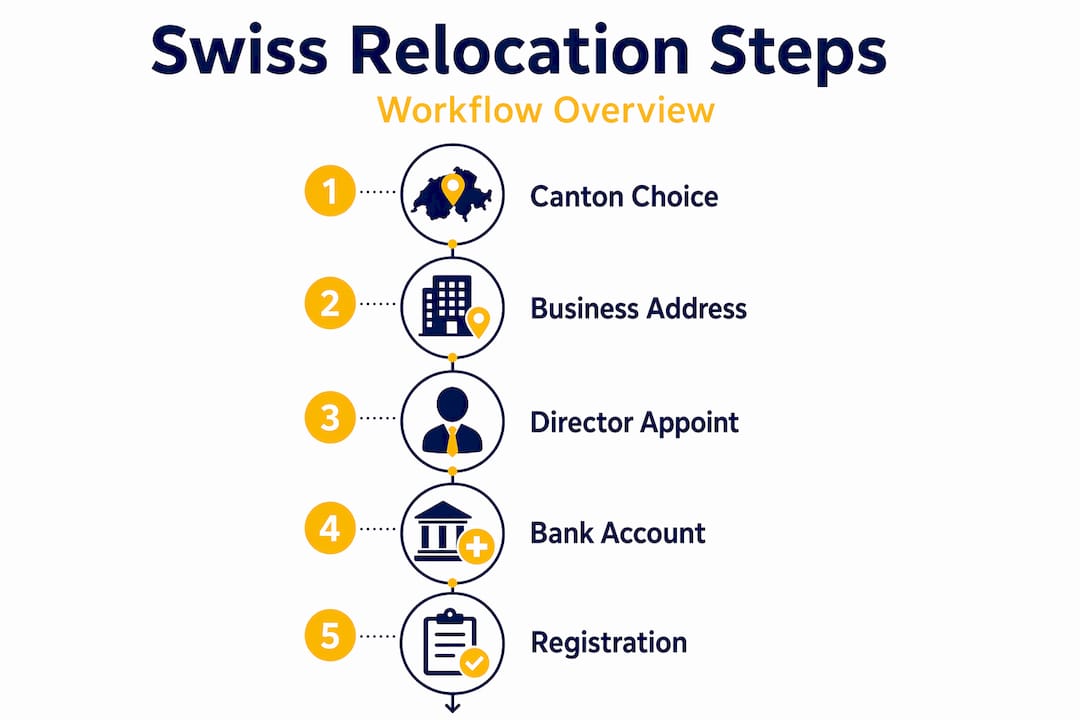
Before a single document gets notarized, your relocation workflow lives or dies on the decisions you make in the preparation phase. The process typically begins with selecting the canton and municipality, then securing a compliant, credible business address. These are not administrative formalities. They are structural choices that shape your tax bill, your banking relationships, and your credibility with Swiss partners for years.
Choosing your canton is a tax decision, not a geography decision. Canton Zug charges some of the lowest effective corporate tax rates in Switzerland, currently around 11.9%. Canton Zurich runs closer to 19.7%. That gap compounds quickly on any meaningful revenue. But lower tax cantons also attract more scrutiny from banks assessing substance, so your address in a low-tax canton must look and function like a real operating location. Reading through the logic behind choosing a Swiss canton before committing saves you from relocating into the wrong environment.
Your business address must do more than pass the legal test. A simple c/o address might satisfy the Commercial Register, but banks and institutional partners will probe whether your company has genuine operational substance at that location. A registered address that includes mail handling, a physical office, and a local phone number dramatically reduces friction in every subsequent onboarding step. Use the registering a Swiss business address guide to understand what “credible address” actually means in practice.
Director requirements and mandatory documents
At least one managing director must be a Swiss resident or hold a valid Swiss work permit. For international entrepreneurs who are not yet resident, appointing a nominee director is the standard legal solution. A nominee director is a Swiss-resident professional who holds the directorship on your behalf, typically under a clear contractual framework that protects your actual control of the business.
Here is the core document set you need to gather before formation begins:
Certified copy of each shareholder’s and director’s passport or ID
Draft articles of association tailored to your business structure
Shareholder agreement (if multiple founders)
Proof of business address (lease agreement or service contract)
Valuation documentation for any non-cash share capital contributions
Bank confirmation of capital deposit (obtained during formation, not before)
Review the full list of company registration documents early, because missing even one triggers delays that can push your timeline back by weeks.
Canton | Effective corporate tax rate | Key advantage |
Zug | ~11.9% | Lowest effective rate, strong international business community |
Schwyz | ~13.8% | Very competitive, growing startup ecosystem |
Nidwalden | ~12.7% | Attractive for holding structures |
Zurich | ~19.7% | Financial center, strong banking access |
Geneva | ~13.99% | International HQ credibility, UN/NGO proximity |
Pro Tip: Lock in your canton decision before you approach any bank. Banks in Switzerland ask about your address and canton when you apply to open the capital deposit account. Changing your canton after that point creates paperwork and delays.
Executing the Swiss company formation and registration process
Having prepared all documents and prerequisites, you can now proceed with official company formation and registration. This is the most procedurally dense part of the company relocation process in Switzerland, and the sequence matters more than most entrepreneurs expect.
Here is the core sequence for a Swiss GmbH (Gesellschaft mit beschränkter Haftung, the most common structure for foreign-owned SMEs):
Draft and finalize articles of association with a Swiss lawyer or formation specialist, incorporating all shareholder and governance provisions.
Open a capital deposit account at a Swiss bank. This is a temporary blocked account created specifically to hold the minimum share capital. Note: this is not your operating business account.
Deposit the minimum share capital of CHF 20,000. Bank confirmation of this deposit is a mandatory document for the Commercial Register application.
Attend the notarization appointment. A Swiss public notary authenticates the formation documents and the identity of all signatories. Remote or power-of-attorney arrangements are possible in most cantons.
Submit to the Commercial Register. The notarized package plus bank confirmation goes to the cantonal Commercial Register office. Processing takes 3 to 10 business days depending on the canton.
Receive your UID (company identification number) and official commercial register extract. This confirms your company legally exists.
Register for VAT if your projected annual turnover exceeds CHF 100,000. You can also voluntarily register below this threshold if it benefits your input tax recovery.
Register with the cantonal social insurance authority (AHV/IV/EO) before hiring any employees or paying salaries.
Use the company formation checklist to track each step against its completion criteria, and review the Swiss company registration process for canton-specific procedural nuances.
Formation stage | Typical timeline | Common error |
Document drafting and review | 5 to 10 days | Missing shareholder agreement clauses |
Bank account and capital deposit | 5 to 15 days | Wrong account type opened |
Notarization | 1 to 3 days | Incorrect ID certification format |
Commercial Register filing | 3 to 10 days | Incomplete notarized package |
VAT registration | 10 to 20 days | Missing projected revenue documentation |
Pro Tip: Ask your bank explicitly whether they offer capital deposit accounts to foreign-owned companies before investing time in the application. Several major Swiss banks declined foreign-owned GmbH applications in 2025 due to internal policy shifts. Fintech-backed Swiss banks and cantonal banks tend to be more accessible.

Coordinating banking and administrative onboarding for operational readiness
With company formation progressing, banking and administrative onboarding determines whether your company can actually operate on day one or sits in legal limbo for weeks. The sequencing here is everything.
The blocked capital deposit account and the operating business account are two different products, often at different banks. Your capital deposit account exists only to generate the bank confirmation letter for the Commercial Register. Once registration is complete, the funds are released and you can transfer them to your operating account. Many entrepreneurs try to skip the blocked account step by using their future operating account, and every Swiss bank will reject that approach.
Administrative onboarding steps to complete in parallel with formation:
Register resident employees at the local municipality (Einwohnerkontrolle) within 14 days of arrival
Register with the cantonal compensation office for AHV social security contributions
Set up SUVA or private accident insurance for employees
Complete the cantonal tax registration for corporate income and capital tax
File the initial tax questionnaire sent by the cantonal tax authority after commercial registration
Register for withholding tax obligations if distributing dividends
Banks require correct sequencing of the capital deposit and confirmation letter to avoid stalled timelines. A confirmation letter issued before the full capital amount is confirmed on deposit will be rejected by the Commercial Register, which means the bank issues a second letter, and the notary may need to re-certify. That cycle costs two to four weeks.
EY’s Switzerland relocation guidance confirms that relocation workflows require town hall registration, social security enrollment, and tax filings as part of the standard administrative sequence, not afterthoughts. Build these into your timeline from the start.
Consider the entrepreneur relocation requirements and make sure your corporate tax registration is filed within the required window after your commercial register entry date.
Pro Tip: If you are opening a Swiss bank account for the operating entity, prepare a clear business plan and source of funds documentation before your first appointment. Swiss banks conduct thorough due diligence, and showing up without these documents adds weeks to the process.
Managing cross-border compliance and workforce integration in relocation workflows
Understanding and applying cross-border compliance completes the relocation workflow, protecting your Swiss operations from regulatory risk. This section is where most companies building a Swiss presence in 2026 face the sharpest learning curve.
Switzerland’s updated framework for cross-border telework means that if any of your employees work partially from outside Switzerland, you now face an obligation to track, report, and respond to day counts at the individual employee level. The risks are real:
Social security exposure: Employees working more than 25% of their time in their home country can trigger social security obligations in that country instead of Switzerland
Tax residency triggers: Sufficient business activity in a foreign country can create permanent establishment exposure for your Swiss company
Business travel compounding telework: A sales director traveling 40 days per year and working from home 30 more days may already be at a threshold limit without anyone noticing
Employers must track cross-border telework days and integrate HR, payroll, and travel data as a single source of truth for compliance. That means you cannot manage this in a spreadsheet. You need systems that talk to each other, or a managed service that does the aggregation for you.
“Data silos across HR, payroll, and travel are the single largest source of unplanned compliance exposure for Swiss employers managing cross-border teams.”
Build your data governance architecture now, before your first cross-border employee starts. Retroactively reconstructing travel and telework records to meet 2027 reporting deadlines is painful, expensive, and sometimes impossible. Your workforce relocation compliance strategy needs to be as detailed as your legal formation plan.
For companies with foreign investors or international ownership structures, the compliance surface is even wider, touching transfer pricing, controlled foreign corporation rules in the shareholders’ home jurisdictions, and Swiss-side documentation requirements.
Pro Tip: Designate one internal owner for cross-border compliance data from day one. At most early-stage Swiss companies, this task falls between HR and finance and gets owned by neither. The regulatory cost of that gap arrives 18 months later.
Rethinking company relocation: substance over form and integrated governance
Here is something the standard step-by-step relocation guides do not say clearly enough: completing all the legal steps correctly does not mean your Swiss company is operationally real yet. It means it exists on paper. The distance between a legally registered Swiss GmbH and a genuinely credible Swiss business presence is where most relocations quietly fail.
A simple c/o address may be legally accepted but it creates immediate friction when you try to open a business bank account, onboard a corporate client, or apply for a credit facility. Swiss banks and major Swiss corporates conduct their own due diligence on suppliers and partners. A P.O. box address triggers questions. A real office with a staffed reception does not. The difference in credibility is disproportionate to the cost.
The same logic applies to governance. A company that has its payroll in one system, travel records in another, and HR data in a third is not just inefficient. It is exposed. When the cantonal tax authority requests documentation, or when a cross-border employee’s home country conducts an audit, a company with integrated records responds in days. A company with data silos responds in months, sometimes with gaps it cannot fill.
We see this pattern repeatedly: an international entrepreneur invests in perfect legal formation, then cuts costs on the registered address and skips building a compliance data architecture. Twelve months later, the bank requests enhanced due diligence, a key employee’s social security allocation gets challenged, and the cost of fixing it dwarfs what good setup would have cost at the start. Start with registering a credible business address and build your substance from day one, not as a remediation project.
The entrepreneurs who get Switzerland right treat relocation as an operational transformation, not a legal filing exercise. They build real substance at a proper address, integrate their compliance data early, and approach the process as though they intend to be in Switzerland for twenty years, because that kind of structure holds up under scrutiny.
Streamline your Swiss company relocation with RPCS Solutions
Executing the complete workflow for relocating a company to Switzerland is manageable when you have the right support structure behind you.

RPCS Solutions provides end-to-end support for international entrepreneurs and corporate clients moving business to Switzerland. From Swiss company formation that covers legal documentation, notarization, and Commercial Register submission, to Swiss bank account opening that navigates the capital deposit sequencing correctly the first time, to Swiss accounting services that keep you tax-compliant after formation, the platform handles every layer of the company relocation process in Switzerland. If you want a credible Swiss presence built on solid substance without spending months learning the system yourself, RPCS is the place to start.
Frequently asked questions
What is the first step in relocating a company to Switzerland?
The process begins with selecting the Swiss canton and securing a compliant, credible business address that provides both legal and operational substance for registration and banking purposes.
Do I need a Swiss resident director to register my company?
Yes. At least one managing director must be a Swiss resident or hold a valid work permit, but appointing a local nominee director is a widely used and legally recognized solution for international entrepreneurs.
When should I open a Swiss bank account during the relocation?
Open a Swiss bank account early in the formation process so you can deposit the minimum share capital and receive the mandatory confirmation letter the Commercial Register requires before it will process your registration application.
How does cross-border telework affect company relocation compliance?
Swiss employers must carefully monitor telework and business travel days at the individual employee level and integrate HR, payroll, and travel data into one source of truth to meet tax and social security obligations under the 2026 framework.
Recommended
Comments