
Step-by-step guide to Swiss GmbH formation in 2026
- Mar 24
- 9 min read

Establishing a Swiss GmbH can feel overwhelming for international entrepreneurs unfamiliar with Swiss corporate law, banking procedures, and compliance requirements. You need clear guidance to navigate notarization, capital deposits, and registration without costly delays or legal missteps. This comprehensive guide walks you through every stage of Swiss GmbH formation, from initial prerequisites to post-formation compliance, equipping you with actionable insights and practical tips. Whether you are launching your first venture in Switzerland or expanding your international portfolio, understanding these steps ensures a smooth, legally compliant setup that positions your business for success in one of the world’s most stable and attractive business environments.
Table of Contents
Key Takeaways
Point | Details |
Minimum share capital | The Swiss GmbH requires CHF 20,000 in share capital, fully paid before registration, with cash being the simplest method though in-kind contributions are possible under specific conditions. |
Residency requirement | At least one managing director must be a Swiss resident or hold a valid work permit, which can be satisfied by appointing a local nominee director with implications for control and liability. |
Mandatory documents | Prepare draft articles of association, shareholder agreements, and identification documents for all shareholders and directors before notarization and registration. |
In kind contributions | If you plan to contribute in kind, you must provide independent valuation reports to satisfy Swiss Commercial Register requirements. |
Notarization steps | A licensed Swiss notary must authenticate articles of association and other formation documents in person, or via power of attorney if travel is not possible. |
Understanding the prerequisites for Swiss GmbH formation
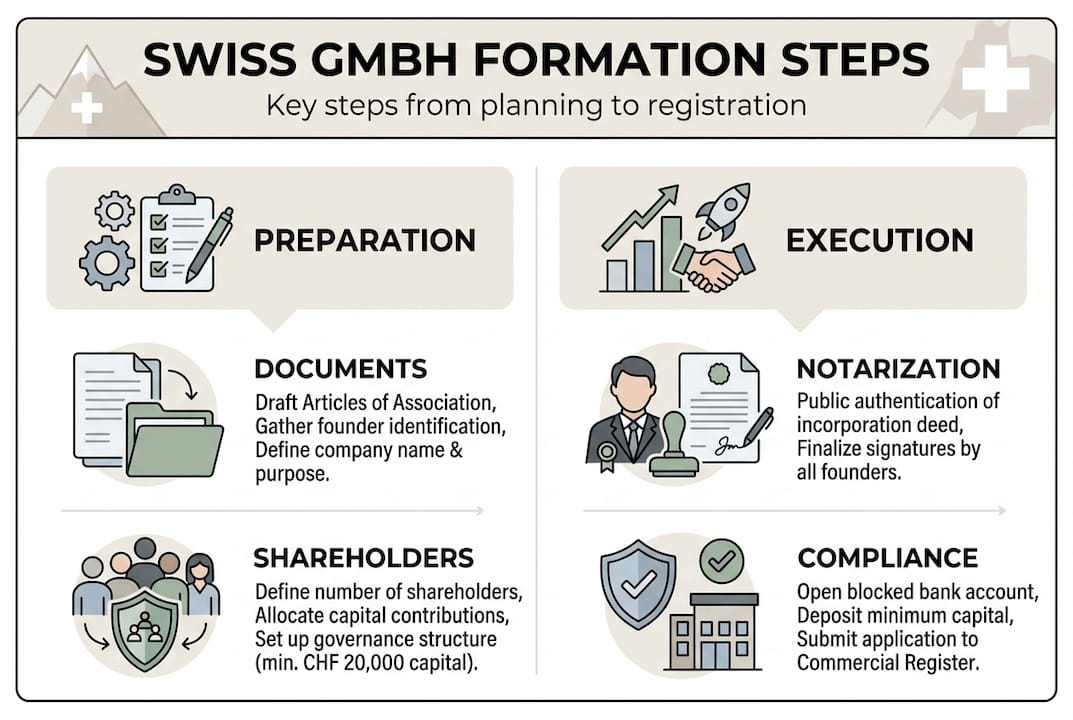
Before you begin the formal incorporation process, you must satisfy several legal and practical requirements. Certain capital and residency requirements must be met before formation, and preparing these elements in advance prevents delays and ensures a smooth registration experience. The minimum share capital for a Swiss GmbH is CHF 20,000, which must be fully paid in before registration. You can contribute this capital in cash or, under specific conditions, through in-kind contributions such as intellectual property or equipment, but cash remains the most straightforward and commonly accepted method.
Shareholders and directors must possess legal capacity, meaning they are of legal age and not subject to legal restrictions that would prevent them from managing or owning a company. While non-residents can be shareholders, Swiss law often requires at least one managing director to be a Swiss resident or hold a valid work permit, ensuring local accountability and compliance. This residency requirement can be satisfied by appointing a local nominee director if you lack Swiss residency, but you must understand the implications for control and liability.
You will need to prepare several mandatory documents before moving forward. These include draft articles of association outlining the company’s purpose, share structure, and governance rules, shareholder agreements detailing ownership and decision-making processes, and identification documents such as passports and proof of address for all shareholders and directors. If you plan to make in-kind capital contributions, you must provide independent valuation reports to satisfy Swiss Commercial Register requirements. Gathering and organizing company documents preparation early accelerates the notarization and registration process.
Official notarization is a legal necessity in Switzerland. A licensed Swiss notary must authenticate your articles of association and other formation documents, verifying the identities of all parties and ensuring the documents comply with Swiss corporate law. This step cannot be bypassed or completed remotely without proper authorization, so plan for in-person notary appointments or arrange for power of attorney if you cannot travel to Switzerland.
Pro Tip: Prepare certified translations of all foreign identification documents into German, French, or Italian depending on your canton of registration. This avoids delays during notarization and registration, as Swiss authorities require documents in an official Swiss language.
Requirement | Details | Notes |
Minimum share capital | CHF 20,000 | Must be fully paid before registration |
Director residency | At least one managing director must be Swiss resident or hold valid permit | Nominee directors available if needed |
Notarization | Mandatory for articles of association and formation documents | In-person or via power of attorney |
Documentation | Passports, proof of address, shareholder agreements, valuation reports for in-kind contributions | Certified translations required for foreign documents |
Step-by-step process to officially form a Swiss GmbH
Once you have satisfied the prerequisites, you can begin the formal incorporation process. Following these steps in order ensures legal compliance and minimizes the risk of rejection or delays at any stage. Understanding the gmbh formation legal steps helps you anticipate requirements and prepare accordingly.
Prepare and notarize formation documents. Draft your articles of association with the help of legal counsel or a professional service provider to ensure they meet Swiss legal standards. Schedule an appointment with a licensed Swiss notary to authenticate these documents. Notary involvement is mandatory for official registration, and the notary will verify the identities of all shareholders and directors, confirm the accuracy of the documents, and ensure compliance with Swiss corporate law. You must bring original identification documents, proof of address, and any powers of attorney if you are appointing representatives.
Deposit share capital to a Swiss bank account. After notarization, you must open a blocked capital deposit account at a Swiss bank and transfer the full CHF 20,000 minimum share capital. The bank will issue a confirmation letter stating that the capital has been deposited and is held in trust pending registration. This confirmation is a mandatory document for the Commercial Register application. Opening a swiss bank account opening can take several days to weeks depending on the bank’s due diligence procedures, so initiate this step as early as possible. Some banks require in-person meetings, while others accept remote applications with certified documentation.
Register with the Commercial Register. Submit your notarized articles of association, bank confirmation letter, and completed registration forms to the Commercial Register of the canton where your GmbH will be domiciled. The register will review your application to ensure all documents are complete and compliant. If approved, your GmbH will be officially entered into the register, and you will receive an extract confirming your company’s legal existence. This process typically takes one to two weeks, but incomplete or incorrect submissions can extend the timeline significantly.
Register for VAT and social security. Once your GmbH is registered, you must register for value-added tax if your annual turnover exceeds CHF 100,000 or if you choose voluntary registration to reclaim input VAT. You must also register your company and any employees with Swiss social security authorities, including AHV/IV/EO (old-age, disability, and income compensation insurance) and occupational pension schemes. These registrations are mandatory for legal operation and must be completed before you begin business activities.
Start business operations under Swiss law. With all registrations complete, you can begin conducting business. Ensure you maintain proper accounting records, comply with Swiss tax filing deadlines, and fulfill all statutory reporting obligations. Your GmbH is now a fully operational legal entity with limited liability protection for its shareholders.
Pro Tip: Consider appointing a Swiss-resident director with signatory authority from the outset. This simplifies banking relationships, contract execution, and day-to-day operations, as many Swiss banks and business partners prefer local signatories for compliance and accessibility reasons.
Approach | Direct Signatory | Proxy Signatory |
Control | Full direct control over all decisions and transactions | Shared control with appointed representative |
Residency | Requires Swiss residency or valid work permit | No residency requirement for foreign shareholders |
Banking | Easier bank account opening and transaction approval | May face additional due diligence from banks |
Speed | Faster execution of contracts and payments | Potential delays if proxy unavailable |
Cost | No additional proxy fees | Ongoing fees for proxy services |
Avoiding common pitfalls and ensuring compliance after formation
Successfully forming your Swiss GmbH is only the beginning. Ongoing compliance and attention to detail are essential to avoid penalties, maintain good standing, and protect your limited liability status. Many international entrepreneurs encounter avoidable mistakes that lead to fines, operational disruptions, or even forced dissolution.

Common errors include submitting incomplete documentation during registration, which causes delays and requires resubmission, and failing to deposit the full share capital before applying to the Commercial Register, which results in automatic rejection. Some entrepreneurs underestimate the importance of qualified directors and appoint individuals without the necessary legal capacity or Swiss residency, leading to complications with banking and regulatory authorities. Delayed VAT or social security registration can trigger backdated penalties and interest charges, so complete these steps promptly after Commercial Register approval.
Non-compliance risks include fines and operational delays, and Swiss authorities enforce corporate law obligations rigorously. Your GmbH must maintain accurate accounting records in accordance with Swiss GAAP or other accepted standards, file annual financial statements with the Commercial Register, and submit tax returns on time. Failure to do so can result in fines, loss of limited liability protection, or even criminal liability for directors in cases of gross negligence or fraud.
Qualified directors play a critical role in compliance. Swiss law requires that at least one managing director be authorized to represent the company and make binding decisions. This person must understand Swiss corporate governance, employment law, and tax obligations. If you lack local expertise, appointing a Swiss-resident director or engaging professional advisory services ensures you meet all statutory requirements and avoid costly mistakes. Proper record keeping is equally important. You must maintain minutes of shareholder and board meetings, document all major decisions, and retain financial records for at least ten years. These records are subject to audit by tax authorities and must be available for inspection.
“Proactive compliance and professional guidance are the foundation of a successful Swiss GmbH. Entrepreneurs who invest in proper legal and accounting support from the outset avoid the majority of pitfalls that lead to penalties and operational setbacks.”
Pro Tip: Establish a compliance calendar that tracks all statutory deadlines, including tax filing dates, annual general meeting requirements, and Commercial Register updates. This simple tool prevents missed deadlines and keeps your GmbH in good standing with Swiss authorities.
Incomplete or inaccurate formation documents lead to registration rejection and costly resubmission delays
Failure to appoint a qualified Swiss-resident director complicates banking and regulatory relationships
Missing VAT or social security registration deadlines triggers backdated penalties and interest charges
Poor record keeping exposes your GmbH to audit risks and potential loss of limited liability protection
Ignoring ongoing compliance obligations such as annual financial statements and tax filings results in fines and legal consequences
Understanding company directorship rules helps you structure governance effectively and avoid common pitfalls related to authority and accountability. Expert advice from legal and accounting professionals who specialize in Swiss corporate law provides peace of mind and ensures your GmbH operates smoothly and compliantly from day one.
How RPCS Solutions supports your Swiss GmbH formation journey
Navigating Swiss GmbH formation and compliance can be complex, especially for international entrepreneurs unfamiliar with local regulations and procedures. RPCS Solutions offers comprehensive support from initial document preparation through registration and beyond, ensuring your company is established correctly and efficiently. Our company formation services handle all legal and administrative steps, including drafting articles of association, coordinating notary appointments, and submitting applications to the Commercial Register.

We also assist with opening compliant swiss bank account services, navigating due diligence requirements, and securing the capital deposit confirmation you need for registration. Once your GmbH is operational, our accounting services provide ongoing bookkeeping, tax filing, and financial reporting tailored to Swiss legal standards, so you can focus on growing your business while we handle compliance. Our team combines local expertise with a client-focused approach, making Swiss company formation accessible and straightforward for international investors.
FAQ
What is the minimum share capital required to form a Swiss GmbH?
The minimum share capital for a Swiss GmbH is CHF 20,000, and this amount must be fully paid in before you can register the company with the Commercial Register. Unlike some jurisdictions that allow partial payment, Swiss law requires the entire capital to be deposited into a blocked bank account and confirmed by the bank before registration proceeds. This ensures the company has adequate financial resources to meet its obligations from the outset.
How long does it typically take to complete a Swiss GmbH formation?
The formation process typically takes one to three weeks, depending on how quickly you prepare documents, complete notarization, and open a Swiss bank account. Notary appointments and bank due diligence procedures can add time, especially if you are a non-resident or if your documentation requires additional verification. Working with experienced professionals who understand Swiss requirements can significantly accelerate the timeline and reduce the risk of delays caused by incomplete or incorrect submissions.
Can non-residents be shareholders or directors of a Swiss GmbH?
Yes, non-residents can be shareholders or directors of a Swiss GmbH, but Swiss law often requires at least one managing director to be a Swiss resident or hold a valid work permit. This requirement ensures local accountability and facilitates compliance with Swiss regulatory and banking standards. If you do not meet the residency requirement, you can appoint a Swiss-resident nominee director to fulfill this role while retaining ultimate control as a shareholder. Understanding Swiss company directorship explained helps you structure your governance appropriately and avoid complications with authorities and banks.
Is a Swiss bank account mandatory for GmbH formation?
Yes, opening a Swiss bank account and depositing the minimum share capital of CHF 20,000 is a mandatory step in the formation process. The bank issues a confirmation letter verifying that the capital has been deposited and is held in trust, and this letter must be submitted to the Commercial Register as part of your application. Without this confirmation, your registration will not be approved. Swiss banks have strict due diligence requirements, so plan for this step early and ensure you provide all requested documentation to avoid delays. Our Swiss bank account opening services can guide you through this process and help you meet banking requirements efficiently.
Recommended
Comments