
Swiss company formation: legal documents you need
- 2 days ago
- 9 min read

TL;DR:
Forming a Swiss company is simpler than many foreign founders expect, once the legal documentation requirements are understood.
Choosing between a GmbH and an AG depends on capital, privacy, and future growth plans, with each having specific advantages.
Switzerland has a reputation for meticulous processes, but the reality is that forming a Swiss company is far more straightforward than most foreign founders expect. The perceived complexity usually comes from not knowing exactly which documents are required, not from the process itself being inherently difficult. Once you understand the precise legal documentation checklist for a GmbH (Gesellschaft mit beschränkter Haftung) or an AG (Aktiengesellschaft), the path from idea to registered company becomes surprisingly predictable. This guide walks you through every mandatory document, explains why each one exists, and flags the nuances that matter most for international investors.
Table of Contents
Key Takeaways
Point | Details |
Clear documentation list | Knowing the exact Swiss requirements makes company formation predictable and fast. |
Residency rules matter | At least one company manager or director must reside in Switzerland with full authority. |
AG vs GmbH implications | Choose AG for investor privacy or GmbH for lower capital needs based on your goals. |
Exceptions save money | You can avoid audits or notarize remotely if you meet special conditions. |
Time and costs are measurable | Expect a 2–4 week formation process and CHF 5,000–10,000 in typical fees. |
Understanding Swiss company types and legal roles
Before you gather a single document, your first decision shapes everything: GmbH or AG? These two legal forms have different capital thresholds, privacy profiles, and documentation requirements.
A GmbH is Switzerland’s equivalent of a limited liability company. It requires a minimum share capital of CHF 20,000, and the names of all shareholders are publicly listed in the Commercial Register. This transparency suits founders who want a lean, cost-efficient structure with clear, direct ownership.
An AG (Aktiengesellschaft) is the Swiss joint-stock company. It requires a minimum share capital of CHF 100,000, with at least CHF 50,000 paid in at formation. Crucially, AG shareholders are not publicly disclosed, which makes this structure the preferred choice for investors who prioritize confidentiality and plan to bring in outside capital later.
Feature | GmbH | AG |
Minimum capital | CHF 20,000 | CHF 100,000 (CHF 50,000 paid in) |
Shareholder privacy | Public | Private |
Ideal for | Small to mid-size operations | Larger ventures, investor-ready firms |
Foreign ownership | 100% allowed | 100% allowed |
Audit obligation | Opt-out possible | Opt-out possible (small firms) |
One of the most critical points for foreign investors is the Swiss director residency requirements. As confirmed by formation specialists, at least one director must reside in Switzerland with signing authority, whether you are forming a GmbH or an AG. Foreign investors can own 100% of the company, but they must secure local representation. This is typically handled through a nominee director or a licensed fiduciary service.
Key facts to remember when choosing your structure:
Foreign nationals can hold all shares in either structure
Sector-specific approvals apply in some industries (Lex Koller restricts foreign real estate acquisition)
The AG offers greater flexibility for future equity rounds or multiple share classes
GmbH statutes can be tailored, but changes require notarial certification each time
Pro Tip: If privacy is your primary concern and you plan to scale, an AG is worth the extra capital requirement. Many international founders initially choose a GmbH for speed, then convert later. Choosing correctly from the start avoids that costly transition.
Core legal documentation checklist for Swiss company formation
With your company type defined, here are the precise documents you’ll need in your application folder. The Swiss registration process follows a well-defined sequence, and missing one step creates delays at the notary or the cantonal Commercial Register.
Here is the standard flow, as confirmed by formation practice and the GmbH formation process:
Company name availability check on ZEFIX.ch (the official Swiss central business name register)
Draft and finalize the Articles of Association (Statuten), which define the company’s purpose, registered seat, capital structure, and governance rules
Deposit share capital in a blocked Swiss bank account and obtain a capital confirmation document (Einzahlungsbestätigung)
Notary certification of founding documents, either in-person or via a notarized Power of Attorney if you are abroad
File with the cantonal Commercial Register, which processes the application in 5 to 14 business days
Post-registration registrations: Federal Tax Administration for corporate tax and VAT (if turnover exceeds CHF 100,000 annually), plus AHV (Swiss social security) enrollment if you have employees
“The capital confirmation from the Swiss bank is often the document that takes the longest to obtain. Prepare your bank account early, ideally before finalizing the articles of association.”
Let’s look at each critical document in more detail:
Articles of Association (Statuten): This is the legal backbone of your company. It must define your company’s purpose clearly but not overly narrowly, your registered Swiss address (Sitz), the share capital amount, and the rules for management. Swiss law requires that the purpose clause accurately reflects your actual business activities. Vague or overly broad clauses can trigger questions from the register.
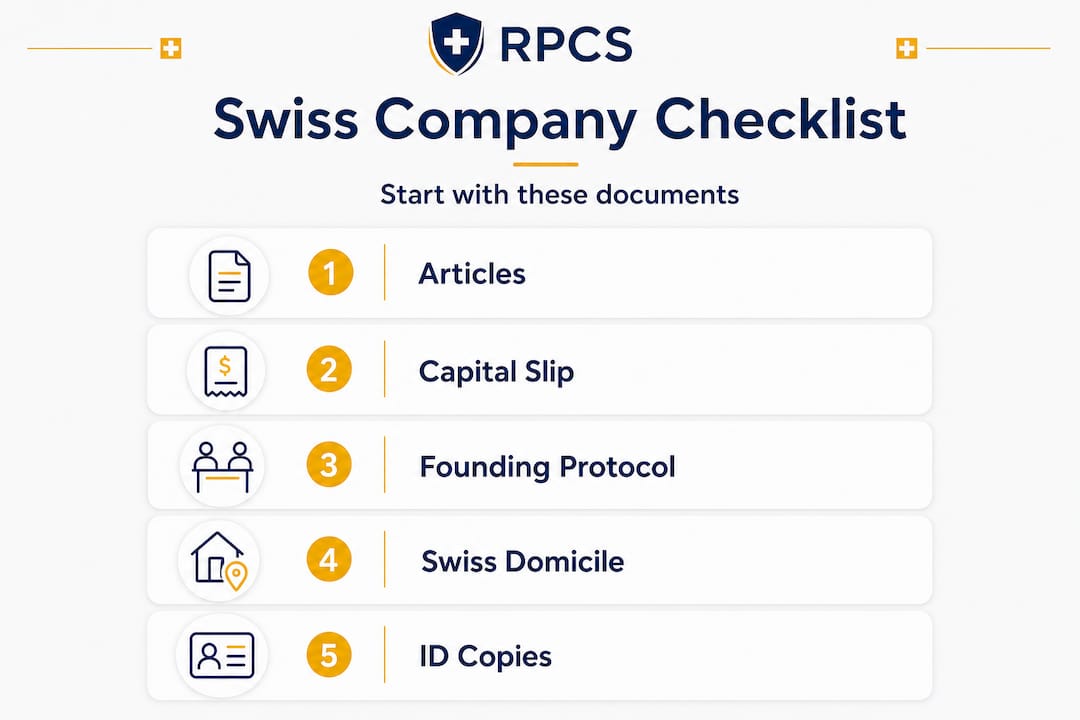
Capital confirmation slip: After depositing the required minimum capital in a blocked Swiss bank account, the bank issues a certified confirmation. This document must be presented to the notary at certification. The bank releases the funds only after the company appears in the Commercial Register. Note that opening a Swiss corporate bank account as a foreign national can take several weeks, so start this step early. Our guide on key documents for registration covers what banks typically require.

Notary-certified founding protocol: For a GmbH, the notary certifies the founding resolutions. For an AG, this includes the deed of incorporation. Both require certified identification documents from all founders (passports, apostilles if required by your home country).
Proof of Swiss domicile: Every Swiss company must have a registered address in Switzerland. This is not just a post office box. The address must be a physical location, and you will need a domicile agreement from the address provider. Many foreign founders use a fiduciary’s address for this purpose.
Following the formation checklist for all required steps ensures nothing slips through before you reach the notary.
Special cases and Swiss legal nuances
Some requirements only apply in particular cases or offer useful shortcuts. Let’s break these down because knowing these exceptions can save you significant time and money.
In-kind contributions: If you are contributing assets (equipment, intellectual property, or real estate) instead of cash as your share capital, Swiss law requires an official valuation report (Sacheinlagebericht). This report must be signed by a licensed auditor and attached to the founding documents. It is a strict requirement with no workaround.
Audit opt-out: Smaller companies benefit from a meaningful simplification. As confirmed by Swiss formation specialists, companies with fewer than 10 full-time employees can opt out of mandatory annual audits. This significantly reduces ongoing compliance costs. For foreign-owned startups and lean operations, this is a major advantage worth building into your planning from day one. An external audit opt-out checklist can help you confirm eligibility before committing.
Remote formation via Power of Attorney: You do not have to be physically present in Switzerland to form your company. A properly notarized and apostilled Power of Attorney (PoA) allows a local representative to sign all founding documents on your behalf. The PoA must be certified by a notary in your home country and carry an apostille stamp if Switzerland and your country are both parties to the Hague Convention (which most nations are). This is a practical route for founders in Asia, the Middle East, or North America. Our guide on notarizing documents explains the exact steps.
Situation | Additional document needed |
Capital in assets, not cash | Valuation report (Sacheinlagebericht) |
Founder not present in Switzerland | Notarized and apostilled Power of Attorney |
Company in regulated sector (e.g., finance) | FINMA license or sector authority approval |
Real estate business focus | Lex Koller compliance documentation |
Foreign founder using nominee director | Nominee agreement and fiduciary contract |
Pro Tip: Cantonal differences matter more than most founders realize. Zurich, Geneva, and Zug all have slightly different standard forms, processing speeds, and local requirements. If you have flexibility in choosing your canton, Zug and Zurich are known for efficient processing. Always confirm the specific forms your chosen canton requires before the notary appointment.
Key situations that trigger additional documentation:
Using a foreign bank transfer to fund the capital account (additional compliance documentation required by Swiss banks)
Having more than one national as a founding member (each requires certified ID documents)
Operating in financial services, healthcare, or telecommunications (sector-specific licenses required before or shortly after registration)
What to expect: timeline, costs, and process flow
Once your documents are ready, here is what you need to know to plan your Swiss company launch timeline and budget.
According to Switzerland Global Enterprise, formation costs run CHF 5,000 to 10,000, covering notary fees, Commercial Register filing fees, and bank charges. The same data shows that over 45,000 new companies were registered in Switzerland in 2020 alone, and standard processing runs 2 to 3 weeks, with express options completing in as few as 5 days.
Here is a realistic process timeline:
Days 1 to 3: Name check, draft articles, prepare founder documents
Days 4 to 10: Open Swiss bank account and deposit capital (this is often the longest step)
Days 10 to 12: Notary appointment (in-person or via PoA)
Days 12 to 20: Filing with the cantonal Commercial Register (standard processing)
Days 20 to 25: Company appears in the register and is legally active
Week 4 onward: Tax registration, VAT enrollment (if applicable), AHV registration
Where delays typically happen:
Swiss bank account opening for foreign nationals (KYC requirements can be extensive)
Capital confirmation issuance (some banks take 3 to 5 business days after deposit)
Busy periods at the cantonal register (end of quarter and year-end are slower)
Incomplete or incorrectly apostilled documents from abroad
Our tax registration guide walks you through the post-registration obligations in detail, including how Swiss cantonal and federal corporate taxes interact.
Post-registration obligations to prepare for immediately:
Corporate tax registration with the cantonal tax authority
VAT registration with the Federal Tax Administration (ESTV) if annual turnover will exceed CHF 100,000
AHV/AVS social security registration if you employ staff (including managing directors)
Opening of an operational bank account (separate from the capital confirmation account)
Why most delays have nothing to do with missing documents
Here is the part most formation guides skip. After years of supporting international founders through Swiss company setup, what actually causes delays is rarely an incomplete document folder.
The real friction points are almost always structural. Most founders trip up on key document nuances they never anticipated, not because they forgot a form, but because they misunderstood a local expectation. For example, Swiss banks have increasingly strict KYC (Know Your Customer) requirements for foreign-owned companies. A perfectly assembled document package can still hit a two-week wall if the bank’s compliance team needs additional background on the business model or the source of funds.
The second major issue is underestimating the Swiss residency rule. Many founders assume they can simply list a business address and handle local requirements from abroad. But the requirement for a Swiss-resident director with actual signing authority is non-negotiable. Discovering this late, after articles are drafted, means restarting key steps.
Remote notarization via Power of Attorney is a genuine shortcut, but only when it is done correctly. An apostille from the wrong authority, a PoA with an outdated translation, or a missing certification layer can send you back to square one with your home country notary. Getting this right the first time is worth professional guidance.
The audit opt-out option also regularly goes unused because founders simply do not know it exists. If your company will have fewer than 10 employees, structuring your founding documents to explicitly include the opting-out declaration at formation eliminates a recurring compliance cost.
The Swiss system rewards preparation over speed. Founders who gather documents carefully, verify them against cantonal requirements, and engage local representation from the start consistently see the fastest timelines.
Start your Swiss company with expert support
Knowing the document checklist is the foundation, but successfully navigating the Swiss formation process as a foreign founder requires more than a list. You need someone who knows where banks stall, which cantons move fastest, and how to structure your articles correctly from day one.
At RPCS, our Swiss company formation services handle every step of the process, from name reservation and articles drafting to notary coordination and Commercial Register filing. We also support the setup of your Swiss bank account, domicile address, and post-registration compliance, so you can focus on building your business, not chasing paperwork across cantons. Foreign founders who work with us consistently complete the full process faster and avoid the common delays that come from navigating Swiss legal requirements without local expertise.
Frequently asked questions
Can a foreigner be the sole owner of a Swiss company?
Yes, foreign investors can own 100% of a Swiss company but must appoint a Swiss-resident director or board member with signing authority. This is a legal requirement, not optional.
How long does company formation take in Switzerland?
The standard timeline runs 2 to 3 weeks. According to Switzerland Global Enterprise, express options can bring that down to 5 business days in some cantons.
Is a notary always required for Swiss company setup?
Yes, notarization is mandatory, but the notary certification process can be completed remotely using a properly notarized and apostilled Power of Attorney from your home country.
What is the minimum share capital for forming a GmbH or AG?
A GmbH requires CHF 20,000 in share capital, fully paid in at formation. An AG requires CHF 100,000, with at least CHF 50,000 deposited at the time of incorporation.
Do all Swiss companies need to have their accounts audited?
No. As confirmed by Swiss formation specialists, companies with fewer than 10 full-time employees can formally opt out of mandatory audits, reducing your annual compliance burden significantly.
Recommended
Comments