
The Role of M&A Advisory in Switzerland: 2026 Guide
- 12 minutes ago
- 8 min read

TL;DR:
M&A advisory in Switzerland provides comprehensive legal, financial, tax, and operational guidance for successful transactions. Advisors coordinate every phase, from valuation to post-deal integration, within a highly regulated environment. Building pre-approved governance frameworks and assembling multidisciplinary teams are key to closing deals efficiently and compliantly.
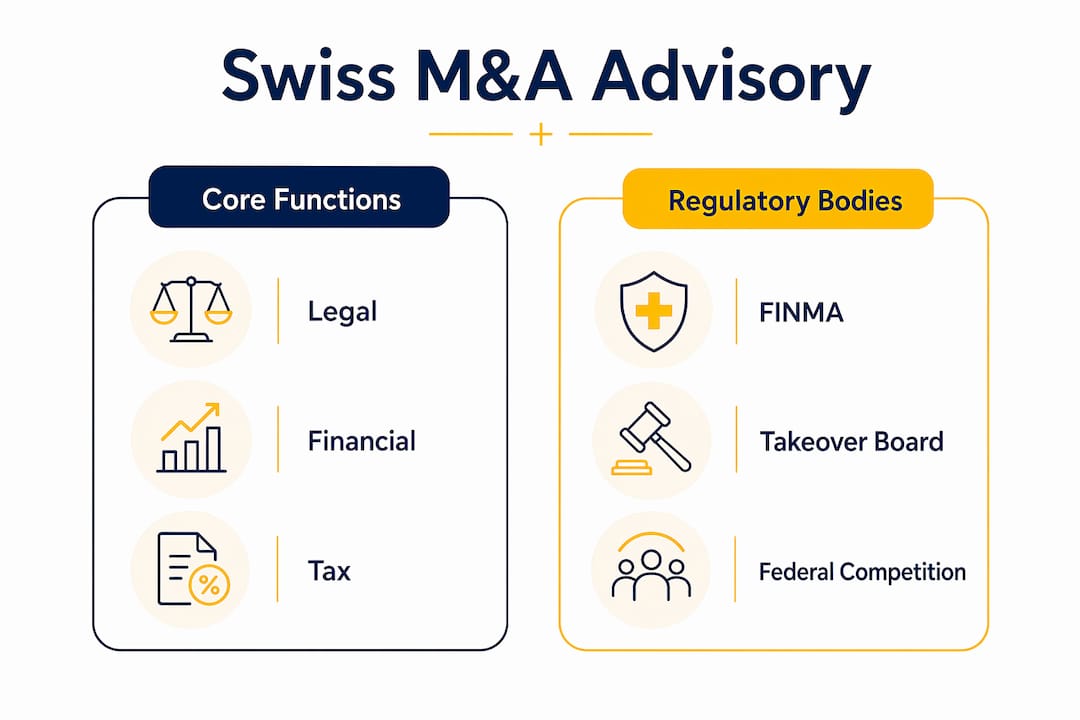
M&A advisory in Switzerland is defined as the coordinated delivery of legal, financial, tax, and operational guidance that enables investors and business leaders to execute mergers and acquisitions with confidence and compliance. The role of M&A advisory in Switzerland goes well beyond deal brokering. Advisors orchestrate every phase of a transaction, from initial valuation through post-deal integration, within one of the world’s most regulated and internationally respected corporate environments. Switzerland hosts 306 investment banking entities primarily in Zurich and Geneva, collectively managing $161 billion in funding across 197 acquisitions in recent years. That concentration of expertise reflects how seriously the Swiss market takes structured, multidisciplinary advisory. Regulatory bodies like FINMA and the Swiss Takeover Board set the compliance floor, and experienced advisors keep every deal above it.
What are the core functions of M&A advisory services in Switzerland?
M&A advisory firms in Switzerland cover the full transaction lifecycle, not just the closing table. Their work begins before a deal is announced and continues long after signatures are exchanged.
The core service areas include:
Strategy formulation. Advisors build tailored acquisition or divestiture plans aligned with your business goals, market position, and risk tolerance.
Valuation analysis and fairness opinions. Independent valuation protects both buyers and sellers from mispriced deals and satisfies Swiss corporate governance requirements.
Due diligence coordination. Advisors manage legal, financial, and operational due diligence in Switzerland, ensuring no material risk goes unexamined before signing.
Negotiation support. Experienced advisors structure term sheets, manage counterparty dynamics, and protect your position throughout price and condition negotiations.
Regulatory navigation. Swiss deals often require FINMA review, Swiss Takeover Board approval, or cantonal clearance. Advisors map the approval path early and manage submissions.
Post-deal integration. Advisors coordinate communication, organizational alignment, and financial reporting after closing to protect the value created during the deal.
Swiss boards also use the full M&A toolbox, including earn-outs and equity rollovers, to manage valuation gaps and deal volatility. These instruments require careful legal drafting and financial modeling, which is exactly where advisory firms add measurable value.
Pro Tip: Request a fairness opinion from your financial advisor before any board vote on deal pricing. Swiss corporate governance norms expect it, and it protects directors from personal liability if the deal is later challenged.
Which experts collaborate in Swiss M&A transactions?
Swiss M&A transactions require a multidisciplinary team working in close coordination. No single advisor covers every dimension of a complex cross-border deal.
The standard advisory team for a Swiss transaction includes four core disciplines, as established in Swiss M&A practice:
Legal counsel and regulatory advisors. They structure the transaction, draft the share purchase agreement, and manage compliance with Swiss corporate law, including the Code of Obligations and any sector-specific regulations. They also handle Swiss legal compliance requirements that affect foreign buyers.
Financial advisers and investment banks. They manage the overall process flow, run the valuation model, and coordinate with counterparties. Zurich and Geneva are home to the largest concentration of these firms in Switzerland.
Tax advisers. They design the deal structure to minimize tax leakage, address withholding tax on dividends, and plan for post-acquisition repatriation. Tax considerations in M&A can significantly affect net deal value, and tax impacts on acquisitions deserve dedicated attention from day one.
Accounting and due diligence specialists. They verify the quality of earnings, assess working capital, and flag any accounting irregularities that could affect the purchase price or post-closing adjustments.
Initial transaction preparation in Swiss M&A requires all four disciplines working in parallel, with early and informed involvement of corporate boards and shareholders. That early engagement is not optional. Swiss corporate governance norms require board approval at key decision points, and shareholder consent thresholds vary by company structure.
Pro Tip: Bring your tax adviser into the deal team at the letter-of-intent stage, not after heads of terms are signed. Restructuring a deal for tax efficiency after the term sheet is agreed costs time and often money.

What regulatory challenges shape M&A advisory in Switzerland?
Switzerland’s regulatory environment creates deal complexities that advisors must anticipate and manage proactively. The challenges are specific, and generic advisory playbooks fail here.
The most significant regulatory and structural challenges include:
Non-linear deal timelines. Linear deal timelines are largely obsolete in Swiss M&A. Boards now adopt multi-path deal planning to handle regulatory delays and valuation shifts. A deal that stalls at FINMA review can restart months later under different market conditions.
Capital-maintenance restrictions. Swiss capital-maintenance rules restrict target companies from paying seller advisory costs unless the payment clearly benefits the transaction. Misallocating these costs can constitute an unlawful distribution of assets, exposing directors to personal liability.
Swiss Takeover Board oversight. Public company deals require Swiss Takeover Board review. The Board can impose conditions, require price adjustments, or block transactions that do not meet Swiss fairness standards.
FINMA licensing requirements. Financial sector acquisitions trigger FINMA approval, which adds time and documentation requirements that non-Swiss buyers often underestimate.
The table below summarizes the key regulatory bodies and their roles in Swiss M&A transactions:
Regulatory Body | Primary Role in M&A |
FINMA | Approves acquisitions in banking, insurance, and financial services |
Swiss Takeover Board | Reviews public company takeovers for fairness and compliance |
Canton authorities | Handle real estate transfers and certain sector-specific approvals |
Swiss Competition Commission | Reviews mergers that meet notification thresholds |
Pre-approval of decision frameworks, including price bands and negotiation menus, accelerates deal completion and reduces the need for full board reconvening at every decision point. Advisors who build these frameworks into the deal governance structure from the start give their clients a measurable execution advantage.
How do M&A advisory services benefit investors and business leaders?
The practical value of M&A advisory services in Switzerland shows up in deal outcomes, not just process management. Investors and business leaders who engage experienced advisors consistently achieve better pricing, faster execution, and fewer post-closing disputes.
The key benefits include:
Governance and decision quality. Corporate advisory in Switzerland prioritizes strategic governance and value preservation through ownership transitions. Advisors help boards make decisions that hold up under scrutiny from shareholders, regulators, and courts.
Local market access. Local M&A advisors act as critical connectors between institutional investors and the Swiss SME landscape, providing bilingual support and deep local networks. Switzerland’s SME sector is the backbone of its economy, and most of those businesses are not publicly listed or easily accessible without local relationships.
Risk reduction through due diligence. Rigorous due diligence catches problems before they become post-closing liabilities. Advisors coordinate legal, financial, and operational reviews so nothing falls through the gaps between disciplines.
Transaction structure refinement. Advisors model alternative deal structures to maximize after-tax value for both parties. This includes choosing between asset deals and share deals, which carry very different tax and liability profiles under Swiss law.
Performance-aligned fee models. Boutique Swiss advisory firms increasingly deploy performance-driven fee models directly aligned with client value from deal scouting and negotiation. This aligns advisor incentives with your outcomes, not just their billable hours.
For investors considering foreign ownership rules in Switzerland, advisors also clarify which sectors carry acquisition restrictions and how to structure ownership to remain compliant. That guidance alone can prevent a deal from failing at the regulatory approval stage.
Key Takeaways
M&A advisory in Switzerland succeeds when multidisciplinary teams, pre-approved governance frameworks, and Swiss-specific regulatory knowledge work together from the first day of deal preparation.
Point | Details |
Multidisciplinary teams are non-negotiable | Legal, financial, tax, and accounting advisors must work in parallel from the letter-of-intent stage. |
Regulatory bodies set the compliance floor | FINMA, the Swiss Takeover Board, and cantonal authorities each play distinct roles that advisors must navigate proactively. |
Linear deal timelines no longer apply | Swiss boards use multi-path planning and pre-approved decision frameworks to handle regulatory delays and valuation shifts. |
Capital-maintenance rules affect fee allocation | Target companies cannot pay seller advisory costs without clear transaction benefit, or risk unlawful asset distribution. |
Local knowledge drives deal access | Bilingual advisors with Swiss SME networks give investors access to deals that never reach public markets. |
Why the best Swiss M&A deals are won before the process starts
After working through dozens of Swiss transactions, the pattern is clear. The deals that close on time and at the right price are not the ones with the most aggressive negotiators. They are the ones where the advisory team built the governance structure, the decision framework, and the regulatory roadmap before the first counterparty conversation happened.
Swiss M&A is not a linear process. Advisors who treat it like one create problems for their clients. The stop-start nature of Swiss regulatory review, combined with the precision that Swiss corporate law demands, means that adaptability is the most underrated skill in this market. I have seen well-funded deals collapse because the board had no pre-approved price band and could not reconvene fast enough when a competing bid emerged.
The shift toward fully integrated advisory teams, where legal, financial, and tax advisors share a single deal room and a single communication cadence, is the most important structural change in Swiss M&A practice right now. Fragmented advisory, where each discipline works in its own lane, costs time and creates gaps that counterparties exploit.
The emergence of performance-based fee models is also worth watching. When your advisor’s compensation is tied to deal value rather than hours billed, the quality of advice changes. That alignment is especially valuable for mid-market transactions where every basis point of deal value matters.
Choose your advisory team based on Swiss-specific experience, not general M&A credentials. The regulatory nuances here are real, and they are not learned from textbooks.
— Rolands
How Rpcs supports your Swiss M&A and company formation needs
Rpcs brings together the legal, accounting, and administrative expertise that investors and business leaders need when entering the Swiss market through acquisition or new company formation.
Whether you are structuring a new Swiss AG or GmbH, managing post-acquisition integration, or preparing for a Swiss company formation that meets every regulatory requirement, Rpcs provides the local knowledge and compliance support to get it right. The platform covers company registration, banking setup, Swiss accounting services, and ongoing administrative management, all under one roof. For international investors who need a trusted local partner to handle Swiss corporate requirements with speed and precision, Rpcs is built for exactly that purpose. Contact Rpcs to discuss your transaction needs and get a tailored advisory consultation.
FAQ
What is the role of M&A advisory in Switzerland?
M&A advisory in Switzerland coordinates legal, financial, tax, and operational expertise across the full transaction lifecycle to ensure compliance, accurate valuation, and deal success. Advisors manage everything from strategy formulation through post-deal integration within Switzerland’s regulated corporate environment.
How do I choose M&A advisors for a Swiss transaction?
Choose advisors with direct Swiss regulatory experience, bilingual capabilities, and a track record in your target sector. Advisors familiar with FINMA, the Swiss Takeover Board, and Swiss corporate law add the most value in complex cross-border deals.
What is the Swiss Takeover Board and when does it apply?
The Swiss Takeover Board reviews public company acquisitions to verify fairness and compliance with Swiss takeover law. Any offer for a listed Swiss company triggers a mandatory review process that advisors must plan for from the outset.
Why do Swiss M&A deals require multi-path planning?
Swiss regulatory reviews, valuation disputes, and board approval requirements create unpredictable timelines. Multi-path planning allows deal teams to maintain momentum and respond to delays without losing the transaction.
Can a target company pay M&A advisory fees in Switzerland?
Swiss capital-maintenance rules restrict target companies from paying seller advisory costs unless the payment clearly benefits the transaction. Misallocating these costs risks constituting an unlawful distribution of assets under Swiss law.
Recommended
Comments