
Explaining International Business Setup: A 2026 Guide
- 14 hours ago
- 8 min read

TL;DR:
International business setup involves legally establishing companies across borders, requiring compliance and operational planning. Swiss entry options include subsidiaries, branches, representative offices, joint ventures, and Employer of Record arrangements for fast market testing and long-term growth. Proper planning, early banking, and local legal advice are essential for successful international expansion, especially in Switzerland.
International business setup is the process of legally establishing and operating a company across national borders, requiring compliance with multiple jurisdictions’ regulations, financial infrastructure, and operational planning. Over 300,000 American entrepreneurs currently operate businesses outside the United States. That number signals one clear truth: global expansion is no longer reserved for large corporations. Switzerland stands out as a top destination for international founders, offering political stability, favorable corporate tax rates, and a globally respected legal framework. This guide walks you through the legal structures, banking requirements, compliance obligations, and step-by-step process for setting up a business internationally, with a sharp focus on Switzerland.
What are the common legal structures for international business setup?
Choosing the right market entry mode is the single most consequential decision in any international expansion. It determines your cost, liability exposure, regulatory burden, and how fast you can operate. Get it wrong early, and you spend months unwinding the mistake.
The five main structures available to international entrepreneurs are subsidiaries, branches, representative offices, joint ventures, and Employer of Record (EOR) arrangements. Each carries a distinct trade-off between control and complexity.
Subsidiary vs. branch vs. EOR: what actually differs
A subsidiary is a separate legal entity in the target country. It limits the parent company’s liability and allows full operational independence. In Switzerland, the two dominant subsidiary forms are the GmbH (Gesellschaft mit beschränkter Haftung, a limited liability company) and the AG (Aktiengesellschaft, a joint-stock company). The Swiss GmbH structure suits most foreign entrepreneurs entering Switzerland for the first time, given its lower minimum capital requirement and simpler governance rules compared to the AG.

A branch is not a separate legal entity. The parent company remains fully liable for branch activities. Branches work well for short-term market testing but carry reputational and legal risk in Switzerland if compliance lapses.
A representative office cannot generate revenue. It exists solely for market research, relationship building, and promotional activities. This structure suits companies that want a Swiss presence without committing to full registration.
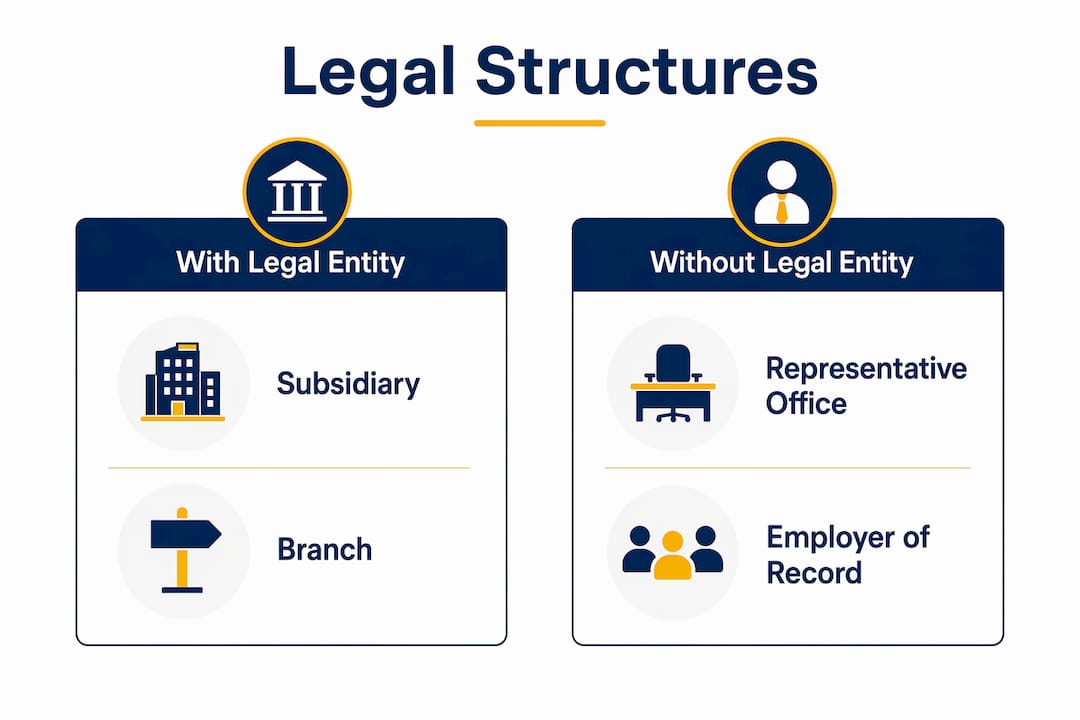
An EOR lets you hire local employees immediately without forming a legal entity at all. EOR arrangements provide compliant local hiring before your entity formation completes. This is the fastest path to boots on the ground.
Entry Mode | Legal Entity | Liability | Setup Speed | Best For |
Subsidiary (GmbH/AG) | Yes | Limited | 3–6 months | Long-term operations |
Branch | No | Unlimited | 1–3 months | Short-term presence |
Representative Office | No | Minimal | 1–2 months | Market research only |
Joint Venture | Shared | Shared | Variable | Local partnerships |
EOR | No | Managed | Days to weeks | Fast hiring, market testing |
Formal subsidiary formation typically takes 3–6 months and suits companies with more than 15 employees or over $1 million in revenue. Below those thresholds, an EOR or branch often makes more financial sense.
Pro Tip: Use an EOR during your first 90 days in Switzerland to hire local talent and test market fit before committing to full GmbH or AG registration.
How to navigate Swiss banking when setting up an international business
Swiss banking is one of the most misunderstood parts of the international business setup process. Many entrepreneurs assume that opening a Swiss business bank account is straightforward. It is not, especially for American founders.
FATCA reporting requirements cause many Swiss banks to avoid American clients entirely. FATCA, the Foreign Account Tax Compliance Act, requires foreign financial institutions to report U.S. account holders to the IRS. The compliance burden is significant enough that several major Swiss banks have quietly stopped accepting U.S.-linked business accounts. American entrepreneurs who skip this research often find themselves incorporated but unable to open a bank account, which effectively paralyzes operations.
What you need to open a Swiss business bank account
Documentation requirements vary by bank, but most Swiss institutions require the following:
Certified copies of company formation documents (articles of association, commercial register extract)
Proof of identity for all directors and beneficial owners
A clear description of business activities and expected transaction volumes
Proof of registered address in Switzerland
Source of funds documentation for initial capital deposits
Multi-currency capability matters for international operations. Swiss banks generally support CHF, EUR, USD, and GBP accounts, but fees and minimum balance requirements vary widely. Online banking access is standard at major institutions but may require in-person verification for non-residents.
Pre-vetted banking relationships are the most reliable path forward. Working with a service provider like Rpcs, which maintains established relationships with Swiss banks, removes the guesswork from account opening. Rpcs offers direct support for opening a Swiss bank account as part of its company formation packages.
Pro Tip: Secure your banking relationship before or immediately after incorporation. Waiting until after registration creates operational delays that can last weeks or months.
What operational and compliance challenges arise in international business setups?
Compliance is where most international business setups fail quietly. Entrepreneurs focus on registration and banking, then underestimate the ongoing obligations that follow. Consulting local legal and accounting experts immediately is the single most effective way to avoid costly mistakes.
Switzerland has a well-defined corporate tax structure. The federal corporate tax rate is low by European standards, and cantonal rates vary, making the choice of canton a genuine financial decision. Zug and Zurich remain the most popular cantons for international companies, each offering distinct advantages in tax treatment and infrastructure.
Key ongoing compliance obligations for foreign entrepreneurs in Switzerland include:
Annual financial statements prepared under Swiss GAAP or IFRS, depending on company size
VAT registration if annual turnover exceeds CHF 100,000
Social security contributions for all employees, including foreign nationals
Corporate tax filings at both federal and cantonal levels
Commercial register updates for any changes to directors, capital, or business purpose
Labor law adds another layer. Switzerland’s employment regulations protect workers strongly, and termination procedures differ significantly from U.S. norms. Import and export regulations apply if your business moves physical goods across Swiss borders, and sector-specific licenses may be required in finance, healthcare, or food production.
The Swiss regulatory environment rewards preparation. Companies that engage local accountants and legal advisors from day one spend far less on remediation than those who try to self-manage compliance in the early months. Rpcs provides accounting services for Swiss companies that cover statutory reporting, VAT, and payroll, removing the compliance burden from founders who are focused on growth.
What steps should entrepreneurs follow to establish a business internationally?
A structured approach to setting up a global business prevents the most common and expensive mistakes. Incremental expansion, testing one market before scaling to multiple countries, is the approach favored by successful founders. Rushing a multi-country launch without validating market fit is the fastest way to burn capital.
Small businesses account for approximately 96% of the international import/export field. That figure proves that global operations are not a large-company privilege. The steps below apply whether you are a solo founder or leading a team of 50.
A practical sequence for international company formation
Conduct market research. Identify demand, competition, regulatory requirements, and cultural factors in your target market. Switzerland’s appeal for foreign entrepreneurs includes political neutrality, strong IP protection, and access to European markets without EU membership.
Define your goals and entry threshold. Decide whether you need a full legal entity or whether an EOR or representative office serves your first-year objectives. Set revenue and headcount targets that will trigger a formal subsidiary formation.
Choose your legal structure. Review the Swiss legal entity options available to foreign founders. For most international entrepreneurs, the GmbH is the starting point. The AG suits companies planning to raise external capital or list shares.
Prepare legal documentation. Articles of association, director appointments, and shareholder agreements must be notarized. Non-residents can use online notarization services to complete this step without traveling to Switzerland.
Register with the Swiss commercial register. Registration is handled at the cantonal level. The process requires notarized documents, proof of capital deposit, and a registered address in Switzerland.
Open a business bank account. Complete this step immediately after registration. Delays here stall payroll, supplier payments, and client invoicing.
Register for taxes and social security. File for VAT if applicable, register with the cantonal tax authority, and set up social security contributions for any employees.
Hire and onboard staff. Use an EOR if your team is small and entity formation is still in progress. Transition employees to direct contracts once your Swiss entity is fully operational.
Launch operations. Begin with a defined pilot scope. Measure performance against your original market research assumptions before expanding further.
Common pitfalls at this stage include premature subsidiary formation before validating demand, choosing the wrong canton for tax purposes, and failing to account for the time required to open a bank account. Each of these errors adds weeks or months to your timeline.
Key Takeaways
Successful international business setup requires choosing the right legal structure, securing banking early, and maintaining ongoing compliance from day one.
Point | Details |
Choose structure by scale | Use an EOR for fast market entry; form a GmbH or AG once you exceed 15 employees or $1 million in revenue. |
Secure banking before launch | FATCA compliance makes Swiss banking complex for Americans; use pre-vetted relationships to avoid delays. |
Comply from day one | Swiss VAT, tax filings, and labor law obligations begin immediately after registration. |
Expand incrementally | Test one market thoroughly before scaling to additional countries or cantons. |
Engage local experts early | Local legal and accounting advisors prevent the most common and costly setup mistakes. |
Switzerland rewards the prepared, not the optimistic
My honest view on international business setup, after working with dozens of foreign entrepreneurs entering Switzerland, is this: the founders who succeed are not the ones with the biggest budgets. They are the ones who treat compliance as a competitive advantage rather than an administrative burden.
The most common mistake I see is founders forming a Swiss subsidiary before they have validated a single customer. They spend CHF 20,000 on formation, notarization, and legal fees, then discover the market does not respond as expected. An EOR would have cost a fraction of that and given them six months of real market data first.
The second mistake is underestimating banking timelines. I have seen well-funded companies sit with a registered Swiss entity and no bank account for three months because they approached the wrong institutions without preparation. That is three months of operational paralysis.
Switzerland’s legal requirements for foreign entrepreneurs are demanding but entirely manageable with the right local partners. The country’s stability, tax efficiency, and international credibility make it worth the effort. The founders who invest in proper guidance from the start consistently outperform those who try to cut corners on legal and financial infrastructure.
Start lean, validate fast, and build your Swiss presence on a foundation that can actually support growth.
— Rolands
How Rpcs supports your Swiss company formation
Setting up a business in Switzerland involves legal registration, banking, tax compliance, and ongoing administration. Rpcs handles all of it for international entrepreneurs who want to move fast without making expensive mistakes.

Rpcs provides end-to-end Swiss company formation services, covering GmbH and AG incorporation, notarization, commercial register filing, and registered address provision. The team also supports foreign founders in opening Swiss business bank accounts through established banking relationships, removing the FATCA-related friction that blocks many American entrepreneurs. For ongoing needs, Rpcs offers Swiss accounting services that cover statutory reporting, VAT, and payroll. If you want a single point of contact for your entire Swiss setup, Rpcs is built for exactly that.
FAQ
What is international business setup?
International business setup is the process of legally establishing and operating a company in a foreign country, including entity registration, banking, tax compliance, and local hiring.
How long does it take to set up a Swiss company?
Forming a Swiss GmbH or AG typically takes 3–6 months from initial documentation to commercial register entry, depending on canton and document readiness.
Do American entrepreneurs face special banking challenges in Switzerland?
Yes. FATCA reporting requirements lead many Swiss banks to avoid U.S.-linked accounts, making pre-vetted banking relationships critical for American founders.
What is the difference between a GmbH and an AG in Switzerland?
A GmbH is a limited liability company suited to smaller operations with simpler governance. An AG is a joint-stock company designed for companies planning to raise external capital or issue shares.
Can I hire employees in Switzerland before my company is registered?
Yes. An Employer of Record lets you hire local staff immediately and compliantly before your Swiss entity formation is complete.
Recommended
Comments