Swiss Succession Planning Basics for Business Owners
Master the basics of Swiss succession planning to protect your wealth and keep the business running, including the 2023 inheritance law changes.

Swiss succession planning combines inheritance law and governance to protect wealth and ensure business continuity. Changes in 2023 increased the free estate portion to 50%, giving business owners more transfer flexibility. Proper planning with legal documents and early decisions helps prevent conflicts and delays during estate transfers.
Swiss succession planning is the legal and strategic process that governs how estates and businesses transfer to heirs, combining the Swiss Civil Code's inheritance framework with practical governance to protect wealth and ensure business continuity. For business owners and high-net-worth individuals, understanding this process is not optional. The 2023 reforms to Swiss inheritance law changed compulsory portion rules in ways that directly affect how much of your estate you can distribute freely. Getting the Swiss succession planning basics right means knowing those rules before a crisis forces the issue.
What are the Swiss succession planning basics under inheritance law?#
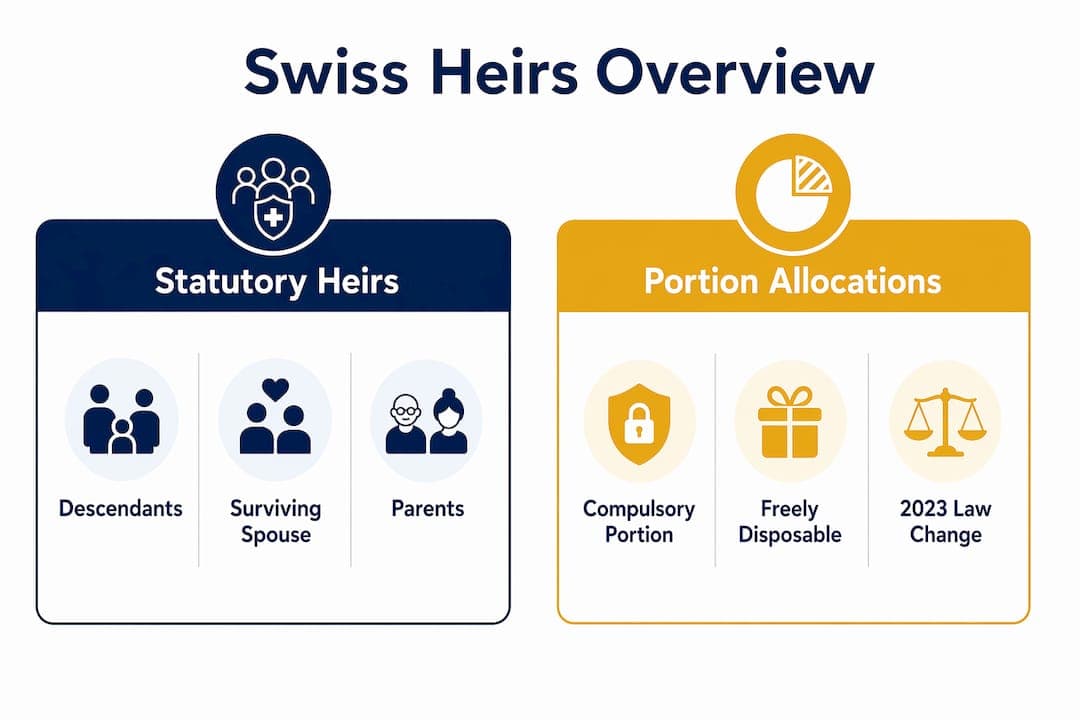
Swiss inheritance law divides every estate into two parts: the compulsory portion and the freely disposable portion. The compulsory portion is the share that certain heirs receive by law, regardless of what any will says. The freely disposable portion is what you can direct as you choose, through gifts, bequests, or business transfers.
The 2023 inheritance law revisions made a significant shift. For estates with a surviving spouse and descendants, the freely disposable portion rose from 37.5% to 50%. That change gives business owners considerably more room to structure transfers without triggering heir disputes. The reform also eliminated the compulsory portion for parents entirely, removing a constraint that previously complicated estate planning for childless individuals.
Who qualifies as a statutory heir in Switzerland?#
Swiss law recognizes three primary categories of statutory heirs: descendants (children, grandchildren), the surviving spouse or registered partner, and parents. Each group holds specific inheritance rights under the Swiss Civil Code. Descendants hold the strongest claim, followed by the spouse, then parents.
The table below shows how compulsory portions apply after the 2023 reform:
| Heir category | Compulsory portion (post-2023) | Freely disposable share |
|---|---|---|
| Spouse or registered partner | 50% of their legal share | 50% |
| Descendants | 50% of their legal share | 50% |
| Parents | None (eliminated in 2023) | 100% |
This structure matters for succession planning in Switzerland because it defines the floor below which you cannot disinherit a statutory heir. Any succession plan that ignores these floors risks legal challenge after death.
What legal documents govern Swiss succession?#
Three types of wills are recognized under Swiss law: holographic (entirely handwritten and signed by the testator), public (drafted before a notary with two witnesses), and oral (used only in emergency situations and rarely enforceable long-term). Each has specific formal requirements. A holographic will that is typed rather than handwritten, for example, is legally void in Switzerland.
For business owners, inheritance contracts (known in German as Erbverträge) offer something wills cannot: binding legal certainty. A will can be changed unilaterally at any time. An inheritance contract requires the agreement of all parties to modify or dissolve. That distinction is critical when multiple stakeholders, such as co-founders, family members, and investors, all have claims on a business.
Choosing between a will and an inheritance contract#
The right document depends on the complexity of your estate and the number of parties involved.
- Holographic will: Lowest cost, no notary required, but easily contested and easily changed.
- Public will: Notarized and witnessed, harder to contest, but still unilateral.
- Inheritance contract: Binding on all signatories, requires notarization, and provides the strongest protection for multi-party business succession.
Inheritance contracts provide stability that wills simply cannot match in complex succession scenarios. For a family business with multiple heirs, an inheritance contract locks in agreed terms and prevents any one party from unilaterally rewriting the plan.
Draft your inheritance contract alongside your shareholders' agreement. The two documents should reference each other to prevent contradictions that could paralyze a business transfer.
How should Swiss family businesses plan for succession?#
Swiss family business succession is one of the most underplanned areas of wealth management. Nearly half of Swiss family businesses have no concrete succession measures in place, and 50% do not know the actual economic value of their company. Those two gaps together create the conditions for family conflict and forced sales at below-market prices.

Succession timelines vary significantly by method. Family buyouts average 12 years of preparation. Management buyouts average 7 years. External sales require roughly 4 years. Starting early is not a preference. It is a structural requirement of the process.
A practical succession planning sequence#
-
Establish company value independently. Commission a formal valuation from a third party. Business owners consistently overestimate company value, which creates unrealistic expectations among heirs and buyers alike.
-
Identify and document the succession method. Decide between family transfer, management buyout, or external sale before drafting any legal documents.
-
Draft the legal framework. Combine a will or inheritance contract with a shareholders' agreement and, where appropriate, life insurance designations.
-
Appoint an executor. An executor appointment prevents estate paralysis. Without one, unanimous heir agreement is required for every administrative decision, giving any single heir the power to delay the entire process.
-
Engage the family early. Transparent family involvement reduces emotional conflict. Only about 10% of Swiss family businesses have formal integration programs for successors, and emotional tensions are the leading cause of succession failures.
-
Review and update the plan. Estate planning requires updates after marriage, birth, divorce, company restructuring, or any major financial event.
"Early succession planning primarily aims to prevent family conflicts through transparent family involvement, not just tax optimization." This reframing changes how business owners should approach the entire process.
Build a governance charter for your family business before succession discussions begin. A charter sets rules for decision-making, dividend policy, and conflict resolution, reducing the emotional load on the succession process itself.
For a broader view of how exit planning connects to succession, the Swiss company exit strategies guide covers legal and financial considerations for SMEs and family businesses in detail.
How does cantonal inheritance tax affect succession strategies?#
Switzerland has no federal inheritance tax. Inheritance taxation falls entirely to the cantons, and the differences between cantons are substantial. This creates real planning opportunities for business owners who structure their residence and company location thoughtfully.
Most cantons levy inheritance taxes, but the rates and exemptions vary widely. Schwyz and Obwalden impose no inheritance tax at all. Lucerne grants gift tax exemptions that make lifetime transfers more attractive than post-death bequests. Cantonal tax differences significantly affect succession strategies, particularly for high-value estates and business transfers.
Key tax planning considerations for succession planning in Switzerland:
- Spousal transfers are exempt from inheritance tax in virtually every Swiss canton.
- Direct descendants receive favorable rates in most cantons, but rates for more distant relatives or unrelated heirs can reach 50% in some jurisdictions.
- Lifetime gifts in cantons with gift tax exemptions can shift value to heirs before death, reducing the taxable estate.
- Business location affects which cantonal rules apply to company shares and assets.
A modular approach combining wills, inheritance contracts, and life insurance designations is best practice for managing complex, multi-stakeholder estates across different cantonal regimes. Choosing the right canton for your Swiss company registration is a decision that affects not just corporate tax rates but also the inheritance tax burden your heirs will face.
Understanding Swiss corporate governance rules is equally relevant here. The governance structure of your company determines how shares are valued, transferred, and taxed at succession.
Key Takeaways#
Swiss succession planning requires combining legal documents, governance structures, and tax positioning well before any transfer event occurs.
| Point | Details |
|---|---|
| 2023 law reform | The freely disposable portion rose to 50%, giving business owners more flexibility in directing their estate. |
| Inheritance contracts win | For multi-stakeholder business succession, inheritance contracts provide binding certainty that wills cannot match. |
| Start early | Family buyouts average 12 years of preparation; waiting until a health crisis forces the issue is the most common and costly mistake. |
| Appoint an executor | Without an executor, any single heir can block estate administration, creating costly delays. |
| Cantonal tax matters | Cantons like Schwyz and Obwalden impose no inheritance tax, making location a meaningful planning variable. |
What I've learned advising business owners on Swiss succession#
The most consistent mistake I see is treating succession planning as a one-time legal event rather than a continuous governance practice. Business owners draft a will, file it away, and assume the problem is solved. Then the company doubles in value, a second child joins the business, or a co-founder exits, and the original document is completely misaligned with reality.
The second mistake is valuation overconfidence. Many business owners overestimate company value, and that gap between perceived and actual value is where family conflicts ignite. An independent valuation done early, and updated regularly, removes the emotional charge from the number.
What actually works is a layered approach: an inheritance contract for binding multi-party commitments, a public will for personal assets, an executor to keep administration moving, and a governance charter to manage family dynamics before they become legal disputes. None of these tools works well in isolation. Together, they cover the legal, financial, and human dimensions of succession.
The emotional dimension is the one most business owners underestimate. Succession is not just a wealth transfer. It is a conversation about identity, legacy, and fairness. Starting that conversation five years early, with a structured family forum and clear governance rules, produces better outcomes than any legal document drafted in a crisis.
How RPCS supports Swiss business succession and company formation#
RPCS works with international entrepreneurs and business owners who need structured support for Swiss company formation and long-term business continuity. Succession planning starts with the right corporate structure, and RPCS helps clients establish GmbH and AG entities with the governance frameworks that make future transfers cleaner and less contested.
From legal documentation and notarization to registered address services and ongoing administrative support, RPCS covers the operational foundation that succession planning depends on. Clients who plan to transfer a Swiss company to family members or management teams benefit from having that structure professionally established from day one. Explore Swiss company formation services to see how RPCS can support your business continuity planning from the ground up.
Frequently asked
01What is the freely disposable portion under Swiss inheritance law?
The freely disposable portion is the share of your estate you can direct to any beneficiary without restriction. After the 2023 reform, this portion is 50% for estates with a surviving spouse and descendants.
02How long does Swiss business succession planning take?
Timelines depend on the succession method. Family buyouts average 12 years of preparation, management buyouts average 7 years, and external sales require roughly 4 years.
03Do all Swiss cantons charge inheritance tax?
No. Schwyz and Obwalden impose no inheritance tax. Most other cantons do levy inheritance taxes, with rates varying significantly based on the relationship between the deceased and the heir.
04What is an inheritance contract and when should I use one?
An inheritance contract is a legally binding agreement between the testator and heirs that cannot be changed without all parties' consent. Business owners with multiple stakeholders should use one instead of a standard will to prevent unilateral changes to the succession plan.
05Why is appointing an executor important in Switzerland?
Without an appointed executor, every heir must agree unanimously on every estate administration decision. A single heir can block the process indefinitely. An executor acts independently per the will's instructions, keeping the transfer on track.
Sources
Information verified as of 20 August 2026.
- Law governing a transfer of assets or of a business
- Registers a Swiss AG must maintain
kmu.admin.ch, verified 20 August 2026
The content on this website is provided for general information purposes only and is general in nature. It does not constitute legal, tax or financial advice and is not a substitute for individual advice in a specific case. No warranty is given as to the accuracy, completeness or currency of the information, and any liability is excluded to the extent permitted by law. Use of this website or contacting us does not create any client, mandate or advisory relationship. For your specific situation we recommend obtaining individual advice from a qualified professional.
Related reading

What Is a Company Secretary? Roles and Duties Explained
Discover what a company secretary is and why the role matters for legal compliance, governance and the smooth running of your business.
Read article
What Is Corporate Compliance? A Guide for Executives
Discover what corporate compliance is, and learn how an effective programme protects your business from fines, liability and reputational damage.
Read article
Nonprofit Board of Directors: Roles and Responsibilities
Discover the essential nonprofit board of directors roles and responsibilities, including the fiduciary duties that underpin good governance.
Read article