
Swiss Cross-Border Operations Explained for Entrepreneurs
- 11 minutes ago
- 8 min read

TL;DR:
Swiss cross-border operations involve managing permits, telework rules, payroll codes, and payment systems to avoid compliance issues and double taxation. Employers must track weekly return compliance, adhere to telework thresholds, and ensure payroll data accuracy under the 2026 LEADS Protocol. Using the correct payment network and proactively claiming double taxation benefits are essential for smooth Swiss international business.
Swiss cross-border operations are defined as business activities that involve employees, payroll, taxation, permits, and payments regulated across Switzerland’s borders under Swiss law and international agreements. For entrepreneurs and corporations, this framework covers everything from hiring workers who commute daily from France, Germany, Italy, or Austria, to managing payroll in Swiss francs, coordinating social security across jurisdictions, and routing international payments through the right banking rails. The 2026 regulatory landscape adds new layers, including the LEADS Protocol for digital payroll data exchange and permanent telework rules replacing COVID-era transitional agreements. Getting these elements right from day one protects your business from cantonal audits, double taxation, and permit violations.
What are the key permits and legal requirements for cross-border workers in Switzerland?
The G Permit, formally called the Grenzgängerbewilligung, is the mandatory authorization for EU and EFTA nationals living in border zones who work in Switzerland. Under 2026 rules, most G permits are issued for five years. The previous restriction limiting eligibility to specific frontier zones has been abolished for EU citizens, though practical commuting distance still applies. Employers carry the full responsibility for filing the permit application. Employees must return to their home country at least once per week.
The weekly return rule carries real consequences. If a worker stays overnight in Switzerland regularly, tax authorities can reclassify that person as a Swiss resident. That reclassification triggers a completely different tax and payroll treatment, including higher withholding tax rates and changed social security allocation. Short stays in a Swiss apartment, sometimes called a pied-à-terre, are increasingly scrutinized under the 2026 LEADS Protocol.
Employer obligations go beyond filing the initial permit. Key responsibilities include:
Registering the worker with the relevant cantonal authority before the start date
Tracking weekly return compliance and documenting it
Notifying authorities within eight days of any change in working hours or telework status
Updating permit records when an employee changes their residential address
Renewing permits before expiration to avoid gaps in legal work authorization
Pro Tip: Run a quarterly address verification check on all cross-border employees. A mismatch between the address on the permit and the address in payroll records is one of the most common audit triggers under the new LEADS Protocol.
Understanding your employer obligations in Switzerland before your first cross-border hire prevents costly corrections later.
How does Swiss cross-border taxation and telework regulation affect business operations?
The 40% telework rule is the single most important threshold in Swiss cross-border taxation for French residents. Cross-border employees from France can telework up to 40% annually without changing their Swiss tax status. Exceeding that threshold triggers French taxation on the excess days. This rule applies to both the general double taxation agreement regime and the 1983 agreement cantons covering Geneva, Vaud, Valais, Bern, Solothurn, Basel-City, and Basel-Country.

The tax threshold and the social security threshold are not the same number. Tax status changes at 40% telework. Social security allocation shifts when telework exceeds 49.9% of total working time. That gap between 40% and 49.9% creates a zone where an employee pays French income tax on excess days but still contributes to Swiss social security. Employers who confuse these two thresholds generate compliance errors that are expensive to unwind.
Double taxation agreements do not apply automatically. Employers and employees must proactively claim DTA benefits with proper documentation. For French workers, this includes forms like the 2041-AS. Failure to submit the right paperwork results in dual taxation, meaning the worker pays full tax in both countries simultaneously.
The numbered steps below reflect the correct compliance sequence for managing telework taxation:
Calculate each employee’s annual telework percentage at the end of each quarter.
Compare the figure against the 40% tax threshold and the 49.9% social security threshold separately.
File pro-rata tax reports for any employee who has exceeded the 40% limit.
Submit DTA claim forms before the relevant tax authority deadlines.
Adjust payroll withholding for the following quarter based on updated projections.
The Swiss-French double taxation amendment, effective 1 January 2026, replaced all transitional COVID-era telework agreements with permanent compliance requirements. There is no longer a grace period. Every day of telework counts from the first working day of the year.
Pro Tip: Cap telework contractually at around 30% annually. That buffer below the 40% legal threshold gives you room to absorb unexpected sick days, public holidays, or schedule changes without triggering a tax breach. This approach is recommended for cross-border employers as a standard risk management practice.
Avoiding common digital nomad tax mistakes is equally relevant for cross-border employees who split their time between Switzerland and their home country.
What are the payroll and social security challenges for Swiss cross-border operations?
Swiss employer social contributions for cross-border workers range approximately 14%–16% of gross salary. That rate is lower than neighboring France’s employer contribution burden. The difference makes Swiss-based hiring cost-competitive, but it does not reduce the administrative complexity of managing cross-border payroll correctly.
The Italian border region adds a layer of payroll coding complexity that catches many employers off guard. Workers hired after july 2023 from the Italian frontier zones require specific payroll codes, specifically codes R, S, T, U, and V, for cantonal compliance. Using the wrong code, or applying codes designed for pre-2023 “old frontaliers” to new hires, invites audits and penalties. The distinction between old and new frontaliers affects both the tax rate applied and the revenue-sharing arrangement between Switzerland and Italy.
The LEADS Protocol changes the stakes for payroll accuracy across all border regions. Key operational impacts include:
Automatic transfer of salary data from Swiss tax authorities to neighboring countries’ tax bureaus
No manual reporting step means errors in payroll records surface directly in foreign tax systems
Address mismatches between payroll files and permit records trigger automatic audit flags
Employers lose the ability to correct errors before they reach foreign authorities
Pro Tip: Treat payroll data as a live compliance document, not a year-end accounting task. Monthly reconciliation of addresses, permit status, and telework days prevents the kind of discrepancies that the LEADS Protocol will surface automatically.
Setting up payroll in Switzerland with the right structure from the start is far less costly than correcting a non-compliant system after an audit.
How do cross-border payment systems and currency flows work for Swiss international business?
Swiss cross-border payments operate across three distinct systems depending on the currency and destination. CHF payments use the SIC system, EUR payments use the SEPA network, and all other transactions route through SWIFT with correspondent banking intermediaries. Each system carries different settlement speeds and cost structures.
Payment System | Currency | Settlement Time | Key Feature |
SIC | CHF | Near-instant | Swiss domestic and cross-border CHF |
SEPA | EUR | Near-instant | Eurozone and SEPA-member countries |
SWIFT | All others | 1–5 business days | Involves 2–4 correspondent banks |
SWIFT transactions involve multiple intermediary banks. Each correspondent bank charges a fee and introduces a potential delay. For a Swiss company paying a supplier in Singapore or the United States, the total cost of a single SWIFT transfer can be significantly higher than a SEPA payment of the same amount. That cost difference compounds quickly for businesses with high transaction volumes.
Maintaining liquidity in both Swiss franc and foreign currency accounts reduces cross-border payment costs and improves operational efficiency. A company that holds EUR in a dedicated account avoids constant CHF-to-EUR conversion fees on routine payroll and supplier payments. The benefits of Swiss international payment infrastructure extend beyond speed to include regulatory stability and banking confidentiality.
Compliance requirements apply to international money transfers above certain thresholds. Swiss banks must report large or suspicious transfers under anti-money laundering rules. Corporations should document the business purpose of all cross-border transfers above reporting thresholds to avoid delays or account restrictions.
Key takeaways
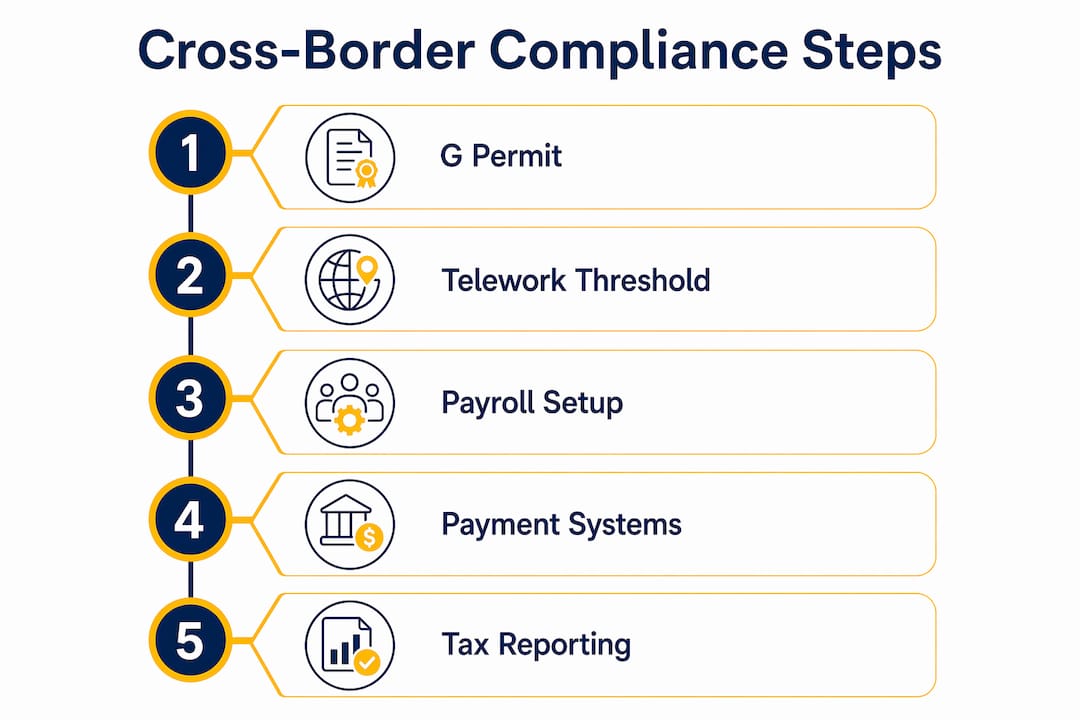
Swiss cross-border operations require coordinated management of G permits, telework thresholds, payroll codes, and payment systems to avoid audits, double taxation, and compliance penalties in 2026.
Point | Details |
G Permit is employer-driven | Employers file the application and must track weekly return compliance for all cross-border workers. |
40% telework is the tax trigger | French residents who telework more than 40% annually face French taxation on the excess days. |
LEADS Protocol removes error buffers | Payroll data transfers automatically to foreign tax authorities, so errors surface without warning. |
Payroll codes matter by region | Italian frontier workers hired after july 2023 require specific codes; wrong coding triggers audits. |
Payment system choice affects cost | SIC and SEPA settle near-instantly; SWIFT involves 2–4 intermediary banks and 1–5 business days. |
What I’ve learned from watching companies get Swiss cross-border compliance wrong
Most compliance failures I see are not caused by ignorance of the rules. They are caused by treating cross-border operations as a single problem when they are actually four separate problems running in parallel: permits, tax, payroll, and payments. Companies that manage these as one process end up with a payroll team that does not know the telework count, a finance team routing payments through SWIFT when SEPA is available, and an HR team that filed the G permit correctly but never set up a tracking system for the weekly return rule.
The 2026 changes make this compartmentalized approach genuinely dangerous. The LEADS Protocol means that a payroll error is no longer an internal problem you can fix quietly before year-end. It becomes a foreign tax authority problem within weeks. I have seen well-run companies face Italian or French tax assessments based on payroll data that was technically correct but used the wrong frontalier classification code.
The telework threshold issue is subtler. A 30% contractual cap sounds conservative until you realize that Swiss public holidays, sick days, and partial weeks all count differently depending on the canton and the DTA involved. The buffer is not just a nice-to-have. It is the only practical way to absorb the ambiguity in how days are counted.
My strongest recommendation is to treat Swiss cross-border compliance as a continuous process, not an annual filing exercise. Quarterly reviews of telework percentages, address records, and permit status catch problems when they are still fixable. Companies that wait for year-end reconciliation are always reacting to problems that could have been prevented in april.
— Rolands
How Rpcs supports Swiss cross-border business setup and compliance
Rpcs provides end-to-end support for entrepreneurs and corporations building a Swiss business presence, from initial company formation in Switzerland through ongoing payroll, accounting, and banking setup.

For cross-border operations specifically, Rpcs handles the legal documentation, notarization, and registration required to establish a compliant Swiss entity. The platform also supports Swiss bank account opening and connects clients with accounting services calibrated to Swiss cross-border payroll requirements. Foreign entrepreneurs who lack local knowledge of cantonal rules, permit procedures, or DTA documentation benefit from Rpcs’s structured packages that cover the full setup process. If you are planning to hire cross-border workers or route international payments through Switzerland, Rpcs offers the compliance infrastructure to do it correctly from day one.
FAQ
What is the G Permit and who needs it?
The G Permit is the mandatory work authorization for EU and EFTA nationals living in border zones who commute to work in Switzerland. Employers file the application, and most permits are valid for five years.
What happens if a cross-border worker exceeds the 40% telework threshold?
Exceeding 40% annual telework triggers French income tax on the excess days for workers covered by the Swiss-French double taxation agreement. The employer must file pro-rata tax reports for the affected period.
How does the LEADS Protocol affect Swiss cross-border payroll in 2026?
The LEADS Protocol automates the transfer of Swiss payroll data to neighboring countries’ tax authorities. Errors in payroll records surface directly in foreign tax systems without any manual correction window.
What payment system should Swiss companies use for EUR transactions?
Swiss companies should use SEPA for EUR payments to eurozone countries. SEPA settles near-instantly and costs less than SWIFT, which involves 2–4 correspondent banks and takes 1–5 business days.
Do double taxation agreements apply automatically for cross-border workers?
Double taxation agreements are not automatic. Employers and employees must actively claim DTA benefits by submitting the required documentation, such as form 2041-AS for French workers, before the relevant tax deadlines.
Recommended
Comments