
What Is Company Domicile? A Guide for Global Founders
- 11 minutes ago
- 8 min read

TL;DR:
Company domicile is the legal jurisdiction where a company is incorporated and governed by laws specific to that location. It determines internal governance, jurisdiction for disputes, and influences tax obligations, which may differ from the principal place of business or mailing address. Understanding these distinctions is crucial, especially for international founders to avoid costly legal and tax conflicts.
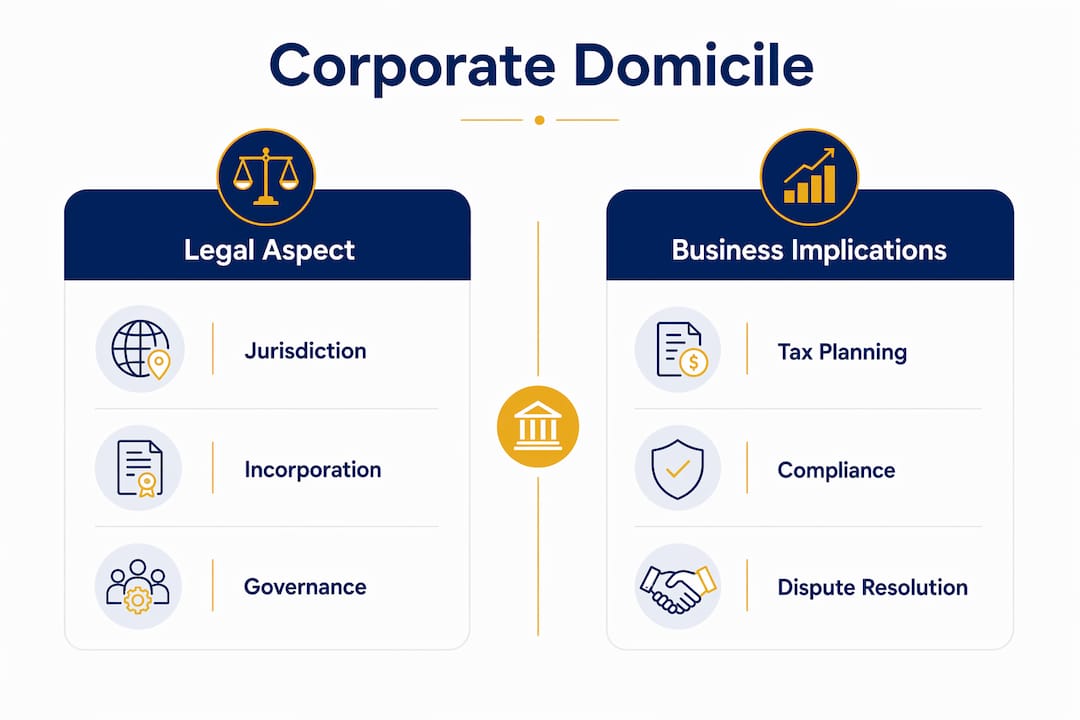
Company domicile is the legal jurisdiction where a corporation is officially registered or incorporated, serving as the foundational home for corporate governance, tax obligations, and legal accountability. This concept, also called corporate domicile, determines which country’s or state’s laws govern a company’s internal affairs, from shareholder disputes to board decisions. For international entrepreneurs, misunderstanding company domicile meaning can trigger filing errors, unexpected tax claims, or jurisdictional conflicts. Whether you are forming a GmbH in Switzerland, a limited company in the UK, or an LLC in Delaware, your domicile choice shapes every legal relationship your business holds.
What is company domicile and how is it determined legally?
Company domicile is the legal home of a corporation, defined by the jurisdiction where it was incorporated and used to determine which courts and corporate laws govern its internal matters. This is not simply where your office sits or where your mail arrives. It is a formal legal connection that courts and regulators use to resolve governance disputes and assign jurisdictional authority.
The most common test for corporate domicile is the place of incorporation. A company formed under Swiss law is domiciled in Switzerland. A company incorporated in Delaware is domiciled in Delaware, even if it operates entirely in California or Germany. That distinction matters because no single test applies across all jurisdictions. The relevant test depends on the specific statute, treaty, or legal instrument in question.
The internal affairs doctrine reinforces this principle. Under this doctrine, internal corporate governance disputes, including shareholder rights, director liability, and voting procedures, are governed by the law of the domicile state. Domicile simplifies internal governance by fixing one jurisdiction’s corporate law to avoid conflicts and jurisdiction-shopping. Without a fixed domicile, every shareholder dispute could trigger competing claims from multiple legal systems.
Key factors courts examine when determining corporate domicile include:
Place of incorporation: The most widely used test across the US, UK, and Switzerland
Registered office address: The official address on file with the company registry
Statutory seat: Used in civil law countries to identify the formal legal seat of a company
Applicable treaty or statute: The specific legal instrument governs which test applies
Pro Tip: Before assuming your company’s domicile, identify the exact statute or treaty under which the domicile question arises. Practitioners must map the domicile test used by that specific instrument before drawing conclusions.
What is the difference between domicile, principal place of business, and mailing address?
These three concepts are legally distinct, and confusing them is one of the most common mistakes international founders make. Company domicile is the jurisdiction of incorporation. The principal place of business is where senior leadership actually directs and coordinates company activities. A mailing address is simply where correspondence is delivered, often through a registered agent.

A common misconception treats domicile as a mailing address, but domicile is a legal and jurisdictional factor with far broader consequences. A company can have its domicile in Switzerland, its principal place of business in Singapore, and its mailing address at a registered agent office in London. Each of these locations triggers different legal and tax obligations.
The principal place of business is the single location where senior leadership directs company activities, creating tax nexus beyond domicile. This is sometimes called the “nerve center” test. Courts in the US use this standard to determine federal jurisdiction. Tax authorities in multiple countries use it to assess where a company is effectively managed and therefore where it owes tax.
Concept | Legal definition | Tax and legal impact |
Company domicile | Jurisdiction of incorporation | Governs internal corporate affairs and court jurisdiction |
Principal place of business | Where senior leadership directs activities | Creates tax nexus and filing obligations |
Mailing address | Where correspondence is received | No direct legal or tax significance |
Registered office | Official address on the company registry | Required for regulatory filings and legal notices |
Pro Tip: If your company’s domicile and principal place of business are in different countries, consult a tax advisor before filing. Overlapping claims from two jurisdictions can create double taxation exposure that a Swiss business address structure can help you address correctly.
How do domicile rules vary across Switzerland, the US, and UK?
Jurisdictional rules on corporate domicile differ significantly, and those differences have real consequences for international founders choosing where to incorporate.
Switzerland treats domicile primarily as the place of incorporation, consistent with its civil law tradition. Switzerland generally treats domicile in line with incorporation jurisdiction, providing a stable governing corporate law and tax framework. Swiss law also recognizes the statutory seat, which is the registered address listed in the Commercial Register. For a GmbH or AG formed in Zurich or Geneva, Swiss corporate law governs all internal matters regardless of where the company’s clients or operations are located. This stability makes Switzerland attractive for global founders who want predictable governance rules.
The United Kingdom takes a firm position on domicile permanence. A UK corporation is domiciled in the jurisdiction under whose laws it was incorporated and cannot change that domicile even if it carries on business elsewhere. A company formed under English law remains domiciled in England regardless of where it moves its offices or operations. This rule anchors jurisdiction for disputes and regulatory oversight firmly to the place of formation.
The United States applies the internal affairs doctrine to separate internal governance from external obligations. The state of incorporation’s law governs internal affairs, while external matters like taxation are governed by the jurisdiction where the company does business. This is why Delaware is the domicile of choice for thousands of US corporations. Delaware corporate law is well-developed and predictable, but a Delaware company operating in New York still owes New York taxes on its New York activities.
Key cross-border implications to understand:
Moving physical operations does not change legal domicile when incorporation defines it
A company domiciled in Switzerland but operating in Germany may owe German taxes on German-source income
Double taxation treaties between countries can reduce but rarely eliminate overlapping obligations
Cross-border domicile and nexus scenarios are complex; domicile moves usually do not eliminate other jurisdictions’ tax or regulatory claims
What are the practical implications of corporate domicile for tax planning?
Corporate domicile has direct, measurable consequences for how a business is taxed, where it can be sued, and which rules govern its internal decisions. Getting this wrong is not a paperwork problem. It is a liability problem.
The practical implications break down into four areas:
Corporate governance framework. The domicile jurisdiction’s company law governs shareholder agreements, director duties, and voting rights. A company domiciled in Switzerland follows the Swiss Code of Obligations for these matters, regardless of where its shareholders live.
Tax nexus and filing obligations. Domicile alone does not determine all tax obligations. A company domiciled in Switzerland but with a permanent establishment in France will owe French corporate tax on French profits. Tax nexus and obligations derive partly from domicile and partly from operational presence, so founders must track both.
Court jurisdiction for disputes. When a shareholder dispute or breach of fiduciary duty claim arises, the domicile jurisdiction’s courts typically have authority. A company domiciled in Delaware will litigate internal disputes in Delaware’s Court of Chancery, one of the most specialized corporate courts in the world.
Strategic domicile selection. Choosing a domicile with favorable corporate law and tax rates is a legitimate planning tool. Switzerland offers Swiss corporate tax rates that are competitive by European standards, combined with a stable legal system and strong international treaty network. Founders who incorporate in Switzerland gain access to these advantages from day one.
A practical example: a founder based in the UAE incorporates a GmbH in Zug, Switzerland. The company’s domicile is Switzerland. Swiss law governs its internal affairs. Swiss corporate tax rates apply to Swiss-source income. If the company later opens a branch in Germany, German tax authorities will assess that branch separately. The Swiss domicile does not shield German branch profits from German tax, but it does keep Swiss governance rules intact and preserves access to Switzerland’s treaty benefits.
Key Takeaways
Company domicile is the jurisdiction of incorporation, and it governs internal corporate affairs, tax planning, and legal jurisdiction for disputes across every country where a business operates.
Point | Details |
Domicile equals incorporation jurisdiction | The place of incorporation sets the corporate law governing internal affairs and court jurisdiction. |
Domicile differs from business location | Principal place of business and mailing address carry separate legal and tax consequences. |
UK domicile is permanent | A UK-incorporated company cannot change its domicile even if it moves all operations abroad. |
US separates internal and external rules | The internal affairs doctrine governs governance by domicile; tax follows where business is conducted. |
Switzerland offers stable domicile benefits | Swiss incorporation provides predictable governance, competitive tax rates, and strong treaty access. |
Why founders underestimate domicile until it costs them
Most founders treat domicile as a checkbox on the incorporation form. They pick a jurisdiction based on cost or convenience, then move on. That approach works fine until a shareholder dispute, a tax audit, or a cross-border acquisition surfaces. At that point, domicile becomes the most important fact in the room.
The part that surprises people most is the permanence. In the UK, incorporation fixes domicile permanently. You cannot restructure your way out of it by moving offices or changing directors. In Switzerland, the same principle applies through the statutory seat. The company’s legal home stays where it was formed unless you go through a formal redomiciliation process, which is complex and not always possible.
What I tell founders is this: domicile is not just a governance question. It is a tax planning question, a dispute resolution question, and a credibility question. Swiss domicile, for example, signals stability and legal rigor to banks, investors, and counterparties in a way that a shell jurisdiction simply does not. That reputational factor has real commercial value.
The other mistake I see regularly is treating domicile and principal place of business as interchangeable. They are not. A company domiciled in Switzerland but effectively managed from Dubai may face tax claims from the UAE under its own evolving corporate tax rules. Internationally, businesses must navigate multiple overlapping connecting factors. Domicile handles governance. Presence handles tax. You need both right.
My practical advice: map your domicile, your principal place of business, and your permanent establishments separately before you file anything. Then check each one against the applicable treaty. That exercise takes a few hours and can save years of disputes.
— Rolands
How Rpcs helps you establish Swiss company domicile
Swiss company formation is one of the most consequential decisions a global founder makes. Getting the domicile, address, and governance structure right from day one avoids costly corrections later.

Rpcs provides end-to-end Swiss company formation services for international entrepreneurs, covering GmbH and AG structures, legal documentation, notarization, and Commercial Register filing. Beyond formation, Rpcs supports founders with a registered address in Switzerland, Swiss bank account setup, and ongoing accounting services tailored to Swiss corporate tax requirements. For founders who need a Swiss resident director or nominee director for compliance, Rpcs handles that too. The platform is built for foreign clients who need Swiss domicile done correctly, without the guesswork of navigating Swiss law alone.
FAQ
What is company domicile in simple terms?
Company domicile is the legal jurisdiction where a company is incorporated. It determines which country’s or state’s corporate laws govern the company’s internal affairs and which courts have jurisdiction over disputes.
Can a company change its domicile?
In most jurisdictions, changing domicile requires a formal redomiciliation process and is not always permitted. In the UK, domicile is fixed at incorporation and cannot be changed by moving operations elsewhere.
Is company domicile the same as tax residency?
No. Domicile governs internal corporate law, while tax residency depends on where a company is effectively managed or where it conducts business. A company can be domiciled in Switzerland but owe taxes in another country based on its operational presence there.
How does Swiss domicile benefit international companies?
Swiss domicile provides stable corporate governance under Swiss law, access to competitive Swiss corporate tax rates, and credibility with international banks and investors. Switzerland’s extensive treaty network also reduces double taxation exposure for global operations.
What is the difference between domicile and principal place of business?
Domicile is the jurisdiction of incorporation and governs internal corporate affairs. The principal place of business is where senior leadership directs company activities and creates tax nexus, which is a separate and distinct legal concept.
Recommended
Comments