
Swiss Intellectual Property Laws Explained for Entrepreneurs
- 3 hours ago
- 8 min read

TL;DR:
Swiss IP law grants entrepreneurs exclusive rights to their innovations, brands, and designs within Switzerland, supported by international treaties. Registering patents, trademarks, and designs through the Swiss Federal Institute of Intellectual Property is essential, while copyrights attach automatically at creation. Early registration and active monitoring are crucial to protect your IP across borders via treaties like the Paris Convention and Madrid Protocol.
Swiss intellectual property law is defined as the federal legal framework granting entrepreneurs exclusive rights to control, license, and enforce their innovations, brands, and creative works within Switzerland. The Swiss Federal Institute of Intellectual Property (IPI) administers this system, covering patents, trademarks, copyrights, and design protections. Understanding Swiss IP laws matters because Switzerland participates in major international treaties including the Paris Convention, the Madrid Protocol, and the TRIPS Agreement, meaning your Swiss IP rights can extend far beyond its borders. For entrepreneurs building companies in Switzerland, this framework is one of the most powerful tools available for protecting competitive advantage.
What types of IP protections are available under Swiss law?
Intellectual property rights in Switzerland are governed by federal law and international treaties, giving rights holders the power to prevent unauthorized use and license their IP. The Swiss system recognizes four primary categories, each with distinct rules and timelines.
Patents protect inventions for up to 20 years from filing, provided the invention is new, non-obvious, and industrially applicable. Registration through the IPI is mandatory. No registration means no patent protection, period.
Trademarks cover names, logos, slogans, and signs that distinguish your goods or services. Swiss trademark law is governed by the Federal Act on the Protection of Trade Marks and includes the “Swissness” legislation, which restricts use of Swiss national symbols and geographic references. That restriction is actually an asset. A brand that legitimately carries Swiss origin credentials commands premium positioning in global markets.
Copyrights protect artistic and literary works automatically. Copyright protection in Switzerland requires no registration and attaches the moment a qualifying work is created. This covers software, music, written content, and visual art. The protection term runs for 70 years after the author’s death.

Design protections cover the novel visual appearance of products, including shape, lines, colors, and texture. Registration is required, and the design must be genuinely new at the time of filing.
Beyond these four, Switzerland also recognizes geographical indications and trade secrets, though the latter relies on contractual and confidentiality law rather than a formal registration system.
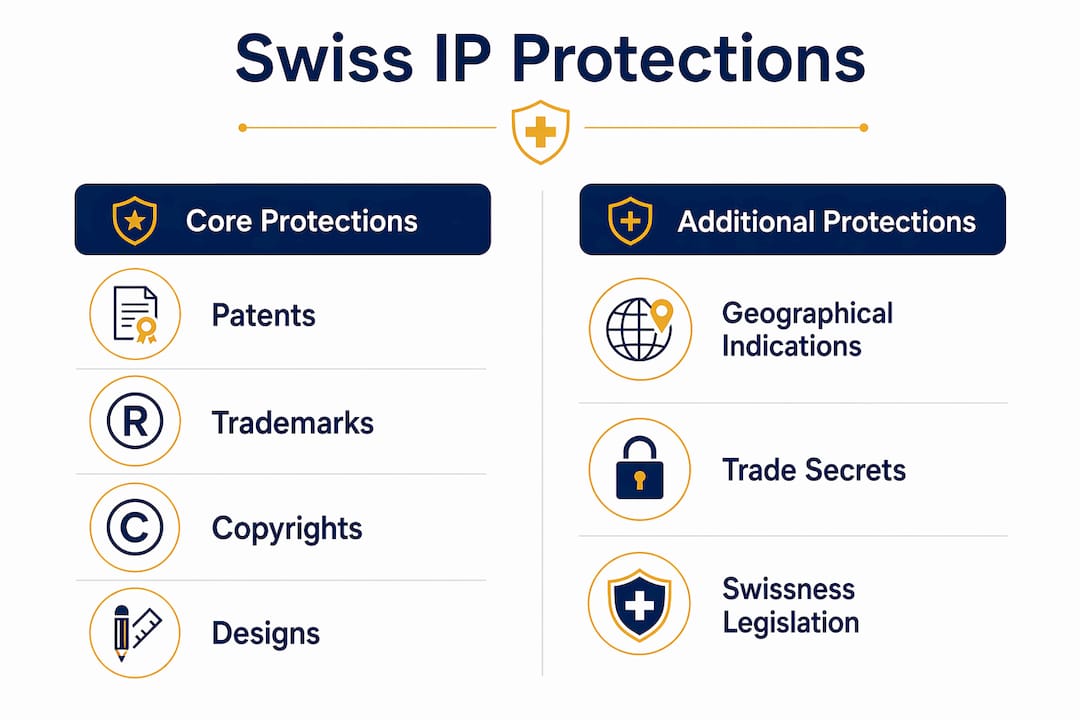
Comparison of Swiss IP protection types
IP Type | Protection Term | Registration Required | Governing Authority |
Patent | Up to 20 years | Yes | IPI |
Trademark | 10 years, renewable | Yes | IPI |
Copyright | Life + 70 years | No | Automatic |
Design | Up to 25 years | Yes | IPI |
Trade Secret | Indefinite | No | Contract/civil law |
The table above shows one critical asymmetry: copyright is the only protection that activates without any action on your part. Every other right requires you to file, pay fees, and maintain registrations actively.
How does the Swiss Federal Institute of Intellectual Property manage IP rights?
The IPI serves as the central federal authority for IP registrations, public information, and policy in Switzerland. Every patent, trademark, and design registration in Switzerland flows through the IPI. Understanding how it operates saves you time and prevents costly mistakes.
The IPI’s core functions include:
Patent registration: Examining applications for formal compliance and novelty before granting protection.
Trademark registration: Reviewing applications against existing marks in the IPI register and checking for absolute grounds of refusal.
Design registration: Recording novel designs and issuing certificates of protection.
Swissreg database: A publicly accessible tool that lets you search all registered patents, trademarks, and designs in Switzerland.
The Swissreg database is an indispensable tool for monitoring your IP portfolio and checking whether a competitor has filed a conflicting mark or patent. Before you invest in branding or product development, a Swissreg search takes minutes and can prevent years of legal disputes.
One critical limitation: the IPI does not verify the credibility of trademark applications. It registers rights and maintains the public record, but it does not investigate whether the applicant actually owns or uses the mark commercially. That means the register can contain conflicting or questionable entries. You are responsible for monitoring and challenging registrations that infringe your rights.
Pro Tip: Set up a monitoring alert through Swissreg or a professional IP monitoring service after you register your trademark. New conflicting filings will not trigger automatic IPI notification. You must watch the register yourself or hire someone to do it.
What are the steps to register and protect IP in Switzerland?
Protecting your IP in Switzerland follows a clear sequence. Skipping steps or filing out of order can permanently disqualify your application.
Conduct a prior art or trademark search. Before filing anything, search Swissreg and international databases to confirm your invention or mark is genuinely new. A conflicting prior registration will block your application.
Prepare your application documents. For patents, this includes a detailed description of the invention, claims defining the scope of protection, drawings, and an abstract. For trademarks, you need a clear representation of the mark and a list of goods or services classified under the Nice Classification system. For designs, you need high-quality visual representations of the design.
File before public disclosure. Filing must happen before any public disclosure of your invention or brand. Public disclosure destroys novelty for patents and can compromise trademark distinctiveness. This rule catches many first-time founders off guard. A product demo at a trade show, a press release, or even a public social media post can disqualify your patent application if it precedes your filing date.
Submit to the IPI and pay filing fees. The IPI publishes a fee schedule on its website. Patent fees are higher and more complex than trademark or design fees, often requiring professional assistance to calculate correctly.
Respond to IPI office actions. The IPI may issue objections or requests for clarification. You typically have a defined response window, often two to four months. Missing this deadline can result in abandonment of your application.
Manage renewals. Trademarks renew every 10 years. Patents require annual maintenance fees to stay in force. Designs renew in five-year increments up to a maximum of 25 years. Missing a renewal deadline means your protection lapses.
For a detailed walkthrough of the trademark process specifically, the trademark registration guide covers each step with the documentation requirements.
Pro Tip: If you are filing a patent, consider hiring a Swiss patent attorney for the claims drafting stage. The scope of your patent protection is determined almost entirely by how your claims are written. Poorly drafted claims leave gaps that competitors can exploit legally.
How do Swiss IP laws interact with international treaties?
Switzerland’s participation in major international IP treaties gives entrepreneurs access to cross-border protection mechanisms that extend well beyond Swiss borders. This is one of the most underused advantages of intellectual property rights in Switzerland.
The key treaties and their practical implications include:
Paris Convention: Switzerland is a member, meaning a Swiss patent or trademark application establishes a priority date. You can file in other member countries within 12 months (patents) or 6 months (trademarks) and claim that original Swiss filing date. This is critical for protecting your invention globally without filing everywhere simultaneously on day one.
Madrid Protocol: Allows you to file a single international trademark application through the IPI that can extend to over 130 countries. One application, one fee structure, one renewal process. For entrepreneurs targeting multiple markets, this is far more efficient than filing country by country.
TRIPS Agreement: Sets minimum IP protection standards across all World Trade Organization members. Switzerland’s domestic law meets and often exceeds TRIPS requirements, which means Swiss IP protections are recognized and enforceable in most major trading economies.
Swissness legislation: This is Switzerland’s national distinction within the trademark framework. It restricts who can use Swiss geographic references and national symbols on products and services. Compliance is mandatory, but the reward is significant. A legitimately Swiss-branded product carries credibility that few other national origins can match.
A practical example: a tech startup registers its trademark in Switzerland through the IPI, then uses the Madrid Protocol to extend that registration to the European Union, the United States, and Japan within six months. The Swiss filing date serves as the priority date in all three jurisdictions. Without the Paris Convention, the startup would need to file simultaneously in every country from day one, at far greater cost and complexity.
For entrepreneurs considering Switzerland as an IP holding structure, the treaty network makes it one of the most strategically positioned jurisdictions in the world.
Key Takeaways
Swiss intellectual property law gives entrepreneurs a structured, treaty-backed system to protect patents, trademarks, copyrights, and designs, with the IPI serving as the central registration and monitoring authority.
Point | Details |
Four core IP types | Patents, trademarks, copyrights, and designs each have distinct terms and registration rules. |
Copyright is automatic | Copyright protection attaches at creation with no registration required, unlike all other IP types. |
File before disclosure | Public disclosure before filing permanently disqualifies patent applications under Swiss law. |
IPI does not verify credibility | The IPI registers rights but does not investigate applicant legitimacy, so active monitoring is your responsibility. |
International treaties amplify reach | The Paris Convention and Madrid Protocol let a Swiss filing extend protection to over 130 countries efficiently. |
Why early registration is the only strategy that works
I have seen entrepreneurs treat IP registration as something to handle after launch, after funding, after the product is proven. That logic is backwards, and it costs them dearly. The Swiss system is unforgiving on timing. One public demo before your patent filing date and you have handed your invention to the public domain.
What surprises most founders I work with is how affordable early trademark registration actually is relative to the cost of a dispute. A Swiss trademark application costs a few hundred Swiss francs. A trademark infringement case can run into six figures before it resolves. The math is not complicated.
The Swissness legislation is another area where I see consistent underestimation. Entrepreneurs assume it is a restriction. It is actually a competitive weapon. If your company genuinely qualifies to use Swiss origin branding, that designation carries weight in luxury goods, financial services, pharmaceuticals, and precision manufacturing that no marketing budget can replicate. The compliance requirements are strict, but the brand premium is real.
My honest advice for international entrepreneurs launching in Switzerland: treat IP registration as part of your company formation checklist, not an afterthought. The tips for international entrepreneurs launching here consistently point to IP timing as one of the top avoidable mistakes. Register early, monitor actively, and use the Madrid Protocol to extend your Swiss registrations internationally before a competitor beats you to it in a key market.
— Rolands
How Rpcs helps entrepreneurs protect their IP from day one
Rpcs specializes in Swiss company formation for international entrepreneurs, and IP protection starts at the company level. A properly structured Swiss GmbH or AG creates the legal entity that holds your patents, trademarks, and designs, making enforcement and licensing far cleaner. Rpcs handles the full formation process, from legal documentation and notarization to registration and Swiss bank account setup, so your business and IP infrastructure are built correctly from the start. The team also provides ongoing accounting services in Switzerland to keep your company compliant. For entrepreneurs ready to establish a Swiss presence with IP protection built in, Swiss company formation with Rpcs is the logical first step.
FAQ
What is covered under Swiss intellectual property law?
Swiss IP law covers patents, trademarks, copyrights, and design protections, each governed by separate federal acts and administered through the IPI. Trade secrets and geographical indications receive additional protection under civil and specialized law.
Does copyright in Switzerland require registration?
Copyright protection in Switzerland is automatic and requires no registration. It attaches at the moment a qualifying artistic or literary work is created and lasts for 70 years after the author’s death.
How long does a Swiss patent last?
A Swiss patent protects an invention for up to 20 years from the filing date, provided annual maintenance fees are paid throughout the protection period.
What is the Swissness legislation?
Swissness legislation restricts the use of Swiss national symbols and geographic references on products and services to those that genuinely meet Swiss origin criteria. Compliance is mandatory, but qualifying brands gain significant market credibility.
Can I protect my Swiss trademark internationally?
Yes. Switzerland participates in the Madrid Protocol, allowing a single international trademark application filed through the IPI to extend protection to over 130 countries using the Swiss filing date as the priority date.
Recommended
Comments