
Swiss Business Legal Compliance Workflow: 2026 Guide
- 2 hours ago
- 9 min read

TL;DR:
Swiss companies must manage compliance across data privacy, anti-money laundering, and statutory accounting to meet Swiss legal standards. Building a documented operational workflow with clear owners, scheduled tasks, and evidence is essential for effective compliance. Using professional services and simple tools helps foreign entrepreneurs establish and maintain regulatory requirements efficiently.
The Swiss business legal compliance workflow is a structured process that ensures your company meets all mandatory legal, financial, and regulatory obligations under Swiss law. For international entrepreneurs, this means managing three distinct compliance tracks simultaneously: data privacy under the new Federal Act on Data Protection (nFADP), anti-money laundering (AML) obligations enforced by FINMA and the Money Reporting Office Switzerland (MROS), and statutory accounting requirements under the Swiss Code of Obligations (Art. 958 OR). Getting this right from day one protects your company from regulatory penalties and builds the credibility that Swiss incorporation is known for.
What are the mandatory swiss legal compliance requirements for businesses?
Swiss compliance obligations fall into three core categories, each with its own regulator, documentation standard, and deadline structure. Understanding all three is the foundation of any solid Swiss compliance process.
Data Privacy Under the nFADP
The Federal Data Protection and Information Commissioner (FDPIC) enforces the nFADP, with authority to issue binding decisions and require corrective measures. FDPIC enforcement focuses on individuals for breaches, which means your company needs clearly assigned personal accountability, not just organizational policies. Every Swiss company processing personal data must maintain a register of processing activities, conduct Data Protection Impact Assessments (DPIAs) where applicable, and execute data processing agreements with third-party vendors.
When a high-risk data breach occurs, Swiss law requires notification to the FDPIC as soon as possible, without a fixed 72-hour window like the EU’s GDPR. That flexibility sounds lenient, but it actually demands a faster internal triage process. Your notification must include the breach’s nature, timing, effects on data subjects, and remedial measures taken.
Pro Tip: Build a two-stage incident response protocol. Stage one is a technical security triage completed within 24 hours. Stage two is a legal assessment that determines whether FDPIC notification is required. Separating these stages prevents premature filings and missed deadlines.
AML Obligations
Swiss AML law is risk-based and ongoing, requiring financial intermediaries to conduct customer due diligence, monitor transactions continuously, and maintain structural organizational controls including staff training and internal audits. Suspicions must be reported to MROS immediately. The record retention requirement is strict: all due diligence documents and transaction records must be kept for 10 years after a business relationship ends. That timeline shapes your entire document management architecture.
Statutory Accounting Requirements
Under Art. 958 OR, every Swiss company must prepare and formally approve annual financial statements within 6 months after the financial year-end. For a December 31 year-end, the board approval deadline is June 30. This is not just a preparation deadline. It requires a formal board resolution, which means your workflow must coordinate both the accounting team and the board calendar well in advance.
Key documentation requirements across all three tracks include:
Registers of processing activities and DPIAs (nFADP)
Customer due diligence files and transaction monitoring logs (AML)
Annual financial statements with board approval minutes (Art. 958 OR)
Internal audit reports and compliance training records (AML)
Data processing agreements with all relevant vendors (nFADP)
How do you build an effective legal compliance workflow in switzerland?
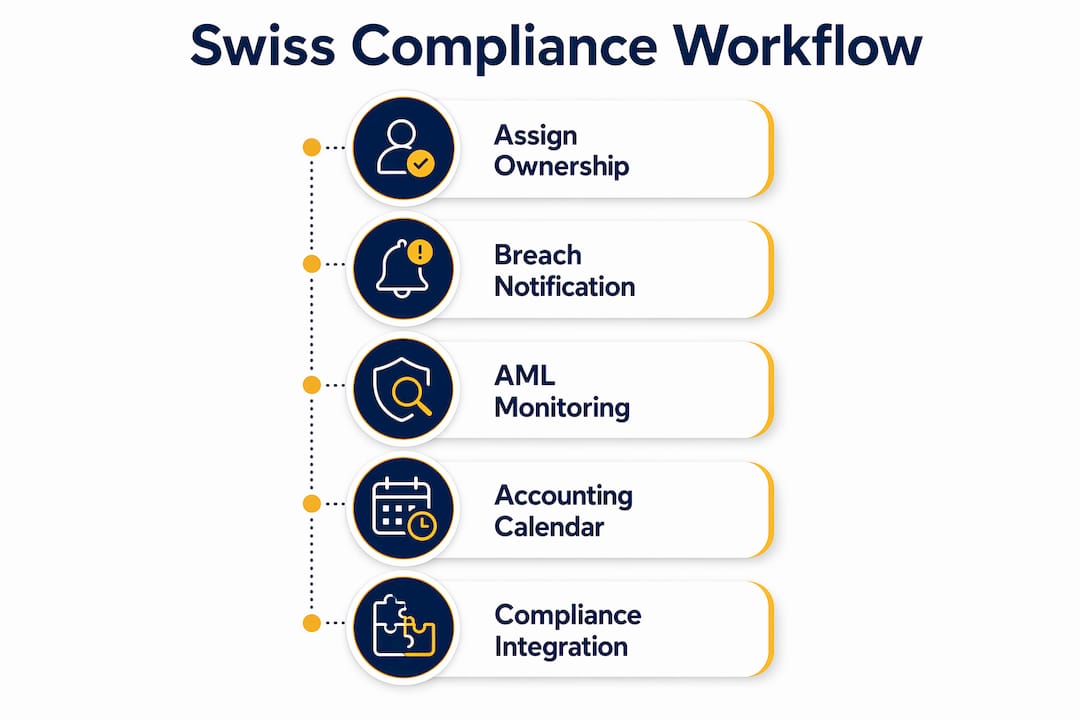
A working compliance workflow is not a policy document. It is an operational system with assigned roles, scheduled tasks, and documented outputs. Here is how to build one that covers all three compliance tracks.

Step 1: Assign Compliance Ownership
Designate a Data Protection Officer (or equivalent) for nFADP obligations and a compliance officer for AML. For smaller companies, one person can hold both roles, but the responsibilities must be formally documented. Without named owners, deadlines slip and regulators find no one accountable.
Step 2: Configure Your Breach Detection and Notification Process
Incident-response workflows must distinguish between security triage and legal notification. Set up automated alerts for unusual data access patterns using tools like Microsoft Sentinel or similar security information and event management (SIEM) platforms. The legal team then reviews flagged incidents against the nFADP high-risk threshold before any FDPIC notification is filed.
Step 3: Build Your AML Onboarding and Monitoring Workflow
AML workflows implement risk-based onboarding with tiered due diligence: simplified for low-risk clients, enhanced for high-risk or politically exposed persons. Use a centralized document taxonomy with controlled access so compliance auditors can retrieve records years later. Set calendar triggers tied to relationship termination dates to start the 10-year retention clock accurately.
Step 4: Set Up Your Annual Accounting Calendar
The table below maps the key milestones for a December 31 year-end company:
Milestone | Deadline | Owner |
Draft financial statements ready | March 31 | Accounting team |
Internal review and adjustments | April 30 | CFO or external accountant |
Board review of draft statements | May 31 | Board of directors |
Formal board approval | June 30 | Board of directors |
Filing with commercial register (if required) | July 31 | Company secretary |
Step 5: Integrate a Compliance Calendar
Combine all three tracks into a single shared compliance calendar. Include FDPIC registration renewals, AML training dates, board approval meetings, and statutory filing deadlines. Tools like Notion, Monday.com, or a dedicated GRC (governance, risk, and compliance) platform work well for this. The goal is one visible system that prevents any deadline from falling through the cracks.
Pro Tip: Review your Swiss accounting setup at least quarterly, not just at year-end. Catching misclassified transactions in March is far cheaper than correcting them during a June board review.
What are the common mistakes in swiss business compliance?
Most compliance failures in Switzerland are not caused by ignorance of the law. They result from poor workflow design and lack of coordination between teams. The Swiss company compliance checklist approach helps, but only if the underlying processes are solid.
The most frequent mistakes include:
Treating the nFADP breach notification as open-ended. “As soon as possible” is not an invitation to deliberate. Regulators expect a documented decision within days, not weeks. Companies without a pre-built incident response protocol consistently miss this standard.
Mismanaging AML retention timers. The 10-year clock starts when the business relationship ends, not when the last transaction occurs. Many companies track transaction dates instead, which creates gaps that surface during audits.
Confusing preparation with approval for statutory accounts. Annual deadlines require formal board approval, not just completed financials. Companies that finish their accounts in June but skip the board resolution step are technically non-compliant.
Siloing compliance functions. Privacy, AML, and accounting teams that operate independently create overlapping documentation gaps. A data breach, for example, may also trigger AML reporting obligations if financial data is involved.
Relying on policy documents as proof of compliance. Operational documentation like processing registers, DPIAs, and audit trails is what regulators actually inspect. A policy manual without supporting evidence fails every supervisory review.
“Swiss compliance is not about having the right policies on paper. It is about demonstrating, through documented workflows and evidence, that those policies are actually running inside your business every day.”
The fix for all of these mistakes is the same: move from ad hoc compliance to a managed workflow with scheduled reviews, named owners, and documented outputs at every step.
Which tools and services support swiss compliance workflows?
The right combination of professional services and software makes the difference between a compliance workflow that runs itself and one that requires constant firefighting. For international entrepreneurs without deep local knowledge, professional support is not optional. It is the fastest path to a working system.
The table below compares the main service categories available to foreign-owned Swiss companies:
Service Type | Primary Function | Key Compliance Benefit |
Swiss company formation | GmbH or AG registration, notarization, commercial register filing | Correct legal structure from day one |
Registered address / virtual office | Mandatory local presence and official mail handling | Meets address requirements for regulatory filings |
Accounting services | Statutory financial statements, tax filings, board approval support | Meets Art. 958 OR deadlines |
Bank account opening | Swiss business account setup | Required for AML-compliant financial operations |
Compliance consulting | Privacy, AML, and workflow design | Reduces regulatory risk across all three tracks |
Virtual office services in Switzerland fulfill the mandatory local presence requirement and also manage official communications from regulators like the FDPIC and cantonal tax authorities. That matters because missing a regulatory letter due to an incorrect address is a compliance failure in itself.
For privacy and AML documentation, software platforms like OneTrust (for data privacy management) and ComplyAdvantage (for AML screening) integrate well with Swiss legal requirements. Both support the evidence-based compliance model that Swiss regulators expect. Pair these with a professional accounting firm that knows Swiss statutory requirements, and you have the core of a functional compliance infrastructure.
The annual administration guide from Rpcs covers the specific reporting and approval steps that foreign-owned companies most commonly miss, making it a practical reference for any compliance calendar build.
Key takeaways
A well-designed Swiss business legal compliance workflow integrates privacy, AML, and statutory accounting obligations into one coordinated system with named owners, documented evidence, and scheduled deadlines.
Point | Details |
Three compliance tracks | Privacy (nFADP), AML (FINMA/MROS), and statutory accounting (Art. 958 OR) must run in parallel. |
Evidence over policy | Regulators inspect processing registers, DPIAs, and audit trails, not policy documents. |
AML retention timing | The 10-year record retention clock starts at relationship termination, not last transaction. |
Accounting approval deadline | Board approval of annual accounts is required by June 30 for December 31 year-end companies. |
Professional services reduce risk | Formation, accounting, and virtual office services help foreign companies meet local compliance requirements from day one. |
Why proactive workflow design is the only strategy that works
I have seen international entrepreneurs approach Swiss compliance in two ways. The first group builds their workflow before they open their doors. The second group reacts to problems after they appear. The second group always spends more money, more time, and more goodwill with regulators.
The thing that surprises most foreign founders is how evidence-dependent Swiss regulators are. FDPIC inspectors do not want to hear that your company takes data protection seriously. They want to see your processing register, your DPIA for the last high-risk activity, and your incident log. FINMA-supervised entities face the same standard on the AML side. If you cannot produce a documented audit trail, the compliance work you did might as well not have happened.
My practical advice: treat your compliance workflow as a product, not a project. A project has an end date. A product has owners, version history, and regular updates. Assign a named owner to each compliance track. Schedule quarterly reviews. Document every decision, including the ones where you concluded no action was needed. That last point matters more than most people realize. A documented “no action required” decision is evidence of an active compliance process. Silence is not.
On technology: do not over-engineer your stack in year one. A well-maintained spreadsheet compliance calendar beats an underused GRC platform every time. Start simple, build discipline, then add software when the manual process is already working.
Finally, stay current with regulatory changes. The nFADP is relatively new, and FDPIC guidance continues to evolve. Subscribe to FDPIC publications and FINMA circulars directly. Do not rely on secondhand summaries for something this consequential.
— Rolands
How Rpcs supports your swiss compliance workflow
Rpcs is built specifically for international entrepreneurs who need a complete Swiss compliance infrastructure without the guesswork. From Swiss company formation covering GmbH and AG structures to ongoing accounting services aligned with Art. 958 OR requirements, Rpcs handles the operational complexity so you can focus on running your business. The platform also supports bank account opening and registered address services, giving you the local presence that Swiss regulators require. If you are building or auditing your compliance workflow, contact Rpcs for tailored support that covers every track from privacy to statutory reporting.
FAQ
What is the swiss business legal compliance workflow?
The Swiss business legal compliance workflow is a structured operational system covering data privacy (nFADP), AML obligations, and statutory accounting under Art. 958 OR. It assigns roles, schedules deadlines, and produces documented evidence for regulators.
How quickly must you notify the FDPIC after a data breach?
Swiss law requires notification to the FDPIC as soon as possible after a high-risk breach, with no fixed 72-hour deadline like GDPR. The notification must include the breach’s nature, timing, effects on data subjects, and remedial measures taken.
How long must swiss companies keep AML records?
Swiss AML law requires keeping due diligence and transaction records for 10 years after the business relationship ends. The retention clock starts at relationship termination, not at the date of the last transaction.
What is the deadline for swiss annual financial statement approval?
Under Art. 958 OR, annual financial statements must be formally approved by the board within 6 months after the financial year-end. For a December 31 year-end, the board approval deadline is June 30.
Do foreign-owned swiss companies need a local address for compliance?
Yes. Swiss law requires a registered local address for official regulatory communications. Virtual office and registered address services fulfill this requirement and manage incoming correspondence from authorities like the FDPIC and cantonal tax offices.
Recommended
Comments