
Data Protection in Switzerland: 2026 Compliance Guide
- 7 hours ago
- 8 min read

TL;DR:
Switzerland’s new data protection law makes organizations responsible for personal data processing and security measures. Compliance requires proactive measures such as DPIAs, detailed registers, and privacy by design, with enforcement by the FDPIC and potential criminal sanctions. Foreign controllers must appoint a Swiss representative, and adherence to core principles ensures lawful cross-border data flows and robust governance.
Data protection in Switzerland is governed by the Federal Act on Data Protection (FADP) and the Data Protection Ordinance (FODP), a legal framework that took effect on September 1, 2023, and places direct accountability on every organization that processes personal data in or about Swiss residents. The role of data protection in Switzerland extends beyond legal formality. It defines how companies collect, store, transfer, and secure personal information, with enforceable obligations tied to privacy by design, breach notification, and risk-based technical controls. For entrepreneurs and investors forming a Swiss company, understanding this framework is not optional. It is a foundational compliance requirement from day one.
What are the key obligations under the swiss FADP?
The FADP and FODP establish the legal foundation for all personal data processing across private entities and federal bodies in Switzerland. Controllers carry primary legal responsibility for compliance. That means your organization, not your vendor or processor, is accountable for how data is handled.
The core processing principles under the FADP include:
Lawfulness: Data must be processed on a recognized legal basis.
Purpose limitation: Data collected for one purpose cannot be repurposed without justification.
Data accuracy: Controllers must keep personal data correct and up to date.
Proportionality: Only data necessary for the stated purpose may be collected.
Good faith: Processing must not deceive or mislead data subjects.
Swiss companies must also implement privacy by design and default, meaning privacy protections must be built into products and services from the initial development stage, not added afterward. This is a concrete engineering obligation, not a policy statement.
Controllers must maintain a register of processing activities. Small and medium-sized enterprises with low-risk processing may qualify for an exemption, but any organization handling sensitive data or running automated decision-making processes will not qualify. The technical and organizational measures required under Article 8 FADP and Article 3 FODP must be proportionate to the risk level of each processing activity.

Breach notification goes to the Federal Data Protection and Information Commissioner (FDPIC). Unlike the EU’s General Data Protection Regulation (GDPR), the FADP sets no fixed 72-hour deadline. Notification must happen “as quickly as possible” when high risks arise. The report must cover the breach’s nature, timing, effects, and mitigation steps, with the option to supplement details later.
Pro Tip: Build your breach notification report as a template before you ever need it. Pre-fill the structural fields (breach type, affected data categories, mitigation steps) so your team can complete and submit it within hours, not days.
How does switzerland’s framework compare to the EU GDPR?
The FADP aligns with GDPR principles in many areas, but the two frameworks are not interchangeable. Swiss law remains distinct in enforcement structure, sanction mechanisms, and specific procedural requirements. Businesses that assume GDPR compliance automatically satisfies Swiss obligations will face gaps.
Feature | Swiss FADP | EU GDPR |
Breach notification deadline | As quickly as possible, no fixed timeline | 72 hours to supervisory authority |
Enforcement body | Federal Data Protection and Information Commissioner (FDPIC) | National Data Protection Authorities |
Criminal sanctions | Yes, for intentional violations by individuals | Administrative fines, no direct criminal liability |
Local representative requirement | Required for foreign controllers with significant Swiss data impact | Required for non-EU controllers |
SME processing register exemption | Yes, for low-risk processing | Limited exemptions |
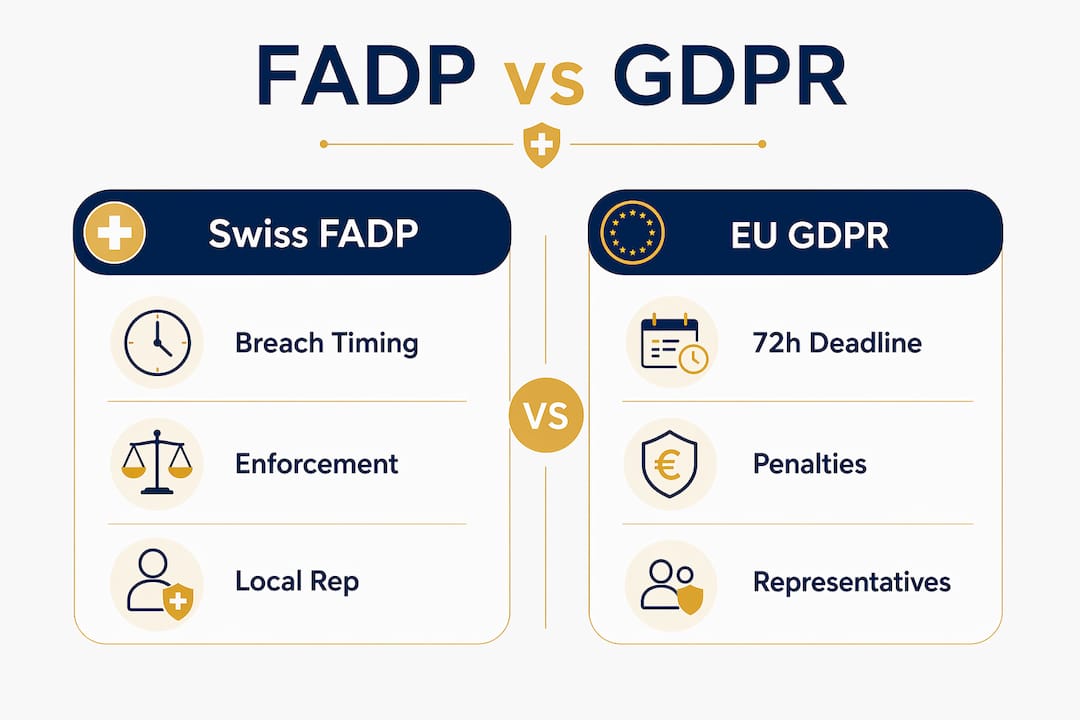
Switzerland maintains data flow compatibility with the EU through its adequacy recognition. The Swiss-US Data Privacy Framework further facilitates compliant cross-border transfers to the United States. That framework reflects Switzerland’s deliberate effort to stay interoperable with major trading partners while preserving its own governance model.
Foreign controllers that process data about Swiss residents at scale must designate a local Swiss representative. This requirement shapes how compliance ownership is structured and how regulator communications are handled. For international investors setting up a Swiss entity, this is often the first practical compliance decision to make.
Sector-specific rules also layer on top of the FADP. Swiss banking law, telecommunications regulations, and health data rules each add requirements that go beyond the base framework. A fintech company operating in Zurich, for example, faces FADP obligations plus Swiss Financial Market Supervisory Authority (FINMA) data governance expectations simultaneously.
What compliance steps does swiss data protection require?
Compliance under the FADP is a structured process, not a one-time checklist. The following steps reflect the obligations most relevant to businesses operating or incorporating in Switzerland.
Conduct a Data Protection Impact Assessment (DPIA) for high-risk processing. Article 22 of the revised FADP mandates DPIAs for high-risk activities. A DPIA identifies risks before processing begins and documents the controls applied to reduce them. Limited exemptions exist, but automated profiling, large-scale sensitive data processing, and systematic monitoring typically trigger the requirement.
Build and maintain two operational registers. The first is a register of processing activities, documenting what data you collect, why, how long you keep it, and who has access. The second is an incident and breach workflow register. These two registers allow rapid assessment of high-risk breaches and provide the audit trail regulators expect during oversight reviews.
Implement technical and organizational measures (TOMs) proportionate to risk. Confidentiality, availability, and integrity of personal data are the three pillars. TOMs include access controls, encryption, pseudonymization, backup protocols, and staff training. The measures must match the sensitivity and volume of data processed.
Establish board-level governance oversight. The FADP’s DPIA and breach notification duties push data protection into executive territory. Board-level oversight is no longer optional for organizations with significant data processing operations. Assign clear ownership at the leadership level.
Appoint a voluntary data protection adviser. Swiss law does not mandate a Data Protection Officer (DPO) in the same way GDPR does. However, appointing a voluntary adviser provides a procedural advantage. It demonstrates accountability and can reduce the FDPIC’s consultation requirements in certain circumstances.
Configure privacy by design into all new IT systems and business processes. Privacy controls must be active at launch, not retrofitted. Default settings must collect the minimum data necessary. This applies to CRM platforms, HR systems, customer portals, and any new digital product your company deploys.
For companies managing Swiss legal compliance, building these steps into your formation and operational setup from the start is far more efficient than retrofitting compliance after a regulatory inquiry.
Pro Tip: Use template-driven DPIAs and breach reports. Pre-structured templates aligned with FDPIC supervision standards reduce the time and cost of each assessment and make audit responses faster and more consistent.
What happens when swiss data protection laws are violated?
Non-compliance with the FADP carries real consequences. Fines and criminal sanctions are enforced by the FDPIC, and the revised law strengthened these mechanisms significantly compared to the previous framework.
Key enforcement realities include:
Criminal liability for individuals. Unlike GDPR, which targets organizations with administrative fines, the FADP can impose criminal penalties directly on responsible individuals within a company for intentional violations.
FDPIC investigative powers. The Federal Data Protection and Information Commissioner can open formal investigations, issue recommendations, and refer cases for prosecution. The FDPIC’s authority covers both private entities and federal bodies.
Reputational and operational risk. A public FDPIC investigation or enforcement action damages client trust, partner relationships, and market credibility. For companies using Switzerland’s reputation as a selling point, this risk is especially acute.
Cross-border transfer liability. Transferring personal data to countries without adequate protection without proper safeguards violates the FADP. The Swiss-US Data Privacy Framework addresses U.S. transfers, but other jurisdictions require individual transfer mechanisms such as standard contractual clauses.
Foreign controller exposure. A foreign company without a designated local Swiss representative that processes Swiss resident data at scale faces both compliance gaps and practical difficulties responding to FDPIC inquiries.
For companies using a registered address in Switzerland as part of their operational structure, that address also anchors regulatory correspondence. Getting this right from formation matters.
Key takeaways
Swiss data protection compliance requires proactive governance, not reactive fixes. The FADP places legal accountability on controllers, mandates risk-based technical measures, and enforces obligations through the FDPIC with criminal sanctions for serious violations.
Point | Details |
FADP is the governing law | The Federal Act on Data Protection, effective September 2023, sets all core obligations for Swiss data processing. |
Privacy by design is mandatory | Controllers must build privacy protections into products and systems from initial launch, not add them later. |
Two registers are required | Maintain a processing activities register and a breach incident register to support audits and rapid notifications. |
FADP differs from GDPR | No fixed 72-hour breach deadline and criminal liability for individuals distinguish Swiss law from EU rules. |
Foreign entities need a local representative | Controllers outside Switzerland processing Swiss resident data must designate a local representative for regulatory contact. |
Why data protection is now a governance function, not a legal checkbox
I have worked with enough international entrepreneurs entering Switzerland to know the most common mistake: they assume GDPR compliance transfers directly. It does not. The FADP shares GDPR’s vocabulary but operates on different enforcement logic. Criminal liability for individuals is not a theoretical risk. It is a structural feature of Swiss law designed to create personal accountability at the executive level.
What I find most underappreciated is the DPIA requirement. Most founders treat it as paperwork. In practice, a well-executed DPIA process surfaces data flows and third-party dependencies that leadership did not know existed. That discovery alone justifies the effort before a breach occurs, not after.
Privacy by design is the other area where I see companies fall short. Retrofitting privacy controls into a live product is expensive and disruptive. Building them in at formation costs almost nothing by comparison. The companies that treat data protection as a product design constraint from day one consistently have cleaner compliance records and lower incident costs.
My practical recommendation: when you form your Swiss entity, set up your processing register, your breach workflow, and your DPIA template on the same day you establish your registered address. These are not separate workstreams. They are part of the same governance foundation.
— Rolands
How Rpcs supports swiss company formation and data compliance
Establishing a Swiss company with the right compliance foundations requires more than filing paperwork. Rpcs provides end-to-end support for international entrepreneurs and investors, covering Swiss company formation, registered addresses, nominee director services, and accounting, all structured to align with Swiss legal requirements including FADP obligations. Whether you need a business address in Switzerland, help opening a Swiss bank account, or guidance on maintaining compliant records from day one, Rpcs handles the operational and legal setup so you can focus on your business.
Rpcs works with foreign clients who need local expertise without the overhead of a full Swiss office. If you are ready to establish or secure your Swiss entity with proper regulatory foundations, contact Rpcs to get started.
FAQ
What is the swiss federal act on data protection?
The Swiss Federal Act on Data Protection (FADP) is the primary law governing personal data processing in Switzerland, effective September 1, 2023. It sets obligations for controllers including privacy by design, breach notification, and risk-based security measures.
How does swiss data protection differ from GDPR?
The FADP aligns with GDPR principles but differs on breach notification timing, enforcement structure, and criminal liability. Swiss law imposes no fixed 72-hour deadline and can hold individuals criminally liable for intentional violations.
When is a DPIA required under swiss law?
A Data Protection Impact Assessment is required under Article 22 of the FADP for high-risk processing activities, including automated profiling, large-scale sensitive data handling, and systematic monitoring of public spaces.
Do foreign companies need a swiss representative?
Yes. Foreign controllers that process personal data about Swiss residents at significant scale must designate a local Swiss representative to handle regulatory communications with the FDPIC.
What are the penalties for non-compliance with the FADP?
The FDPIC can investigate violations and refer cases for criminal prosecution. Individuals responsible for intentional violations face direct criminal liability, and companies risk reputational damage, operational disruption, and financial penalties.
Recommended
Comments