
Swiss Debt Enforcement Explained: 2026 Business Guide
- 23 hours ago
- 8 min read

TL;DR:
Swiss debt enforcement allows creditors to recover debts directly through cantonal offices without prior court rulings, using a streamlined administrative process. Success depends heavily on proper documentation, timely filings, and managing debtor objections within strict deadlines, especially for corporate insolvency cases. Effective strategy involves prompt enforcement, thorough evidence preparation, and understanding the procedural nuances to optimize debt recovery in Switzerland.
Swiss debt enforcement is the formal administrative procedure that allows creditors to recover monetary claims through specialized cantonal offices without needing an initial court ruling. Governed by the Federal Act on Debt Enforcement and Bankruptcy (SchKG/DEBA), this system is unique globally. It gives creditors direct access to a structured collection process while protecting debtors through built-in objection rights. For entrepreneurs operating through a Swiss GmbH or AG, or for foreign investors managing receivables in Switzerland, understanding how debt enforcement in Switzerland works is not optional. It is a core business competency.

What is swiss debt enforcement and how does it work?
Swiss debt enforcement, formally known as the Betreibungsverfahren under the SchKG/DEBA, is an administrative debt collection process that operates independently of the civil court system at its initiation stage. Cantonal debt enforcement offices, called Betreibungsämter, administer every step. Each Swiss canton maintains its own network of these offices, and creditors file directly with the office in the debtor’s jurisdiction.
The system’s defining feature is accessibility. A creditor does not need a court judgment, a lawyer, or even a prior reminder to begin proceedings. The Betreibungsamt receives the filing, issues a payment order, and serves it on the debtor. That single administrative act sets the entire legal machinery in motion.
This design reflects a deliberate policy balance. The Swiss enforcement system gives creditors a fast entry point while giving debtors a structured right to contest claims before assets are touched. For businesses, this means the process can move quickly when documentation is solid, or stall significantly when a debtor chooses to object.
What are the key steps and timelines in the swiss debt collection process?
The Swiss debt collection process follows a fixed procedural sequence with statutory deadlines that cannot be waived or extended by agreement.
Step 1: Filing the Betreibungsbegehren
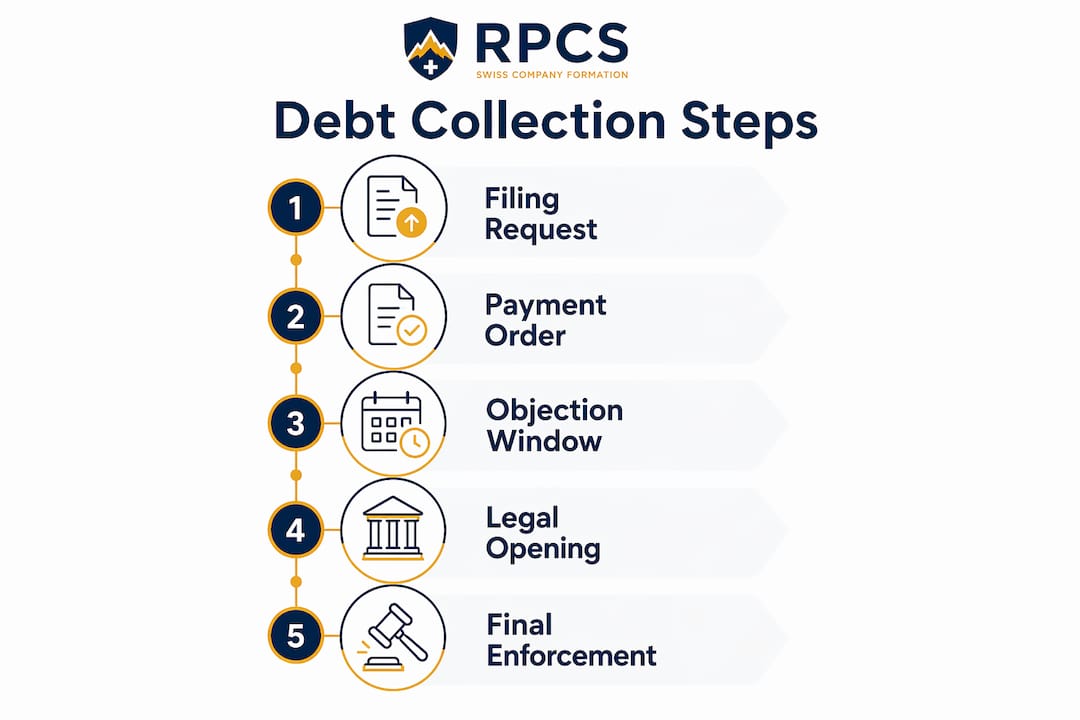
The creditor submits a formal enforcement request (Betreibungsbegehren) to the local Betreibungsamt. The filing identifies the debtor, the claimed amount, and the legal basis. No supporting documents are required at this stage.
Step 2: Issuance of the Zahlungsbefehl
The enforcement office issues a payment order (Zahlungsbefehl) and serves it on the debtor. This document demands payment within 20 days and informs the debtor of their right to object.
Step 3: The Debtor’s Objection Window
The debtor has 10 days after service to file a Rechtsvorschlag, which is a formal objection. Filing this objection immediately suspends enforcement. The objection requires no stated reason, which means any debtor can halt proceedings with a single written statement.
Step 4: Legal Opening (Rechtsöffnung)
When a debtor objects, the creditor must apply to a court for legal opening (Rechtsöffnung) to lift the suspension. Two tracks exist. Provisional opening applies when the creditor holds a documentary debt acknowledgment such as a signed contract or invoice. Definitive opening applies when the creditor holds a final enforceable judgment. The quality of documentation determines which track is available and how quickly the court acts.
Step 5: Continuation and Final Enforcement
Once the objection is lifted or the debtor fails to object within 10 days, the creditor requests continuation of enforcement. The creditor must request continuation within one year of the payment order’s service date. Missing this deadline requires restarting the entire procedure from the beginning.
Pro Tip: Track the official service date on the Zahlungsbefehl, not the invoice due date. Deadline calculations under SchKG use official notification dates, and foreign businesses frequently miscalculate by relying on commercial payment terms instead.
How does debt enforcement differ for individuals versus corporate debtors?
The enforcement track depends entirely on the debtor’s legal classification. This distinction has major strategic implications for creditors pursuing debt recovery in Switzerland.
Debtor Type | Enforcement Track | Typical Outcome |
Natural person (individual) | Pfändung (asset/wage seizure) | Partial recovery through seized assets or garnished wages |
Sole proprietor | Pfändung | Same as natural person; business assets included |
GmbH or AG (registered company) | Konkurs (bankruptcy proceedings) | Full liquidation of company assets; creditor ranks in insolvency |
Foreign company with Swiss branch | Konkurs on branch assets | Limited to Swiss-registered assets |
Corporate enforcement through the Konkurs track typically leads to full bankruptcy liquidation rather than targeted asset seizure. This outcome is fundamentally different from what creditors experience when pursuing individuals.
For creditors pursuing a GmbH or AG, the Konkurs path carries specific risks and opportunities:
Bankruptcy opens a formal creditor committee process where all creditors rank according to legal priority classes.
Secured creditors rank ahead of unsecured trade creditors in the distribution of liquidated assets.
A composition agreement (Nachlass) may be proposed by the debtor company to avoid full liquidation, which can result in partial debt satisfaction for creditors.
Insolvency restructuring options exist under Swiss law that may delay or modify enforcement outcomes for corporate debtors.
For businesses owed money by another Swiss company, understanding the Konkurs track means recognizing that initiating enforcement may trigger a bankruptcy that yields only cents on the dollar. That reality should inform whether enforcement or negotiated settlement is the smarter path.
What documents support effective debt enforcement under swiss law?
Documentation quality determines the speed and outcome of debt enforcement in Switzerland. A creditor with strong evidence moves through the process faster and faces fewer procedural obstacles.
The most valuable documents at each stage include:
Signed contracts with clear payment terms and amounts. These form the basis for provisional legal opening after a debtor objection.
Invoices with proof of delivery or service completion. Courts treat acknowledged invoices as strong evidence of a debt acknowledgment.
Written debt acknowledgments signed by the debtor. These are the most direct route to provisional Rechtsöffnung.
Final court judgments or arbitral awards. These qualify for definitive legal opening and bypass the provisional stage entirely.
Correspondence showing debtor acknowledgment, such as emails where the debtor confirms the debt or requests a payment extension.
Debtor objections are filed without stated reasons in the vast majority of cases. Creditors who treat the objection stage as a formality rather than a legal contest often lose weeks or months recovering their position. The creditor who walks into the Rechtsöffnung hearing with a signed contract, delivery confirmation, and payment demand correspondence moves to enforcement continuation far faster than one relying on verbal agreements or undocumented transactions.
Pro Tip: Before filing a Betreibungsbegehren, organize your documentation into a clear file: contract, invoice, delivery proof, and any written acknowledgment. Courts reviewing Rechtsöffnung applications respond to organized, unambiguous evidence.
Building strong documentary evidence before filing is the single most reliable way to reduce enforcement delays. This is not a legal nicety. It is a practical requirement for anyone serious about debt recovery in Switzerland.
What practical strategies help businesses manage swiss debt enforcement?
Effective management of the Swiss debt collection process requires both procedural knowledge and strategic judgment. The following approaches reflect how experienced creditors and their advisors operate within the system.
Initiate enforcement without delay. Sending a prior reminder is not legally required. Many creditors waste weeks on informal reminders while the one-year continuation deadline runs. File the Betreibungsbegehren as soon as a payment is overdue and negotiations have stalled.
Prepare for the Rechtsvorschlag as a certainty, not a possibility. Sophisticated debtors file objections routinely to buy time. Treat the legal opening phase as part of your standard enforcement plan, not an unexpected complication.
Account for cantonal variations. Each Betreibungsamt operates under cantonal rules that affect processing times, office hours, and local procedural customs. Enforcement in Zurich moves differently than enforcement in a smaller canton. Build extra time into your planning for unfamiliar jurisdictions.
Calculate default interest correctly. Swiss law entitles creditors to default interest at the statutory rate from the date of default. Include this in your enforcement filing to recover the full economic cost of the delay.
Monitor the one-year continuation deadline strictly. Missing the deadline to request continuation after the Zahlungsbefehl forces a complete restart. Use a calendar system tied to the official service date, not your internal accounting records.
Consider negotiated resolution alongside enforcement. For corporate debtors on the Konkurs track, the threat of bankruptcy proceedings often creates negotiating leverage. A structured payment plan may recover more value faster than a full liquidation process. Managing business debt strategically often means knowing when to enforce and when to negotiate.
Engage local legal counsel for contested cases. When a debtor files a Rechtsvorschlag and the Rechtsöffnung hearing becomes contested, professional representation significantly improves outcomes. The procedural rules are precise, and errors at this stage can delay recovery by months.
Key takeaways
Swiss debt enforcement under the SchKG/DEBA is an administrative process that gives creditors direct access to collection without a prior court ruling, but documentation quality and deadline management determine whether enforcement succeeds or stalls.
Point | Details |
No court judgment required | Creditors file directly with the Betreibungsamt to initiate enforcement proceedings. |
10-day objection window | Debtors can suspend enforcement by filing a Rechtsvorschlag within 10 days of the payment order. |
Documentation drives speed | Strong contracts, invoices, and acknowledgments unlock faster legal opening after a debtor objection. |
Corporate vs. individual tracks | Companies face bankruptcy liquidation (Konkurs); individuals face asset or wage seizure (Pfändung). |
One-year continuation deadline | Creditors must request continuation within one year of the payment order or restart the entire process. |
The part of swiss enforcement most businesses get wrong
Most foreign entrepreneurs I work with arrive in Switzerland with a reasonable grasp of contract law and a very poor grasp of enforcement procedure. They assume that having a signed contract and an unpaid invoice is enough to recover a debt quickly. It is not.
The Rechtsvorschlag is the part of the system that consistently surprises them. A debtor can file it with no explanation, no legal basis, and no cost. That single act stops enforcement cold and forces the creditor into a court proceeding to lift it. Creditors who have not prepared their documentation in advance suddenly find themselves scrambling to compile evidence under time pressure.
The second mistake I see regularly is deadline mismanagement. The one-year continuation window sounds generous until you realize that businesses often let enforcement files sit while pursuing informal negotiations. Then the deadline passes, and the entire filing must be restarted. That costs time, fees, and sometimes the debt itself if the debtor’s financial position deteriorates in the interim.
My honest advice: treat Swiss debt enforcement as a parallel track, not a last resort. File the Betreibungsbegehren while continuing to negotiate. The filing creates urgency for the debtor without preventing a settlement. And for companies operating through a Swiss AG or GmbH structure, understanding how the Konkurs track interacts with your own corporate structure is equally important. The same system that lets you pursue debtors can be used against your company.
— Rolands
How Rpcs supports your swiss business compliance
Running a Swiss company means operating inside a legal framework where debt enforcement, bankruptcy rules, and financial compliance intersect constantly. Rpcs provides Swiss company formation services for GmbH and AG structures, including registered address, legal documentation, and ongoing compliance support. Foreign entrepreneurs who set up through Rpcs gain access to accounting services that track receivables and flag enforcement risks before they escalate. Rpcs also assists with Swiss bank account opening, which is foundational for managing the financial flows that enforcement proceedings depend on.

Whether you are establishing a new Swiss entity or managing an existing one, Rpcs gives you the operational infrastructure to stay compliant and financially organized in one of the world’s most precise legal environments.
FAQ
What is swiss debt enforcement in simple terms?
Swiss debt enforcement is an administrative process under the SchKG/DEBA that lets creditors pursue unpaid debts through cantonal offices without first obtaining a court judgment. The process starts with a payment order served on the debtor.
Can a creditor start enforcement without sending a reminder first?
Yes. Sending a prior reminder is not legally required under Swiss law. Creditors can file a Betreibungsbegehren directly with the local Betreibungsamt as soon as a debt is overdue.
What happens if the debtor objects to the payment order?
The debtor’s Rechtsvorschlag immediately suspends enforcement. The creditor must then apply to a court for legal opening (Rechtsöffnung) to lift the suspension and continue the process.
How does enforcement differ for a GmbH versus an individual?
A GmbH or AG registered in the Swiss Commercial Register faces bankruptcy proceedings (Konkurs) leading to potential liquidation. An individual or sole proprietor faces asset or wage seizure (Pfändung) instead.
What is the most critical deadline in swiss debt enforcement?
The creditor must request continuation of enforcement within one year of the payment order’s service date. Missing this deadline requires restarting the entire procedure from the beginning.
Recommended
Comments