
Swiss Residency for Entrepreneurs: A 2026 Guide
- 12 minutes ago
- 8 min read

TL;DR:
Swiss residency for entrepreneurs depends on demonstrating economic benefit to Switzerland through job creation, investment, or innovation. To obtain it, founders must form a Swiss company with a Swiss-resident director, often using nominee services, and meet canton-specific legal and financial requirements. Ongoing compliance, including tax filings and social security registration, is essential to maintain the residency.
Swiss residency for entrepreneurs is defined as a legal status granted to foreign business founders who demonstrate clear economic benefit to Switzerland through job creation, investment, or innovation. Knowing how to obtain Swiss residency for entrepreneurs means understanding a two-track process: forming a legally compliant Swiss company and convincing cantonal authorities your business serves the Swiss economy. This guide covers every prerequisite, governance rule, and application step you need to move forward with confidence.
What are the core requirements to obtain Swiss residency as an entrepreneur?
Swiss residency through entrepreneurship is not a right. It is a privilege granted to founders who meet specific economic, financial, and legal criteria. Admission is exceptional for third-country nationals, meaning you must build a compelling case from the start.
The core requirements include:
Proof of economic interest: Your business must create jobs, attract investment, or introduce innovation that benefits Switzerland. Cantonal authorities weigh this heavily.
A credible business plan: Detailed business plans with financial projections and proof of self-sufficiency funds are mandatory for permit review.
Sufficient start capital: Capital thresholds vary by canton, but financial readiness must be documented clearly.
A Swiss residential address: You need a registered address in Switzerland before the permit is processed.
Legal company governance: Swiss law requires at least one director with signing authority to be a Swiss resident. This applies to both GmbH and AG structures under Articles 814(3) and 718(4) of the Swiss Code of Obligations.
Permit type awareness: Most entrepreneurs apply for a B permit (annual residence permit). L permits cover short-term stays and are rarely suitable for business founders.
The governance rule catches many founders off guard. You can own 100% of your Swiss company, but you cannot be the sole signatory if you do not yet live in Switzerland.
Pro Tip: Review the legal requirements for foreign entrepreneurs in Switzerland before drafting your business plan. Aligning your plan with cantonal economic priorities from day one dramatically improves approval odds.
How to set up a Swiss company to support your residency application
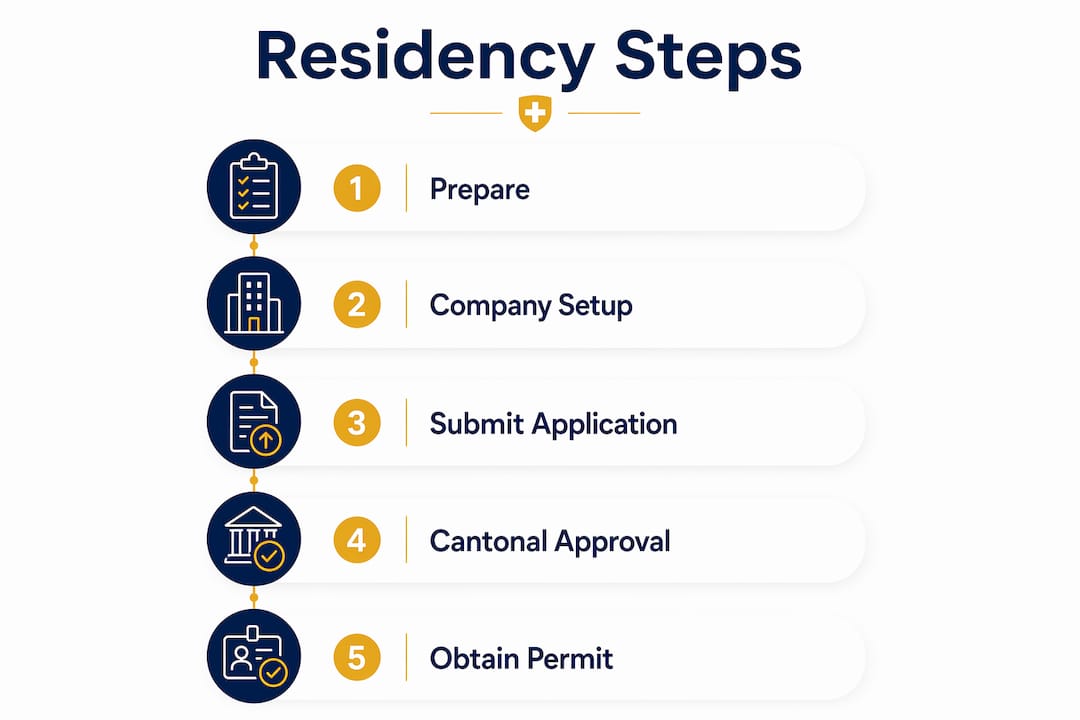
Company formation is the foundation of your residency application. The structure you choose affects governance, liability, and how quickly you can satisfy Swiss legal requirements.
Choose your legal structure. A GmbH (limited liability company) requires a minimum capital of CHF 20,000. An AG (stock corporation) requires CHF 100,000. A sole proprietorship is simpler but offers no governance flexibility and limits your credibility with cantonal authorities.
Appoint a Swiss-resident director. Before registration, you must name at least one director who lives in Switzerland and holds sole signing authority. If you are not yet a resident, you need a nominee or co-director. Nominee director services from professional fiduciaries fulfill this requirement legally and transparently.
Notarize your founding documents. A notary is mandatory for GmbH and AG formation. Formation costs range from CHF 1,100 to CHF 2,400, covering notarization and commercial register fees.
Register with the commercial register. Companies with annual revenue above CHF 100,000 must register. Below CHF 100,000, registration is voluntary but strongly recommended for banking access and credibility.
Open a Swiss bank account. Banks require proof of registration and governance documents. A registered business address in Switzerland is also needed at this stage.
Submit your residency permit application. Once the company is formed and governance is in place, you apply to the cantonal migration authority with your full documentation package.
The typical timeline from company formation to permit decision runs several months. Cantonal processing speeds vary, so choosing the right canton matters.
Pro Tip: Cantons like Zug, Zurich, and Geneva are known for business-friendly environments, but each has distinct economic priorities. Research your target canton’s focus industries before incorporating.

What is the Swiss residency permit application process for entrepreneurs?
The permit application process involves both cantonal and federal authorities. Understanding who decides what prevents costly delays.
Cantonal migration office: This is your first point of contact. The canton reviews your economic contribution, integration potential, and business viability. Cantonal authorities coordinate with federal migration bodies for final approval.
State Secretariat for Migration (SEM): The federal body sets quota limits and approves exceptional admissions for third-country nationals.
Required documents: Business plan with financial forecasts, proof of funding, accommodation confirmation, company registration documents, and personal identification.
Quota system: Third-country entrepreneurs do not have a legal right to residence and face strict annual quota limits. Applications compete within these limits.
Evaluation criteria: Authorities assess economic interest, your professional qualifications, financial self-sufficiency, and your potential to integrate into Swiss society.
“Third-country entrepreneurs should treat the residency application as a rigorous evidence-building exercise, not a routine formality, due to strict admission criteria and quotas.” — wiki.private.law
Strengthening your application means going beyond minimum requirements. Show projected tax contributions, planned hires, and letters of intent from Swiss clients or partners. Cantonal labor-market authorities apply quota controls rigorously and respond to well-documented economic cases.
How do third-country entrepreneurs overcome Swiss governance challenges?
The Swiss-resident director rule is the single biggest operational hurdle for founders arriving from outside the EU and EEA. Swiss law enforces this requirement regardless of your ownership stake or nationality.
Governance approach | Who holds signing authority | Residency status of entrepreneur |
Entrepreneur as sole director | Entrepreneur | Must already be Swiss resident |
Nominee director appointed | Professional fiduciary | Not yet required |
Co-director structure | Shared between entrepreneur and Swiss resident | Not yet required |
The nominee director model is the most common solution. Professional fiduciaries act as Swiss-resident directors, satisfying the legal signing requirement while you pursue your permit. Control rights, profit distribution, and strategic decisions remain with you through shareholder agreements.
The co-director model works well when you have a trusted Swiss-based partner. Both parties share signing authority, which distributes legal responsibility. This structure suits founders who plan to relocate quickly and want a transition arrangement.
Non-compliance carries real consequences. A company without a Swiss-resident signatory cannot complete commercial register filing. Without registration, you cannot open a bank account or demonstrate operational readiness to migration authorities. The governance step is not optional.
Pro Tip: Read the full breakdown of Swiss residency rules for directors before you finalize your company structure. The legal details around sole signing authority affect both your company’s validity and your permit application.
What ongoing compliance issues should entrepreneurs understand after obtaining Swiss residency?
Obtaining your permit is the beginning, not the end. Swiss residency carries ongoing legal and financial obligations that directly affect your ability to keep it.
AHV/AVS social security registration: Registration with the cantonal compensation office is mandatory for self-employed residents. Complete this early. Delays create gaps in your social security record that complicate permit renewals.
Accounting and tax filings: Swiss companies must maintain proper accounts and file annual tax returns. Corporate tax rates vary by canton, with some cantons offering rates well below the European average. Engaging Swiss accounting services from a local fiduciary keeps you compliant.
Permit renewal: B permits are renewed annually for the first five years. Renewal requires proof that your business remains active and economically viable. Dormant companies or those with no revenue risk non-renewal.
Registered address maintenance: Your business address in Switzerland must remain valid. A virtual office or registered address service covers this requirement if you travel frequently.
Banking compliance: Swiss banks conduct regular KYC (know your customer) reviews. Keep your company documents current and respond promptly to bank requests.
The most common reason entrepreneurs lose their residency status is failing to demonstrate ongoing business activity. Switzerland expects your company to operate, not just exist on paper.
Key Takeaways
Obtaining Swiss residency as an entrepreneur requires proving economic value to Switzerland, forming a legally compliant company with a Swiss-resident director, and navigating cantonal permit processes with thorough documentation.
Point | Details |
Economic interest is mandatory | Your business must create jobs, attract investment, or bring innovation that benefits Switzerland. |
Swiss-resident director required | GmbH and AG structures legally require at least one signatory director living in Switzerland. |
Nominee directors solve the gap | Professional fiduciaries can act as Swiss-resident directors while you pursue your permit. |
Cantons decide your fate | Cantonal migration authorities evaluate your application before federal approval, so align your plan with local priorities. |
Ongoing compliance protects status | AHV/AVS registration, active accounting, and permit renewals are non-negotiable after residency is granted. |
What I’ve learned about Swiss residency that most guides skip
Most articles on Swiss business immigration focus on the permit types and miss the real bottleneck: governance. I have seen founders spend months preparing a business plan, only to discover at the registration stage that their company cannot be filed without a Swiss-resident signatory. That single oversight delays everything.
The Swiss system rewards preparation. Authorities are not looking for perfect businesses. They are looking for credible ones. A founder who shows up with a detailed business plan, a clear governance structure, a nominee director already in place, and documented proof of funding sends a very different signal than one who treats the application as a formality.
My strongest recommendation is to plan governance and permit strategy in parallel, not sequentially. Appoint your Swiss-resident director or nominee before you submit your permit application. This shows operational readiness and removes a major compliance risk from the review process.
The canton you choose also matters more than most guides admit. Zug offers low corporate tax rates. Zurich offers access to talent and finance. Geneva connects you to international organizations. Each canton has economic priorities, and aligning your business with those priorities is not manipulation. It is good strategy.
Treat the application as evidence building. Every document, every financial projection, every letter of intent is a piece of evidence that your business belongs in Switzerland. Founders who think this way consistently outperform those who treat it as paperwork.
— Rolands
How Rpcs supports entrepreneurs with Swiss company formation
Rpcs specializes in helping international entrepreneurs and investors establish Swiss companies and navigate the residency process from day one.
Rpcs handles Swiss company formation for both GmbH and AG structures, including notarization, commercial register filing, and governance setup. The team assists with appointing Swiss nominee directors to satisfy the resident signatory requirement before your permit is approved. Rpcs also supports opening a Swiss bank account and securing a registered business address in Switzerland. For founders who need ongoing support, Rpcs provides accounting services and compliance guidance to protect your residency status long after the initial setup. If you are serious about establishing a Swiss presence, Rpcs gives you the legal and operational foundation to do it correctly.
FAQ
What is Swiss residency for business purposes?
Swiss residency for business is a legal status granted to entrepreneurs who demonstrate economic benefit to Switzerland through company formation, job creation, or investment. It is obtained through a cantonal and federal permit process, not automatically through company registration.
Can a third-country entrepreneur get Swiss residency?
Yes, but admission is exceptional and subject to strict annual quotas. Third-country entrepreneurs must show strong economic interest, sufficient capital, and a credible business plan to qualify.
What is the minimum capital required to form a Swiss GmbH?
A Swiss GmbH requires a minimum share capital of CHF 20,000. Formation costs, including notarization and registration, typically range from CHF 1,100 to CHF 2,400.
Do I need a Swiss-resident director before I have residency?
Yes. Swiss law requires at least one signatory director to be a Swiss resident for both GmbH and AG companies. Founders without residency use nominee or co-director services to meet this requirement legally.
How do I maintain my Swiss residency after it is granted?
Keep your company operationally active, file annual tax returns, register for AHV/AVS social security, and renew your B permit annually. Dormant companies or missing filings are the most common reasons permits are not renewed.
Recommended
Comments