
Swiss Company Ongoing Management Process Explained
- 12 minutes ago
- 8 min read

TL;DR:
Swiss company management involves continuous governance, compliance, and financial reporting required by Swiss law for legal operation.
Directors must fulfill mandatory obligations like annual assemblies, board re-elections, and maintaining accurate shareholder registers to avoid penalties.
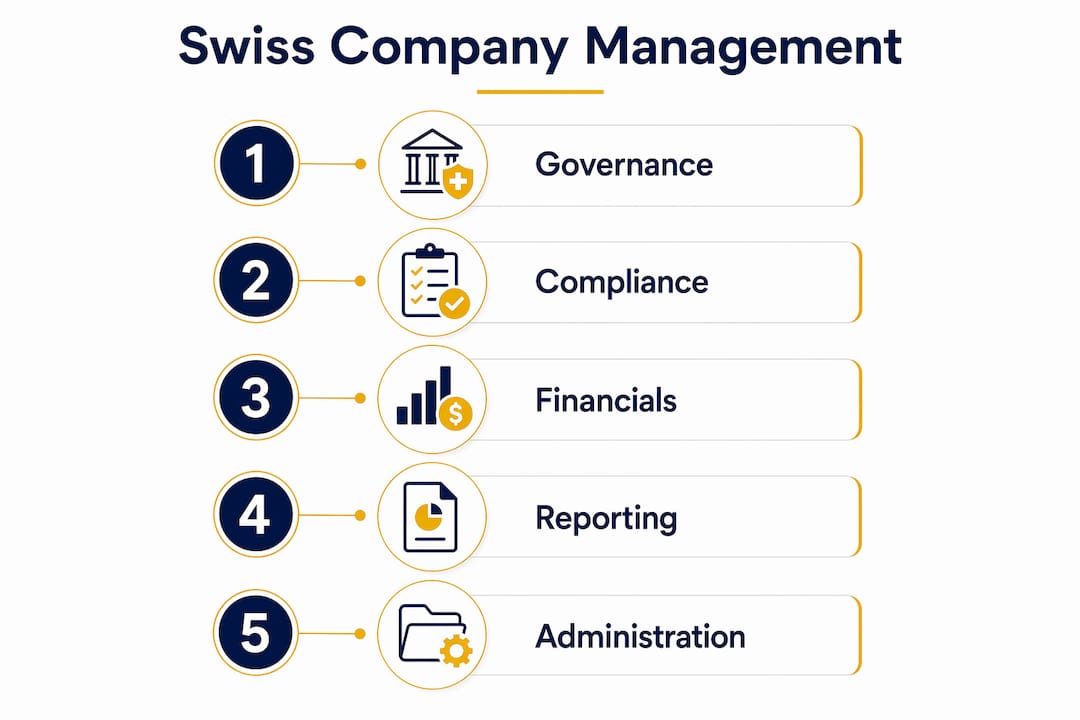
The Swiss company ongoing management process is defined as the continuous cycle of governance, compliance, financial reporting, and administrative duties required by Swiss law to keep a company legally active and operationally sound. Both the AG (Aktiengesellschaft) and GmbH (Gesellschaft mit beschränkter Haftung) structures carry these obligations from the moment of registration. The Swiss Code of Obligations sets the legal baseline, and directors are personally accountable for meeting it. International entrepreneurs who treat ongoing management as a one-time setup task routinely face penalties, governance lapses, and banking complications. Getting this right from year one is not optional.
What are the core compliance and governance requirements for Swiss company management?
Swiss corporate governance is not a background formality. It is a structured legal obligation with real consequences for directors who ignore it.
The Swiss Code of Obligations requires every Swiss company to hold at least one general assembly annually, within six months after the financial year ends. That assembly must produce written minutes, address board elections, and approve the annual financial statements. Missing this deadline is a compliance failure, not an administrative oversight.
Board member mandates deserve particular attention. Swiss law does not automatically renew director terms. Board mandates lapse unless explicitly re-elected, which means a company can technically operate without a valid board if re-elections are skipped. The best practice is two-year terms with annual re-election votes to prevent any gap in governance authority.
A Swiss resident director is required for most Swiss companies, particularly the AG. At least one board member must be domiciled in Switzerland and authorized to represent the company. International founders who lack a local presence often use nominee director services to satisfy this requirement while maintaining operational control.
AG vs. GmbH governance requirements
Requirement | AG | GmbH |
Annual general assembly | Mandatory | Mandatory |
Board of directors | Required (min. 1 member) | Managers replace board |
Resident director | At least 1 required | At least 1 manager domiciled in Switzerland |
Share register | Must be maintained | Partner register required |
Audit requirement | Mandatory above thresholds | Mandatory above thresholds |
Articles of association | Required and registered | Required and registered |
Key compliance deadlines and document obligations include:
Annual general assembly: within 6 months of financial year-end
Tax return filing: deadlines vary by canton, typically march to june
VAT reporting: quarterly or annually depending on turnover
Social security contributions: monthly or quarterly payments
Share register updates: required after every ownership transfer
Articles of association: must reflect any structural changes approved by the assembly
Pro Tip: Set calendar reminders 60 days before each annual assembly. This gives you time to prepare financial statements, draft the agenda, and confirm director mandates before the legal deadline.
How to maintain and organize Swiss company financial administration and accounting?
Swiss accounting standards require every company to maintain detailed, accurate books from the first day of business. This is not a year-end exercise. It is a continuous process.

Annual financial statements must be prepared according to the Swiss Code of Obligations. Companies above certain size thresholds face a mandatory audit obligation. Smaller companies may qualify for an opting-out arrangement if all shareholders agree, but this only applies to companies with fewer than ten full-time employees on average. Most international companies with active operations will not qualify.
Swiss corporate tax rates vary by canton, making location a real financial variable. Zug and Nidwalden consistently rank among the lowest-tax cantons for corporations. VAT registration becomes mandatory once annual turnover exceeds CHF 100,000. Once registered, companies must file VAT returns and remit payments on a quarterly or annual cycle depending on their chosen method.
Ongoing financial management tasks follow a predictable annual cycle:
Record all transactions in a double-entry bookkeeping system throughout the year
Reconcile bank accounts monthly against accounting records
Calculate and remit social security contributions for all employees each month
File quarterly VAT returns if registered for VAT
Prepare draft annual financial statements by the end of the first quarter following year-end
Submit the annual tax return to the cantonal tax authority by the applicable deadline
Archive all financial records for the legally required retention period of ten years
Pro Tip: Choose an accounting service provider with direct experience in Swiss cantonal tax law, not just general European accounting. Canton-specific rules on deductions and filing formats differ significantly and generic advice creates errors.
Integrating your Swiss bank account directly with your accounting software reduces reconciliation time and lowers the risk of transcription errors. Most Swiss banks support data exports compatible with accounting platforms used by local service providers.
What tools and professional services support efficient Swiss company management?
Efficient ongoing management of a Swiss company depends on combining the right technology with qualified local professionals. Neither alone is sufficient.
Compliance automation tools reduce human error in monitoring and reporting. Technical solutions enable continuous compliance surveillance rather than periodic manual checks. For international entrepreneurs managing Swiss entities remotely, this kind of automation is the difference between catching a missed filing and receiving a penalty notice.
A dedicated compliance officer or an outsourced compliance function handles the day-to-day monitoring that directors cannot realistically perform themselves. Swiss law holds directors personally responsible for compliance failures, so delegating execution without oversight is not a defense. The director remains accountable; the officer handles the workflow.
Virtual office and registered address services in Switzerland satisfy the legal requirement for a local business address without requiring a physical office. This is particularly relevant for international companies that operate primarily outside Switzerland but need a compliant Swiss presence for registration and correspondence purposes.
Service category | Primary responsibility | Key benefit |
Nominee director | Satisfies resident director requirement | Meets legal governance standard |
Accounting firm | Bookkeeping, tax filing, VAT | Reduces compliance risk |
Virtual office | Registered address, mail handling | Maintains legal Swiss presence |
Compliance officer | Monitoring, reporting, document control | Prevents regulatory breaches |
Legal advisor | Corporate documents, assembly preparation | Ensures governance accuracy |
Recommended service categories for international operators:
Swiss accounting services covering bookkeeping, payroll, and tax filing
Nominee or resident director services for governance compliance
Virtual office or registered business address in Switzerland
Corporate secretarial services for assembly minutes and document filing
Legal advisory for articles of association updates and structural changes
What are common mistakes in Swiss company ongoing management?
The most damaging compliance failures are not dramatic. They are administrative oversights that compound over time.
Failure to update the shareholder register after ownership transfers is one of the most common errors. Swiss law requires the register to reflect current ownership at all times. An outdated register complicates banking relationships, audits, and any future sale or restructuring of the company.
Neglecting to hold the annual general assembly or skipping board re-elections creates governance gaps that can invalidate company decisions made during that period. Such errors lead to legal penalties and complicate operations in ways that are expensive to unwind. Swiss authorities and banks both scrutinize governance records when companies apply for credit or expand their activities.
Corporate documents must reflect the actual state of the company. Any change to the registered office address, company purpose, or capital structure requires a general assembly resolution and registration with the Commercial Register. Companies that skip this step operate with a legal mismatch between their documents and their reality.
Common mistakes and corrective actions:
Outdated shareholder register: update immediately after every transfer and verify annually
Missed annual assembly: schedule the assembly date at the start of each financial year
Lapsed board mandates: include re-election as a standing agenda item at every assembly
Unfiled VAT returns: set automated reminders 30 days before each quarterly deadline
Unregistered address changes: submit Commercial Register updates within 30 days of any change
Missing beneficial owner disclosures: review and update the register of beneficial owners annually
Pro Tip: Assign one person, whether internal or an external service provider, as the single point of accountability for all Swiss compliance deadlines. Shared responsibility without a named owner is the fastest path to missed filings.
Engaging advisors familiar with Swiss legal and tax systems early prevents most of these errors. Professional service providers handle the recurring tasks that fall through the cracks when international founders manage Swiss entities from abroad without local support.
Key Takeaways
Effective Swiss company management requires a continuous, structured approach to governance, financial reporting, and compliance, not a one-time setup.
Point | Details |
Annual assembly is mandatory | Hold the general assembly within six months of financial year-end and document all resolutions. |
Board mandates must be renewed | Re-elect directors explicitly at each assembly to prevent governance gaps and invalid decisions. |
Resident director is required | At least one director domiciled in Switzerland must be appointed for AG and GmbH structures. |
Financial records need continuous upkeep | Maintain double-entry books, file VAT returns quarterly, and archive records for ten years. |
Shareholder register must stay current | Update the register after every ownership transfer to avoid banking and regulatory complications. |
Why Swiss management culture rewards the disciplined operator
Most international entrepreneurs I work with underestimate how seriously Swiss authorities and banks treat governance documentation. Switzerland’s business environment is not forgiving of sloppy administration, even when the underlying business is profitable and legitimate.
What I have observed consistently is that the companies that thrive long-term in Switzerland are not necessarily the ones with the best products. They are the ones that treat compliance as a core operating discipline rather than a legal checkbox. Transparent actions strengthen trust with clients and authorities in Switzerland’s regulated environment, and that trust has real commercial value.
The personal accountability of Swiss directors is something many foreign founders do not fully internalize until they face their first audit or banking review. Swiss law does not allow directors to hide behind corporate structures when governance failures occur. That accountability is actually a feature, not a burden. It forces a level of operational discipline that protects the company and its owners over time.
My honest advice: build your compliance calendar before you need it, not after your first missed deadline. The cost of prevention is a fraction of the cost of remediation. And if you are managing a Swiss entity remotely, invest in a local professional who owns the compliance function. Remote management of Swiss governance without local expertise is the single biggest risk factor I see among international operators.
— Rolands
How Rpcs supports your Swiss company management
Managing a Swiss company from abroad is straightforward when you have the right infrastructure in place.

Rpcs provides Swiss company formation services covering AG and GmbH structures, along with ongoing management support that includes nominee and resident director services, registered business address solutions, and professional accounting services tailored to Swiss compliance requirements. International entrepreneurs use Rpcs to satisfy local governance rules, maintain accurate financial records, and meet cantonal tax deadlines without building an in-house Swiss team. Rpcs also supports Swiss accounting services for companies that need bookkeeping, VAT filing, and annual financial statement preparation handled by specialists with direct cantonal experience.
FAQ
What is the Swiss company ongoing management process?
The Swiss company ongoing management process covers the recurring governance, compliance, financial reporting, and administrative duties required by Swiss law to keep a company legally active. It includes annual assemblies, board elections, tax filings, and shareholder register maintenance.
How often must a Swiss company hold a general assembly?
Swiss companies must hold at least one general assembly per year, within six months after the financial year ends. The assembly must produce written minutes and address board elections and financial statement approval.
Does a Swiss GmbH require a resident director?
Yes. At least one manager of a Swiss GmbH must be domiciled in Switzerland and authorized to represent the company. International founders without a local presence typically use nominee director services to meet this requirement.
What are the main Swiss corporate tax obligations for ongoing management?
Swiss companies must file annual tax returns with the cantonal tax authority and remit VAT quarterly or annually once turnover exceeds CHF 100,000. Social security contributions for employees are due monthly or quarterly depending on the payroll cycle.
What happens if a Swiss company misses compliance deadlines?
Missing compliance deadlines, such as failing to hold the annual assembly or file tax returns on time, can result in legal penalties, governance invalidation, and complications with Swiss banks and authorities. Directors are personally accountable for these failures under the Swiss Code of Obligations.
Recommended
Comments