
Swiss Market Entry Checklist: Your 2026 Step-by-Step Guide
- 12 minutes ago
- 8 min read

TL;DR:
Setting up in Switzerland involves careful legal, operational, and market research steps to ensure compliance and success.
Foreign entrepreneurs should focus on canton selection, language-specific marketing, and building local relationships to accelerate growth.
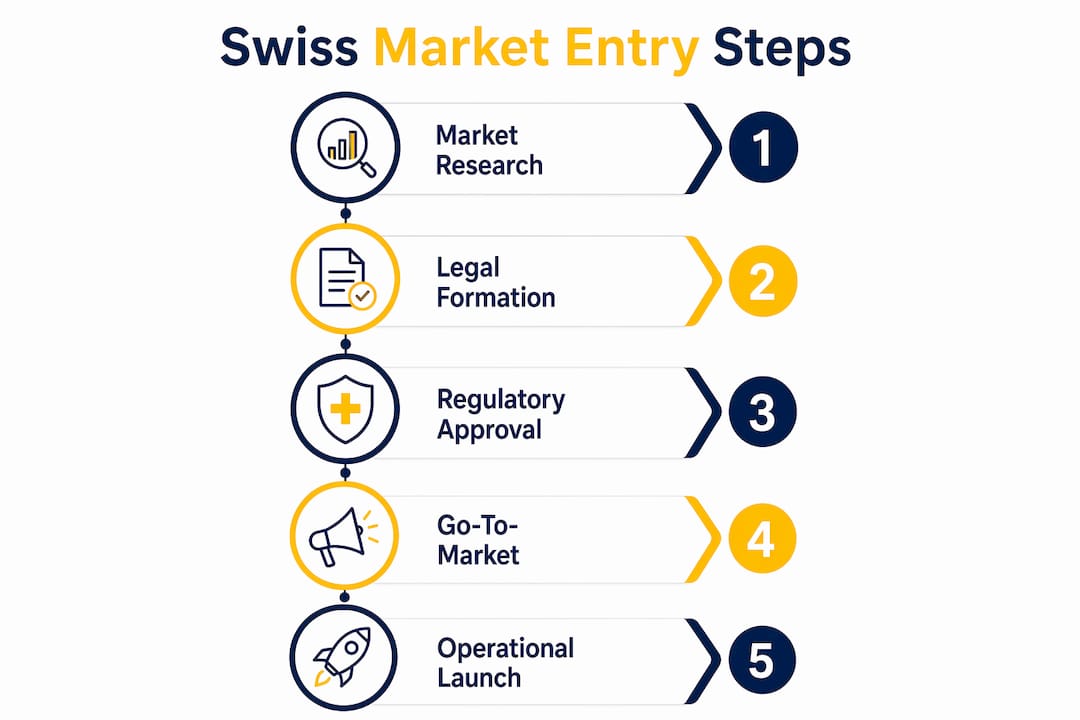
A Swiss market entry checklist is the structured set of legal, operational, and commercial steps a foreign company must complete to establish a lawful, functioning business presence in Switzerland. Switzerland ranks among the world’s most attractive destinations for international entrepreneurs, offering political stability, favorable corporate tax rates, and a reputation that opens doors globally. Getting the process right requires more than ambition. It demands a clear sequence: market validation, entity selection, cantonal registration, compliance setup, and operational launch. This guide walks you through each phase with the specificity you need to move fast and avoid costly mistakes.
What does a Swiss market entry checklist cover?
The Swiss market entry checklist covers five distinct phases: market research, legal entity formation, regulatory compliance, operational setup, and ongoing management. Each phase has hard requirements, not suggestions. The Swiss Federal Tax Administration (ESTV) governs corporate tax obligations, while the Handelsregister (commercial register) at the cantonal level controls company registration. Missing a step in either area delays your launch and can trigger legal liability.
Switzerland is not a single market. It is 26 cantons, four linguistic regions, and dozens of distinct regulatory environments operating under one federal framework. Entrepreneurs who treat it as a uniform market consistently underperform. The checklist format forces you to address each layer in the right order.
What preliminary market research and strategy steps are crucial for Swiss market entry?
Market research for Switzerland starts with linguistic segmentation, not demographics. Over 60% of Swiss market potential requires native-language capability across German, French, and Italian regions. That figure means a single English-language pitch deck will not close deals in Zurich, let alone Geneva or Lugano.

Define your target canton and linguistic region
Switzerland’s German-speaking region (roughly 63% of the population) centers on Zurich, Basel, and Bern. French-speaking Romandy includes Geneva and Lausanne. Italian-speaking Ticino operates with its own business culture. Each region has distinct buyer behavior, preferred communication styles, and industry concentrations. Fintech and banking cluster in Zurich. Life sciences dominate Basel. International organizations fill Geneva. Picking the wrong canton for your first office wastes time and money.
Validate market fit before committing capital
Run structured interviews with at least 10–15 potential Swiss customers before registering a company. Swiss B2B buyers are conservative. They evaluate vendors on reliability, references, and local presence before price. A pilot project or proof-of-concept with a Swiss reference customer is worth more than any marketing campaign in this market.
Pro Tip: Use canton-specific trade association databases and the Swiss Federal Statistical Office (FSO) to pull industry concentration data by region. This tells you exactly where your buyers are before you spend a franc on office space.
Build a multilingual go-to-market plan
Multilingual marketing materials aligned to each linguistic region are not optional for serious market entry. Localized materials per region include native-speaking sales representatives, region-specific case studies, and translated website content. A website translation strategy that covers German, French, and Italian from day one signals commitment to Swiss buyers and avoids the perception that you are testing the market halfheartedly.
Which Swiss business entities best suit foreign entrepreneurs?
Two legal structures dominate Swiss company formation for foreign entrepreneurs: the GmbH (Gesellschaft mit beschränkter Haftung) and the AG (Aktiengesellschaft). Each has distinct capital requirements, governance rules, and suitability profiles.
GmbH (Limited Liability Company): The GmbH is the standard choice for small to mid-size foreign businesses. Minimum capital is CHF 20,000, deposited in full into a Swiss bank account before incorporation. It offers simpler governance and lower setup costs than an AG.
AG (Stock Corporation): The AG suits larger operations or companies planning to raise external investment. Minimum share capital is CHF 100,000, with at least CHF 50,000 deposited into a blocked bank account at incorporation. The AG structure supports share issuance and is preferred by institutional partners.
Cantonal registration: Swiss company incorporation happens at the cantonal level. Each canton has independent tax rates and business incentives. Zug and Nidwalden offer some of the lowest effective corporate tax rates in the country. Choosing your canton is a financial decision, not just a geographic one.
Notarial deed: Both GmbH and AG formation require a notarized deed of incorporation. The notary certifies the articles of association and files the registration with the cantonal commercial register.
Swiss resident director: Swiss employment law requires at least one individual domiciled in Switzerland with legal authority to represent the company. Foreign founders who lack Swiss residency must appoint a Swiss resident director or use a nominee director service to satisfy this requirement.
Entity | Minimum Capital | Best For |
GmbH | CHF 20,000 (full deposit) | SMEs, startups, foreign founders |
AG | CHF 100,000 (CHF 50,000 at formation) | Larger firms, investor-ready companies |
Pro Tip: Cantons like Zug, Schwyz, and Nidwalden consistently attract foreign companies with low cantonal tax rates and business-friendly administrations. Run a canton comparison before signing any lease or opening a bank account.
For a detailed walkthrough of the GmbH formation process, the Swiss GmbH setup guide covers every legal and financial step for foreign entrepreneurs in 2026.
What legal, compliance, and operational prerequisites must you satisfy?
Swiss compliance is a three-tier obligation. Corporate taxation applies at the federal, cantonal, and communal levels, with effective rates varying significantly by location. The federal corporate tax rate is fixed, but cantonal and communal rates create wide variation across Switzerland. This three-tier structure means your effective tax rate depends directly on where you register.
Key compliance requirements
Registered business address: A registered address in Switzerland is mandatory for company registration and all legal correspondence. A virtual office or physical office both satisfy this requirement, provided the address is in Switzerland and managed by a licensed provider.
Swiss bank account: Opening a Swiss bank account is a prerequisite for capital deposit and day-to-day operations. Foreign founders often underestimate how long this takes. Swiss banks conduct thorough due diligence on foreign-owned companies, and the process can take 4–8 weeks without proper documentation.
Employment permits: Hiring non-EU nationals in Switzerland requires work permits issued by cantonal authorities. EU and EFTA nationals have simplified access under bilateral agreements. Understanding Swiss employment law before your first hire prevents costly delays.
Data protection: Switzerland’s Federal Act on Data Protection (nFADP) aligns closely with GDPR but has distinct requirements. Companies processing Swiss resident data must comply with nFADP regardless of where they are incorporated.
VAT registration: Companies with annual turnover exceeding CHF 100,000 must register for Swiss VAT with the ESTV. Registration below this threshold is voluntary but can be advantageous for input tax recovery.
The most common compliance failure among foreign entrants is underestimating the timeline for bank account opening and director appointment. Both must be completed before the commercial register will finalize your registration.
How do you launch and sustain operations after company formation?
Operational launch in Switzerland is where many foreign companies stall. Formation is complete, but revenue generation requires a different set of actions. The Swiss enterprise sales cycle runs 8–15 months for complex deals. That timeline demands patience and a structured pipeline from day one.
Build local presence and relationships
Swiss customers strongly prefer vendors with a local physical presence. A single Swiss-based business development representative can build pipeline and credibility faster than any digital campaign. Swiss buyers check LinkedIn, ask for references, and verify that your company is real and local before engaging seriously.
Ongoing operational requirements
Annual accounting and audit: Swiss companies must maintain proper accounts and file annual financial statements. AG companies above certain thresholds require an external audit. Engaging Swiss accounting services from the start prevents compliance gaps.
Multilingual customer support: Localized customer support in German, French, and Italian is a competitive differentiator in Switzerland. Companies that offer support only in English lose deals to local competitors who speak the buyer’s language.
Canton expansion: Once established in one canton, expanding into additional linguistic regions requires localized sales staff and potentially additional registered addresses.
Director and governance updates: Any change in directors or company structure must be filed with the cantonal commercial register promptly.
Pro Tip: Assign a dedicated Swiss relationship manager for your top 20 prospects in the first year. Swiss buyers reward consistency and personal attention. A quarterly in-person visit from a local representative outperforms any email nurture sequence.
For a full breakdown of the company formation checklist covering every legal step, Rpcs publishes a detailed step-by-step guide updated for 2026.
Key takeaways
Entering the Swiss market requires completing legal formation, cantonal registration, and local compliance before generating a single franc of revenue.
Point | Details |
Linguistic segmentation is mandatory | Address German, French, and Italian regions separately with native-language materials and sales staff. |
Canton selection drives tax rates | Register in a low-tax canton like Zug or Nidwalden to reduce your effective corporate tax burden. |
Capital deposit precedes registration | Deposit CHF 20,000 for a GmbH or CHF 50,000 for an AG into a Swiss bank account before filing. |
Swiss resident director is required | Appoint at least one Switzerland-domiciled director or use a nominee service to meet legal requirements. |
Sales cycles run 8–15 months | Build a structured pipeline from day one and invest in local presence to accelerate trust-building. |
What I’ve learned from watching companies get Switzerland wrong
Most foreign companies that fail in Switzerland make the same mistake: they treat it as a smaller version of Germany or a neutral European hub with no cultural complexity. That assumption costs them 12–18 months and significant capital before they course-correct.
The cantonal system is genuinely confusing at first. I’ve seen founders register in Zurich because it’s the most recognizable Swiss city, only to realize later that Zug offered a materially lower tax rate for their business model. The difference in effective tax rates between cantons is not marginal. It can be several percentage points on net profit, which compounds significantly over time.
The language issue is equally underestimated. Treating Switzerland as a single unified market ignores the fact that a German-speaking sales rep will not build the same trust in Geneva that a French-speaking one will. Swiss buyers notice. They interpret language mismatch as a signal that you don’t understand their market.
My strongest recommendation: engage a Swiss-based legal and accounting advisor before you file a single document. The cost of professional guidance is a fraction of the cost of fixing a compliance error or re-registering in a different canton. Local expertise is not a luxury in Switzerland. It is the fastest path to a functioning business.
— Rolands
How Rpcs supports your Swiss company formation
Rpcs specializes in Swiss company formation for international entrepreneurs and business leaders who need a fast, compliant path into the Swiss market. The platform covers GmbH and AG incorporation, notarization, cantonal registration, and nominee director services for founders without Swiss residency. Rpcs also provides a registered business address in Switzerland, Swiss bank account opening support, and ongoing accounting services to keep your company compliant after formation. For entrepreneurs who want a single point of contact for every step of the Swiss market entry process, Rpcs delivers the local expertise and legal infrastructure that foreign founders need.
FAQ
What is the minimum capital required to form a Swiss GmbH?
A Swiss GmbH requires a minimum capital deposit of CHF 20,000, paid in full into a Swiss bank account before incorporation is finalized.
Do foreign founders need a Swiss resident director?
Swiss law requires at least one director domiciled in Switzerland with legal authority to represent the company. Foreign founders without Swiss residency must appoint a resident director or use a nominee director service.
How long does Swiss company registration take?
Swiss company registration typically takes 2–4 weeks after all documents are submitted, provided the bank account is open and the notarial deed is complete. Bank account opening for foreign-owned companies can add 4–8 weeks to the total timeline.
Which canton is best for foreign company registration?
Zug, Schwyz, and Nidwalden consistently offer the lowest effective corporate tax rates in Switzerland. The best canton depends on your industry, target clients, and operational needs.
How long does it take to close a B2B deal in Switzerland?
Swiss enterprise sales cycles run 8–15 months for complex deals. Swiss buyers prioritize trust, local presence, and references over price, so relationship-building from day one is the most effective sales strategy.
Recommended
Comments