
Crypto Business Registration in 2026: A Complete Guide
- 1 day ago
- 9 min read

TL;DR:
Crypto business registration is essential for legal operation within regulated markets, requiring licenses like VASP or CASP. Proper early licensing facilitates banking access, institutional client attraction, and operational legitimacy, especially in Switzerland under FINMA and FATF standards. Aligning your business model and corporate structure with licensing requirements from the start offers a competitive edge and long-term stability.
Crypto business registration is the formal legal authorization process that allows cryptocurrency companies to operate within regulated frameworks, specifically under Virtual Asset Service Provider (VASP) or Crypto Asset Service Provider (CASP) licensing regimes. Without this authorization, your business cannot legally hold client assets, convert crypto to fiat, or solicit customers in most major markets. The EU’s MiCA regulation reached full application on december 30, 2024, with mandatory CASP authorization required by july 1, 2026, covering all 27 EU member states. Regulatory bodies including the Financial Action Task Force (FATF), the European Securities and Markets Authority (ESMA), and the US Financial Crimes Enforcement Network (FinCEN) each define the rules your business must meet. Getting this right from the start determines whether you can open a bank account, attract institutional clients, and operate without enforcement risk.
What is crypto business registration and which frameworks govern it?
Crypto business registration is the process of obtaining legal permission from a national or supranational regulator to provide virtual asset services. The term covers several distinct licensing regimes depending on your jurisdiction and business model.

The FATF defined the VASP category in its 2019 guidance. Under this definition, any business exchanging or transferring virtual assets must register or obtain a license under local anti-money laundering and counter-terrorism financing laws. Most major jurisdictions have now implemented VASP requirements, and unregistered firms face banking exclusion by credible institutions.
The EU operates under MiCA, which introduced the CASP framework. MiCA’s full application completed on december 30, 2024, and national registrations are transitioning to mandatory CASP authorization by july 1, 2026. A single CASP license grants passporting rights across all 27 EU countries. That is a significant operational advantage for businesses targeting European markets.
In the United States, the picture is more fragmented. FinCEN requires Money Services Business (MSB) registration via Form 107 within 180 days of starting operations, with renewal every two years. FinCEN registration applies nationwide but does not grant state-level operational authorization. Most states require separate money transmitter licenses, and the combination of federal and state requirements creates a layered compliance burden.
Other notable jurisdictions include:
Switzerland: Supervised by FINMA, with crypto businesses often registering as financial intermediaries or obtaining a FinTech license, depending on activity scope.
Singapore: The Monetary Authority of Singapore (MAS) licenses digital payment token service providers under the Payment Services Act.
United Kingdom: The Financial Conduct Authority (FCA) registers crypto asset businesses under its AML regime, though the FCA rejects approximately 75% of applications due to inadequate AML frameworks.
That rejection rate is not a deterrent. It is a signal that generic compliance templates fail. Regulators expect AML and KYC programs built specifically for your business model.
How do activity types and business models determine required licenses?
Your specific business activities determine which license you need. This is the most commonly misunderstood aspect of the crypto business formation process.
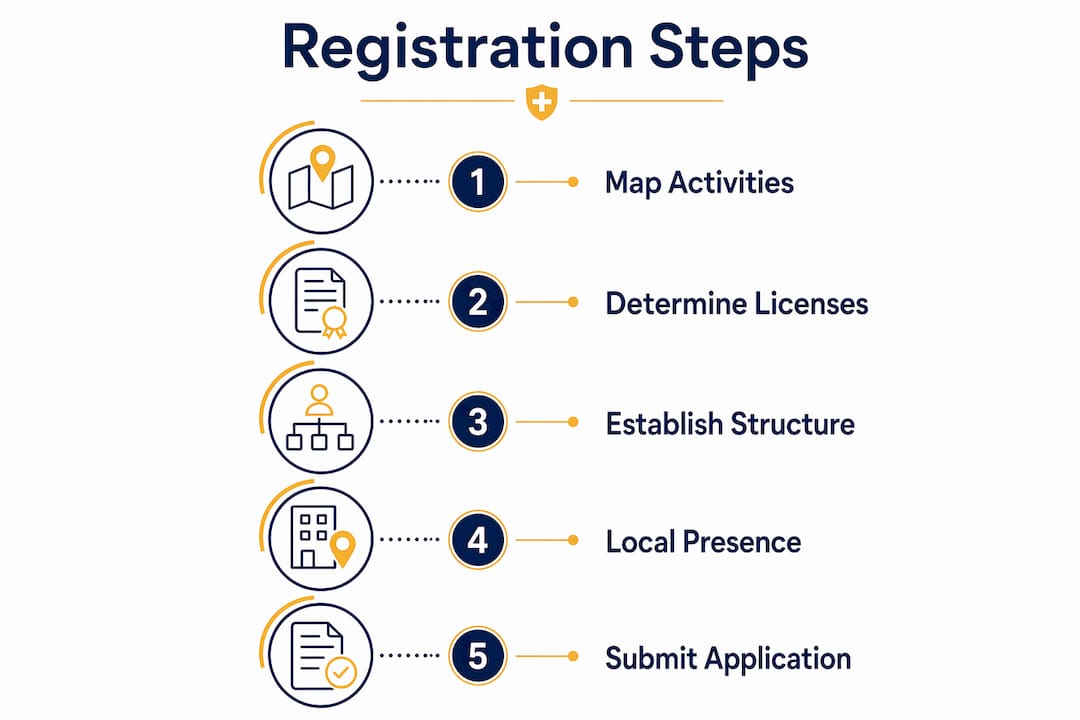
Licensing triggers almost always involve one or more of the following: custody of client assets, crypto-to-fiat conversion, or active solicitation of clients within a regulated jurisdiction. Misclassifying your activities leads to regulatory liability and application rejection.
Here is how common business models map to licensing requirements:
Crypto exchanges: Require VASP or CASP registration because they convert crypto to fiat and hold client funds.
Custodial wallets: Trigger licensing because the provider controls private keys on behalf of clients.
OTC desks: Require registration when they execute trades for clients, even without a public order book.
Payment processors: Need licensing when they accept crypto on behalf of merchants and convert it to fiat.
Non-custodial wallets: Generally fall outside licensing scope because the user controls their own keys.
One rule catches many founders off guard. Active marketing or soliciting clients in a jurisdiction triggers licensing obligations regardless of where your company is physically located. Local language support, payment acceptance from local users, and advertising targeting local residents all count as solicitation. Regulators rarely accept “reverse solicitation” as a defense.
Pro Tip: Map every revenue-generating activity against the licensing triggers in each target market before you incorporate. A single overlooked activity, such as earning a spread on crypto-fiat conversion, can reclassify your entire operation.
What corporate structure and local presence does registration require?
Registration is not just a paperwork exercise. Regulators require a substantive local management presence, not a registered address with a forwarding service.
Non-resident founders must appoint locally resident directors and compliance officers who are personally accountable to the local regulator. Outsourcing this responsibility to a third-party administrator without genuine authority does not satisfy regulators. The compliance officer must have real decision-making power and direct access to the regulator.
The steps for building a compliant corporate structure typically follow this sequence:
Incorporate locally. Form a legal entity in the target jurisdiction. In Switzerland, this means choosing between a GmbH (minimum CHF 20,000 share capital) or an AG (minimum CHF 100,000 share capital). The choice affects governance requirements and banking relationships.
Appoint a local director. The director must be resident in the jurisdiction and have genuine management authority. Swiss nominee director services from Rpcs fulfill this requirement for international founders.
Designate a Money Laundering Reporting Officer (MLRO). The MLRO is responsible for filing suspicious activity reports and maintaining the AML program. Regulators treat a weak MLRO appointment as a red flag.
Establish governance documentation. This includes AML policies, KYC procedures, risk appetite statements, and board-level oversight frameworks.
Meet capital adequacy requirements. Each jurisdiction sets minimum capital thresholds. Switzerland’s GmbH vs AG structure has direct implications for capital requirements and ongoing accounting obligations.
Pro Tip: Do not assume that a nominee director alone satisfies regulators. The director must be able to demonstrate actual knowledge of your business model and compliance program during regulatory interviews.
Common pitfalls include using a virtual office as a registered address without any local staff, appointing directors who cannot explain the business to a regulator, and failing to disclose ultimate beneficial owners in the initial application.
How does crypto business registration impact banking and operational legitimacy?
Registration is the baseline requirement for accessing banking services. Most respected banks will not open accounts for crypto businesses without a VASP or CASP authorization certificate and a documented AML/KYC program.
Registered crypto businesses gain access to institutional liquidity, card scheme partnerships, and critical business relationships that unregistered firms cannot reach. Registration does not guarantee a bank account. It qualifies you to apply for one.
The operational benefits of registration extend well beyond banking:
Institutional client access: Asset managers, family offices, and corporate treasuries require counterparties with regulatory authorization before transacting.
Card scheme eligibility: Visa and Mastercard require licensing before approving crypto-related card programs.
Brand credibility: A VASP or CASP registration signals to partners and clients that your business meets minimum governance standards.
Regulatory safe harbor: Registered businesses face lower enforcement risk and can engage regulators proactively when issues arise.
Registration is not just a compliance checkbox. It is the entry ticket to the financial infrastructure that makes a crypto business commercially viable at scale.
Unregistered firms face a compounding disadvantage. Banks decline them. Institutional clients avoid them. And regulators treat their operations as presumptively illegal. The cost of registration is real, but the cost of operating without it is higher.
Swiss banking for crypto businesses adds another layer of advantage. Switzerland’s regulatory environment is stable, internationally recognized, and aligned with FATF standards. Swiss banks that work with crypto firms expect FINMA compliance and robust KYC documentation, but they offer account stability that many other jurisdictions cannot match.
What are the steps for registering a crypto company in Switzerland?
Switzerland is one of the most credible jurisdictions for crypto business registration, combining FATF-aligned AML standards with a stable banking environment and clear regulatory guidance from FINMA.
Swiss company formation for crypto businesses follows a defined sequence. Swiss frameworks require transparency, capital adequacy based on company type, and governance structures that support credible banking partnerships.
The registration process works as follows:
Choose your corporate structure. A GmbH suits smaller operations with lower capital requirements. An AG is preferred for businesses seeking institutional credibility or planning external investment.
Appoint a Swiss resident director. FINMA and Swiss cantonal authorities require at least one locally resident director. Rpcs provides Swiss nominee director services for international founders who lack a local presence.
Secure a registered business address. A physical Swiss business address is required for incorporation and ongoing regulatory correspondence.
File incorporation documents. This includes articles of association, shareholder agreements, and beneficial ownership declarations with the Swiss commercial register.
Apply for FINMA registration or FinTech license. Depending on your activity scope, you may register as a financial intermediary with a self-regulatory organization (SRO) or apply directly to FINMA.
Open a Swiss bank account. Swiss banks require incorporation documents, AML policies, and director identification. Meeting Swiss KYC requirements from the outset speeds up the banking application significantly.
Establish ongoing accounting and compliance. Swiss law requires annual financial statements and ongoing AML reporting. Rpcs offers accounting services tailored to Swiss crypto companies.
Switzerland’s alignment with MiCA principles and FATF guidance means that a Swiss-registered crypto business carries regulatory credibility across European and global markets. That credibility translates directly into better banking relationships and stronger institutional partnerships.
Key Takeaways
Crypto business registration is the non-negotiable legal foundation that determines banking access, institutional credibility, and long-term operational viability for any cryptocurrency company.
Point | Details |
Registration defines legal status | VASP or CASP authorization is required to legally hold, exchange, or transfer virtual assets in most jurisdictions. |
Activity type drives license type | Custody, crypto-fiat conversion, and client solicitation each trigger specific licensing obligations regardless of company location. |
Local presence is mandatory | Regulators require resident directors and compliance officers with genuine authority, not just a registered address. |
Registration unlocks banking | Most banks require VASP or CASP authorization before opening accounts for crypto businesses. |
Switzerland offers a credible path | Swiss GmbH and AG structures, combined with FINMA alignment and FATF compliance, provide a stable foundation for global crypto operations. |
Why I think most crypto founders get registration backwards
Most founders treat licensing as the last step before launch. That instinct is wrong, and it costs them months of delay and sometimes the business itself.
I have seen founders spend a year building a product, only to discover that their core revenue model, earning a spread on crypto-fiat conversion, requires a money transmitter license in every US state they plan to operate in. By that point, the cost of restructuring is enormous.
The smarter approach is to treat licensing as a product design constraint from day one. Your business model, your target markets, and your corporate structure should all be shaped around what your regulator will accept. That is not a limitation. It is a competitive advantage. Firms that get licensed early gain access to banking, institutional clients, and card schemes that their unlicensed competitors cannot touch.
Switzerland stands out in my experience because the regulatory environment is predictable. FINMA communicates clearly, the SRO system provides a structured path for smaller firms, and Swiss banks, while demanding, are stable counterparties. For international founders without a local presence, Rpcs provides the director services, registered address, and accounting infrastructure that make Swiss registration practical rather than theoretical.
The founders who succeed are the ones who treat compliance as a business function, not a legal formality. Build your AML program before you need it. Appoint your MLRO before the regulator asks. And choose your jurisdiction based on where you can actually sustain a compliant operation, not just where registration looks cheapest on paper.
— Rolands
Swiss company formation for crypto businesses
Rpcs specializes in Swiss company formation for international entrepreneurs who need a compliant, credible base for their crypto operations.

Rpcs handles the full formation process, from GmbH and AG incorporation to Swiss nominee director services and registered business address provision. For crypto businesses, Rpcs also supports Swiss bank account opening and ongoing accounting services aligned with FINMA and FATF requirements. Whether you are registering a new crypto startup or relocating an existing operation to Switzerland, Rpcs provides the local infrastructure that regulators and banks require. The combination of Swiss credibility, stable banking access, and expert compliance support makes Switzerland a practical choice for crypto founders building for the long term.
FAQ
What is crypto business registration?
Crypto business registration is the process of obtaining legal authorization from a financial regulator to provide virtual asset services, typically under a VASP or CASP framework. Without registration, businesses cannot legally hold client assets, convert crypto to fiat, or solicit customers in most regulated markets.
Is crypto business registration required even for offshore companies?
Yes. Active solicitation of clients in a jurisdiction triggers licensing obligations regardless of where your company is incorporated. Local language websites, payment acceptance, and targeted advertising all count as solicitation under modern regulatory interpretations.
What does the EU MiCA regulation require for crypto businesses?
MiCA requires crypto asset service providers to obtain a CASP authorization by july 1, 2026, replacing earlier national registrations. A single CASP license grants passporting rights across all 27 EU member states.
Why do crypto businesses need a local director for registration?
Regulators require a locally resident director and compliance officer who are personally accountable to the regulator. Outsourcing management presence to a third party without genuine authority does not satisfy this requirement.
How does Swiss company formation support crypto business registration?
Swiss company formation provides a FATF-aligned corporate structure, access to stable Swiss banking, and a credible regulatory environment through FINMA. Swiss GmbH and AG structures meet capital adequacy and governance requirements that support both local and international licensing applications.
Recommended
Comments