
Setting Up Payroll in Switzerland: A Complete Guide
- 3 hours ago
- 9 min read

TL;DR:
Switzerland’s complex, multi-tiered payroll system requires accurate registration with social security, tax, and pension authorities before employment begins.
Choosing between an Employer of Record and establishing a local entity depends on your company’s size, timeline, and long-term plans, with EOR enabling rapid market entry.
Switzerland is one of the most rewarding places to build a business, and one of the most unforgiving places to get payroll wrong. This setting up payroll Switzerland guide exists because the system here operates across 26 cantons, each with its own tax rates, labor regulations, and deduction rules. Miss a registration, misclassify an employee, or submit a wage certificate late, and you’re looking at retroactive penalties that can run into the tens of thousands of francs. What follows covers the full picture: legal foundations, step-by-step setup, strategic decisions like Employer of Record versus local entity, and the ongoing compliance calendar you need to stay clean.
Table of Contents
Key takeaways
Point | Details |
Register before day one | Employers must register with social security, tax, and pension authorities before the first payslip is issued. |
Contributions are substantial | Combined employer and employee social security contributions total 20 to 25% of gross salary, requiring accurate budget forecasting. |
Canton determines tax rules | Payroll configuration must follow the employee’s canton of residence, not just the company’s location. |
EOR vs. entity is a real choice | An Employer of Record can get you operational in roughly 3 days, while a local entity setup takes several months. |
Annual wage certificates are mandatory | The Lohnausweis must be issued by January each year; missing this deadline creates compliance exposure. |
Setting up payroll in Switzerland: what you must know first
Before you process a single franc in wages, Switzerland requires you to build a compliance infrastructure. There is no shortcut here, and the structure matters more than most international entrepreneurs initially expect.
Switzerland runs on a multi-tiered payroll system that operates at the federal, cantonal, and municipal levels simultaneously. A global payroll template built for Germany or the UK will not transfer. Each layer has distinct obligations, and gaps between them are where foreign companies get caught.
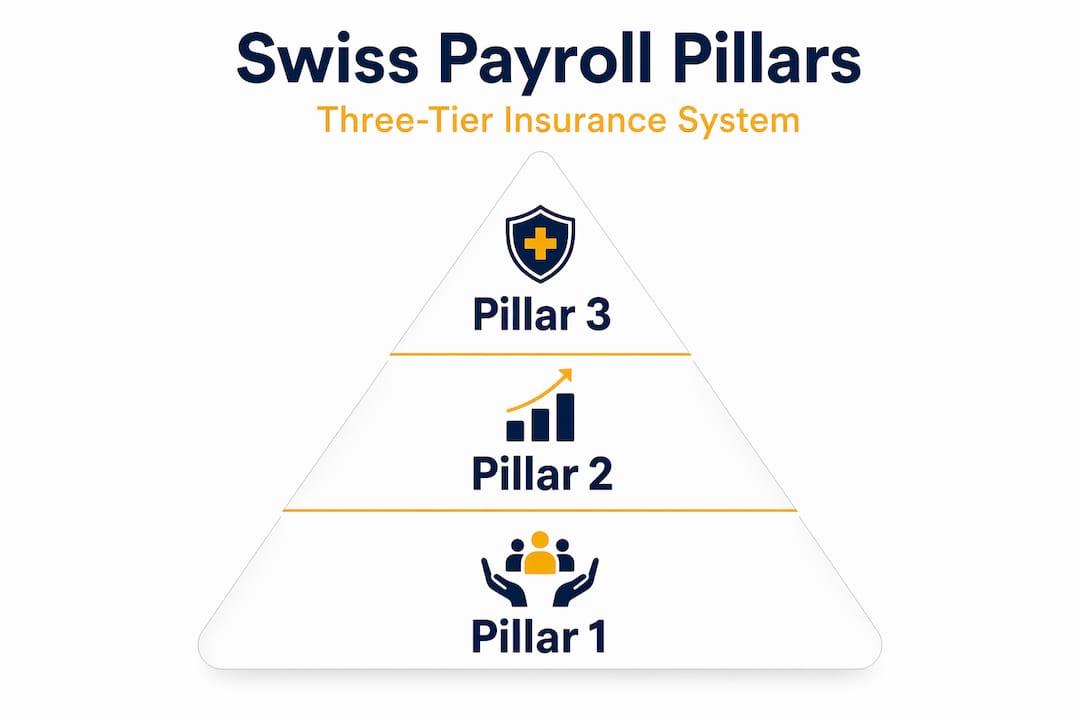
The three-pillar social insurance structure
Switzerland’s social insurance system is built on three pillars, and every employer must register for contributions to each one. The three-pillar system includes AHV/IV/EO, which covers old age, disability, and loss of earnings; ALV, which is unemployment insurance; and BVG/LPP, the mandatory occupational pension scheme. Understanding which pillar applies to which contribution is not optional. It is the foundation of every payslip you issue.
Employers must register with the cantonal compensation office (Ausgleichskasse) for AHV contributions, with a certified pension fund for BVG obligations, and with a licensed accident insurer under SUVA or a private equivalent. This registration must happen before any employee starts work. No registration means no legal basis for the payroll you are running.
Pro Tip: Register with the accident insurer before the employee’s first day, not after. Injuries that occur before registration create personal liability for the employer, regardless of subsequent filings.
Cantonal tax variations you cannot ignore
The employee’s canton of residence, not your company’s location, controls which tax rates and deductions apply. Canton-specific tax withholding varies widely across all 26 cantons, which means a Zurich employee and a Geneva employee on identical salaries will have meaningfully different net pay. Your payroll system must be configured to handle each employee’s canton individually.
Here is a summary of the key mandatory registrations and contributions:
Contribution type | Swiss name | Who pays |
Old age and disability insurance | AHV/IV/EO | Employer and employee, split equally |
Unemployment insurance | ALV | Employer and employee, split equally |
Occupational pension | BVG/LPP | Employer and employee (employer pays at least 50%) |
Accident insurance | UVG | Employer pays occupational accidents; employee pays non-occupational |
Source tax (foreign nationals) | Quellensteuer | Employer withholds from employee salary |
The step-by-step setup process
With registrations in motion, the procedural work of building payroll infrastructure begins. Setting up Swiss payroll step by step requires sequencing the right actions in the right order.
Register your company with the Commercial Register (Handelsregister). This is the legal prerequisite for everything that follows, including opening a bank account and registering for tax.
Obtain your UID number (Unternehmens-Identifikationsnummer). This federal business identifier appears on all official filings, tax returns, and social insurance submissions. You can find more on company registration documents required at this stage.
Register for corporate tax with the cantonal tax authority in the canton where your company is domiciled. The guide to Swiss corporate tax registration walks through this process in detail.
Open a Swiss bank account designated for payroll transactions. Swiss banks require full business documentation before approval, so build this into your timeline early.
Choose your payroll processing model. You have three main options: run payroll in-house using Swiss payroll software, engage a local payroll partner, or use an Employer of Record service.
Set your payroll cycle. Switzerland runs on monthly payroll. Establish your processing dates, payslip issuance schedule, and bank transfer timing before hiring begins.
Calculate compensation correctly. Gross salary in Switzerland frequently includes a 13th month salary, which is standard in most employment contracts and collective agreements. Your payroll calculation must account for gross pay, all mandatory deductions, and net pay as separate line items on every payslip.
Pro Tip: If your employees include foreign nationals without a C permit, you are required to withhold source tax (Quellensteuer) at source on their behalf. Failing to do this correctly is one of the most common errors for international employers in Switzerland.
When choosing between in-house processing, a local payroll partner, and an Employer of Record, weigh your headcount, timeline, and compliance tolerance honestly.
EOR vs. local entity: which option fits your situation
This is often the most consequential decision in the entire swiss payroll setup process, and most guides treat it superficially.
An Employer of Record is a third-party company that legally employs your workers in Switzerland on your behalf. The EOR holds the employment contracts, handles registrations, processes payroll, and absorbs the legal employer responsibility. You manage the work. They manage the compliance. EOR providers absorb legal employment responsibility, facilitating rapid compliance without entity delays.
Factor | Employer of Record | Local Swiss entity |
Setup time | Approximately 3 days | Several months |
Upfront cost | Lower | Higher (notary, registration, capital) |
Ongoing control | Moderate | Full |
Compliance risk | Transferred to EOR | Borne by employer |
Best for | Small teams, market testing, speed | Long-term operations, large headcount |
EOR setup takes as little as 3 days compared to the months required when establishing a local entity. For companies testing the Swiss market with one or two employees, paying for full entity formation before knowing if the market will work is a real financial risk.
That said, EOR is not the permanent answer for every business. Once your Swiss team exceeds roughly ten employees, or once your operations are clearly long-term, establishing a local entity typically becomes more cost-effective and gives you direct control over employment terms and benefits structuring.
Pro Tip: Use EOR as a market entry tool, not a permanent solution. Build your local entity setup timeline in parallel with EOR deployment so the transition is planned, not reactive.
Ongoing compliance and reporting obligations
Setting up payroll is a one-time project. Keeping it compliant is a permanent one. This section covers what hr and payroll services Switzerland 2025 best practices look like once your payroll is running.

Payroll must be processed monthly, and payslips must be issued to employees each pay period. These payslips are legal documents. They are used by employees to prove income when renting housing, applying for credit, or filing personal tax returns. Payslip errors require immediate correction with full documentation of what changed and why.
Key ongoing obligations include:
Monthly or quarterly remittances. Social security and withholding tax remittances have deadlines that vary by canton. Most cantons require monthly remittance for social insurance; withholding tax schedules depend on the specific authority.
Annual wage certificate (Lohnausweis). This document must be issued to every employee and submitted to the cantonal tax authority by the end of January each year. Missing this deadline triggers automatic penalties.
Recordkeeping. Swiss law requires employment records to be retained for at least ten years. This includes contracts, payslips, registration confirmations, and correspondence with authorities.
Audit readiness. The cantonal compensation office can audit your AHV contributions with minimal notice. Your records must be organized and accessible at all times.
Swiss compliance is not about filing when you remember. It is about building systems that make filing automatic. The employers who get audited and walk out clean are the ones who treated documentation as a daily habit, not an annual scramble.
Common mistakes and how to avoid them
Even well-resourced companies stumble in predictable ways when entering Switzerland. Knowing where others have failed is worth more than general advice.
Misclassification of employees as independent contractors is the most expensive error you can make. Switzerland’s authorities apply strict tests to determine employment status. If a contractor is found to be an employee, you owe retroactive AHV contributions, tax withholdings, and penalties for every month of misclassification. The financial exposure can span years.
Other mistakes that appear repeatedly:
Applying your home country’s payroll logic to Swiss employees without adjusting for local rules
Ignoring the distinction between cantonal payroll variations when employees live in different cantons from your office
Issuing incorrect payslips and not correcting them within the same pay period
Choosing payroll software not configured for Swiss social insurance calculations
Missing the BVG registration for employees who cross the annual income threshold (currently CHF 22,050)
Pro Tip: Always verify your payroll software handles BVG coordination deductions correctly. The coordination deduction reduces the insured salary, and getting it wrong means employees are under-insured and your contributions are miscalculated from day one.
For ongoing compliance support, reviewing Swiss company compliance steps gives you a structured checklist of what needs to happen and when.
My perspective on navigating Swiss payroll as an outsider
I have worked with international founders who arrived in Switzerland confident that their experience building teams across Europe would carry over. It almost never does cleanly. The reason is not complexity for its own sake. It is that Switzerland’s system is genuinely decentralized in ways that require local knowledge at the cantonal level, not just the federal level.
What I have learned is that the worst outcomes come from the gap between what founders think they know and what Switzerland actually requires. The company that registered for AHV but forgot BVG because they did not realize their hire had crossed the income threshold. The team that issued 12 payslips without source tax because no one flagged that the employee held a B permit.
My honest advice: do not rush the entity formation decision. EOR is not a compromise. For many international businesses in the first 12 to 18 months in Switzerland, it is the smarter financial choice. Once your Swiss operation proves itself, form the entity with the knowledge and team in place to run it properly.
Swiss payroll regulations are also not static. Contribution rates adjust annually, BVG reform is actively reshaping the pension landscape, and cantonal rules continue to evolve. Staying current is not optional. The businesses that handle this well treat payroll compliance as a live operational function, not a setup task they completed once.
— Rolands
How Rpcs simplifies Swiss payroll and company formation
Setting up payroll correctly requires getting the company foundation right first. Rpcs specializes in Swiss company formation for international entrepreneurs, handling everything from Commercial Register filings and notarization to banking setup and tax registration. Once your entity is in place, the firm’s accounting and bookkeeping services cover the ongoing payroll reporting, social insurance filings, and annual wage certificate submissions that keep you compliant year after year.

For foreign business owners who want Switzerland done right without building an in-house compliance team, Rpcs functions as the local expertise layer you need. Reach out directly to discuss your structure, timeline, and payroll requirements before your first hire.
FAQ
What registrations are required before running payroll in Switzerland?
Employers must register with the cantonal compensation office for AHV, a certified pension fund for BVG, a licensed accident insurer, and the cantonal tax authority before any employee begins work.
How much do Swiss payroll contributions cost the employer?
Combined employer and employee contributions for social security and unemployment insurance total roughly 20 to 25% of gross salary, with the employer paying the larger share in most categories.
What is the Lohnausweis and when must it be issued?
The Lohnausweis is the annual wage certificate that documents an employee’s total compensation and deductions for the tax year. It must be issued to employees and submitted to cantonal tax authorities by the end of January each year.
When does an Employer of Record make more sense than a local entity?
An EOR is typically the better choice when you are hiring a small team, testing the Swiss market, or need to start operations quickly. EOR services can be operational in approximately 3 days, whereas establishing a local entity takes several months.
Which canton’s rules apply to payroll if my company and employee are in different cantons?
The employee’s canton of residence controls the applicable tax withholding rates and certain deduction rules, not the canton where your company is registered. Your payroll system must be configured per employee, not per company location.
Recommended
Comments