
Role of notary in Swiss company registration guide
- 10 hours ago
- 10 min read

TL;DR:
Notarization in Switzerland is a crucial legal process that authenticates company documents, ensuring international acceptance and legal certainty for foreign investors. It verifies identities, confirms informed consent, authenticates signatures, and applies seals that prevent ownership disputes and fraud, especially during company formation. Proper preparation and early engagement with qualified notaries streamline registration, minimize delays, and provide lasting legal protection for your Swiss company.
Many international entrepreneurs assume the role of notary in company registration is little more than watching someone sign a piece of paper. That assumption is costly. In Switzerland, notarization is a formal legal process that authenticates your company’s founding documents, confirms that every signatory understands what they are committing to, and creates a paper trail that regulators, banks, and foreign authorities will trust. This guide explains exactly what notaries do in the Swiss context, which documents they must handle, how the process unfolds in practice, and why getting this right from day one is one of the smartest decisions you can make as a foreign investor.
Table of Contents
Understanding notarization and the notary’s role in Swiss company registration
Which company registration documents require notarization in Switzerland and why
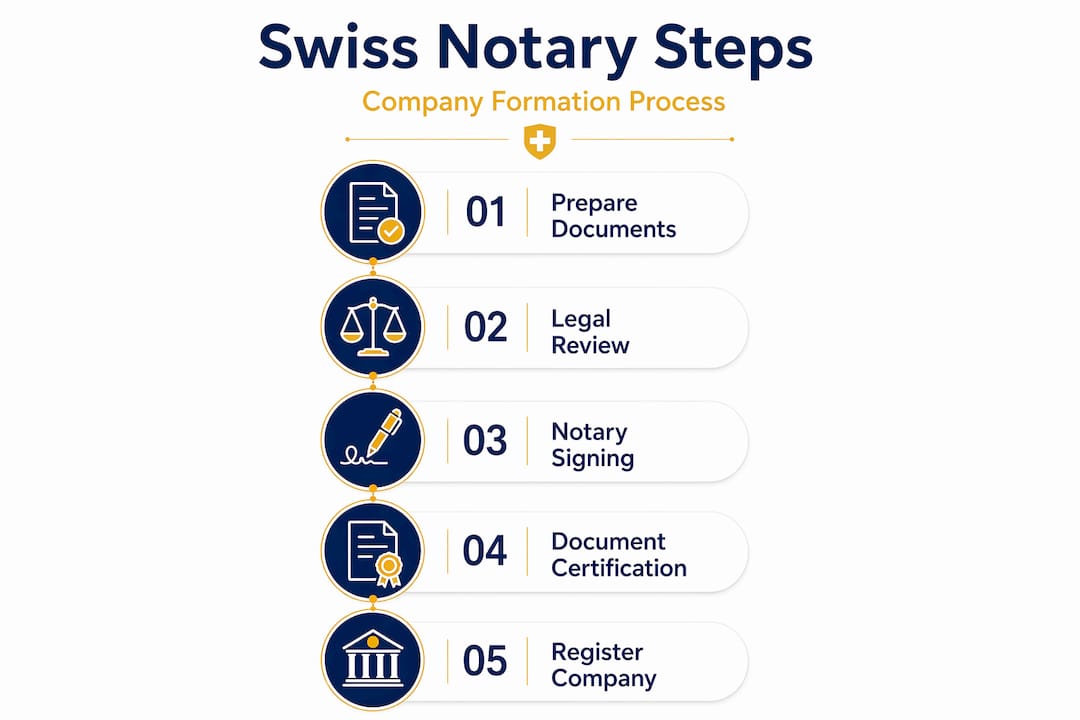
Step-by-step notarization process during Swiss company formation
How notarization protects investors and ensures legal compliance in Swiss company registration
Common challenges and tips when working with notaries in Swiss company formation
Why the notary’s role in Swiss company registration is your best investment in legal certainty
Get expert support for notarization and Swiss company registration
Understanding notarization and the notary’s role in Swiss company registration
Notarization is not a formality. It is a legal process with specific, enforceable outcomes. When a Swiss notary certifies a document, that document gains a legal status it could not achieve through ordinary signing. The notaries in Swiss company formation carry out a function that sits at the intersection of identity verification, legal authentication, and public record.
A notary public is not the same as a solicitor. A solicitor advises you on your legal rights and drafts contracts. A notary verifies facts and authenticates documents so they are accepted as legally valid, both within Switzerland and internationally. In the Swiss corporate context, this distinction matters enormously. When you form a GmbH or AG (Aktiengesellschaft, the Swiss equivalent of a corporation), the founding act must pass through a notary before the commercial register will accept it.
Here is what a notary actually does during company formation:
Verifies your identity using official documents, ensuring the person signing is who they claim to be
Confirms informed consent, meaning each signatory understands the document’s content and is acting voluntarily
Witnesses and authenticates signatures so they cannot be disputed later
Applies an official seal, which triggers international acceptance under the Hague Convention’s Apostille framework
As one source explains, a notary public verifies your identity, confirms that you understand the document, witnesses your signature, and applies an official seal to ensure international acceptance. For international investors, this seal is what makes your Swiss company documents usable across borders, whether you are opening a bank account in Singapore, entering a contract in the UAE, or reporting to regulators in the European Union.
“A notarized document carries a presumption of authenticity that an ordinary signed document cannot match. Courts, banks, and government agencies treat notarized documents as reliable evidence of fact.”
The key documents for company registration in Switzerland all rely on this presumption. Without it, your company’s legal foundation is weaker than it needs to be.
Which company registration documents require notarization in Switzerland and why
Now that we understand the notary’s role, let us explore which company documents require notarization and what this legally achieves.
Not every piece of paperwork you file needs a notary. But the foundational documents do, and skipping that step is not possible under Swiss law. The Memorandum of Association is a crucial document that must be notarized to establish the company’s legal environment and shareholders.
The following documents typically require notarization when forming a Swiss GmbH or AG:
Articles of Association (Statuten): The constitutional document of your company, defining its purpose, share structure, and governance rules
Deed of incorporation (Gründungsurkunde): The founding act that formally brings the company into existence
Shareholder agreements: Any agreement that assigns rights or obligations between shareholders
Powers of attorney: Documents authorizing a representative to act on behalf of a shareholder or director
Board resolutions: Formal decisions made by the board that carry legal consequences, such as approving capital increases
The legal reasoning behind these requirements is straightforward. Notarization provides authenticity, which prevents ownership disputes. It enforces agreements by establishing that all parties signed knowingly. And it creates a transparent record that Swiss authorities can rely on when scrutinizing the company’s founding history.
Document | Purpose of notarization | Legal effect |
Articles of Association | Authenticate company rules and structure | Required for commercial register filing |
Deed of incorporation | Confirm valid company formation | Creates legal personality |
Power of attorney | Verify authorized representation | Enables remote or proxy participation |
Shareholder agreement | Confirm all parties’ informed consent | Enforceable in Swiss courts |
Board resolutions | Validate formal company decisions | Binding on company and third parties |
Pro Tip: Have a legal advisor prepare your Swiss company documents before the notary appointment. Incomplete drafts are the single most common cause of delays. A notary will not certify a document with missing clauses or incorrect information, and rescheduling costs time and money.
Step-by-step notarization process during Swiss company formation
Having identified the key documents, let us break down the notarization process step by step to show how each stage unfolds in practice.
The process has four distinct phases, and each one has specific requirements. Knowing them in advance removes the anxiety that many first-time investors feel.
Document preparation and review. Your legal advisor or service provider drafts the Articles of Association, deed of incorporation, and any related agreements. These must conform to Swiss corporate law requirements before the notary will even review them. This stage often takes the most time, especially when multiple shareholders are located in different countries.
Pre-appointment identity verification. Before the signing ceremony, the notary requests certified copies of identity documents from all signatories. For foreign nationals, this typically means a valid passport and sometimes a certified translation of supporting documents. The notary confirms identities of signatories, ensures signatures are voluntary and valid, and applies official certification needed before submission to authorities.
The notarization ceremony. All signatories (or their authorized representatives) appear before the notary. The notary reads or summarizes the key document provisions, confirms each party’s understanding, witnesses the signing, and then applies the official notarial seal. For a Swiss AG formation, this ceremony must take place in person or via a notarized power of attorney arrangement.
Filing with the commercial register. Notarized documents, along with proof of share capital deposit (typically held in a blocked bank account), are submitted to the relevant cantonal commercial register. Notarization of key documents is mandatory before registration and trade license issuance to avoid legal complications and delays.
The essential steps for business notarization follow this same logic across different legal structures. Use a company formation checklist to track each milestone and avoid missing a filing deadline.
Pro Tip: If you cannot travel to Switzerland for the notarization ceremony, a power of attorney granted to a local representative resolves the issue. The power of attorney itself must be notarized in your home country and, in most cases, apostilled under the Hague Convention before it is valid in Switzerland.
How notarization protects investors and ensures legal compliance in Swiss company registration
Understanding the procedural steps, it is crucial to appreciate how notarization ultimately protects your investment and secures legal compliance.

The legal protections notarization provides are not abstract. They translate into concrete outcomes that affect your company’s operations, banking relationships, and ability to defend its interests in court.
Here is what notarization actually protects you from:
Fraudulent incorporation: Identity verification at the notarial stage ensures no unauthorized person can register a company in your name or use forged documents to claim ownership
Coercion claims: Because the notary confirms that all parties signed voluntarily, a future claim that someone was pressured into signing is far harder to sustain in court
Ownership disputes: Notarized founding documents establish a clear, legally authenticated chain of ownership from day one
International rejection of documents: Banks, foreign regulators, and counterparties in other jurisdictions accept notarized Swiss documents as reliable without requiring additional verification
As one analysis confirms, notarization ensures signatures are genuine, parties understand their commitments, and documents are legally binding to prevent future ownership or management disputes.
“For international investors, the notarized founding document is often the single most important piece of evidence your company was formed correctly. Banks rely on it. Courts rely on it. Tax authorities rely on it.”
This matters especially when you are opening a Swiss company bank account or seeking financing from institutional lenders. Banks conduct due diligence on your founding documents, and notarized paperwork moves through that review faster than unverified alternatives.
Common challenges and tips when working with notaries in Swiss company formation
While notarization brings many benefits, being aware of common pitfalls and how to avoid them can save time and money.
Most delays in Swiss company formation trace back to notarization problems, not registration backlogs. The good news is that almost all of them are preventable with basic preparation.
The most frequent mistakes international entrepreneurs make include:
Submitting incomplete documents: Missing clauses, unsigned pages, or incorrect company names force the entire document back to drafting
Mismatched identification: The name on your passport must match the name in every corporate document exactly, including middle names and transliterations
Failing to coordinate multiple shareholders: When founders are in different time zones or countries, scheduling the notarization ceremony becomes a logistical challenge that can delay registration by weeks
Using an unqualified notary: Not every notary in Switzerland is equally familiar with corporate formation law. A notary who primarily handles property transactions may be unfamiliar with the specific requirements for GmbH or AG formation
Proper preparation and professional support ensures all documents meet legal standards and notarization requirements to prevent costly rework.
Working with a service provider who has established relationships with Swiss corporate notaries removes all of these friction points. They know the document standards, the formatting requirements for each canton, and how to coordinate remote signatories efficiently. To get your documents right from the start, review how to prepare your company documents well before your notary appointment.
Pro Tip: If you have multiple shareholders who cannot be present in Switzerland simultaneously, consider a nominee director arrangement combined with individual powers of attorney. Each shareholder notarizes their power of attorney in their home country, gets it apostilled, and sends it to Switzerland. The nominee then represents them at the single notarization ceremony, eliminating travel requirements entirely.
Why the notary’s role in Swiss company registration is your best investment in legal certainty
Here is a perspective that most guides on this topic miss entirely: entrepreneurs who view notarization as a bureaucratic hurdle consistently spend more money fixing problems than those who treat it as an early investment in legal certainty.
The conventional view is that notarization is something you get through, a box to check before the real work of running your company begins. That framing is wrong, and it leads to real consequences. Companies that rush the notarization stage with incomplete documents, unverified representatives, or the wrong notary type often discover their errors only when it matters most: during a banking review, a corporate transaction, or a shareholder dispute.
What most people do not realize is that a well-executed notarization does active work for your company long after the signing ceremony is over. It is what makes your Swiss entity credible to a Singaporean bank that has never heard of your company. It is what prevents a disgruntled co-founder from claiming the shareholder agreement was signed under duress. It is what Swiss tax authorities accept as proof that your company was formed with the required capital and proper governance.
Notaries are neutral parties by definition. They have no interest in favoring one shareholder over another, one clause over another, or one outcome over another. That neutrality is precisely what gives notarized documents their legal weight internationally. Treating the notary as a strategic partner rather than a bureaucratic gatekeeper means engaging them early, asking about cantonal-specific requirements, and using their expertise to catch document problems before they become registration problems.
International investors who build notarization planning into their Swiss company formation strategy from day one consistently report faster registration timelines, smoother banking onboarding, and fewer legal complications in the first year. That is not coincidence. It is the compounding effect of getting the foundation right.
Get expert support for notarization and Swiss company registration
Navigating Swiss notarization requirements from abroad is one of the most practical challenges international entrepreneurs face. The legal details are specific, the cantonal variations are real, and the cost of errors is high.

RPCS specializes in handling the full notarization and legal documentation process for foreign entrepreneurs forming Swiss companies. From drafting compliant Articles of Association to coordinating notary appointments, arranging nominee directors, and managing commercial register filings, the team covers every step so you do not have to navigate Swiss corporate law alone. RPCS also assists with setting up a Swiss bank account and securing a registered business address, giving your company a fully operational presence in Switzerland from day one.
Frequently asked questions
Is notarization mandatory for all company registration documents in Switzerland?
Not all documents require notarization, but key documents like the Memorandum of Association and powers of attorney must be notarized to be legally valid for company registration. Certain corporate documents must be notarized to establish the company structure legally under Swiss law.
Can a representative handle notarization if I cannot be in Switzerland?
Yes, a notarized power of attorney allows an appointed representative to sign documents and complete the registration on your behalf. A representative can undertake company formation with a notarized power of attorney from the shareholders, provided it carries a valid Apostille.
What is the difference between a notary public and a solicitor in company registration?
A notary public authenticates documents and verifies identities for legal validity and international use, while a solicitor provides legal advice on rights and contracts. Solicitors advise on legal rights while notaries certify documents for international authenticity, and their roles complement but differ significantly in corporate formation.
How does notarization benefit international investors opening a Swiss company?
Notarization ensures documents are legally sound, signatures are valid, and signatories understand their commitments, providing legal certainty and smoother cross-border transactions. It offers legal protection, confirms informed consent, and helps avoid ownership and management disputes from the moment your Swiss company is formed.
Recommended
Comments