
How to Set Up a GmbH in Switzerland: Step-by-Step Guide
- Dec 31, 2025
- 9 min read

Global tech expansion is accelerating, and every American founder knows the race for efficient company setups can define future growth. Switzerland stands out for its robust regulatory standards and unmatched startup incentives. If you want to establish a Swiss GmbH, precise documentation and local expertise are essential. With over 80 percent of foreign startups qualifying for preferential tax regimes, preparing your paperwork properly could unlock your entry into Switzerland’s thriving tech environment.
Table of Contents
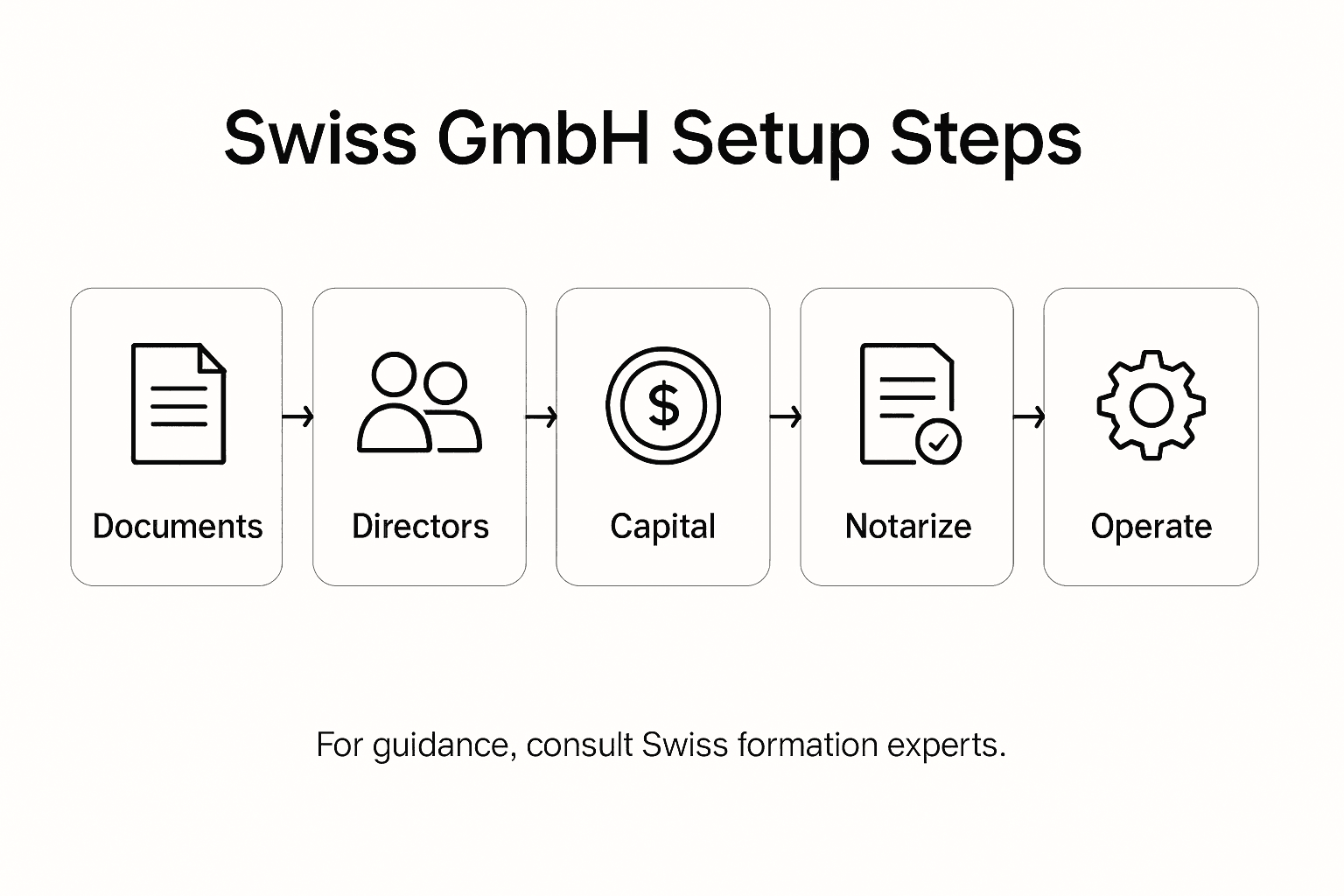
Quick Summary
Key Point | Explanation |
1. Assess Eligibility Thoroughly | Compile all required documents, including legal certifications and a detailed business plan, to demonstrate legitimacy as a foreign entrepreneur. |
2. Appoint Qualified Directors | Ensure at least one director is a Swiss resident, and select individuals with solid corporate compliance experience to guide your governance. |
3. Draft Articles of Association | Create comprehensive company bylaws compliant with Swiss law and ensure they are notarized by a certified notary for legal recognition. |
4. Complete Accurate Registration | Submit all necessary documents accurately to the local commercial registry for your GmbH to become a legally recognized entity. |
5. Open a Corporate Bank Account | Open a bank account to deposit the minimum share capital and provide all required documents for financial transactions and compliance. |
Step 1: Assess Eligibility and Prepare Required Documents
Setting up a GmbH in Switzerland requires careful preparation and understanding of specific legal requirements. This step focuses on evaluating your eligibility and gathering the necessary documentation to successfully establish your Swiss company.
To begin, you will need to compile a comprehensive set of documents that demonstrate your business legitimacy and personal qualifications. This typically includes authenticated legal documents through proper certification processes. Foreign entrepreneurs must provide a valid passport, proof of professional background, and detailed business plan that aligns with Swiss regulatory standards. Pay special attention to preparing your articles of association, which outline your company’s structure, purpose, and governance.
Carefully review the documentation requirements specific to your business sector. Some industries might demand additional permits or specialized certifications. Ensure all documents are translated into either German, French, or Italian and authenticated with an apostille stamp to meet Swiss legal standards. Your paperwork must demonstrate financial stability, professional competence, and a clear business strategy that contributes to the Swiss economic ecosystem.
Pro Tip: Engage a local Swiss legal consultant who specializes in company formation to review your documents and ensure complete compliance before submission.
Step 2: Appoint Directors and Define Share Capital
This critical stage involves selecting the right leadership for your Swiss GmbH and establishing the financial foundation that will support your company’s legal structure and operational capabilities. Your director selection and capital allocation will directly impact your company’s credibility and operational flexibility.

When appointing directors, you need to carefully consider both local and international requirements. Swiss regulations typically require at least one director who is either a Swiss resident or a legal entity registered in Switzerland. Directors carry significant legal responsibilities that shape the company’s governance and strategic direction, so choose individuals with proven professional experience and a strong understanding of corporate compliance. For foreign entrepreneurs, this often means partnering with a local Swiss nominee director who can provide the necessary residential representation and navigate local regulatory frameworks.
Defining share capital involves determining the appropriate monetary investment required to establish your GmbH. In Switzerland, the minimum share capital requirement is typically 20000 Swiss francs, which must be fully subscribed by shareholders. Your capital structure should reflect your business model, anticipated operational costs, and growth strategies. Consider whether you will have multiple shareholders or maintain a single ownership structure, and ensure that the capital allocation aligns with your long term business objectives.
The following table highlights differences between Swiss-resident and foreign directors in a GmbH:
Criteria | Swiss-Resident Director | Foreign Director |
Residency Requirement | Must reside in Switzerland | No Swiss residency required |
Legal Representation | Can interact directly with authorities | May need Swiss representative |
Compliance Role | Ensures local compliance | Advises on international matters |
Appointment Commonality | Legally mandatory for most GmbHs | Optional, adds expertise |
Decision Authority | Full authority locally | Subject to cross-border limitations |
Pro Tip: Consult with a Swiss corporate lawyer to ensure your director appointments and share capital structure meet all legal requirements and optimize your company’s financial positioning.
Step 3: Draft and Notarize the Articles of Association
This crucial step involves creating the foundational legal document that defines your Swiss GmbH operational framework and governance structure. Your Articles of Association will serve as the constitutional blueprint for your company, outlining everything from shareholder rights to management responsibilities.
When drafting your Articles of Association, you must carefully prepare a comprehensive document that meets Swiss legal requirements. Cantonal notary offices provide specific templates and guidelines for creating legally compliant company statutes, which will help you structure your document correctly. Your articles should comprehensively address key elements such as company purpose, share capital details, shareholder voting rights, director appointment processes, and procedures for corporate decision making. Pay special attention to including precise language that defines the scope of your business activities and the specific powers granted to directors and shareholders.
The notarization process is mandatory and requires presenting your drafted Articles of Association to a certified Swiss notary who will authenticate the document. International entrepreneurs can leverage notarial services through their local embassies to prepare supporting documentation before submitting to Swiss authorities. Ensure all documents are professionally translated into an official Swiss language and include all required signatures and corporate seals to guarantee legal recognition.
Pro Tip: Request a preliminary review of your draft Articles of Association by a Swiss corporate legal specialist to identify and resolve potential compliance issues before formal notarization.
Step 4: Register the GmbH with Swiss Authorities
Registering your GmbH with Swiss authorities represents the pivotal moment that transforms your business concept into a legally recognized corporate entity. This process solidifies your company’s official status and grants you the legal permissions necessary to operate within Switzerland’s robust business ecosystem.
The registration process requires submitting a comprehensive set of documents to the commercial registry in the specific canton where your company will be headquartered. Business registration involves filing precise legal documents with government offices to establish official corporate status, and Switzerland maintains strict protocols for this procedure. You will need to present your notarized Articles of Association, proof of share capital deposit, identification documents for directors, and a formal registration application. Most cantons now offer online submission platforms, though some still require in person filing or certified mail submission.
Careful attention to detail is paramount during registration. Your application must include precise information about your company structure, including full names of shareholders and directors, registered business address, exact business purpose, and total share capital. Swiss commercial registries are meticulous about documentation accuracy and will reject applications with incomplete or inconsistent information. Expect the registration process to take approximately two to four weeks, depending on the specific cantonal requirements and the completeness of your submitted documentation.
Pro Tip: Prepare digital and physical copies of all documents beforehand and consider engaging a local Swiss registration specialist to streamline the submission process and minimize potential administrative delays.
Step 5: Open a Corporate Bank Account and Deposit Capital
Opening a corporate bank account represents the critical financial milestone that transforms your Swiss GmbH from a legal concept into an operational business entity. This step ensures your company can conduct financial transactions and meet regulatory requirements for capital deployment.
Digital banking platforms now offer streamlined processes for establishing Swiss corporate accounts, allowing entrepreneurs to navigate complex banking requirements more efficiently. You will need to prepare several key documents including your company registration certificate, Articles of Association, identification documents for all shareholders and directors, and proof of business address. Most Swiss banks require a personal interview either in person or via video conference, during which they will assess your business model, verify your documents, and confirm your compliance with international financial regulations.
The capital deposit process demands precision and adherence to Swiss financial standards. You must transfer the minimum required share capital directly into your newly opened corporate bank account typically within three months of company registration. Swiss banks are known for their rigorous due diligence, so expect a comprehensive review of your business background, source of funds, and intended financial activities. The U.S. Department of State notes Switzerland maintains robust financial sector oversight to support transparent business operations, which means your banking process will be thorough but designed to facilitate international business.
Pro Tip: Choose a Swiss bank with demonstrated experience supporting international startup ecosystems and request a comprehensive consultation to understand all account maintenance requirements and potential transaction fees.
Step 6: Verify Formation and Begin Operations
This final stage transforms your meticulously planned Swiss GmbH from a legal document into a fully operational business entity. Verification and initial operations represent the critical moment where your entrepreneurial vision transitions into market reality.
Navigating Switzerland’s market entry requires strategic understanding of local business regulations and economic frameworks, so precision in these initial steps is paramount. You will need to systematically review all documentation to confirm your company is fully compliant. This includes cross checking your commercial registry extract, verifying tax identification numbers, ensuring all shareholders and directors are correctly registered, and confirming your VAT registration status. Some critical tasks include obtaining your company seal, setting up official communication channels, establishing accounting systems, and preparing for your first quarterly financial reporting.
Initial operational setup demands careful attention to Swiss regulatory nuances. You must develop robust internal processes that align with Swiss corporate governance standards, including maintaining accurate corporate records, understanding local tax reporting requirements, and establishing proper communication protocols with Swiss governmental authorities. Consider hiring a local Swiss accounting firm to help you navigate these initial complexities and ensure your GmbH meets all ongoing compliance requirements.
Pro Tip: Schedule an initial consultation with a Swiss business compliance specialist within the first month of operations to perform a comprehensive regulatory audit and identify any potential administrative or legal optimization opportunities.
Here’s a summary of the main steps in forming a Swiss GmbH for quick reference:
Step | Main Task | Key Document or Action | Critical Consideration |
1 | Assess eligibility | Valid passport, business plan | Documents must be certified and translated |
2 | Appoint directors & define share capital | Director agreement, share capital | At least one Swiss-resident director required |
3 | Draft & notarize Articles | Articles of Association | Notarization by Swiss notary is mandatory |
4 | Register with authorities | Registration application, proof of capital | All details must be accurate and complete |
5 | Open bank account & deposit capital | Bank documents, proof of address | Minimum CHF 20,000 deposited post-registration |
6 | Verify & begin operations | Registry extract, VAT number | Setup accounting and verify full compliance |
Smooth Your Path to Setting Up a Swiss GmbH with Expert Support
Setting up a GmbH in Switzerland involves complex steps like appointing Swiss-resident directors, notarizing the Articles of Association, and opening a corporate bank account with proper capital deposits. These processes can overwhelm international entrepreneurs who lack local knowledge of Swiss legal and financial standards. Common pain points include meeting residency requirements, navigating strict documentation certification, and ensuring swift registration without delays.
At rpcs.ch, we specialize in simplifying these challenges by providing comprehensive legal and administrative support tailored to foreign investors. Our expert team guides you through document preparation, notarization, and transparent capital deposit procedures while ensuring full compliance with Swiss corporate regulations. With rapid setup times and confidential service, we help you avoid costly mistakes and accelerate your entry into the Swiss market.

Take control of your Swiss GmbH formation today by leveraging trusted professionals dedicated to your success. Visit rpcs.ch now to discover how our seamless company setup and ongoing business services unlock the full benefits of Swiss incorporation with confidence and ease. Do not wait until complexities slow your progress. Start your journey with a strong foundation that drives your international business forward.
Frequently Asked Questions
What documents do I need to set up a GmbH in Switzerland?
To set up a GmbH in Switzerland, you need to prepare a valid passport, proof of professional background, a detailed business plan, and your Articles of Association. Gather all necessary documentation and ensure they are translated into an official Swiss language and authenticated with an apostille.
How many directors are required for a Swiss GmbH?
A Swiss GmbH must have at least one director who is either a Swiss resident or a legal entity registered in Switzerland. Select someone with strong professional experience to fulfill this crucial compliance role.
How do I register my GmbH with Swiss authorities?
To register your GmbH with Swiss authorities, submit necessary documents such as the notarized Articles of Association and proof of share capital deposit to the commercial registry in your chosen canton. Make sure your application is complete to avoid delays, as the registration process may take two to four weeks.
What is the minimum share capital required for a Swiss GmbH?
The minimum share capital required to set up a Swiss GmbH is typically 20,000 Swiss francs, and it must be fully subscribed by shareholders. Ensure that this amount is deposited into your corporate bank account within three months of registration to meet compliance requirements.
How do I verify and begin operations for my Swiss GmbH?
To verify and begin operations for your Swiss GmbH, review all documentation for compliance, including checking your commercial registry extract and tax identification numbers. Set up your accounting systems and obtain all necessary permits to start operating legally in Switzerland.
Should I hire a local consultant when setting up my GmbH?
Yes, hiring a local consultant can significantly simplify the process of setting up your GmbH. They can help ensure compliance with Swiss laws, review your documentation, and guide you through each step efficiently.
Recommended
Comments