
Role of accountants in Switzerland: 2026 guide
- Mar 15
- 10 min read

Many international entrepreneurs assume accountants in Switzerland only handle tax returns. This misconception overlooks their comprehensive role in ensuring business compliance, managing complex payroll systems, and providing strategic financial insights. Swiss accountants navigate cantonal regulations, interpret financial reporting standards, and deliver essential services that keep businesses legally compliant and financially healthy. Understanding these multifaceted responsibilities helps you leverage accounting expertise effectively, avoid costly mistakes, and build a sustainable operation in one of Europe’s most business-friendly environments. This guide reveals exactly how accountants support international entrepreneurs throughout their Swiss business journey.
Table of Contents
Understanding The Comprehensive Role Of Accountants In Switzerland
Navigating Fiduciary Services And Typical Costs In Switzerland
The Critical Importance Of Accounting Expertise For Cross-Border Entrepreneurs
Essential Accounting Best Practices For Startup And SME Success In Switzerland
Explore Professional Accounting And Company Formation Services With RPCS
Frequently Asked Questions About The Role Of Accountants In Switzerland
Key takeaways
Point | Details |
Compliance assurance | Accountants ensure adherence to Swiss tax laws, financial reporting standards, and cantonal regulations |
Comprehensive services | They handle bookkeeping, payroll processing, financial statements, tax returns, and strategic consulting |
Cantonal complexity | Regulations vary significantly by canton, requiring localized expertise for proper compliance |
Cost considerations | Fiduciary services typically range CHF 150-300 per hour depending on complexity and location |
Payroll expertise | Professional support is critical even for small companies due to Switzerland’s complex insurance systems |
Understanding the comprehensive role of accountants in Switzerland
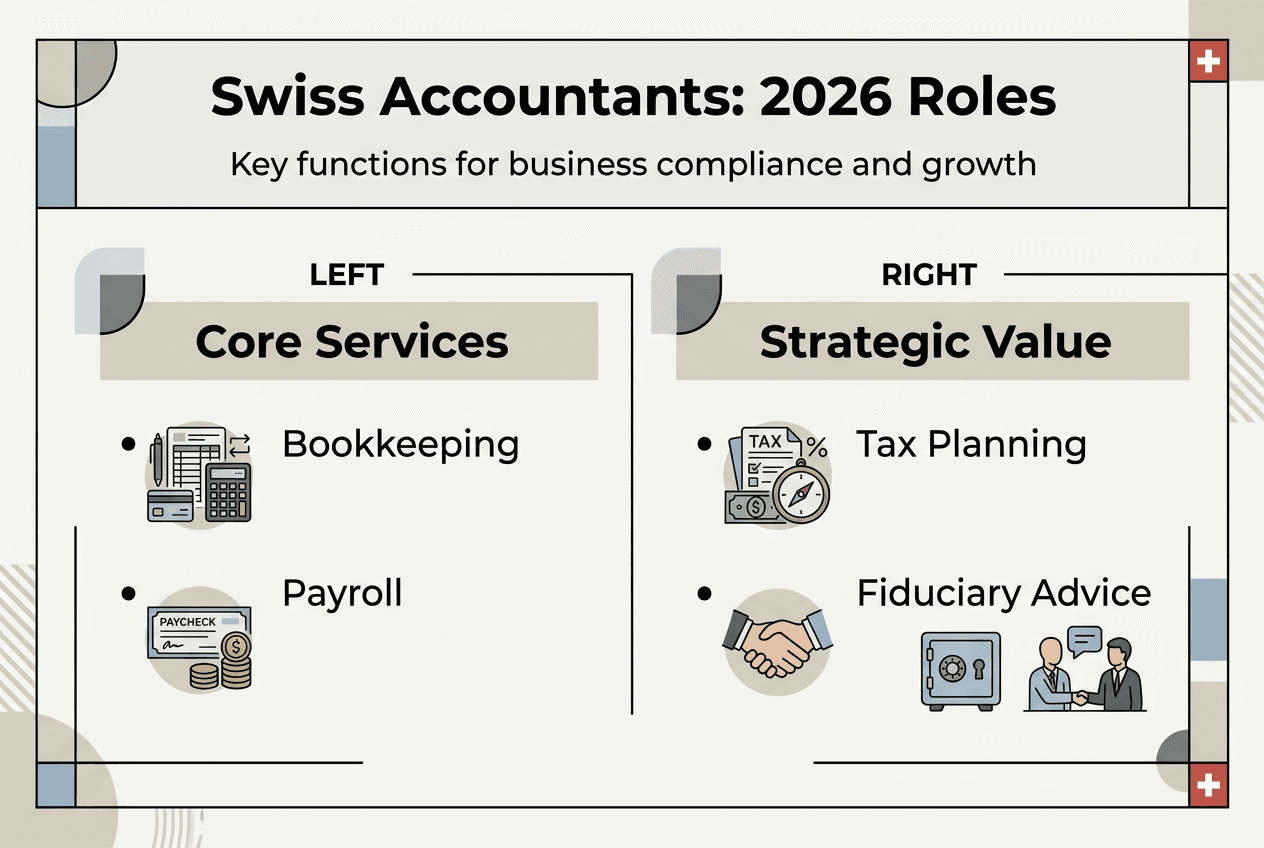
Swiss accountants deliver far more than basic number crunching. They serve as compliance guardians, financial strategists, and regulatory interpreters for businesses operating in Switzerland’s sophisticated economic landscape. Their responsibilities span bookkeeping accuracy, payroll administration, financial statement preparation, tax return filing, and strategic business consulting. This broad mandate reflects Switzerland’s commitment to financial transparency and rigorous regulatory oversight.
Swiss GAAP FER 1 emphasizes creating meaningful financial reporting that delivers a true and fair view of an organization’s financial position. Accountants ensure your business adheres to these standards while maintaining compliance with federal and cantonal requirements. They translate complex regulations into actionable processes, helping you understand obligations rather than simply processing transactions.
The strategic dimension of accounting services often surprises new entrepreneurs. Beyond recording transactions, accountants analyze financial patterns, identify cost optimization opportunities, and provide insights that inform business decisions. They help you understand cash flow dynamics, assess profitability by product or service line, and evaluate expansion opportunities through financial modeling.
Core accounting responsibilities include:
Maintaining accurate books that reflect all business transactions
Processing payroll with proper insurance contributions and deductions
Preparing annual financial statements that meet Swiss standards
Filing federal and cantonal tax returns with supporting documentation
Advising on financial strategy, budgeting, and business structure optimization
Pro Tip: Choose an accountant familiar with your specific canton’s regulations. Tax rates, filing deadlines, and compliance requirements vary significantly across Switzerland’s 26 cantons, making local expertise invaluable for avoiding penalties and optimizing your tax position.
Accountants bridge the gap between your business operations and Switzerland’s regulatory framework. They ensure financial reporting compliance while helping you leverage Switzerland’s business advantages. Their expertise becomes particularly valuable during audits, tax inquiries, or when navigating changes in business structure or expansion plans.
“Swiss accounting standards prioritize transparency and accuracy, requiring professionals who understand both technical requirements and practical business applications.”
This comprehensive approach means your accountant becomes a trusted advisor, not just a service provider. They help you anticipate regulatory changes, prepare for tax obligations, and maintain the financial health that supports sustainable growth in Switzerland’s competitive market.
Navigating fiduciary services and typical costs in Switzerland
Fiduciary services represent the backbone of professional accounting support in Switzerland. These services encompass bookkeeping, payroll administration, financial statement preparation, tax return filing, and ongoing business consulting. Understanding what each service entails and how much time they require helps you budget appropriately and set realistic expectations for your accounting partnership.
Bookkeeping forms the foundation of all accounting services. Your fiduciary records every business transaction, categorizes expenses and income, reconciles bank accounts, and maintains organized financial records. For small to medium enterprises, this typically requires 2 to 8 hours monthly depending on transaction volume. A consulting firm with dozens of client invoices and expense receipts needs more time than a holding company with minimal activity.

Payroll processing demands specialized expertise due to Switzerland’s complex social insurance system. Even companies with a single employee benefit from professional support. Your accountant calculates gross salaries, withholds appropriate taxes, manages AHV/IV/EO contributions (old age, disability, and income compensation insurance), handles pension fund payments, and ensures accident insurance compliance. This complexity justifies the investment in professional services regardless of company size.
Typical fiduciary services include:
Monthly bookkeeping and transaction recording
Quarterly financial reviews and management reporting
Payroll processing with all required insurance contributions
Annual financial statement preparation
Federal and cantonal tax return preparation and filing
VAT return preparation and submission
Strategic financial consulting and business planning support
Cost structures vary based on service complexity, geographic location, and provider expertise. Hourly rates typically range between CHF 150 and CHF 300, with Zurich and Geneva commanding premium prices compared to smaller cantons. Some fiduciaries offer fixed monthly packages that bundle common services, providing budget predictability for startups and SMEs.
Service Type | Monthly Time Commitment | Typical Cost Range |
Basic bookkeeping | 2-4 hours | CHF 300-1,200 |
Bookkeeping with payroll | 4-8 hours | CHF 600-2,400 |
Full service package | 8-15 hours | CHF 1,200-4,500 |
Annual financial statements | One-time | CHF 1,500-5,000 |
Tax return preparation | One-time | CHF 800-3,000 |
Pro Tip: Request detailed service agreements that specify exactly what’s included in quoted prices. Some fiduciaries charge separately for email correspondence, phone consultations, or document preparation, while others bundle these into their base rates. Clarity upfront prevents billing surprises later.
Understanding Swiss accounting requirements helps you evaluate whether quoted services match your actual needs. Some businesses require only basic bookkeeping and annual statements, while others need comprehensive monthly reporting, multi-currency accounting, or specialized industry compliance. Your accountant should tailor services to your situation rather than applying a one-size-fits-all approach.
Many international entrepreneurs underestimate the value of ongoing consulting access. Beyond processing transactions, quality accounting services include answering questions about tax implications of business decisions, advising on optimal payment structures, and helping you understand financial reports. This advisory relationship often delivers more value than the transactional services themselves.
The critical importance of accounting expertise for cross-border entrepreneurs
International entrepreneurs face unique challenges when establishing businesses in Switzerland. Cantonal tax variations, unfamiliar insurance systems, and language barriers create complexity that specialized accounting support directly addresses. Choosing the right fiduciary becomes critical due to varying tax regulations by canton and complex administrative requirements that differ significantly from other countries.
Switzerland’s federal structure means each canton sets its own corporate tax rates, filing deadlines, and compliance procedures. An accountant in Zug understands that canton’s favorable tax regime and specific reporting requirements, while a Geneva specialist navigates that canton’s higher rates and French language documentation. This localized expertise prevents costly errors and ensures you benefit from available tax optimizations.
Payroll complexity represents another area where professional support proves essential. Swiss payroll involves multiple insurance systems, justifying professional support even for companies with a single employee. You must navigate AHV/IV/EO contributions, occupational pension requirements, accident insurance, family allowances, and potentially unemployment insurance. Each system has specific calculation rules, payment deadlines, and reporting obligations.
Key risks avoided with expert accounting support:
Late filing penalties from missing cantonal tax deadlines
Incorrect insurance contributions leading to employee coverage gaps
Improper expense categorization triggering tax authority inquiries
VAT calculation errors resulting in payment disputes or audits
Non-compliant financial statements rejected by authorities
Missed tax deduction opportunities increasing your effective tax rate
Without professional support, international entrepreneurs often struggle with basic compliance tasks that Swiss accountants handle routinely. Language barriers compound these challenges, as official communications arrive in German, French, or Italian depending on your canton. Your accountant translates these requirements literally and contextually, explaining what actions you must take and why they matter.
Challenge | Without Accounting Support | With Professional Accountant |
Cantonal compliance | Risk of penalties from unfamiliarity | Expert ensures all deadlines met |
Payroll processing | Time-consuming with error risk | Accurate processing with full coverage |
Tax optimization | Likely overpayment | Legitimate deductions maximized |
Financial reporting | May not meet Swiss standards | Compliant statements prepared |
Regulatory changes | Missed updates cause issues | Proactive adjustment to new rules |
“Switzerland’s business environment rewards proper compliance and penalizes errors. Professional accounting support transforms regulatory complexity from a liability into a competitive advantage.”
Your accountant also helps you understand managing Swiss accounting as a global business. They advise on transfer pricing if you operate across borders, explain treaty benefits that reduce withholding taxes, and structure operations to minimize administrative burden while maintaining compliance. This strategic guidance helps you leverage Switzerland’s international agreements and business-friendly environment.
The relationship between accounting and banking deserves attention. Swiss banks require proper documentation and financial statements for account opening and ongoing relationship management. Your accountant prepares materials that satisfy banking requirements, facilitating smoother interactions with financial institutions and supporting credit applications when needed.
Essential accounting best practices for startup and SME success in Switzerland
Implementing robust accounting practices from day one sets your Swiss business up for sustainable success. Rather than treating accounting as an administrative afterthought, integrate it into your core operations through systematic processes and clear communication with your fiduciary partner. These best practices help you maintain compliance while gaining financial insights that drive better business decisions.
Establishing a clear accounting workflow prevents problems before they start. Begin by selecting your fiduciary during company formation, not months later when records are disorganized. Schedule regular bookkeeping sessions based on your transaction volume. Bookkeeping for SMEs typically requires 2 to 8 hours per month, depending on transaction volume, so align your record submission schedule accordingly.
Step-by-step accounting integration process:
Select a fiduciary with experience serving international entrepreneurs in your canton
Establish a dedicated business bank account and link it to your accounting system
Implement a consistent system for collecting and organizing receipts and invoices
Schedule monthly or quarterly bookkeeping sessions based on transaction volume
Review financial statements with your accountant to understand business performance
Plan for tax obligations by setting aside funds based on accountant projections
Maintain open communication channels for quick questions and ongoing guidance
Document organization dramatically improves accounting efficiency and reduces costs. Create digital folders for invoices, receipts, contracts, and correspondence. Many Swiss accountants accept scanned documents, eliminating the need to physically deliver paperwork. Consistent naming conventions and chronological organization help your accountant process information quickly, reducing billable hours.
Communication quality directly impacts the value you receive from accounting services. Share business plans, anticipated changes, and strategic questions proactively rather than only during crisis moments. Your accountant can provide better guidance when they understand your goals and challenges. Schedule quarterly strategy sessions beyond routine bookkeeping to discuss growth plans, tax optimization, and financial health.
Common pitfalls to avoid:
Mixing personal and business expenses in the same account
Waiting until year end to organize financial records
Failing to communicate major business changes to your accountant
Choosing the cheapest fiduciary without evaluating expertise or responsiveness
Ignoring financial reports rather than using them to guide decisions
Delaying tax payments and creating cash flow problems
Pro Tip: Establish a monthly routine where you review key financial metrics with your accountant. Understanding revenue trends, expense patterns, and profitability helps you make informed decisions about pricing, hiring, and investment. This regular engagement transforms accounting from a compliance obligation into a strategic asset.
Implementing proper Swiss accounting setup workflows from the beginning costs less than fixing problems later. Correcting years of disorganized records, amending incorrect tax filings, or resolving compliance issues consumes significant time and money. Prevention through proper systems and professional guidance delivers far better return on investment.
Technology integration enhances accounting efficiency without replacing professional expertise. Cloud-based accounting software allows real-time collaboration with your fiduciary, automatic bank feed imports, and instant access to financial reports. Discuss software options with your accountant to ensure compatibility with their systems and Swiss reporting requirements.
Your relationship with your accountant should evolve as your business grows. Initial focus on basic compliance gradually expands to include strategic planning, tax optimization, and perhaps international expansion support. Regular evaluation ensures your accounting services match your current needs rather than remaining static as circumstances change.
Explore professional accounting and company formation services with RPCS
Navigating Swiss business establishment and ongoing compliance becomes straightforward with expert support. RPCS specializes in helping international entrepreneurs establish and manage Swiss companies through comprehensive services that address every aspect of business formation and financial management. Whether you’re incorporating a GmbH or AG structure, our team handles legal documentation, notarization, registration, and banking setup while ensuring full regulatory compliance.

Our company formation services streamline the entire establishment process, typically completing incorporation within days rather than weeks. We understand the unique challenges international entrepreneurs face when entering the Swiss market and provide guidance in multiple languages to ensure clarity throughout the process. Beyond formation, our accounting services deliver ongoing bookkeeping, payroll processing, financial reporting, and tax compliance tailored to your specific canton and industry requirements. We also provide business address services that establish your professional presence in Switzerland while maintaining confidentiality and meeting legal domicile requirements. This integrated approach means you work with a single trusted partner rather than coordinating multiple service providers across different aspects of Swiss business operations.
Frequently asked questions about the role of accountants in Switzerland
What services do Swiss accountants typically provide?
Swiss accountants offer comprehensive fiduciary services including monthly bookkeeping, payroll processing with insurance contributions, annual financial statement preparation, federal and cantonal tax return filing, VAT administration, and strategic business consulting. They ensure compliance with Swiss GAAP standards while providing insights that support informed business decisions.
How much do fiduciary services cost in Switzerland?
Fiduciary services typically cost between CHF 150 and CHF 300 per hour, with geographic location and service complexity affecting rates. Monthly packages for SMEs range from CHF 600 to CHF 2,400 depending on transaction volume and services included. Annual financial statements and tax returns involve additional one-time fees.
Why is professional payroll support important in Switzerland?
Swiss payroll involves multiple insurance systems including AHV/IV/EO, occupational pensions, accident insurance, and family allowances, each with specific calculation rules and deadlines. Professional support ensures accurate contributions, proper employee coverage, and compliance with changing regulations, justifying the investment even for single-employee companies.
How do cantonal tax differences affect accounting needs?
Each of Switzerland’s 26 cantons sets its own corporate tax rates, filing deadlines, and compliance procedures, creating significant variation in requirements. Accountants with local expertise ensure you meet canton-specific obligations, optimize available deductions, and avoid penalties from unfamiliarity with regional regulations.
What are best practices for startups managing accounting in Switzerland?
Select a qualified fiduciary during company formation, establish organized document systems, schedule regular bookkeeping based on transaction volume, maintain clear communication about business changes, and review financial reports monthly to understand performance. Proactive engagement with your accountant transforms compliance from a burden into a strategic advantage that supports sustainable growth.
Recommended
Comments