
How to choose the right Swiss company type for your business
- Mar 23
- 9 min read

Choosing the right company structure in Switzerland can feel overwhelming for foreign investors. You face two main options, each with distinct capital requirements, governance rules, and tax implications. Making the wrong choice can lead to unnecessary costs, compliance headaches, and missed opportunities. This guide breaks down the key Swiss company types and walks you through a practical decision framework, helping you select the structure that aligns with your business goals, budget, and growth plans.
Table of Contents
Key Takeaways
Point | Details |
AG vs GmbH outline | The Aktiengesellschaft and Gesellschaft mit beschränkter Haftung are the two main Swiss company types with distinct liability, governance, and capital rules. |
Capital and transferability | AG requires 100,000 CHF in minimum capital with at least 50,000 CHF paid in at formation and its shares are freely tradable, while GmbH requires 20,000 CHF and ownership is not publicly traded. |
Governance differences | AG has a formal board and stricter audit and disclosure rules, whereas GmbH offers simpler governance and lower reporting requirements. |
VC planning tip | If you plan to attract venture capital within three years, start with AG to avoid costly later conversion. |
Understanding Swiss company types: AG vs. GmbH
The AG and GmbH are the predominant legal structures used by international entrepreneurs in Switzerland, with distinct liability and governance frameworks. Each serves different business needs and investor profiles.
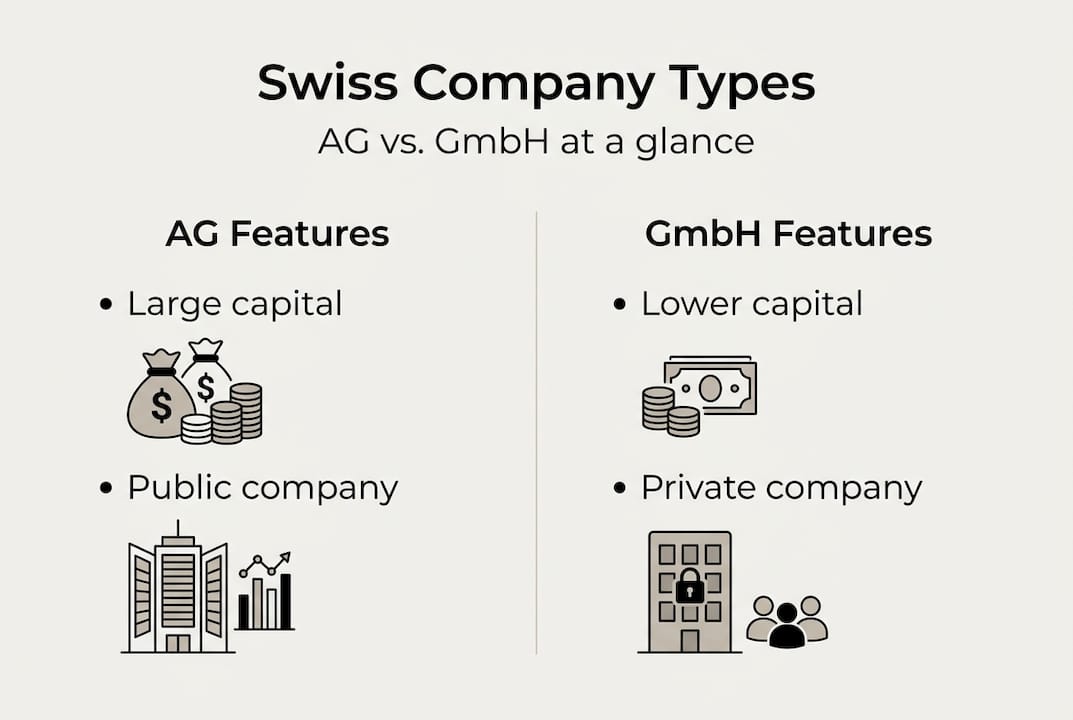
The Aktiengesellschaft (AG) functions as a public limited company ideal for larger businesses seeking to raise capital through public markets. It requires a minimum share capital of 100,000 CHF, with at least 50,000 CHF paid in at formation. AG shares can be freely traded and transferred, making this structure attractive for companies planning expansion or investor rounds. The governance structure includes a board of directors and general assembly of shareholders, with more formal reporting and disclosure requirements.
The Gesellschaft mit beschränkter Haftung (GmbH) operates as a private limited company suited to smaller, closely held businesses. It demands only 20,000 CHF minimum capital, fully paid at formation. Unlike AG shares, GmbH membership interests cannot be publicly traded and require notarized transfer agreements. This structure offers simpler management rules and reduced disclosure obligations, making it popular with family businesses and foreign entrepreneurs starting their Swiss operations.
Both structures provide limited liability protection, shielding personal assets from business debts. The company itself bears responsibility for obligations, with shareholders risking only their invested capital. This protection remains consistent whether you choose AG or GmbH.
Here are the core differences:
AG allows public share trading while GmbH restricts ownership transfers
AG requires double the minimum capital of GmbH
AG faces stricter audit and disclosure requirements
GmbH offers more flexible governance and decision making
AG suits businesses planning IPOs or significant fundraising
Feature | AG | GmbH |
Minimum capital | 100,000 CHF | 20,000 CHF |
Capital paid at formation | 50,000 CHF | 20,000 CHF |
Share transferability | Freely tradable | Restricted, notarized |
Audit requirement | Mandatory for most | Limited scope |
Governance complexity | Higher | Lower |
Public disclosure | Extensive | Minimal |
Pro Tip: If you plan to attract venture capital or institutional investors within three years, start with an AG despite higher setup costs. Converting from GmbH to AG later involves significant legal expenses and administrative burden.
Key factors to consider when choosing your Swiss company type
Your business goals and operational needs should drive the structure decision, not just the lower formation cost. Tax implications and capital requirements significantly affect the strategic choice of company type for foreign investors.
Capital availability shapes your initial options. If you have 100,000 CHF available but only need to deploy 50,000 CHF immediately, AG becomes viable. However, tying up capital in minimum share requirements might limit your operational flexibility. GmbH’s 20,000 CHF threshold makes it accessible for bootstrapped startups and entrepreneurs testing the Swiss market before committing larger resources.
Liability protection matters equally across both structures, but your risk tolerance affects governance preferences. AG’s formal board structure and shareholder meetings create accountability layers that some investors value. GmbH allows more informal decision making, which suits owner operators who want direct control without extensive corporate formalities.

Shareholder composition influences your choice significantly. Planning to bring in multiple investors or partners? AG’s freely transferable shares simplify equity transactions and future fundraising rounds. GmbH works better when you want to maintain tight control over who owns your company, as every ownership transfer requires notarization and existing member approval.
Swiss tax treatment varies by canton rather than company type, but your structure affects dividend taxation and profit distribution flexibility. Both AG and GmbH face corporate income tax, but the way you extract profits as an owner differs. Consider how you plan to compensate yourself, whether through salary, dividends, or a combination.
International perception plays a role in B2B relationships and banking. Some European partners view AG as more established and credible for larger transactions. However, this perception gap has narrowed as GmbH structures have become common throughout German speaking business communities.
Here are the top considerations for foreign investors evaluating company types:
Available startup capital and cash flow projections for first 18 months
Number of founders and planned investor involvement
Desired governance complexity and administrative capacity
Industry norms and client expectations in your sector
Plans for future fundraising or public listing
Personal involvement level in daily operations
Pro Tip: Create a five year business projection before choosing your structure. If your model shows potential for 5 million CHF revenue by year three, start with AG even if you are small now. The conversion costs and disruption later will exceed any savings from choosing GmbH initially.
Step by step process to select and form your company type in Switzerland
Adhering to the formal Swiss company formation process ensures legal compliance and smooth business operations. Follow this systematic approach to move from decision to registered company.
Conduct preliminary research on your industry requirements and cantonal regulations. Some sectors face restrictions on foreign ownership or require special permits regardless of company type. Verify that your business activity is permissible and identify any licensing needs before committing to a structure.
Prepare your formation documents including articles of association, shareholder agreements, and capital contribution proof. Articles must specify company purpose, registered address, share capital, and governance rules. Have these documents professionally drafted in German, French, or Italian depending on your canton.
Open a capital deposit account at a Swiss bank and transfer the required minimum capital. The bank issues a confirmation letter proving the funds are blocked for company formation. This step often creates delays for foreign investors without existing Swiss banking relationships.
Notarize your formation documents at a Swiss notary office. All founders must appear in person or grant power of attorney to a Swiss resident. The notary verifies identities, confirms capital deposit, and authenticates the articles of association.
Register your company with the cantonal Commercial Registry. Submit notarized documents, capital confirmation, and registry application forms. The registry reviews your submission for completeness and legal compliance before approving registration.
Obtain your company identification number and register for VAT if your projected revenue exceeds 100,000 CHF annually. Complete social insurance registrations for any employees, including yourself if taking salary.
Formation Step | AG Timeline | GmbH Timeline | Typical Cost |
Document preparation | 1-2 weeks | 1-2 weeks | 1,500-3,000 CHF |
Bank account opening | 2-4 weeks | 2-4 weeks | 200-500 CHF |
Notarization | 1-2 days | 1-2 days | 1,500-2,500 CHF |
Registry approval | 1-2 weeks | 1-2 weeks | 600-800 CHF |
Total formation time | 5-9 weeks | 5-9 weeks | 3,800-6,800 CHF |
The complete checklist includes additional items like domain registration, business insurance, and accounting system setup. These parallel activities can proceed during registry approval.
Pro Tip: Start your bank account application before notarization. Swiss banks take two to four weeks to approve accounts for foreign nationals, and you cannot complete notarization without capital deposit confirmation. This parallel processing can cut three weeks from your formation timeline.
Common challenges and how to avoid mistakes in choosing your Swiss company type
Many foreign investors face delays or legal issues due to misunderstanding Swiss company law requirements. Learning from others’ mistakes saves time and money.
Insufficient capital planning creates immediate problems. Some entrepreneurs deposit exactly 20,000 CHF for GmbH formation, leaving no working capital for initial operations. Your minimum capital becomes locked in the company and cannot cover formation costs, which run 4,000 to 7,000 CHF. Budget for minimum capital plus at least 10,000 CHF additional working capital.
Unclear governance structures cause partner conflicts later. Failing to document decision making processes, profit distribution rules, and exit procedures in your articles of association leads to disputes. These foundational documents are difficult and expensive to modify after registration. Invest time upfront to address scenarios like deadlock resolution, new partner admission, and buyout terms.
Ignoring tax consequences costs money annually. Some foreign investors choose GmbH for lower formation costs without analyzing how their canton taxes dividend distributions versus salary income. The structure you select affects your personal tax burden, not just corporate obligations. Model different compensation scenarios before deciding.
Here are the top five mistakes and prevention strategies:
Choosing based solely on formation cost rather than long term business model
Underestimating timeline and missing market opportunities due to delays
Failing to verify director residency requirements before starting formation
Selecting inappropriate registered address that limits business credibility
Skipping professional legal review of articles and shareholder agreements
“The company structure you choose at formation shapes your options for years. Changing from GmbH to AG or restructuring governance requires shareholder approval, notarization, and registry amendments. These modifications cost 5,000 to 15,000 CHF and take months to complete. Getting it right initially is worth the extra planning time.”
Documentation errors cause the most formation delays. Missing signatures, incorrect capital amounts, or improperly translated documents force resubmission and extend your timeline by weeks. The Commercial Registry rejects incomplete applications without detailed feedback, leaving you to identify problems yourself.
Foreign investors often underestimate the director residency requirement. Swiss law mandates that at least one AG board member or GmbH managing director must reside in Switzerland. If you lack Swiss residency, you need to appoint a local director or use a professional director service, adding 3,000 to 8,000 CHF annually to your costs.
Pro Tip: Engage a Swiss business formation specialist before you start document preparation. They identify jurisdiction specific requirements, recommend optimal structure for your situation, and manage the entire process. Their fees of 2,000 to 4,000 CHF are recovered through faster approval, fewer mistakes, and better structural decisions that save money over time.
Explore professional Swiss company formation services
Navigating Swiss company formation requirements becomes simpler with expert guidance. RPCS Solutions specializes in helping international entrepreneurs establish the right company structure efficiently.
Swiss company formation services from RPCS cover everything from initial structure consultation through final registry approval. You get personalized advice on whether AG or GmbH fits your business model, complete document preparation in the required language, and coordination with notaries and registry offices. The team handles complex requirements like director appointments and registered address provision.
Beyond formation, RPCS assists with Swiss bank account opening for foreign nationals, a process that typically creates significant delays. Their banking relationships and application support help you secure accounts faster. They also provide business address services if you need a prestigious Swiss location without physical office costs. This complete support system means you avoid the common pitfalls that delay or derail company formation for foreign investors.
FAQ
Which Swiss company type is best for startups?
GmbH typically suits early stage startups with limited capital and fewer shareholders. The 20,000 CHF minimum capital requirement is more accessible, and the simpler governance structure reduces administrative overhead. However, if you plan to raise venture capital within two years, AG provides easier equity transactions and better alignment with institutional investor expectations.
How much minimum capital is needed for AG and GmbH?
AG requires 100,000 CHF minimum share capital, with at least 50,000 CHF paid at formation. GmbH needs 20,000 CHF minimum capital, fully paid when you register the company. These amounts must be deposited in a Swiss bank and remain as company equity. You cannot use minimum capital to pay formation costs or initial operating expenses.
Can foreigners fully own a Swiss company?
Foreigners can own 100% of Swiss AG or GmbH companies without restrictions in most industries. However, you must comply with director residency rules requiring at least one board member or managing director to reside in Switzerland. If you lack Swiss residency, you need to appoint a local director or use professional director services to meet this legal requirement.
What are the tax benefits of forming a company in Switzerland?
Switzerland offers attractive tax rates and incentives that benefit company owners financially. Corporate income tax rates vary by canton, ranging from 11% to 21% effective rates when combining federal, cantonal, and municipal taxes. Some cantons provide special tax status for holding companies, reducing taxation on qualifying income. The specific benefits depend on your company type, location, and business activities, making professional tax planning essential.
Recommended
Comments