
Company secretary role in Switzerland explained 2026
- 2 days ago
- 9 min read

Many international entrepreneurs assume the company secretary role in Switzerland mirrors practices in the UK or US, where the position carries formal legal obligations and statutory mandates. In reality, Swiss corporate law treats this role with greater flexibility, making it optional for many business structures while still critical for governance and compliance. Understanding these distinctions helps you navigate Swiss company formation with confidence and avoid costly missteps that stem from misapplied assumptions about corporate administration.
Table of Contents
Key takeaways
Point | Details |
Company secretary role varies | Swiss law does not mandate company secretaries for all AG or GmbH structures, unlike some jurisdictions. |
Core duties center on compliance | Responsibilities include maintaining corporate records, organizing meetings, and ensuring regulatory filings. |
Role differs internationally | Swiss company secretaries typically do not hold director responsibilities, contrasting with UK and US practices. |
Appointment enhances governance | Hiring a qualified company secretary strengthens compliance and supports board effectiveness. |
Legal framework is flexible | Swiss corporate law allows companies to tailor the secretary role to their specific governance needs. |
Legal foundations of the company secretary role in Switzerland
Swiss corporate law establishes distinct frameworks for business entities, primarily the Aktiengesellschaft (AG) and Gesellschaft mit beschränkter Haftung (GmbH). These structures form the backbone of Swiss commerce, yet neither mandates a company secretary by statute. The Swiss company secretaries have specific governance and compliance duties set by Swiss corporate law, but companies retain discretion in defining and filling this position based on operational complexity and governance preferences.
The absence of a statutory requirement creates flexibility for international investors establishing Swiss entities. Unlike jurisdictions where company secretaries must be appointed by law, Switzerland allows businesses to determine whether the role adds value to their specific governance model. This approach reflects Swiss corporate philosophy, which emphasizes practical governance over rigid formalism while maintaining strict compliance standards for core obligations like financial reporting and shareholder communication.
Despite this flexibility, larger AG companies and those with international shareholders often appoint company secretaries to manage the administrative burden of Swiss corporate law for AG and GmbH compliance. The role becomes particularly valuable when navigating complex governance structures, multiple board members, or frequent shareholder meetings that require meticulous documentation and coordination with regulatory authorities.
Key governance responsibilities typically assigned to company secretaries include:
Maintaining accurate shareholder registers and corporate books
Coordinating with external auditors and legal advisors
Managing communication between the board and regulatory bodies
Ensuring compliance with Swiss Code of Obligations requirements
Preparing documentation for annual general meetings
A common misconception among foreign entrepreneurs holds that Swiss companies must appoint a company secretary similar to UK requirements. This assumption can lead to unnecessary costs or, conversely, neglecting valuable governance support that a secretary provides. The reality lies between these extremes: while not legally required, the role delivers substantial benefits for companies prioritizing professional administration and compliance rigor.
Pro Tip: Before establishing your Swiss company, clarify whether your business complexity justifies a dedicated company secretary by evaluating factors like shareholder count, board size, and regulatory reporting frequency. This assessment helps you allocate resources effectively while maintaining governance standards that satisfy investors and authorities.
Core duties and responsibilities of company secretaries in Swiss companies
The practical responsibilities of company secretaries in Switzerland center on maintaining corporate hygiene and supporting board effectiveness. Company secretaries manage board meeting minutes, shareholder registers, regulatory filings, and support corporate governance, creating a foundation for legal compliance and operational transparency that protects both the company and its stakeholders.

Corporate record maintenance forms the bedrock of the secretary role. This includes keeping the share register current with accurate ownership details, maintaining minutes of board and shareholder meetings, and preserving corporate resolutions in accessible formats. Swiss authorities expect these records to be immediately available during audits or regulatory inquiries, making systematic documentation essential for avoiding penalties and demonstrating good faith compliance.
Board support represents another critical dimension of the company secretary function. Secretaries coordinate meeting schedules, prepare agendas in consultation with directors, distribute materials in advance, and ensure quorum requirements are met. During meetings, they capture accurate minutes that reflect decisions, voting outcomes, and action items. This documentation serves as the official record of corporate governance and provides legal protection when decisions are later questioned or reviewed.
Regulatory filing responsibilities demand careful attention to deadlines and procedural requirements. Company secretaries track submission dates for annual administration and compliance obligations, coordinate with accountants and auditors to gather necessary financial statements, and ensure filings reach cantonal commercial registers and federal authorities on time. Late submissions trigger fines and can jeopardize a company’s good standing, making this function particularly valuable for busy entrepreneurs managing multiple priorities.
The secretary also serves as a liaison between the company and external parties. This includes coordinating with notaries for shareholder resolutions requiring authentication, managing communication with auditors during annual reviews, and responding to inquiries from cantonal commercial registers. These relationships require diplomatic skill and procedural knowledge to navigate Swiss administrative processes efficiently.
Top five company secretary duties in Swiss business context:
Maintaining and updating the official shareholder register with current ownership information
Recording comprehensive minutes of all board meetings and annual general meetings
Coordinating regulatory filings with cantonal registers and federal authorities
Supporting the board of directors role in Switzerland through administrative and procedural guidance
Managing corporate document retention and ensuring accessibility for audits and reviews
These responsibilities require a blend of legal knowledge, administrative precision, and interpersonal skills. Effective company secretaries anticipate governance needs, proactively address compliance gaps, and create systems that reduce administrative burden on directors while maintaining rigorous standards. This support becomes especially valuable for international entrepreneurs unfamiliar with Swiss procedural norms and regulatory expectations.
Comparing Swiss company secretary roles with other jurisdictions
Understanding how the Swiss company secretary role differs from international counterparts helps you avoid transplanting inappropriate governance models when establishing your Swiss entity. Swiss company secretary roles differ significantly from UK and US practices, especially regarding mandatory appointments and directorial duties, creating a distinct operational framework that reflects Swiss corporate philosophy and legal traditions.
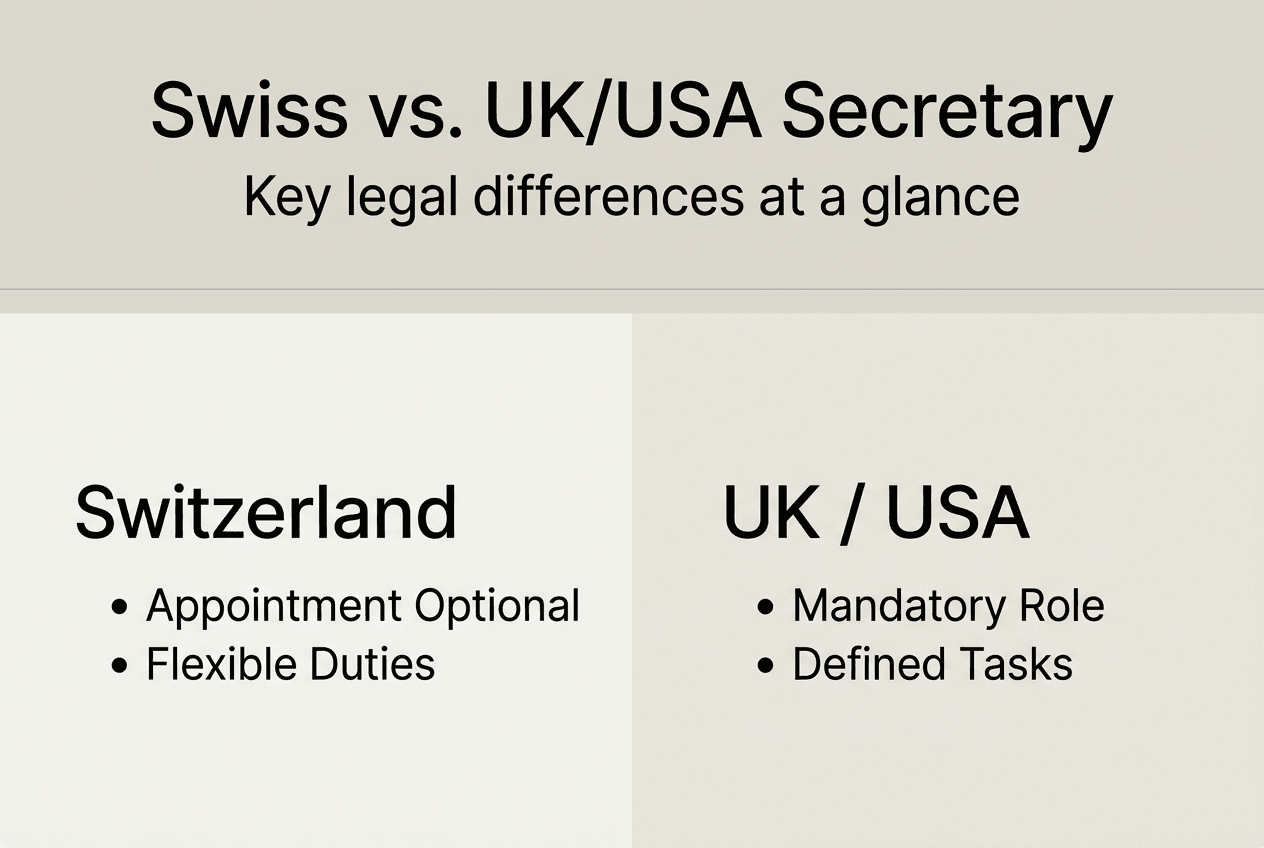
In the United Kingdom, every private limited company must appoint a company secretary or assign secretary duties to a director, creating a statutory obligation that shapes corporate structure from inception. UK company secretaries carry significant legal responsibilities, including ensuring compliance with the Companies Act, maintaining statutory registers, and filing returns with Companies House. The role carries potential personal liability for failures, elevating its importance and formality within British corporate governance.
United States corporate law varies by state but generally does not mandate a company secretary position in the Swiss or UK sense. Instead, US corporations typically designate a corporate secretary as an officer responsible for maintaining corporate records and managing shareholder communications. This role focuses heavily on documenting board actions and ensuring compliance with state corporate law requirements, but it lacks the standardized statutory framework found in UK practice.
Feature | Switzerland | United Kingdom | United States |
Mandatory appointment | Optional for most companies | Required for private limited companies | Varies by state, generally optional |
Legal liability | Limited, primarily administrative | Significant personal liability possible | Moderate, depends on state law |
Director responsibilities | Separate from director roles | Can be combined with director duties | Often held by officers or directors |
Statutory duties | Flexible, company defined | Defined by Companies Act | Defined by state corporate codes |
Regulatory filing role | Important but not exclusive | Central responsibility | Varies by corporate structure |
The Swiss approach prioritizes flexibility and practical governance over rigid statutory requirements. This reflects broader Swiss legal philosophy, which trusts companies to develop appropriate governance structures while enforcing strict compliance with core obligations like financial transparency and shareholder protection. The result is a system where company secretaries add value through expertise rather than fulfilling a checkbox requirement.
For international investors, these differences matter when structuring governance for Swiss subsidiaries or relocating operations to Switzerland. Importing UK governance models wholesale can create unnecessary complexity and cost, while assuming US informality may leave compliance gaps that Swiss authorities find unacceptable. The optimal approach adapts Swiss company roles comparison to your specific business needs while respecting local norms and expectations.
Pro Tip: When establishing a Swiss company, resist the temptation to replicate your home country governance structure exactly. Instead, consult with Swiss corporate advisors to design a model that satisfies local expectations while leveraging the flexibility Swiss law provides. This tailored approach optimizes both compliance and operational efficiency.
Practical considerations for entrepreneurs when appointing a company secretary in Switzerland
Selecting and working effectively with a company secretary requires careful evaluation of your company’s governance needs and the candidate’s qualifications. The decision to appoint a secretary should flow from a realistic assessment of administrative complexity, board size, shareholder count, and regulatory obligations rather than reflexive adherence to foreign corporate norms.
Qualifications matter significantly when evaluating potential company secretaries. Look for candidates with demonstrated knowledge of Swiss corporate law, experience with AG or GmbH administration, and familiarity with cantonal commercial register procedures. Many effective company secretaries hold backgrounds in corporate law, accounting, or business administration, bringing cross-functional expertise that enhances their value beyond pure administrative support.
Experience with international business structures adds particular value for foreign entrepreneurs. A secretary who understands cross-border governance challenges, multilingual documentation requirements, and the expectations of international investors can bridge cultural and procedural gaps that might otherwise create friction or compliance issues. This expertise becomes especially valuable when coordinating with foreign parent companies or managing shareholder communications across jurisdictions.
Checklist for confirming company secretary duties:
Maintaining current shareholder register with ownership percentages
Recording minutes of all board and shareholder meetings
Tracking and coordinating regulatory filing deadlines
Managing corporate document retention and accessibility
Liaising with auditors, notaries, and commercial registers
Supporting board with procedural guidance and governance best practices
Ensuring compliance with compliance risks and company secretary mitigation strategies
Compliance Risk | Company Secretary Impact | Mitigation Value |
Late regulatory filings | High | Prevents fines and maintains good standing |
Incomplete corporate records | High | Ensures audit readiness and legal defensibility |
Inadequate meeting documentation | Medium | Protects directors and validates decisions |
Shareholder communication gaps | Medium | Maintains transparency and investor confidence |
Procedural governance errors | Low to Medium | Reduces administrative burden on directors |
Common pitfalls when appointing or working with company secretaries include:
Underestimating the time commitment required for proper corporate administration
Failing to provide secretaries with timely information needed for accurate record keeping
Confusing the secretary role with director responsibilities or decision making authority
Neglecting to establish clear communication protocols between secretary and board
Assuming a part time or outsourced secretary can manage complex governance needs without adequate support
Best practices center on clear role definition, regular communication, and appropriate resource allocation. Define the secretary’s responsibilities explicitly in writing, establish regular check ins to review compliance status and upcoming obligations, and ensure the secretary has access to necessary information and decision makers. This structure creates accountability while empowering the secretary to perform effectively.
Pro Tip: Leverage your company secretary as a governance resource for board members, especially those unfamiliar with Swiss corporate procedures. A knowledgeable secretary can provide informal coaching on Swiss governance norms, helping directors fulfill their responsibilities while avoiding procedural missteps that could create liability or compliance issues. This educational function often delivers value far exceeding the secretary’s direct administrative contributions.
How RPCS Solutions supports your Swiss company setup
Navigating Swiss company formation and ongoing administration requires expertise that many international entrepreneurs lack when entering the market. RPCS Solutions specializes in Swiss company formation services that streamline establishment while ensuring compliance with cantonal and federal requirements from day one. Our team handles legal documentation, notarization, commercial register filings, and coordination with authorities, removing administrative burden while you focus on business development.

Beyond formation, we provide comprehensive support for ongoing corporate administration, including company secretary services tailored to your governance needs. Whether you require full service corporate administration or targeted support for specific compliance obligations, our solutions scale with your business. We also offer business and company address in Switzerland services that establish your Swiss presence professionally, plus accounting services in Switzerland that ensure financial compliance and transparency. This integrated approach delivers the expertise international investors need to succeed in Switzerland’s dynamic business environment.
FAQ
What is a company secretary in Switzerland?
A company secretary in Switzerland is a corporate officer responsible for governance support, compliance coordination, and administrative duties as defined by company needs and Swiss corporate law. The role supports the board of directors by maintaining corporate records, organizing meetings, and ensuring regulatory obligations are met on time. While not always mandatory under Swiss law, the position delivers significant value for companies prioritizing professional administration and governance rigor.
Is a company secretary mandatory for Swiss AG or GmbH companies?
Company secretaries are not mandatory for all Swiss AG or GmbH companies under statutory law, giving businesses flexibility in structuring their governance. However, appointing a company secretary is strongly recommended for companies with complex governance structures, multiple shareholders, or significant regulatory obligations. The role is more common in larger companies, publicly traded entities, and businesses with international shareholders who expect professional corporate administration consistent with global governance standards.
What are the main duties of a company secretary in Switzerland?
The main duties include maintaining accurate shareholder registers and corporate records, organizing and documenting board and shareholder meetings, coordinating regulatory filings with cantonal and federal authorities, and supporting the board with governance and procedural guidance. Company secretaries also liaise with external auditors, notaries, and commercial registers to ensure smooth compliance processes. These responsibilities create a foundation for legal compliance and operational transparency that protects both the company and its stakeholders from governance risks.
How does the company secretary role in Switzerland differ from other countries?
The Swiss company secretary role is generally less formalized and not statutorily mandatory compared to the United Kingdom, where every private limited company must appoint a secretary or assign duties to a director. Unlike some jurisdictions, Swiss company secretaries typically do not hold director responsibilities or carry the same level of personal legal liability. The role focuses more on compliance support and administrative coordination than on decision making authority, reflecting Swiss corporate law’s emphasis on flexibility and practical governance over rigid statutory requirements.
Recommended
Comments