
Business immigration Switzerland 2026: Entrepreneur guide
- Mar 19
- 8 min read

Switzerland attracts entrepreneurs worldwide with its stable economy and favorable business climate, but many assume business immigration is a straightforward visa process. In reality, obtaining a work and residence permit through self-employment demands proving economic benefit, navigating strict permit quotas, and understanding cantonal priorities. Non-EU nationals face particularly rigorous requirements, including demonstrating active management and aligning business plans with local economic interests. This 2026 guide clarifies permit types, incorporation requirements, and strategic steps to successfully establish your Swiss company while securing residency.
Table of Contents
Eligibility Criteria And Business Incorporation Requirements
Cantonal Variations, Economic Priorities, And Practical Steps For Application
Common Challenges And Strategic Tips For Successful Business Immigration
How Rpcs Solutions Can Support Your Swiss Company Formation And Immigration
Frequently Asked Questions About Business Immigration In Switzerland
Key takeaways
Point | Details |
Active management required | Entrepreneurs must demonstrate hands-on business involvement and economic contribution, not passive investment. |
EU/EFTA advantage | Free movement agreements allow simpler permit access for EU/EFTA nationals compared to quota-based non-EU routes. |
No startup visa | Switzerland lacks a dedicated startup visa as of 2026, requiring entrepreneurs to use standard self-employment permits. |
Capital varies by structure | GmbH requires CHF 20,000 minimum capital while AG demands CHF 100,000 for incorporation. |
Cantonal priorities matter | Tailoring your business plan to local economic sectors like tech or healthcare improves permit approval chances. |
Overview of business immigration permits in Switzerland
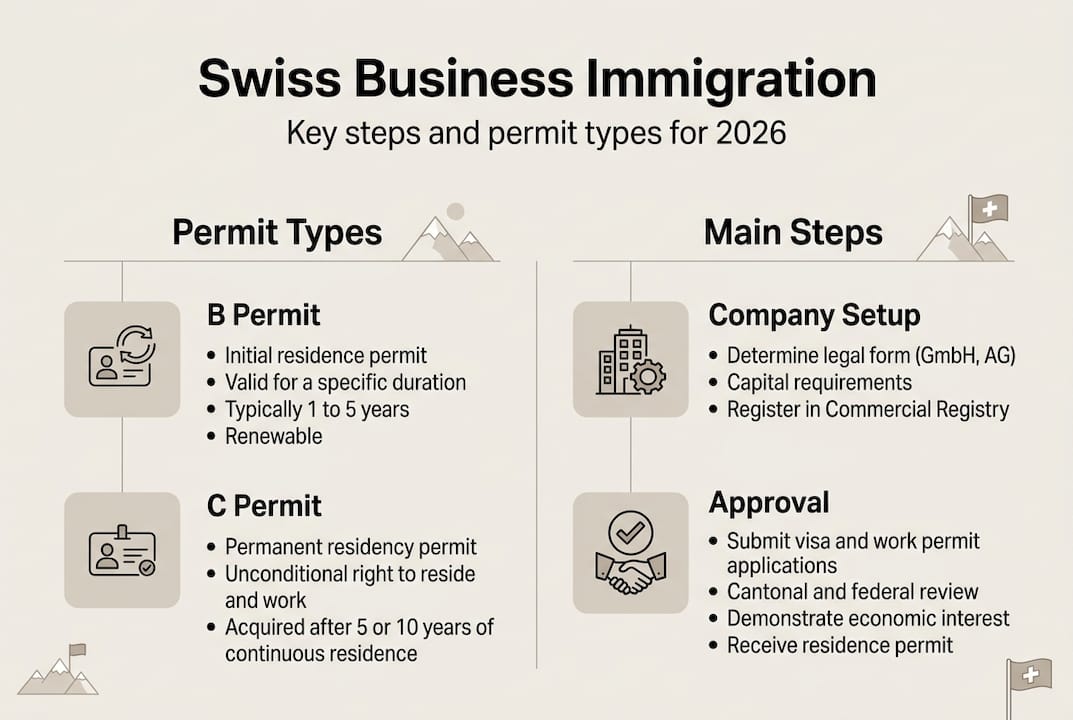
Business immigration to Switzerland centers on the B permit, the principal route for entrepreneurs establishing themselves as self-employed residents. This permit requires you to create or manage a Swiss company that delivers measurable economic benefit to your chosen canton. Unlike tourist or short-term visas, the B permit grants you legal authorization to live and actively operate your business within Switzerland.
Your nationality significantly impacts permit accessibility. EU/EFTA nationals benefit from streamlined requirements under the Free Movement of Persons agreement, needing only a viable business plan, sufficient funds, and mandatory insurance to qualify. Non-EU nationals face stricter conditions, including quota limitations and heightened scrutiny of economic merit.
For 2026, Switzerland allocated 4,500 B permits and 4,000 L permits for third-country nationals, with entrepreneur permits forming a subset of these quotas. Interestingly, historical data shows these quotas are often underutilized, suggesting opportunities exist if you meet stringent criteria. Cantonal authorities evaluate applications based on economic contribution rather than quota availability alone, prioritizing businesses that create jobs, drive innovation, or fill market gaps.
Key permit considerations include:
B permit duration: Initially granted for one year, renewable annually based on continued business activity and compliance.
Economic benefit assessment: Cantons review your business plan, projected revenue, employment creation, and alignment with local priorities.
Quota competition: Non-EU applicants compete within limited quotas, making strong business cases essential.
Family reunification: Approved entrepreneurs can bring immediate family members under the same permit framework.
“The permit system favors entrepreneurs who demonstrate active engagement and tangible economic impact, not merely capital investment. Passive investors rarely qualify under current 2026 regulations.”
Understanding these permit mechanics helps you position your application strategically. For detailed guidance on Swiss business permits for foreign entrepreneurs and requirements to move to Switzerland as an entrepreneur in 2026, explore specialized resources that break down nationality-specific pathways and documentation needs.
Eligibility criteria and business incorporation requirements
Qualifying for a Swiss entrepreneur permit demands more than capital. Non-EU/EFTA nationals must prove high skills, active management, and viable business plans showing job creation or innovation. Your business plan becomes the centerpiece of your application, requiring clear demonstration of how your venture benefits the canton economically.

While no fixed minimum investment exists across all cases, capital expectations align with your chosen company structure. A GmbH (limited liability company) requires at least CHF 20,000 in share capital, while an AG (corporation) demands CHF 100,000. These amounts must be fully paid and verifiable at incorporation. Beyond statutory minimums, authorities expect capital proportional to your business type and projected operations.
Choosing between GmbH and AG involves weighing capital, liability, and permit considerations:
Feature | GmbH | AG |
Minimum capital | CHF 20,000 | CHF 100,000 |
Liability | Limited to company assets | Limited to company assets |
Shareholder structure | Suitable for small teams | Preferred for larger ventures |
Administrative complexity | Lower compliance burden | Higher reporting requirements |
Permit perception | Adequate for most entrepreneurs | May signal stronger financial backing |
Your business plan must highlight specific elements that resonate with cantonal priorities:
Job creation potential: Outline hiring plans, skill levels needed, and timeline for employment growth.
Innovation or market differentiation: Explain how your business introduces new technologies, services, or approaches to the Swiss market.
Economic alignment: Demonstrate understanding of cantonal economic priorities, such as tech development, healthcare innovation, or sustainable industries.
Financial viability: Provide realistic revenue projections, cost structures, and break-even analysis supported by market research.
Active management commitment: Clarify your hands-on role, distinguishing yourself from passive investors who merely provide capital.
Tailoring business plans to cantonal economic priorities significantly improves approval chances. Cantons favor entrepreneurs who fill local skill gaps or contribute to strategic sectors. For example, Zurich emphasizes fintech and digital services, while Basel prioritizes life sciences and pharmaceuticals.
EU/EFTA entrepreneurs enjoy simplified requirements under free movement agreements. You still need a solid business plan and adequate capital, but face fewer bureaucratic hurdles and no quota restrictions. Permit approvals typically process faster, often within weeks rather than months.
Pro Tip: Before finalizing your company structure, consult with cantonal economic development offices to understand current priorities and align your business plan accordingly. This proactive approach demonstrates commitment and increases approval likelihood.
For comprehensive support navigating company formation in Switzerland and understanding Swiss banking requirements, leverage specialized resources that guide you through documentation, notarization, and registration processes.
Cantonal variations, economic priorities, and practical steps for application
Switzerland’s federal structure grants cantons significant autonomy in permit approvals, creating variations in priorities and processes. Cantonal preferences emphasize innovation sectors like technology, healthcare, and sustainable industries. Understanding these local priorities helps you position your business strategically.
Each canton evaluates applications based on specific economic goals. Geneva favors international trade and commodity businesses, while Vaud emphasizes life sciences and research. Zug attracts crypto and blockchain ventures with favorable tax treatment. Researching cantonal economic development strategies before choosing your business location maximizes approval chances.
The application process involves several coordinated steps:
Company incorporation: Register your GmbH or AG with the commercial register, completing notarization and capital deposit requirements.
Business plan submission: Present detailed plans to cantonal migration authorities, highlighting economic benefit and active management.
Proof of funds: Demonstrate sufficient capital for both company operations and personal living expenses during the initial period.
Insurance coverage: Secure mandatory health insurance and potentially liability coverage depending on your business type.
Cantonal approval: Await cantonal review, which may include interviews or requests for additional documentation.
Federal coordination: After cantonal approval, federal authorities conduct final checks before issuing permits.
Processing times vary significantly by canton and nationality. EU/EFTA applications often conclude within 4-8 weeks, while non-EU cases may extend 3-6 months due to quota considerations and deeper scrutiny.
Application Stage | EU/EFTA Timeline | Non-EU Timeline |
Company incorporation | 2-4 weeks | 2-4 weeks |
Cantonal review | 2-4 weeks | 6-12 weeks |
Federal processing | 1-2 weeks | 4-8 weeks |
Total estimated time | 5-10 weeks | 12-24 weeks |
Family reunification becomes possible once you secure your entrepreneur permit. Spouses and dependent children can join you in Switzerland, subject to proving adequate housing and financial means to support them. This provision makes Switzerland attractive for entrepreneurs relocating with families.
Long-term residency pathways open after sustained business activity. You can apply for a C permit (permanent residence) after 5-10 years of continuous legal residence, depending on your nationality and canton. EU/EFTA nationals typically qualify after 5 years, while non-EU nationals may wait 10 years. Permanent residency removes renewal requirements and provides greater stability.
Pro Tip: Engage local business consultants or chambers of commerce in your target canton early in the process. They provide insights into unstated preferences and can introduce you to relevant networks, strengthening your application and future business prospects.
Explore resources on benefits of Swiss residency for entrepreneurs and founder shares in Switzerland to understand equity structures and residency advantages. For broader immigration context, review global visa and immigration advice services to compare Switzerland’s approach with other jurisdictions.
Common challenges and strategic tips for successful business immigration
Entrepreneurs face distinct obstacles when pursuing Swiss business immigration. The absence of a dedicated startup visa complicates entry for international founders, forcing them into standard self-employment permit categories designed for established businesses. This mismatch creates friction for early-stage ventures lacking extensive track records or immediate profitability.
Quota limitations for non-EU nationals present another hurdle. While 2026 allocations include 4,500 B permits, entrepreneur applications compete with other employment categories. However, empirical data reveals quota underutilization, suggesting opportunities exist if you meet quality criteria. Cantonal authorities prioritize economic merit over quota availability, meaning strong applications succeed even in competitive years.
Retention challenges affect Switzerland’s entrepreneurial ecosystem despite high-skilled immigration benefits. Many foreign entrepreneurs struggle with cultural integration, administrative complexity, or restrictive permit renewal conditions. Business migration constitutes nearly half of regulated labor immigration, yet retention rates lag compared to traditional employment categories.
Strategic approaches to overcome these challenges include:
Align with cantonal priorities: Research specific industries and skill gaps in your target canton, tailoring your business model to address these needs explicitly.
Demonstrate active engagement: Clearly differentiate your hands-on management role from passive investment, emphasizing daily operational involvement and strategic decision-making.
Build local partnerships: Establish relationships with Swiss suppliers, customers, or advisors before applying, demonstrating market validation and integration commitment.
Prepare comprehensive documentation: Anticipate requests for financial projections, market analysis, and operational plans by assembling thorough materials upfront.
Consider multiple cantons: If one canton’s priorities don’t align with your business, explore alternatives with better strategic fit.
“Success in Swiss business immigration requires treating your permit application as seriously as your business plan. Cantonal authorities seek entrepreneurs who contribute meaningfully to local economies, not merely individuals seeking residency through minimal business activity.”
Pro Tip: If you’re launching an innovative startup, consider initially incorporating in a canton with strong startup ecosystems like Zurich or Vaud, even if living costs are higher. The supportive infrastructure, investor networks, and favorable cantonal attitudes toward innovation can offset initial expense and significantly improve permit approval odds.
For specialized guidance on navigating Swiss business visas in 2026 and understanding why Switzerland attracts startups, explore resources that detail regulatory frameworks and competitive advantages.
How RPCS Solutions can support your Swiss company formation and immigration
Navigating Swiss company formation and business immigration requires expertise in legal structures, cantonal regulations, and compliance requirements. RPCS specializes in streamlining these processes for international entrepreneurs, offering comprehensive company formation services that handle documentation, notarization, and commercial register filings efficiently.

Beyond incorporation, RPCS provides registered business and company addresses in Switzerland, essential for entrepreneurs not yet physically present in the country. Maintaining compliance with Swiss regulations becomes simpler through reliable accounting services that ensure accurate financial reporting and tax adherence. Whether you’re establishing a GmbH or AG, RPCS experts guide you through capital requirements, shareholder agreements, and permit application preparation, helping you present the strongest possible case to cantonal authorities in 2026.
Frequently asked questions about business immigration in Switzerland
What is the typical processing time for a business immigration permit in Switzerland?
EU/EFTA nationals typically receive permits within 5-10 weeks, while non-EU applicants face 12-24 weeks due to quota considerations and deeper cantonal review. Processing times vary by canton, with some offering faster tracks for priority sectors.
Is there a minimum investment required to qualify for a Swiss entrepreneur residence permit?
No universal minimum exists, but capital must align with your company structure. GmbH requires CHF 20,000 minimum while AG demands CHF 100,000. Authorities expect capital proportional to your business type and operational needs beyond these statutory minimums.
Can family members join me under a business immigration permit?
Yes, approved entrepreneurs can bring spouses and dependent children through family reunification provisions. You must demonstrate adequate housing and financial means to support family members without relying on social assistance.
Why doesn’t Switzerland have a dedicated startup visa?
Switzerland’s permit system evolved for traditional businesses rather than early-stage ventures. Industry advocates continue pushing for startup-specific visas to reduce barriers for international founders, but as of 2026, no dedicated category exists despite recognition of economic benefits.
How long until I can apply for permanent residency through business immigration?
EU/EFTA nationals qualify for C permits after 5 years of continuous legal residence, while non-EU nationals typically wait 10 years. Permanent residency requires sustained business activity, clean legal record, and demonstrated integration into Swiss society.
Recommended
Comments