
Key documents for Swiss company formation in 2026
- Mar 20
- 10 min read

Establishing a company in Switzerland offers international entrepreneurs access to favorable tax regimes, global credibility, and political stability. However, many foreign investors find the documentation requirements complex and overwhelming. Understanding the seven key documents for Swiss company formation is essential for smooth incorporation of GmbH and AG structures. This guide breaks down each critical document, explains notarization processes, outlines submission procedures, and reveals ongoing compliance requirements to help you navigate Swiss company formation with confidence in 2026.
Table of Contents
Key takeaways
Point | Details |
Seven critical documents | Articles of Association, Declaration of Incorporators, Shareholder Register, notarized signatures, proof of capital deposit, Commercial Register application, and bank confirmation letter are required. |
Notarization mandatory | All official company formation documents must be authenticated by a Swiss notary to comply with legal standards. |
GmbH versus AG differences | Document requirements vary between company types, particularly regarding minimum capital and shareholder disclosures. |
Timeline acceleration | Proper document preparation can reduce incorporation time by up to 35% compared to incomplete submissions. |
Professional assistance | Expert services simplify complex documentation, ensure compliance, and prevent costly delays in the formation process. |
Essential documents for Swiss company formation
Forming a Swiss company requires precise documentation that meets strict legal standards. The seven key documents for Swiss company formation serve as the foundation for your GmbH or AG incorporation. Each document plays a specific role in establishing your company’s legal identity and proving compliance with Swiss commercial law.
The Articles of Association represent your company’s constitutional framework. This document outlines your business purpose, share capital structure, shareholder rights, and governance rules. For a GmbH, you need minimum capital of CHF 20,000, while an AG requires CHF 100,000. The Articles must specify how shares are distributed, voting procedures, and profit allocation mechanisms.
Your Declaration of Incorporators formally identifies all founding members and their commitments. This document includes personal details of each incorporator, their capital contributions, and signatures confirming their intent to establish the company. Swiss authorities scrutinize this declaration to verify that all parties meet legal requirements for company ownership.
The Shareholder Register maintains a comprehensive record of all equity holders. This living document tracks ownership percentages, share transfers, and beneficial ownership information. Swiss law mandates accurate shareholder records to ensure transparency and prevent money laundering. You must update this register whenever ownership changes occur.
Notarized signatures authenticate all incorporation documents. A licensed Swiss notary verifies the identity of signatories and witnesses their signatures on critical paperwork. This legal formality ensures document authenticity and protects against fraud. Without proper notarization, Swiss authorities will reject your application.
Proof of capital deposit demonstrates that you have transferred the required minimum capital into a blocked Swiss bank account. The bank issues a confirmation letter stating the deposited amount and account holder details. This document proves your financial commitment and remains blocked until incorporation completes.

The Commercial Register application formally requests your company’s entry into Switzerland’s official business registry. This standardized form collects information about your company name, legal structure, business address, authorized signatories, and purpose. Accuracy is critical because errors trigger delays and potential rejections.
A bank confirmation letter verifies that your capital deposit meets Swiss requirements. The financial institution certifies the amount, currency, and account status. This document works in tandem with your proof of capital deposit to satisfy regulatory standards.
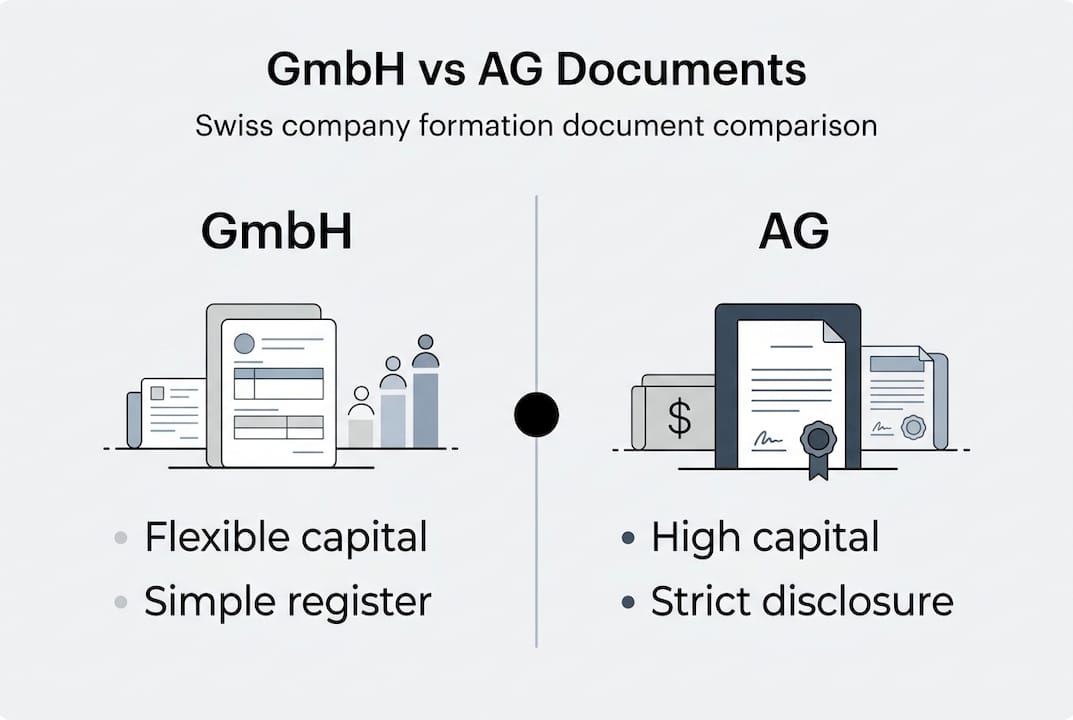
Key differences exist between GmbH and AG documentation. GmbH formations allow more flexibility in shareholder agreements and require less initial capital. AG companies face stricter disclosure requirements and must publish more detailed financial information. Understanding these distinctions helps you prepare appropriate documents for your chosen structure.
Pro Tip: Start gathering personal identification documents, proof of address, and business plan materials at least 60 days before your planned incorporation date to avoid rushed preparation and potential errors.
Preparing and notarizing your Swiss company documents
Document preparation demands meticulous attention to detail and adherence to Swiss legal standards. Following a structured approach ensures your paperwork meets all requirements and accelerates the incorporation timeline. Notarization accelerates company formation by up to 35% and remains mandatory for official documents in Switzerland.
Begin by drafting your Articles of Association using templates that comply with current Swiss commercial law. Customize the template to reflect your specific business structure, capital distribution, and governance framework. Include provisions for shareholder meetings, voting thresholds, and profit distribution mechanisms. Verify that all monetary amounts, percentages, and legal clauses align with 2026 regulations.
Next, compile accurate information for your Declaration of Incorporators. Gather certified copies of passports, proof of residence documents, and tax identification numbers for all founding members. Double check spelling of names, accuracy of addresses, and validity of identification documents. Even minor discrepancies can trigger rejections from Swiss authorities.
Prepare your Shareholder Register by documenting each equity holder’s personal details, share quantities, and ownership percentages. Create a systematic tracking method for future updates. Many entrepreneurs use specialized software to maintain this register, but a well organized spreadsheet also works effectively.
The notarization process requires scheduling appointments with a licensed Swiss notary. You can find qualified notaries through cantonal registries or professional legal networks. Bring all original documents, valid identification, and any required translations to your appointment. The notary will verify your identity, review document content, and witness your signatures.
Notarization serves as Switzerland’s primary defense against document fraud and ensures that all parties understand their legal commitments before finalizing incorporation.
Timeline implications vary by canton and notary availability. Urban centers like Zurich and Geneva typically offer faster appointment scheduling, while rural areas may require longer wait times. Budget two to three weeks for the complete notarization cycle, including document review and final certification.
Common mistakes during document preparation include incomplete shareholder information, incorrect capital amounts, missing signatures, and outdated legal clauses. Many entrepreneurs underestimate the importance of professional translation for non German, French, or Italian documents. All paperwork submitted to Swiss authorities must appear in an official language of the relevant canton.
Compliance with Swiss commercial law prevents costly delays and potential rejections. Familiarize yourself with cantonal variations in requirements, as some regions impose additional documentation standards. Staying current with 2026 regulatory updates ensures your documents meet the latest legal benchmarks.
Pro Tip: Request a preliminary document review from your chosen notary before the official appointment to identify and correct potential issues, saving time and avoiding rescheduling fees.
Submitting documentation and registration process
Successful incorporation depends on timely submission of accurate documents and proof of capital deposit. The Commercial Register application process follows standardized procedures, but understanding specific requirements prevents unnecessary delays and ensures smooth registration.
Submit your complete documentation package to the Commercial Register office in your chosen canton. The package must include notarized Articles of Association, Declaration of Incorporators, Shareholder Register, proof of capital deposit, bank confirmation letter, and the completed application form. Many cantons now accept electronic submissions through secure online portals, while others still require physical delivery.
The Commercial Register office reviews your submission for completeness and legal compliance. Officials verify that all signatures are properly notarized, capital requirements are met, and company name availability is confirmed. This review process typically takes five to ten business days, though complex applications may require additional time.
Swiss banks play a crucial role in confirming capital deposit. After you transfer the minimum required capital into a blocked formation account, the bank issues an official confirmation letter. This letter must state the exact amount deposited, the account holder name matching your company formation documents, and confirmation that funds remain blocked until registration completes.
Your registration timeline follows predictable milestones when documentation is complete:
Milestone | Typical Timeframe | Key Actions |
Document submission | Day 1 | Submit complete package to Commercial Register |
Initial review | Days 2 to 5 | Officials verify completeness and flag issues |
Corrections period | Days 6 to 10 | Address any identified deficiencies |
Final approval | Days 11 to 15 | Receive registration confirmation |
Capital release | Days 16 to 20 | Bank unfreezes deposited funds |
Common hurdles include incomplete paperwork, missing signatures, incorrect capital amounts, and name conflicts with existing companies. Incomplete shareholder information frequently triggers requests for additional documentation. Missing notarization stamps or outdated notary certifications also cause rejections.
To verify completion of registration, request an official extract from the Commercial Register. This document proves your company’s legal existence and includes your unique business identification number. Many entrepreneurs order multiple certified copies for banking relationships, tax registration, and commercial contracts.
Maintain communication with the Commercial Register office throughout the process. Respond promptly to any requests for clarification or additional documentation. Delays in responding extend your overall incorporation timeline and may require resubmission of time sensitive documents.
Monitor your formation account status regularly. Once the Commercial Register confirms successful incorporation, notify your bank to release the blocked capital. This step activates your company’s operational bank account and allows you to begin business activities.
Post-incorporation compliance and maintaining your Swiss company documents
Continuous compliance with Swiss company law and updating statutory documents is essential to avoid legal issues. Your documentation responsibilities extend far beyond initial formation, requiring ongoing attention to maintain good standing with Swiss authorities.
Annual reports represent your primary compliance obligation. Swiss companies must prepare financial statements that accurately reflect business activities, assets, liabilities, and equity positions. GmbH companies face simpler reporting requirements than AG structures, but both must submit annual accounts to the Commercial Register. Deadlines vary by canton, typically falling six months after your fiscal year ends.
Financial statements require professional preparation following Swiss accounting standards. Your balance sheet must reconcile with tax filings and shareholder distributions. Income statements should categorize revenues and expenses according to accepted accounting principles. Many entrepreneurs engage licensed accountants to ensure accuracy and compliance.
Updated shareholder registers track all ownership changes throughout your company’s existence. Record every share transfer, inheritance, or sale transaction immediately. Include the date of transfer, parties involved, number of shares exchanged, and transaction price. Swiss law requires beneficial ownership transparency, meaning you must identify individuals who ultimately control shares held through corporate structures.
Legal obligations for updating registration arise whenever company structure or shareholding changes occur. Notify the Commercial Register within specific timeframes when you:
Change your company name or business purpose
Modify share capital through increases or reductions
Add or remove authorized signatories
Relocate your registered business address
Alter shareholder composition beyond minor transfers
Each modification requires notarized documentation and formal registration amendments. Failure to report changes can result in fines, legal complications, and potential criminal liability for company officers.
Record keeping and document management demand systematic organization. Maintain physical or digital archives of all incorporation documents, board meeting minutes, shareholder resolutions, contracts, tax filings, and correspondence with authorities. Swiss law mandates retention of business records for ten years, with some documents requiring permanent storage.
Implement a document management system that categorizes files by type, date, and relevance. Regular backups protect against data loss. Many companies use cloud based solutions with encryption and access controls to secure sensitive information.
Benefits of professional support services for compliance continuity include expert knowledge of changing regulations, timely filing reminders, accurate document preparation, and representation in communications with authorities. Specialized service providers monitor regulatory updates and proactively advise on necessary adjustments to maintain compliance.
Pro Tip: Schedule quarterly compliance reviews to verify that all statutory documents remain current, shareholder registers reflect accurate ownership, and upcoming filing deadlines are identified well in advance.
Professional Swiss company formation services from RPCS Solutions
Navigating Swiss company formation documentation can feel overwhelming for international entrepreneurs unfamiliar with local requirements. RPCS Solutions specializes in comprehensive Swiss company formation services that eliminate complexity and accelerate your incorporation timeline. Our expert team handles every aspect of document preparation, notarization, and submission to ensure compliance with 2026 regulations.

We prepare all seven key documents according to current Swiss legal standards, coordinate notarization appointments, and manage Commercial Register submissions on your behalf. Our services extend beyond formation to include assistance with establishing a business and company address in Switzerland and helping you open a Swiss bank account efficiently. This integrated approach reduces formation time, minimizes errors, and allows you to focus on building your business while we handle administrative complexities. With deep expertise in both GmbH and AG structures, we tailor our support to your specific needs and ensure your Swiss company launches successfully.
Frequently asked questions
What are the main document differences between GmbH and AG formation?
GmbH formations require CHF 20,000 minimum capital and allow more flexible shareholder agreements with simplified disclosure requirements. AG companies need CHF 100,000 minimum capital and must publish detailed financial information with stricter governance documentation. Both structures require the same seven core documents, but AG formations demand additional shareholder disclosure and more formal board resolutions.
How long does notarization of Swiss company documents typically take?
Notarization appointments usually last 30 to 60 minutes for straightforward formations. However, scheduling availability varies by canton and notary workload, often requiring two to three weeks advance booking. The notary reviews documents, verifies identities, witnesses signatures, and issues certified copies. Rush services exist in major cities but carry premium fees.
Can I prepare Swiss company formation documents without professional assistance?
You can technically prepare documents independently using publicly available templates and guidelines. However, Swiss commercial law contains nuanced requirements that vary by canton and company type. Most international entrepreneurs benefit from professional guidance to avoid costly mistakes, ensure regulatory compliance, and accelerate the incorporation process. Self preparation often leads to rejections and delays that outweigh initial cost savings.
What happens if my Commercial Register application is rejected?
Rejections typically result from incomplete documentation, incorrect capital proof, or non compliance with naming regulations. The Commercial Register office provides specific reasons for rejection and allows resubmission after corrections. You must address all identified issues and may need to obtain fresh notarizations if original documents expire. Resubmission restarts the review timeline, potentially delaying incorporation by several weeks.
How often must I update my Swiss company’s shareholder register?
Update your shareholder register immediately whenever ownership changes occur through transfers, sales, inheritances, or new share issuances. Swiss law requires real time accuracy for beneficial ownership transparency. Additionally, conduct annual reviews to verify all information remains current and compliant. Failure to maintain accurate registers can result in fines and complications during audits or commercial transactions.
Recommended
Comments