
Why Use Swiss Jurisdiction for Your Business in 2026
- May 22
- 8 min read

TL;DR:
Switzerland offers a highly deliberate business environment characterized by political stability, legal certainty, and tax flexibility across cantons. Its well-structured legal and banking systems provide international entrepreneurs with predictable dispute resolution and global financial access. Choosing the right canton and designing contracts accordingly are crucial steps to leveraging Swiss jurisdiction’s full benefits for long-term success.
Switzerland does not get nearly enough credit for how deliberately it has designed its business environment. Ask most international entrepreneurs why use Swiss jurisdiction and you will get a vague answer about “stability” or “low taxes.” That answer is both true and incomplete. The real case for choosing Swiss jurisdiction involves a precise combination of political architecture, legal infrastructure, cantonal tax flexibility, and banking depth that few countries can replicate. This article breaks down each of those layers so you can make a genuinely informed decision.
Table of Contents
Key takeaways
Point | Details |
Political stability by design | Switzerland’s federal structure and neutrality create measurable business predictability that pure tax havens cannot match. |
Canton choice drives tax outcomes | Effective corporate tax rates range from 11.85% in Zug to 21.04% in Bern. Choosing the right canton is a structural decision, not an afterthought. |
Legal framework is codified and current | Revised procedures effective January 1, 2025 make Swiss dispute resolution more predictable and enforcement more reliable than before. |
Banking system built for international clients | Multi-currency accounts and rigorous compliance standards give foreign founders access to a globally recognized financial infrastructure. |
Formation is faster than you think | With the right partner, a Swiss GmbH or AG can be registered and operational, including bank account setup, within weeks. |
Why use Swiss jurisdiction: the stability argument
Most entrepreneurs looking for a favorable jurisdiction focus almost entirely on tax rates. Switzerland makes you think differently. The political stability here is not accidental. It is structurally engineered through a federal system, a militia democracy, and centuries of deliberate neutrality.
Swiss stable governance is directly linked by UBS to the kind of business predictability that lets founders plan five or ten years ahead without worrying about sudden regulatory reversals. When you invest in a jurisdiction, you are betting that the rules will stay coherent. Switzerland has the strongest track record in the world for honoring that bet.
Here is what that means in practical terms for your business:
No sudden nationalization risk or capital controls
Federal separation of powers that prevents any single party from rewriting commercial rules overnight
An independent judiciary that interprets law consistently over decades
A referendum-based democracy that gives citizens direct power to reverse extreme policy swings
Pro Tip: Do not underestimate the value of policy consistency when modeling long-term investment returns. A jurisdiction that adds 2% to your tax burden but eliminates regulatory surprise risk will often produce better after-risk outcomes than a lower-tax jurisdiction prone to instability.
The long-term investment hub status Switzerland has built is not marketing. It is the direct outcome of these institutional choices made over generations.
Swiss legal framework for business disputes
This is where many international entrepreneurs are genuinely surprised. Switzerland is not just tax-efficient. It has one of the most codified and procedurally clear civil law systems in the world, and that matters enormously when a contract dispute arises.
The Swiss Code of Civil Procedure governs all civil proceedings with structured appeal pathways that culminate in the Federal Supreme Court. As of January 1, 2025, revised procedures took effect, making the system faster and cleaner for international litigants. If you are writing contracts with counterparties in Asia, the Middle East, or North America, having Swiss law as the governing law provides a credibility anchor that most jurisdictions cannot offer.
Three specific legal advantages matter most here:
Commercial specialization: Swiss cantonal courts increasingly have dedicated commercial chambers, which means judges who understand complex financial and corporate disputes rather than generalist courts trying to parse M&A contracts
International arbitration access: Switzerland is a recognized seat for international arbitration, with Zurich and Geneva offering institutional frameworks that global counterparties accept without pushback
State immunity clarity: Switzerland applies relative state immunity, meaning that when a foreign state acts as a private commercial entity rather than a sovereign, Swiss courts can assert jurisdiction. This is critical for founders dealing with state-owned enterprise counterparties in emerging markets
The predictable appellate outcomes in Swiss courts are not an accident. Practitioners who work here consistently emphasize that the system rewards early, precise contract drafting aligned with Swiss procedural rules. The flip side: poor contract design leaves you exposed to delays that the system does not forgive easily.
The Swiss corporate tax structure explained
Switzerland’s tax system has three layers: federal, cantonal, and communal. Federal corporate income tax is fixed at 8.5% on profit after tax (which translates to roughly 7.83% effective rate). The cantonal and communal layers are where the real variation happens, and where your structural decisions have the most impact.
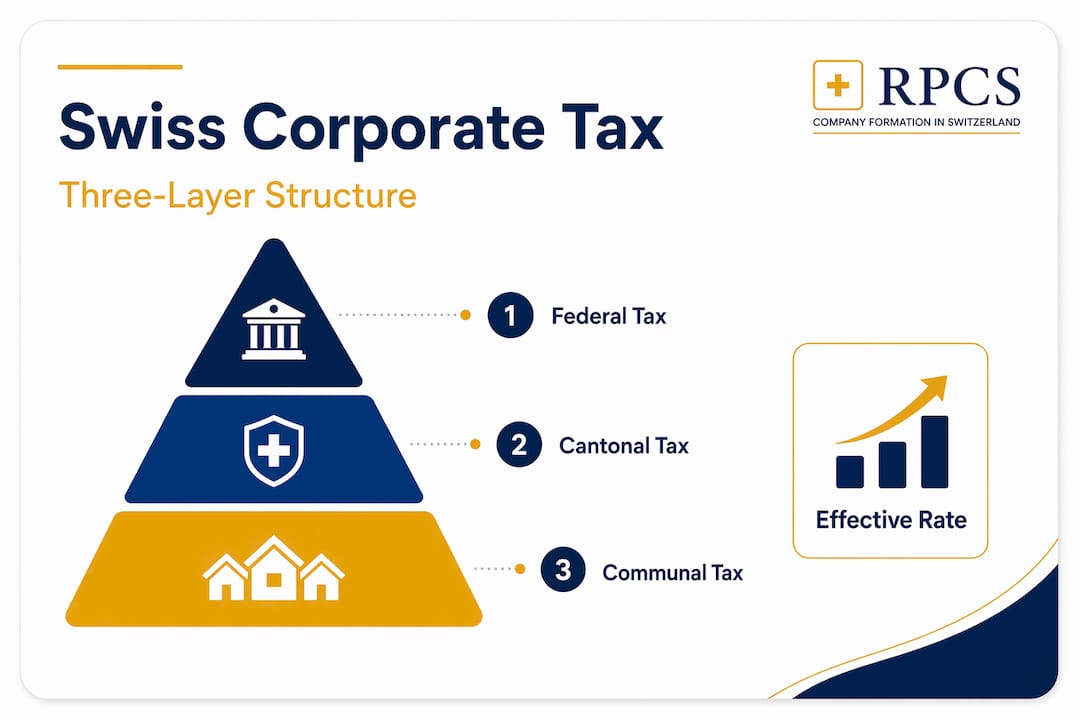
Here is how effective combined rates compare across major cantons in 2026:
Canton | Effective Combined Tax Rate |
Zug | ~11.85% |
Nidwalden | ~11.97% |
Obwalden | ~12.74% |
Lucerne | ~12.32% |
Zurich | ~19.70% |
Geneva | ~13.99% |
Bern | ~21.04% |
The canton and commune combination is the dominant variable in your effective rate. Two companies registered in the same country, paying federal tax at the same rate, can face a 9-percentage-point difference in combined tax burden purely based on canton selection. That is a material number at any revenue scale.
When deciding between a GmbH and an AG, the structural tax treatment is nearly identical at the entity level. The AG tends to be preferred for companies planning to raise institutional capital or issue shares widely, while the GmbH suits closely-held businesses with a smaller founding group. Both can be domiciled in any canton. For a detailed breakdown of how these cantonal tax layers affect your net position, reviewing the full structure before formation is worth the time.
Pro Tip: Do not choose your canton based on tax rates alone. Consider where your clients, employees, and banking relationships will be concentrated. A lower-rate canton that creates logistical friction for your operations can cost more than the tax savings.
For founders comparing jurisdictions, it is worth noting that UAE corporate tax at 9% looks competitive on paper. But the Swiss combination of tax efficiency, legal certainty, and banking access typically produces stronger total outcomes for businesses with European and global operations.
Operational infrastructure: banking, formation, and services
Switzerland’s operational advantages go well beyond the legal and tax framework. The global banking reputation of Swiss institutions is backed by multi-currency functionality, rigorous compliance standards, and decades of serving international private and corporate clients. For a founder based in Singapore, the UAE, or the US, having a Swiss corporate account signals credibility to clients and suppliers in a way that accounts in less-recognized jurisdictions simply do not.

Switzerland also hosts over 40 international organizations, which creates an ecosystem effect that benefits businesses in professional services, financial consulting, technology, and international trade. Your clients are here. Your potential partners are here. The network effects are real and underestimated.
Practically speaking, the formation infrastructure in Switzerland has matured significantly for foreign founders:
GmbH and AG registration can be completed with a notarized founding act, registered capital deposit, and commercial registry filing
Swiss nominee director services allow foreign founders who cannot fulfill the local residency requirement to satisfy Swiss company law without relocating
A registered address in Switzerland is legally required and can be fulfilled through virtual office arrangements, separating physical presence from administrative compliance
Banking account opening for newly formed Swiss entities is achievable for international founders with proper documentation and compliance preparation
The advantages of a Swiss business address extend beyond mere legality. Clients and institutional partners respond differently to a Zurich or Zug address than they do to an offshore registry. That perception has real commercial value.
For founders who want to understand the full picture before committing, reviewing the tax and stability advantages in one place helps frame the decision correctly from the start.
My take on getting Swiss jurisdiction right
I have worked with enough international founders navigating Swiss incorporation to say this clearly: the biggest mistakes are not made in the tax planning phase. They are made in the legal design phase and the canton selection phase, well before formation.
I have seen founders choose Zurich over Zug purely for lifestyle reasons, then spend years paying nearly 8 percentage points more in combined tax than they needed to. I have also seen founders who picked the right canton but wrote contracts that completely ignored Swiss procedural rules, only to discover during a dispute that their agreements were harder to enforce than they expected. The legal certainty of Swiss procedures requires you to design for it from day one, not retrofit later.
What I find most underappreciated is the ecosystem value. Switzerland has built a genuinely unusual concentration of institutional knowledge, international talent, and global connectivity. When you incorporate here, you are not just filing paperwork. You are placing your business inside one of the most trusted commercial environments in the world, and that trust compound over time in ways that are hard to quantify but very easy to feel.
My advice: treat canton selection and contract design as equally important to tax rate selection. And get local support that knows both the regulatory side and the banking side, because those two tracks need to be aligned from the start.
— Rolands
Set up your Swiss company with Rpcs
If this article has clarified the core reasons to choose Swiss jurisdiction, the next step is making it concrete for your specific situation.
Rpcs specializes in Swiss company formation for international entrepreneurs and investors, handling every step from legal documentation and notarization to commercial registry filing and banking setup. Whether you are forming a GmbH or an AG, need a Swiss nominee director to meet residency requirements, or want to open a Swiss bank account for a newly formed entity, Rpcs coordinates all of it as a single process. Ongoing accounting and compliance services are also available so your company stays in good standing after formation. No guesswork, no gaps.
FAQ
What is Swiss jurisdiction for businesses?
Swiss jurisdiction refers to the legal, regulatory, and tax framework that governs companies registered in Switzerland. It encompasses cantonal and federal corporate law, the Swiss Code of Civil Procedure, and the tax system administered across 26 cantons.
Why choose Swiss jurisdiction over other European options?
Switzerland combines political neutrality, a codified legal system with clear dispute resolution pathways, and canton-level tax rates as low as 11.85% in cantons like Zug. Most EU jurisdictions cannot match that combination of legal certainty and tax flexibility.
Is Swiss jurisdiction safe for international investors?
Yes. Swiss institutional stability is consistently ranked among the highest globally. The federal governance structure, independent judiciary, and direct democracy prevent the kinds of sudden regulatory shifts that create risk in other jurisdictions.
What are the Swiss jurisdiction tax benefits in 2026?
Combined effective corporate tax rates in 2026 range from approximately 11.85% in Zug to 21.04% in Bern, depending on canton and commune. Companies also benefit from participation exemptions, capital gains treatment, and treaty networks covering over 100 countries.
Do I need to live in Switzerland to use Swiss jurisdiction?
No. Foreign founders can incorporate a Swiss GmbH or AG remotely and satisfy the local director residency requirement through Swiss nominee director services, making Swiss jurisdiction accessible without relocation.
Recommended
Comments