
Risk Management for Swiss Companies: 2026 Guide
- May 21
- 9 min read

TL;DR:
Swiss companies must integrate operational resilience and risk management into strategic governance to meet FINMA’s 2026 mandates. Implementing ISO 31000, focusing on genuinely critical functions, and conducting realistic, multi-failure scenario testing are essential for building lasting resilience. Engaged board involvement and proactive gap analysis ensure compliance and help create a risk-aware organizational culture.
Effective risk management for Swiss companies has moved well beyond filing policies and ticking regulatory boxes. With FINMA’s operational resilience mandates now fully in force for 2026 and the regulatory environment growing more demanding each year, decision-makers who treat risk management as a compliance formality are leaving their organizations exposed. This guide cuts through the confusion, giving you a clear picture of your obligations, a practical framework for implementation, and the strategic mindset that separates companies that merely survive audits from those that actually build lasting resilience.
Table of Contents
Key takeaways
Point | Details |
FINMA 2026 mandates are live | All supervised institutions must define critical functions, disruption tolerances, and testing procedures under FINMA Circular 2023/1. |
ISO 31000 is your framework foundation | Applying ISO 31000 integrates risk management into governance and daily operations, not just compliance reporting. |
Critical functions must be genuinely critical | Defining 5 to 15 truly strategic functions beats listing dozens that dilute focus and confuse your team. |
Scenario testing must go beyond cyber | Realistic tests combine multiple failure conditions, such as IT outages alongside staffing shortages, to validate true resilience. |
Siloed risk management fails under pressure | Integrating BCM, ICT, cyber, and third-party risk into one board-level framework is the standard, not an optional enhancement. |
The regulatory framework shaping risk management for Swiss companies
The regulatory floor for Swiss businesses has risen significantly. FINMA Circular 2023/1 is the defining instrument here, requiring all supervised institutions to implement operational resilience by January 1, 2026. That means formally defining critical functions, setting measurable disruption tolerances, and conducting scenario-based testing. This is no longer a planning exercise. It is a current obligation.
What makes 2026 particularly demanding is that FINMA’s supervisory notices are already identifying gaps. According to FINMA Supervisory Notice 05/2025, only 12 to 15% of the 267 institutions reviewed had fully integrated risk management, ICT, cyber, business continuity management, and third-party oversight into a unified framework by late 2025. That number is a serious signal for any compliance officer still managing these areas in separate silos.
The obligations differ by supervisory category and company size, but the core requirements apply broadly:
Critical functions: You must formally identify which functions, if disrupted, would materially harm clients, financial stability, or the broader economy.
Disruption tolerances: These are board-approved thresholds for how long a critical function can be unavailable before causing unacceptable harm.
Scenario testing: Regular exercises, including tabletop scenarios at the board level, must validate that tolerances are achievable in practice.
Cyber reporting: FINMA Circular 2023/1 includes mandatory 24-hour early warnings and 72-hour detailed incident reports for severe cyberattacks.
Beyond FINMA, Swiss companies with EU operations or EU-dependent supply chains are also feeling the influence of DORA and NIS2. While these EU frameworks do not directly bind Swiss entities, they increasingly shape what counterparties, auditors, and boards expect. Understanding the Swiss corporate governance requirements that intersect with these standards is becoming a baseline expectation for board directors and compliance officers alike.
Pro Tip: Do not wait for your next supervisory review to map your compliance gaps against FINMA Circular 2023/1. A gap analysis done now gives you time to remediate before FINMA asks the questions.
Core principles of an effective risk management framework
The foundation most Swiss practitioners point to is ISO 31000. It is not a certification standard. It is a strategic framework that enables organizations of any size to integrate risk management into governance structures and daily decisions, rather than running it as a parallel compliance process.
The key distinction ISO 31000 draws is between managing risk reactively and building a risk-aware organization that detects, evaluates, and responds to threats as part of normal operations. ISO 31000 emphasizes top-down commitment, continuous improvement, and risk-informed decision-making at every level of the organization. That last point matters more than most companies realize. If risk management only lives inside a compliance team, it will always lag behind actual business decisions.
Here is how to translate ISO 31000 principles into a working governance structure:
Establish clear ownership. Assign risk ownership at the board level, with a designated risk function that reports directly to senior management. Ownership without authority produces reports, not change.
Map your risk universe. Conduct structured identification across strategic, operational, financial, regulatory, and reputational risk categories. Use workshops, scenario analysis, and structured interviews to avoid blind spots.
Assess and prioritize. Rate risks by likelihood and impact. Use a consistent methodology so your board can compare risks across functions and make informed trade-offs.
Design treatment strategies. For each significant risk, choose a response: accept, mitigate, transfer, or avoid. Document rationale and assign accountability.
Monitor and report. Build regular reporting cycles into governance calendars. Risk registers should not be annual documents. They should be living tools reviewed at board and management level on a defined schedule.
Review and improve. After every significant incident, near-miss, or scenario test, run a structured review. Feed findings back into your framework.
The benefits of ISO 31000 for Swiss organizations are well-documented: improved transparency, earlier risk detection, more efficient resource allocation, and a stronger risk-aware culture. These are competitive advantages, not just compliance outcomes.
Pro Tip: Treat your risk register as a board-level decision support tool, not a compliance document. When boards actively engage with risk data, the quality of both risk identification and treatment improves markedly.
Practical steps to implement risk management in your company
Implementation is where most companies stumble. The plan looks reasonable on paper, but execution reveals gaps in scope, ownership, and methodology. These steps reflect what actually works in practice.

Identifying critical functions without overloading the list
One of the most common mistakes Swiss institutions make is treating every business process as critical. Defining 5 to 15 genuinely critical functions produces a focused, manageable resilience program. FINMA’s own supervisory data shows an average of 3.5 critical functions identified per institution, while some listed up to 36, creating confusion rather than clarity. Start by asking which functions, if unavailable for 48 hours, would cause direct harm to clients or trigger regulatory escalation. That filter eliminates a lot of noise.
Setting disruption tolerances the right way
Many institutions set tolerances by working backward from their current IT recovery capabilities. That gets it backwards. Disruption tolerances often set incorrectly are derived from what the system can currently achieve, not from what the board has decided is acceptable. The board must define the maximum acceptable outage first. Then your technical and operational teams work out how to meet it.
Scenario testing that covers the real threat landscape
The 2025 National Risk Analysis identifies pandemics, power shortages, and armed conflict as top-tier threats across 44 hazards, drawing on input from 265 cross-sector experts. Your scenario testing should reflect this breadth. Most companies still run cyber-only tests. That misses the point. Realistic scenario tests combine multiple simultaneous failures, such as an IT outage coinciding with a staffing shortage. Only 15% of institutions had performed this type of testing by 2025, which means the gap is significant.
Third-party and supply chain risk
Map every critical function to its third-party dependencies. For each vendor supporting a critical function, define contractual resilience requirements, conduct periodic reviews, and test recovery scenarios that assume vendor unavailability.
Risk management area | Common gap | Recommended action |
Critical functions | Overlong lists dilute focus | Limit to 5 to 15, tied to board-defined criteria |
Disruption tolerances | Reverse-engineered from IT capability | Define tolerance first at board level, then validate against capability |
Scenario testing | Cyber-only focus | Expand to multi-resource failures and non-cyber threats |
Third-party risk | No lifecycle management | Implement onboarding, ongoing review, and exit testing for critical vendors |
Reporting and dashboards | Manual spreadsheet tracking | Adopt automated tools with visualization and audit trails |
Challenges, pitfalls, and what is changing in 2026
Even companies that understand the framework often run into the same obstacles. Knowing them in advance saves time and avoids costly remediation.
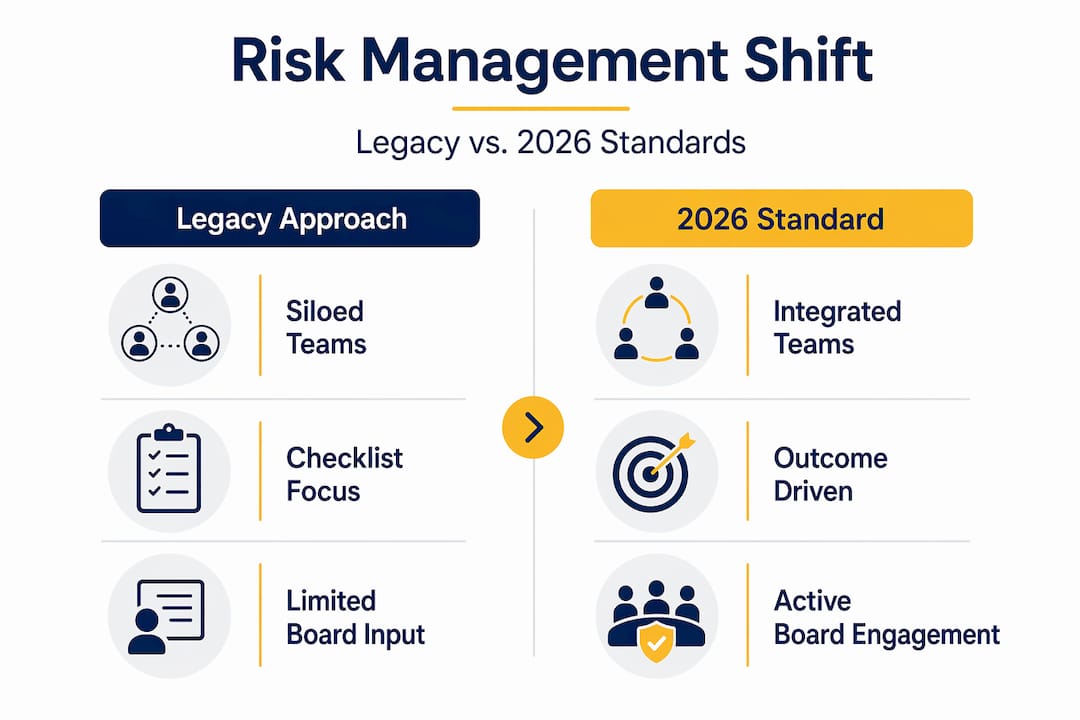
The most pervasive challenge is siloed risk management. BCM sits with operations, cyber risk sits with IT, third-party risk sits with procurement, and nobody has a consolidated view at the board level. Integrating BCM, ICT, and cyber into a single board-level framework is not aspirational best practice at this point. It is what FINMA expects, and only a fraction of institutions have achieved it.
A second pitfall is what practitioners call “reverse engineering” tolerances. When a board approves a disruption tolerance of 48 hours simply because that is what IT currently delivers, you do not have a resilience standard. You have a status quo document. Real tolerance-setting requires the board to answer a harder question: what level of service disruption is genuinely unacceptable to our clients and regulators?
The broader trend shaping risk management strategies in Switzerland is the shift from compliance to resilience-by-design. The expectation is no longer that companies react to regulatory updates. It is that risk management is embedded in strategy, culture, and operational design from the start.
“The companies that will meet FINMA’s 2026 expectations are not the ones that started preparing in late 2025. They are the ones that built risk management into their governance model years ago and are now refining, not scrambling.”
Compare where most companies are versus where the standard now sits:
Dimension | Legacy approach | 2026 standard |
Governance | Risk team reports to compliance officer | Risk function reports to board level |
Scope | Cyber and financial risk only | ICT, BCM, cyber, third-party, crisis management |
Testing | Annual IT disaster recovery | Regular multi-scenario tabletop exercises with board participation |
Culture | Risk as a constraint | Risk awareness embedded in strategic decision-making |
For more on staying ahead of compliance requirements, the step-by-step compliance guide from Rpcs covers the ongoing administrative cycle that underpins effective risk governance.
My perspective on where Swiss companies actually get this wrong
I have worked through enough risk frameworks with Swiss companies to see a consistent pattern. The organizations that struggle most are not the ones with bad intentions. They are the ones that built their risk program around FINMA requirements rather than around what their business actually needs.
When you start with the regulator’s checklist, you end up with a framework that passes a supervisory review and does almost nothing during a real crisis. I have seen companies produce beautifully formatted critical function registers that no board member has ever actually reviewed in practice.
What changes the quality of a risk program is board engagement. Not board sign-off. Active engagement. When a board genuinely challenges the disruption tolerance assumptions, when directors ask whether the scenario tests reflect real threats rather than convenient ones, the whole program sharpens. The compliance documentation becomes a byproduct of real governance, not its substitute.
My honest take on the 2026 regulatory cycle: FINMA is not bluffing. The supervisory notices from 2025 were explicit about widespread non-compliance, and the 2026 review cycle will be harder. But the companies that treat this as a one-time remediation project will be back in the same position in three years. The ones that use this pressure to embed genuine risk governance will come out ahead.
For companies looking at crypto and digital asset exposure as an emerging risk category, the same principle applies: start with the business risk, not the regulatory minimum.
— Rolands
How Rpcs helps Swiss companies get risk management right

Building a compliant and genuinely functional risk management program in Switzerland requires more than a policy document. It requires the right governance structure, accurate financial reporting, and a clear understanding of your regulatory obligations from day one.
Rpcs provides Swiss company formation services that build compliance and risk governance into your corporate structure from the outset, covering GmbH and AG formations, legal documentation, and the ongoing administrative framework that supports FINMA compliance. For companies already operating in Switzerland, Rpcs accounting services give you the financial visibility and reporting structure that effective risk management depends on.
Whether you are establishing a new Swiss entity or strengthening the governance of an existing one, Rpcs brings the local expertise and regulatory knowledge to help you meet your obligations without the guesswork. Reach out to discuss how Rpcs can support your specific risk management and compliance needs.
FAQ
What does FINMA require for operational resilience in 2026?
Under FINMA Circular 2023/1, all supervised institutions must define critical functions, set board-approved disruption tolerances, and conduct regular scenario-based testing. The requirements have been in force since January 1, 2026.
What is ISO 31000 and why does it matter for Swiss companies?
ISO 31000 is an international risk management framework that helps organizations integrate risk governance into strategy and daily operations. Swiss companies use it as a foundation for meeting FINMA expectations and building a risk-aware culture beyond basic compliance.
How many critical functions should a Swiss company define?
Defining 5 to 15 genuinely critical functions is considered best practice. FINMA data shows an average of 3.5 per institution, and over-identifying critical functions dilutes focus and complicates your resilience program.
What is the most common mistake in setting disruption tolerances?
Most institutions set tolerances based on what their IT systems can currently recover, rather than what the board defines as acceptable. Tolerances must be set top-down from board-defined risk appetite, then validated against operational capability.
Does DORA or NIS2 apply directly to Swiss companies?
DORA and NIS2 are EU regulations and do not directly bind Swiss entities. However, Swiss companies with EU operations, clients, or supply chain dependencies increasingly need to align with these standards to meet counterparty and audit expectations.
Recommended
Comments