
Why Switzerland for International Payments Explained
- Feb 24
- 9 min read
Updated: Mar 2

Global entrepreneurs often face uncertainty when moving funds internationally, but Switzerland offers solutions trusted across borders. With a foundation of political stability and a reputation for technological innovation, Swiss financial institutions provide payment reliability that few countries can match. This article shows how a Swiss company structure, supported by advanced banking technology and clear legal frameworks, allows international business owners to access secure, seamless payments and financial credibility worldwide.
Table of Contents
Key Takeaways
Point | Details |
Switzerland’s Global Payment Dominance | Switzerland’s political stability and monetary independence make it a trusted hub for international payments, processing trillions of dollars annually. |
Technological Leadership | Swiss banks are at the forefront of payment innovations, utilizing advanced technologies like blockchain and real-time settlement to enhance transaction efficiency. |
Legal and Regulatory Advantages | The Swiss legal framework ensures reliable contract enforcement and flexibility, making it an attractive environment for international entrepreneurs. |
Tax Efficiency | Establishing a company in Switzerland allows for predictable tax compliance and optimization strategies that increase profitability from international operations. |
Switzerland’s Role in International Payments
Switzerland commands a unique position in the global payments ecosystem. This small nation processes trillions of dollars annually while maintaining the infrastructure that underpins international commerce.
The country’s dominance stems from multiple reinforcing factors. Political stability and monetary independence create the foundation for trust among international businesses and financial institutions worldwide.
Swiss financial institutions serve as critical intermediaries for cross-border transactions. Banks here connect businesses from emerging markets to global capital markets, processing payments that fuel international trade.
Why Switzerland Leads Global Payments
Switzerland’s payment infrastructure reflects decades of investment and innovation. The adoption of advanced payment systems has made Swiss banks central to international finance.
Key factors driving Switzerland’s position include:
SWIFT network integration – Switzerland hosts major SWIFT hubs that route international payments across continents
Regulatory compliance – Swiss banks meet the strictest international standards, making them trusted counterparties
Technological advancement – Swiss financial institutions pioneered many innovations in payment system evolution that now define global standards
Financial expertise – Generations of banking experience enable complex international transactions
The Swiss Payment Monitor 2023/24 reveals widespread adoption of modern payment methods and innovations that reinforce Switzerland’s critical role as a payments hub.
The Payments Advantage for International Entrepreneurs
For entrepreneurs from emerging markets, Swiss payment solutions offer distinct advantages. Operating a Swiss company means accessing payment infrastructure trusted globally.
Key benefits include:
Faster settlement times for international transactions
Lower fraud risk due to rigorous Swiss banking standards
Access to multiple currency options and hedging tools
Streamlined compliance with international tax regulations
When you establish a Swiss business address and Swiss bank account, you gain credibility with international partners. Clients and suppliers recognize Switzerland’s financial reputation immediately.
Switzerland processes international payments with a reliability standard that most other nations simply cannot match.
This reputation translates directly into business advantage. Emerging market entrepreneurs can leverage Swiss financial infrastructure to compete on equal footing with established Western businesses.
Pro tip: When opening a Swiss bank account for your company, verify that your chosen bank specializes in supporting international entrepreneurs—this ensures faster setup and better service for cross-border payments.
Swiss Banking Infrastructure and Technology
Swiss banks operate on infrastructure built for reliability and speed. The technological backbone supporting these institutions makes them central to global finance.

The nation has invested heavily in systems that process millions of transactions daily. These networks connect traders, investors, and businesses across every continent.
Technology Driving Swiss Banking Leadership
Switzerland’s banking system combines traditional expertise with cutting-edge innovation. Banks here leverage advanced payment technologies like digital asset custody and tokenization services.
Key technological strengths include:
Real-time settlement systems that reduce transaction delays
Multi-currency processing enabling instant currency conversions
Blockchain integration for transparent, secure transactions
API-driven banking connecting third-party applications seamlessly
Swiss banks pioneered many innovations now adopted globally. When you maintain a Swiss bank account, you access technology that competes with Silicon Valley fintech.
Digital Assets and Innovation
Swiss banking has emerged as a leader in digital asset management. The Distributed Ledger Technology Act provides regulatory clarity for blockchain-based services.
Swiss institutions now offer services including:
Cryptocurrency custody solutions
Staking and yield services
Tokenization of traditional assets
Digital wallet integration
This positions Switzerland as the bridge between traditional banking and decentralized finance. Entrepreneurs seeking banking requirements for crypto operations find Switzerland uniquely positioned.
Swiss banks combine regulatory clarity with technological innovation—a combination few other nations can match.
Why This Matters for Your Payments
For international entrepreneurs, Swiss banking infrastructure means faster, more secure transactions. Your Swiss business address connects you to systems processing trillions annually.
You benefit from:
Lower latency in cross-border payments
Advanced fraud detection systems
24/7 transaction monitoring
Compliance automation reducing processing delays
The technology running these systems operates with redundancy and backup systems. If primary networks fail, secondary systems instantly activate.
Here is how Swiss payment technology compares to major global alternatives:
Factor | Switzerland | United States | Singapore |
Real-time settlement | Standard across banks | Available, not universal | Common for local payments |
Multi-currency support | Robust, many options | Limited, USD dominant | Extensive in Asia-Pacific |
Blockchain integration | Widely adopted | Growing adoption | Increasing, regulatory focus |
Regulatory clarity | High, proactive | Complex, evolving | Strong, pro-innovation |
Pro tip: When selecting a Swiss bank for your company, ask specifically about their API capabilities and real-time settlement features—these determine how quickly international payments reach your clients.
Legal Frameworks Supporting Global Transactions
Swiss law creates the foundation for reliable international business. The legal system enforces contracts, protects assets, and resolves disputes with predictability that attracts global entrepreneurs.
When you operate through a Swiss company, you benefit from centuries of refined commercial law. These frameworks make cross-border transactions safer and more efficient.
Contract Enforcement and Company Law
Switzerland’s legal system prioritizes contract enforcement and reliable dispute resolution. Courts here consistently interpret agreements fairly, giving international partners confidence in transactions.
Key legal strengths include:
Enforceable contracts recognized globally
Clear company law protecting shareholder rights
Independent judiciary ensuring fair rulings
Fast dispute resolution mechanisms
Swiss legal frameworks enabling global business transactions provide essential infrastructure for international trade. When disputes arise, Swiss courts resolve them predictably and thoroughly.
Your Swiss business address signals access to these legal protections. International clients recognize this as a mark of legitimacy.
Regulatory Flexibility and Innovation
Switzerland adapts its laws proactively to support emerging technologies. The Blockchain Act and FINMA regulations demonstrate this forward-thinking approach.
The regulatory framework supports:
Digital asset transactions
Cryptocurrency operations
Smart contract deployments
Tokenized securities trading
This flexibility means Swiss law accommodates tomorrow’s business models today. Entrepreneurs launching blockchain-based ventures find Switzerland’s regulatory environment uniquely welcoming.
Switzerland’s legal system balances protection with innovation—rigid enough to enforce standards, flexible enough to enable growth.
Why This Matters for Your Payments
Legal certainty directly impacts payment reliability. When contracts are enforceable and disputes resolved fairly, transactions proceed smoothly.
You gain:
Legal recourse if payment disputes arise
Asset protection under Swiss company law
Recognition of contracts by international courts
Compliance with multiple jurisdictions automatically
Establishing a Swiss company means your payment obligations carry legal weight globally. Partners trust Swiss contracts because Swiss courts enforce them.
Pro tip: When structuring international payments, consult with Swiss accounting services to ensure your payment transactions comply with both Swiss law and your home country regulations—this prevents legal complications later.
Tax Efficiency, Costs, and Regulatory Compliance
Swiss tax treatment makes international payments more profitable. The system balances competitive rates with transparent compliance requirements that appeal to legitimate businesses.
When you establish a Swiss company, you access a tax framework designed for global operations. This structure lets you retain more revenue from international transactions.
Transfer Pricing and Arm’s Length Principle
Swiss tax authorities follow OECD transfer pricing guidelines closely. This means intercompany transactions must reflect what unrelated parties would agree to.
Key compliance elements include:
Documentation of pricing rationale
Safe harbor rules for intercompany financing
Withholding tax considerations
Profit allocation across jurisdictions
Switzerland’s transfer pricing guidance ensures your cross-border payments meet international standards. Compliance becomes straightforward when you understand these rules upfront.
Your Swiss company structure simplifies this process. Swiss tax advisors know exactly how to document transactions properly.
Intercompany Financing and Tax Optimization
Many entrepreneurs use intercompany loans to move funds efficiently. Swiss law permits intragroup financing with defined interest rates.
Optimization strategies include:
Setting safe harbor interest rates
Structuring loan documentation properly
Planning withholding tax obligations
Timing payments strategically
Swiss transfer pricing rules specify exactly how these arrangements work. This clarity eliminates uncertainty during tax audits.
Benefits for your international payment structure:
Lower overall tax burden
Legitimate profit allocation
Clear audit trails
Reduced withholding tax exposure
Swiss tax compliance is transparent, predictable, and cost-effective—exactly what international entrepreneurs need.
Regulatory Compliance Made Simple
Compliance costs decrease when regulations are clear. Swiss authorities provide detailed guidance on expectations.
You avoid:
Surprise tax assessments
Aggressive audits
Penalties for documentation gaps
Currency conversion disputes
Establishing a Swiss company with proper accounting support ensures you stay compliant automatically. Your Swiss accounting services handles documentation, reporting, and filing obligations.
This proactive approach saves money long-term. Prevention costs less than remediation.
To summarize, here is how Switzerland’s payment infrastructure creates business impact:
Advantage | Business Impact | Long-term Benefit |
Reliable legal systems | Fewer contract disputes | Higher partner trust |
Transparent tax treatment | Predictable cash flow | Sustainable growth |
Advanced fraud prevention | Fewer lost payments | Reduced risk exposure |
Fast settlement | Improved liquidity | Competitive positioning |
Pro tip: Review Swiss company tax structure advantages with a Swiss tax advisor before finalizing your corporate setup—optimizing your structure at formation prevents costly restructuring later.
Comparing Switzerland to Other Payment Jurisdictions
Switzerland stands apart from competing payment centers. Other jurisdictions offer pieces of what Switzerland delivers—but few combine all advantages together.
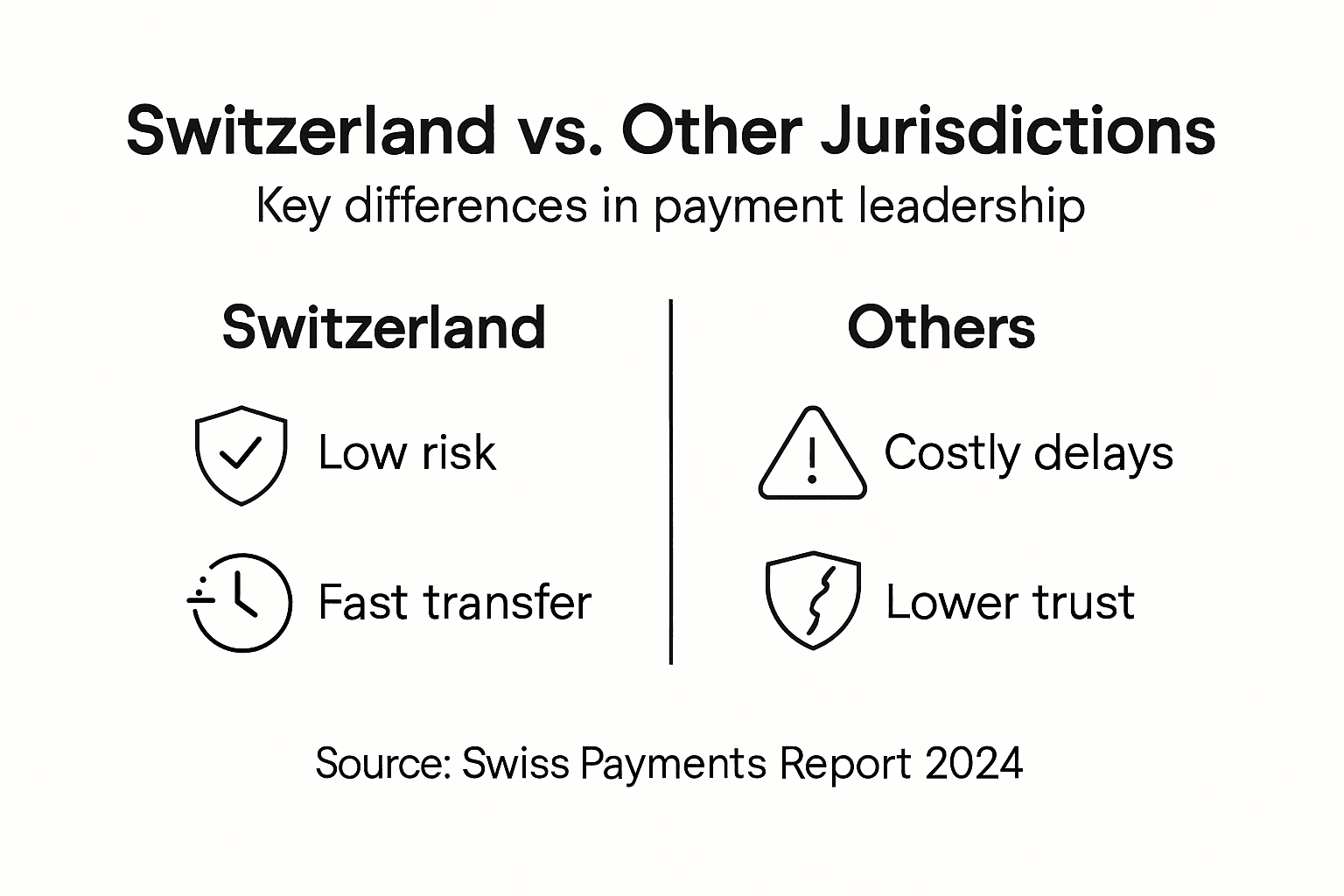
Understanding these differences helps you choose the right jurisdiction for your business. Switzerland’s integrated advantages create genuine competitive superiority.
Regulatory Quality and Efficiency
Switzerland’s regulatory environment surpasses most international competitors. The system prioritizes clarity without sacrificing innovation.
Key differentiators include:
Streamlined approval processes for financial operations
Technology-neutral regulations supporting emerging solutions
Clear guidance reducing compliance uncertainty
Regular regulatory updates maintaining relevance
The OECD Regulatory Policy Outlook 2025 documents Switzerland’s advanced regulatory framework, which supports innovation while maintaining strict compliance standards.
Compare this to jurisdictions where regulatory changes arrive unpredictably. Swiss stability lets you plan confidently.
Payment System Technology and Adoption
Switzerland leads in payment technology adoption. The nation integrated innovations like digital wallets and blockchain systems faster than most competitors.
Swiss advantages over other jurisdictions:
Earlier adoption of real-time payment systems
Higher digital payment penetration rates
Advanced security standards across payment networks
Faster settlement and clearing mechanisms
Comparative payment system studies highlight Switzerland’s efficiency advantage. Processing speeds, fraud prevention, and system reliability exceed many alternatives.
Switzerland combines financial stability with technological leadership—a rare combination most jurisdictions cannot match.
Cost and Efficiency Comparison
Swiss payment costs appear higher initially. However, total cost of ownership tells a different story.
Where Switzerland saves money:
Fewer compliance complications reduce legal costs
Faster transactions reduce working capital needs
Lower fraud rates decrease loss exposure
Transparent tax treatment eliminates surprises
Other jurisdictions may offer lower nominal fees but compensate with hidden costs. Swiss pricing reflects genuine service value.
When you operate through a Swiss company, you access these cost advantages systematically. Your banking options for Swiss firms include institutions designed to support international entrepreneurs efficiently.
Political and Economic Stability
Switzerland’s political neutrality creates unique advantages. No single political agenda dominates Swiss financial policy.
This stability means:
Consistent long-term policies
Predictable regulatory environment
Low political risk for foreign businesses
Protection against geopolitical disruptions
Most alternative jurisdictions lack this stability combination. Political changes create unpredictability affecting your payment operations.
Pro tip: When evaluating payment jurisdictions, assess not just current conditions but regulatory trajectory—Switzerland’s history shows consistent improvement over decades, while many alternatives experience unpredictable shifts.
Unlock Switzerland’s Payment Power for Your Business Success
Navigating international payments from emerging markets presents real challenges such as regulatory complexity, slow settlement times, and the need for trusted banking infrastructure. This article clearly shows why establishing a Swiss company and maintaining a Swiss bank account provides decisive advantages like faster transactions, legal certainty, and access to advanced payment technologies. Swiss stability and transparency turn these challenges into growth opportunities.

Take the next step with RPCS, your partner for seamless Swiss company formation and comprehensive business support. Our expert services cover everything from legal documentation to banking setup, ensuring your entry into Switzerland’s robust international payments ecosystem is quick and compliant. Do not miss out on the credibility, efficiency, and protection that come with a Swiss business address. Visit RPCS now and turn complex cross-border payments into your competitive edge.
Frequently Asked Questions
What are the advantages of using Swiss payment infrastructure for international transactions?
Swiss payment infrastructure offers faster settlement times, lower fraud risk, and access to multiple currency options, making it a reliable choice for international transactions.
How does Switzerland’s legal framework support international payments?
Switzerland has a robust legal system that ensures enforceable contracts and efficient dispute resolution, providing protection and reliability for cross-border transactions.
What technological innovations do Swiss banks utilize for payment processing?
Swiss banks leverage advanced technologies such as real-time settlement systems, multi-currency processing, and blockchain integration to enhance transaction speed and security.
How does Switzerland ensure regulatory compliance for international entrepreneurs?
Switzerland maintains high regulatory standards and provides clear guidance on compliance requirements, which helps international entrepreneurs navigate legal complexities efficiently.
Recommended
Comments