
Switzerland Payroll Setup Guide for International Businesses
- 5 days ago
- 9 min read

TL;DR:
Setting up payroll in Switzerland requires registering with multiple authorities and completing social contribution and tax obligations before paying employees. Cantonal differences make early, simultaneous registration essential to avoid costly delays or penalties. Using an Employer of Record can reduce risk for small or temporary teams unsure about local compliance complexities.
Setting up payroll in Switzerland requires registering with multiple federal and cantonal authorities, calculating mandatory social contributions, and applying withholding tax rules before your first salary payment clears. This switzerland payroll setup guide covers every registration step, explains the AHV/IV/EO, ALV, BVG, and Quellensteuer obligations that govern Swiss payroll compliance, and outlines the ongoing monthly and annual processes that keep your business audit-ready. Cantonal differences add a layer of complexity that catches most international businesses off guard, making early preparation the single most important factor in a clean setup.
What registrations does a Switzerland payroll setup require?
Every employer in Switzerland must complete several registrations before processing a single salary. Registration takes approximately four to eight weeks and must be finished before paying employees. Starting the process late is the most common and most expensive mistake international businesses make.
The core registrations are:
Cantonal compensation office (Ausgleichskasse): This office administers AHV (old-age insurance), IV (disability insurance), EO (income compensation), and ALV (unemployment insurance). Every employer registers here first.
Licensed pension fund (BVG/LPP): Enrollment in a second-pillar occupational pension fund is mandatory for qualifying employees. You may join an industry-specific fund or select an independent licensed provider.
Accident insurance (UVG/LAA): The Federal Accident Insurance Act requires coverage for all employees. Occupational accident insurance is fully employer-funded; non-occupational accident insurance is typically deducted from the employee’s salary.
Cantonal tax authority for Quellensteuer: If you employ foreign nationals without a C permit or cross-border workers, you must register with the relevant cantonal tax office to withhold income tax at source.
Family allowance fund: Contributions vary by canton and must be registered separately in most cases.
Pro Tip: Start all registrations simultaneously on day one of your Swiss company formation process. Waiting until you have a signed employment contract puts you behind schedule and risks your first payroll date.
Rpcs supports international businesses through Swiss company formation and coordinates all payroll registrations as part of a single onboarding process, reducing the risk of missed deadlines.
How do social security contributions and pension obligations work?

Swiss payroll contributions follow a three-pillar structure. The first pillar covers state social insurance. The second pillar covers occupational pensions. The third pillar is voluntary private savings and does not affect employer payroll obligations.
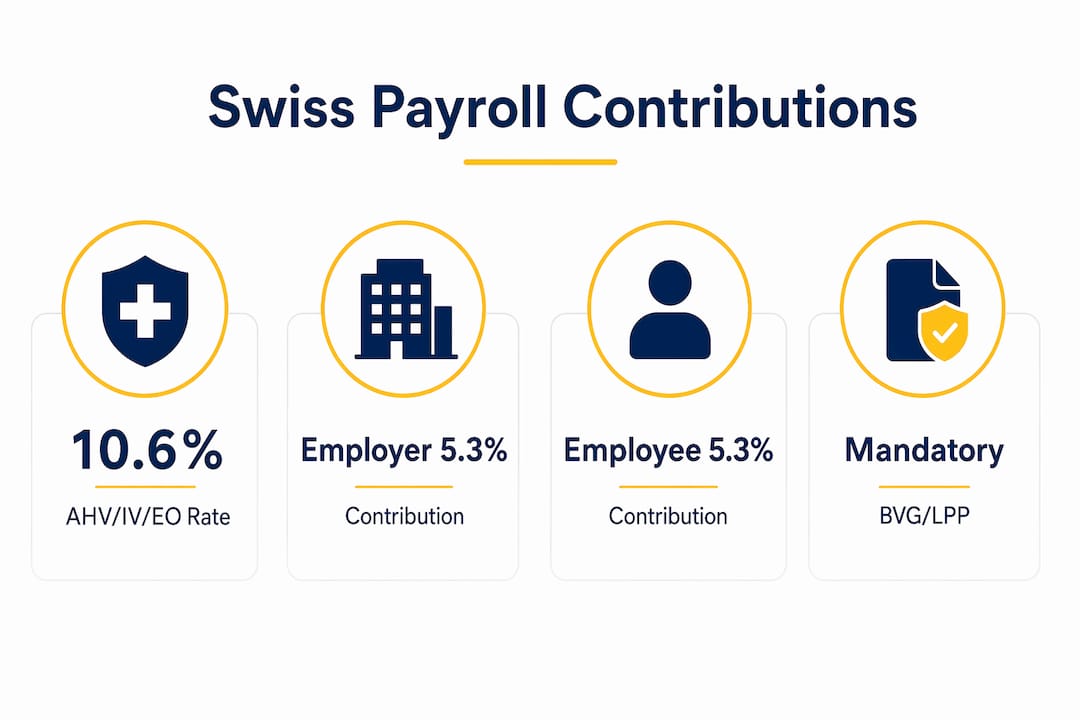
First-pillar contributions: AHV, IV, EO, and ALV
The AHV/IV/EO combined rate is approximately 10.6%, split evenly between employer and employee, with no earnings ceiling. That means every franc of salary carries this contribution, regardless of how high the salary goes. ALV contributions add 1.1% each for employer and employee, capped at CHF 148,200, with a solidarity surcharge applied above that threshold.
Second-pillar occupational pension: BVG/LPP
BVG/LPP contributions are mandatory for employees who earn above the entry threshold, and contribution rates typically range between 7% and 18% depending on the pension plan and the employee’s age band. Older employees attract higher rates because the savings horizon is shorter. Employers must contribute at least as much as the employee, though many plans require a higher employer share.
Accident insurance and family allowances
Accident insurance under the UVG covers all employees from day one. Occupational accident premiums are paid entirely by the employer. Non-occupational accident premiums are deducted from the employee’s gross salary. Family allowance rates and administration vary significantly by canton, so confirm the local rules for each location where you employ staff.
Contribution type | Employer rate | Employee rate | Ceiling |
AHV/IV/EO | ~5.3% | ~5.3% | None |
ALV | 1.1% | 1.1% | CHF 148,200 |
BVG/LPP | Varies by age | Varies by age | Plan-specific |
Occupational accident (UVG) | 100% | 0% | Plan-specific |
Non-occupational accident (UVG) | 0% | 100% | Plan-specific |
Pro Tip: When comparing pension fund options, look beyond the minimum BVG contribution rate. Some industry funds offer better risk coverage or lower administrative fees, which directly affects your total payroll cost per employee.
How does income tax withholding (Quellensteuer) work in Swiss payroll?
Quellensteuer is the Swiss withholding tax system applied to employees who do not hold a permanent residence permit. It applies to foreign nationals without a C permit and to cross-border workers, with the employer deducting tax directly from the gross salary and remitting it to the cantonal tax authority. The employee never handles the tax payment directly.
The key compliance steps are:
Identify which employees are subject to Quellensteuer. Swiss nationals and C permit holders file their own taxes. All other foreign employees fall under the withholding system.
Assign the correct tariff code. Each canton publishes tariff tables that encode marital status, number of dependent children, religious affiliation, and dual-income household status. The wrong code produces the wrong deduction and triggers a correction demand.
Update tariff tables every january. Cantons revise their tables annually. Using outdated tables is a compliance failure, even if the error is unintentional.
Remit monthly. Most cantons require remittance by the 10th to 15th of the following month. Late payments attract interest charges.
File the annual declaration. At year-end, employers submit a reconciliation report to the cantonal tax authority listing every Quellensteuer employee, their earnings, and the total tax withheld.
Issue employee statements. Each affected employee receives a written statement of the tax withheld, which they may need for cross-border tax filings in their country of residence.
The most common mistake is applying a generic tariff code instead of verifying each employee’s personal situation. A single-parent employee with two children has a materially different tax rate than a single employee with no dependents.
What does the monthly and annual payroll cycle look like?
Swiss payroll runs on a tight monthly cycle with no room for late filings. Deadlines generally fall between the 10th and 15th of the following month for tax remittances, with social security contributions due by end of month. Missing these dates triggers interest and, in serious cases, formal enforcement action.
The monthly workflow follows this sequence:
Calculate gross salary for each employee, including bonuses, commissions, and benefits in kind.
Deduct employee-side contributions: AHV/IV/EO, ALV, BVG, non-occupational accident insurance, and Quellensteuer where applicable.
Issue a payslip to each employee showing gross pay, all deductions, and net pay.
Transfer net salaries to employee bank accounts on the agreed pay date.
Remit employer and employee social security contributions to the cantonal compensation office.
Remit pension contributions to the BVG fund.
Remit Quellensteuer to the cantonal tax authority.
Annual obligations add another layer of work. Employers must issue the Lohnausweis salary certificate by january 31 for the previous calendar year. This standardized document summarizes all earnings, benefits, and deductions and is required for employee tax filings. Failure to issue it on time can trigger audits and penalties.
Swiss directors face personal liability for late or unpaid social security contributions. This is not a theoretical risk. The compensation office can pursue directors individually when a company fails to remit AHV contributions, regardless of whether the company itself is solvent.
Record retention rules require keeping all payroll records for a minimum of ten years. This includes payslips, contribution statements, Quellensteuer declarations, and Lohnausweis copies. Audit readiness depends on organized, complete documentation, not just accurate calculations.
When an employee leaves, you must process a final payslip covering all outstanding salary, unused vacation pay, and any contractual termination payments. Notify the pension fund and accident insurer of the termination date. For Quellensteuer employees, file a final declaration with the cantonal tax authority.
Should you run payroll in-house or use an Employer of Record?
International businesses face a clear choice when entering Switzerland: establish a Swiss legal entity and run payroll directly, or use an Employer of Record service to employ staff without forming a company first.
Running in-house payroll through a Swiss entity gives you full control over hiring, compensation, and HR processes. It is the right structure for businesses committing to Switzerland long-term with a team of meaningful size. The setup cost and administrative burden are justified when you have stable, ongoing operations. You will need a registered Swiss company, a local bank account, and either internal payroll expertise or an external payroll provider.
EOR services handle all employer legal responsibilities and regulatory filings on your behalf, which reduces risk and administrative burden significantly for smaller teams. An EOR is the employer of record on paper, managing registrations, payroll calculations, contributions, and compliance while your business directs the employee’s work. This is cost-effective for businesses testing the Swiss market or employing fewer than 10–15 people before committing to a full entity setup.
Approach | Best for | Key trade-off |
Swiss entity with in-house payroll | Long-term operations, larger teams | Higher setup cost, full control |
Swiss entity with external payroll provider | Established companies without local HR expertise | Lower admin burden, shared compliance risk |
Employer of Record (EOR) | Market entry, small teams, short-term projects | Less control, ongoing service fees |
Pro Tip: If you plan to grow your Swiss team beyond 15 employees within 18 months, start the entity formation process now. Transitioning employees from an EOR to a direct employment structure mid-growth is administratively complex and disruptive.
Rpcs offers Swiss employment law guidance and full payroll setup support for both entity-based and EOR-adjacent structures, helping you choose the right approach for your specific situation.
Key Takeaways
Swiss payroll compliance requires completing all registrations before the first salary payment and maintaining accurate monthly and annual filings across multiple federal and cantonal authorities.
Point | Details |
Register before paying | Complete AHV, BVG, UVG, and Quellensteuer registrations four to eight weeks before the first payroll. |
Know your contribution rates | AHV/IV/EO runs at approximately 10.6% split evenly; BVG rates vary by age band from 7% to 18%. |
Apply correct tariff codes | Quellensteuer codes must reflect each employee’s marital status, dependents, and canton every year. |
Meet monthly deadlines | Remit social contributions and withholding tax by the 10th to 15th of the following month. |
Issue the Lohnausweis on time | Deliver the annual salary certificate to every employee by january 31 to avoid audits and penalties. |
What I’ve learned about Swiss payroll that most guides skip
Most articles about setting up payroll in Switzerland treat it as a checklist exercise. Register here, contribute there, file by this date. That framing misses the real risk.
The cantonal layer is where international businesses consistently underestimate complexity. Switzerland has 26 cantons, and each one administers Quellensteuer differently, publishes its own tariff tables, and sets its own remittance deadlines. A business employing staff in Zurich, Geneva, and Basel simultaneously is managing three separate tax authority relationships with three different sets of rules. I have seen companies get the federal contributions right and still face back-payment demands because they applied Zurich tariff codes to Geneva employees.
The director liability issue deserves more attention than it typically gets. Swiss law allows compensation offices to pursue company directors personally for unpaid AHV contributions. This is not a last resort. It is a standard enforcement tool. Any director of a Swiss GmbH or AG who signs off on payroll without verifying that contributions have been remitted is taking on personal financial risk.
My practical recommendation: do not try to manage Swiss payroll setup from abroad without local expertise. The cost of getting it wrong, including back contributions, interest, penalties, and the time spent on corrections, far exceeds the cost of professional support from day one. For businesses entering Switzerland with a small team, an EOR is genuinely the lower-risk path until you understand the system well enough to run it yourself.
— Rolands
How Rpcs helps you set up Swiss payroll correctly
International businesses that try to navigate Swiss payroll registrations alone often discover the gaps only when a penalty notice arrives.
Rpcs provides end-to-end support for international companies establishing payroll in Switzerland. From Swiss company formation and cantonal compensation office registration to BVG enrollment, accident insurance setup, and Quellensteuer compliance, Rpcs handles the registrations that must be in place before your first salary payment. Ongoing services include monthly payroll processing, annual Lohnausweis preparation, and coordination with cantonal tax authorities. Rpcs also offers Swiss accounting services that integrate directly with payroll records, keeping your books and compliance filings aligned. Contact Rpcs to discuss a payroll setup plan tailored to your Swiss operations.
FAQ
What registrations are required before running payroll in Switzerland?
Employers must register with the cantonal compensation office for AHV/IV/EO and ALV, enroll in a BVG pension fund, obtain UVG accident insurance, and register for Quellensteuer if employing foreign nationals without a C permit. Registration takes approximately four to eight weeks and must be completed before the first salary payment.
Who is subject to Quellensteuer in Switzerland?
Quellensteuer applies to foreign nationals who do not hold a permanent residence permit (C permit) and to cross-border workers. The employer deducts the tax directly from gross salary using cantonal tariff tables and remits it monthly to the cantonal tax authority.
What is the AHV contribution rate for Swiss payroll?
The AHV/IV/EO combined rate is approximately 10.6%, split evenly between employer and employee with no earnings ceiling. ALV contributions add 1.1% each, capped at CHF 148,200.
When must the Lohnausweis be issued to employees?
Employers must issue the Lohnausweis by january 31 for the previous calendar year. The certificate summarizes all earnings and deductions and is required for employee tax filings.
Is an Employer of Record a viable option for Swiss payroll without a local entity?
Yes. EOR services manage all employer registrations and compliance filings on behalf of international companies, making them a practical option for businesses testing the Swiss market or employing small teams before committing to a full entity setup.
Recommended
Comments