
Swiss Corporate Tax Optimization Steps: 2026 Guide
- 3 days ago
- 9 min read

TL;DR:
Swiss corporate tax optimization relies on applying statutory reliefs, selecting the right canton, and maintaining strict compliance. Proper use of the Patent Box, R&D super-deduction, and Capital Contribution Principle can result in significant, lasting savings if executed correctly and on time. Ongoing discipline, real substance, and timely filings are essential to sustain these tax advantages.
Swiss corporate tax optimization is the structured process of reducing a company’s tax burden in Switzerland by applying statutory reliefs, selecting the right canton, and maintaining documented compliance. The key tools are the Patent Box, the R&D super-deduction, and the Capital Contribution Principle. Each delivers real savings, but only when applied correctly and on time. This guide walks business owners and financial decision-makers through the essential swiss corporate tax optimization steps, covering 2026 rules, substance requirements, and the filing discipline that separates compliant savings from costly mistakes.
What are the primary statutory tax reliefs available for Swiss companies?
Switzerland offers three major statutory reliefs that directly cut the corporate tax bill. Understanding each one is the foundation of any effective tax planning approach.
Patent Box reduces cantonal and communal tax on qualifying intellectual property income by up to 90%. That means a company earning CHF 1 million from licensed patents could shelter up to CHF 900,000 of that income from cantonal tax. The relief applies only at the cantonal level. Federal corporate tax, fixed at 8.5% on a statutory basis, does not recognize the Patent Box.
R&D super-deduction lets qualifying companies deduct up to 150% of their research and development costs against cantonal taxable income. Spend CHF 200,000 on qualifying R&D, and you can deduct CHF 300,000. That extra CHF 100,000 deduction costs nothing and reduces the cantonal tax base directly.
Capital Contribution Principle allows companies to return paid-in equity to shareholders free of Swiss withholding tax and income tax, provided the contribution was properly recorded and Form 170 was filed on time. This is the relief most often lost through administrative error.
Key points to keep in mind:
Patent Box and R&D super-deduction compress the cantonal and communal tax layers only.
Federal tax at 8.5% is flat and unaffected by these reliefs.
Both reliefs can be combined, subject to an overall cap on cantonal tax reduction.
Capital Contribution Principle requires booking paid-in surplus as “Reserven aus Kapitaleinlagen” from day one.
Pro Tip: Request an advance tax ruling from the cantonal authority before claiming Patent Box or R&D super-deduction for the first time. Rulings provide binding certainty as long as the underlying facts stay accurate, and they prevent disputes at assessment.
How does canton and company structure choice affect tax rates?
Canton selection is the single biggest variable in Swiss corporate tax planning. Effective combined rates range from approximately 11.85% in Zug to 20.54% in Bern, including federal, cantonal, and communal layers. Choosing Zug over Bern on a CHF 500,000 profit saves roughly CHF 43,000 per year in tax. That gap compounds quickly.

The choice between a GmbH and an AG matters less than most business owners expect. Both structures pay the same federal profit tax, face the same cantonal rates, and qualify for the same TRAF reliefs including the Patent Box and R&D super-deduction. The real differences are capital requirements (CHF 20,000 for GmbH versus CHF 100,000 for AG) and shareholder visibility. For a deeper breakdown of those structural differences, the AG vs GmbH comparison covers the mechanics in full.
Canton selection also interacts with owner-manager compensation. In low-tax cantons, a higher dividend relative to salary can be tax-efficient because the combined corporate and personal tax burden stays low. In higher-tax cantons, the calculus shifts. The right split depends on the specific cantonal rate, the AHV contribution base, and the owner’s personal income tax bracket.
Factors to weigh when choosing a canton:
Effective combined corporate tax rate (federal plus cantonal plus communal)
Availability and generosity of cantonal TRAF reliefs
Physical office and substance requirements for the chosen canton
Personal income tax rates for owner-managers living in that canton
Proximity to banking, legal, and administrative infrastructure
Pro Tip: Do not choose a canton based on the headline rate alone. Check the canton-specific conditions for Patent Box and R&D relief, since some cantons apply stricter eligibility rules than others.
What compliance requirements are critical for sustaining tax benefits?
Compliance is where Swiss tax optimization either holds or collapses. The rules are clear, but the deadlines are unforgiving.
File Form 170 within 30 days. The Capital Contribution Principle requires filing Form 170 with the Swiss Federal Tax Administration (ESTV) within 30 days of each capital contribution. The 2025 Federal Supreme Court ruling confirmed that late or missing filings permanently void the tax-free status of that equity. There is no cure period and no appeal on the merits once the deadline passes.
Document substance with real functions. Tax reliefs and treaty benefits require genuine Swiss operations. The DEMPE framework (Development, Enhancement, Maintenance, Protection, Exploitation) applies to IP companies. Tax authorities expect to see Swiss-based employees or directors performing these functions, not just a registered address.
Set arm’s-length transfer pricing from day one. Intra-group transactions must reflect market rates. Underpriced loans, management fees, or royalties trigger tax adjustments and can unwind treaty benefits.
Monitor safe-harbor interest rates annually. The Federal Tax Administration (FTA) publishes Circular 215 each year. For 2026, minimum safe-harbor rates are 0.75% for CHF loans, 3.00% for EUR, and 4.50% for USD. Loans priced below these floors are treated as hidden profit distributions.
Register for corporate tax correctly. The Swiss corporate tax registration process sets the foundation for all subsequent filings. Errors at registration create problems that compound over years.
“The most expensive tax mistake Swiss companies make is not a wrong deduction. It is a missed deadline that converts a tax-free asset into a taxable one, permanently.”
Pro Tip: Build Form 170 filing into your closing checklist for every funding round or capital injection. Treat it the same way you treat notarization. Missing it once costs more than any tax saving you were trying to protect.
How to implement practical tax optimization steps and monitor effectiveness
Execution matters as much as planning. The correct sequence is: design the structure, build substance, set pricing, then confirm the tax position. Reversing that order creates structures that look good on paper but fail under audit.
Step 1: Set up the right structure and canton. Choose the canton and legal form before incorporation. Changing canton after the fact is possible but expensive and disruptive. Use the Swiss company formation process to lock in the right setup from the start.
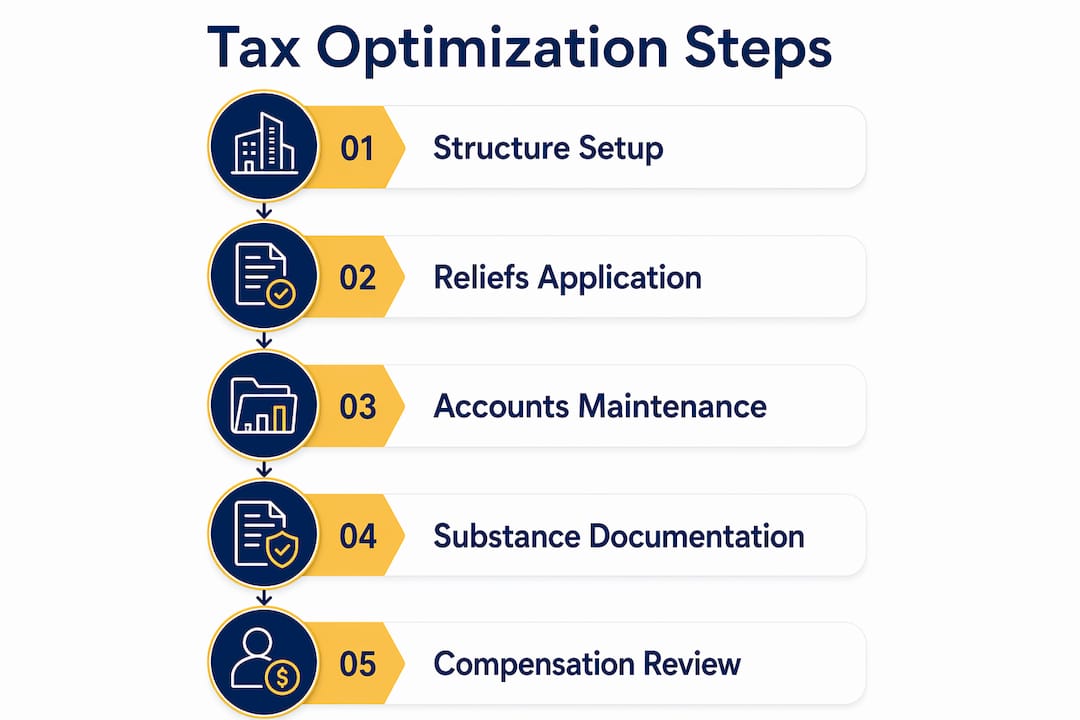
Step 2: Apply statutory reliefs proactively. File for Patent Box treatment in the first tax year it applies. Claim R&D super-deductions in the year costs are incurred. Do not wait for the tax authority to prompt you.
Step 3: Maintain clean statutory accounts. Swiss tax is assessed on statutory profit, not management accounts. Errors in the statutory books flow directly into the tax return. Clean books from year one prevent restatements and audit triggers.
Step 4: Document substance continuously. Keep board minutes, employment contracts, and service agreements current. Tax authorities increasingly require documented substance before granting rulings or accepting treaty positions.
Step 5: Review owner-manager compensation annually. The split between salary and dividends affects both corporate tax and AHV social security contributions. Owner-managers must pay a market-rate salary before taking dividends. Misallocating the split triggers back assessments from the cantonal Ausgleichskasse.
Step 6: Adjust intra-group loan rates each january. When FTA Circular 215 publishes new safe-harbor rates, update loan agreements before the first interest payment of the year.
Common mistakes to avoid:
Treating the Patent Box as automatic without a formal election and qualifying IP documentation
Skipping advance rulings to save time, then facing uncertainty at assessment
Letting substance lapse after the first year when scrutiny is lower
Assuming GmbH and AG differ significantly for tax purposes when they do not
Ignoring Swiss tax planning as a continuous process rather than a one-time setup
What are common challenges in Swiss corporate tax optimization?
The most frequent failure point is underestimating what “substance” actually means. A registered address and a nominee director do not satisfy the DEMPE requirements for IP companies. Tax authorities expect real decision-making to happen in Switzerland, with documented evidence.
“A paper structure without genuine activity is not a tax optimization strategy. It is a liability waiting to be assessed.”
The second most common problem is the Form 170 deadline. Companies raise capital, forget to file, and permanently lose the Capital Contribution Principle benefit on that round. No amount of subsequent compliance recovers it.
For large consolidated groups, the OECD Pillar Two rules impose a 15% global minimum tax on groups with consolidated revenues above EUR 750 million. Below that threshold, Swiss cantonal reliefs remain fully available. Most SMEs and mid-market companies are unaffected, but any group approaching that revenue level should model the Pillar Two impact before relying on cantonal Patent Box savings.
Pro Tip: Follow the expert-recommended sequence every time: design the structure first, build real substance second, set transfer pricing third, and confirm the tax position fourth. Skipping steps two or three makes step four impossible to defend.
Additional challenges to watch:
Overpaying AHV by failing to benchmark salary against cantonal Ausgleichskasse tables
Relying on holding structures without understanding that former cantonal holding exemptions were abolished in 2020
Missing annual safe-harbor rate updates on intra-group loans
Failing to adapt tax strategies as OECD standards evolve
Key Takeaways
Swiss corporate tax optimization delivers real, lasting savings only when statutory reliefs, canton selection, and compliance discipline work together from the start.
Point | Details |
Statutory reliefs are powerful but layered | Patent Box cuts cantonal IP tax by up to 90%; R&D super-deduction allows up to 150% cost deduction at cantonal level only. |
Canton choice drives the biggest rate difference | Effective rates range from 11.85% in Zug to 20.54% in Bern; choose before incorporation, not after. |
Form 170 is non-negotiable | Missing the 30-day filing deadline permanently voids Capital Contribution Principle benefits with no remedy. |
Substance must be real and documented | DEMPE functions, arm’s-length pricing, and genuine Swiss operations are required to sustain reliefs and treaty benefits. |
Optimization is an ongoing process | Annual reviews of safe-harbor rates, compensation splits, and regulatory changes are required to maintain the tax position. |
What I have learned about Swiss tax planning after years of working with international founders
The biggest misconception I see is that Swiss tax optimization is a setup task. Founders incorporate in Zug, elect the Patent Box, and assume the work is done. It is not. The tax position you build in year one requires active maintenance every year after that.
The companies that sustain the lowest effective rates are not the ones with the most aggressive structures. They are the ones with the cleanest documentation, the most disciplined filing calendars, and the clearest substance. Advance rulings are underused. Most founders avoid them because they take time. But a ruling that takes six weeks to obtain protects years of tax savings from being unwound at audit.
The 2026 environment is more demanding than it was five years ago. Cantonal tax authorities are more sophisticated about substance, and the OECD Pillar Two framework has made large-group planning more complex. For business owners below the EUR 750 million threshold, the Swiss toolkit remains excellent. The Patent Box, R&D super-deduction, and Capital Contribution Principle are genuinely generous reliefs. The condition is that you use them correctly, on time, and with real operations behind them. That is not a burden. It is the price of a legitimate and durable tax advantage.
— Rolands
How Rpcs helps you build a tax-efficient Swiss company
Rpcs works with international entrepreneurs and investors who want to get Swiss company formation right from day one. Choosing the wrong canton or missing a compliance deadline costs far more than the setup itself.
Rpcs guides you through canton selection, GmbH or AG structure choice, and the full company formation process with legal documentation, notarization, and registration handled correctly. The accounting services keep your statutory books clean, your Form 170 filings on schedule, and your owner-manager compensation split aligned with AHV requirements. If you are ready to build a compliant, tax-efficient Swiss company, Rpcs provides the structure and the ongoing support to make it work.
FAQ
What is the Patent Box in Swiss corporate tax?
The Patent Box is a cantonal tax relief that reduces the tax on qualifying intellectual property income by up to 90%. It applies only at the cantonal and communal level, not to the federal corporate tax rate of 8.5%.
How does canton selection affect my corporate tax rate?
Effective combined corporate tax rates range from approximately 11.85% in Zug to 20.54% in Bern. Choosing the right canton before incorporation is the single largest variable in reducing your total tax burden.
What happens if I miss the Form 170 filing deadline?
Missing the 30-day Form 170 filing deadline permanently voids the Capital Contribution Principle benefit for that capital contribution. The 2025 Federal Supreme Court confirmed there is no remedy once the deadline passes.
Is a GmbH or AG better for tax optimization in Switzerland?
Both structures pay the same federal and cantonal tax rates and qualify for the same TRAF reliefs. The choice between them turns on capital requirements and shareholder mechanics, not tax rates.
Does Pillar Two affect my Swiss company’s tax reliefs?
Pillar Two imposes a 15% global minimum tax only on consolidated groups with revenues above EUR 750 million. Companies below that threshold retain full access to Swiss cantonal reliefs, including the Patent Box and R&D super-deduction.
Recommended
Comments