
Why Choose Zurich for Business: 2026 Investor Guide
- Jun 6
- 8 min read

TL;DR:
Zurich is Switzerland’s financial hub, offering a competitive tax rate, a highly skilled talent pool, and strong legal protections. It prioritizes reputation and market access over minimal tax benefits, making it ideal for long-term, credible operations. Establishing a business requires careful planning of banking relationships, legal structure, and talent recruitment strategies.
Zurich is defined as Switzerland’s financial capital and the most internationally connected business hub in the German-speaking world. For international entrepreneurs and investors asking why choose Zurich for business, the answer sits at the intersection of a combined corporate tax rate of approximately 19.7%, a talent pool where nearly 50% of residents hold tertiary degrees, and a legal framework that protects intellectual property with the same rigor it applies to banking secrecy. This is not a tax haven. It is a premium jurisdiction where the “Swiss Made” label alone adds measurable credibility to any corporate structure, from a GmbH startup to a multinational AG holding company.
What are the key economic and tax advantages of Zurich for businesses?
Zurich’s corporate tax framework is competitive without being aggressive. The combined rate of 19.7% as of 2026 covers federal, cantonal, and municipal taxes, placing Zurich above ultra-low-tax cantons like Zug but well below the average burden in Germany, France, or the United Kingdom. That positioning is deliberate. Zurich trades a slightly higher rate for unmatched reputational capital and access to Europe’s deepest financial markets.
One of the most overlooked Zurich business benefits applies to founders personally. Capital gains on privately held shares are generally tax-free for individuals in Switzerland. An entrepreneur who builds and exits a company in Zurich can realize the full upside of that exit without a capital gains tax bill. That single provision changes the math on long-term wealth creation dramatically.
The tax picture extends further for R&D-intensive businesses. Switzerland’s patent box regime allows qualifying income from patents and similar rights to be taxed at a reduced rate, and additional R&D super-deductions are available at the cantonal level. These incentives make Zurich particularly attractive for technology, life sciences, and financial services companies that generate significant intellectual property.
Pro Tip: Zurich is not the right choice if your primary goal is minimizing tax at all costs. Zug offers lower rates. Choose Zurich when reputation, banking access, and talent density matter as much as the tax line.
Tax Feature | Detail |
Combined corporate tax rate | Approximately 19.7% covering federal, cantonal, and municipal layers |
Capital gains for individuals | Generally tax-free on privately held share exits |
Patent box deduction | Reduced tax rate on qualifying IP income at cantonal level |
R&D super-deduction | Additional deductions available for qualifying research expenditure |
How to establish a business in Zurich: procedural and banking essentials
Setting up a company in Zurich follows a defined process, but two requirements catch most foreign founders off guard: minimum capital and banking validation. The minimum capital for a GmbH is CHF 20,000, while an AG requires CHF 100,000. Total initial setup costs typically range from CHF 5,000 to CHF 12,000, covering notary fees of CHF 1,200 to CHF 2,500, commercial register fees of CHF 600, and compliance costs. Registration itself takes two to three weeks once documents are in order.
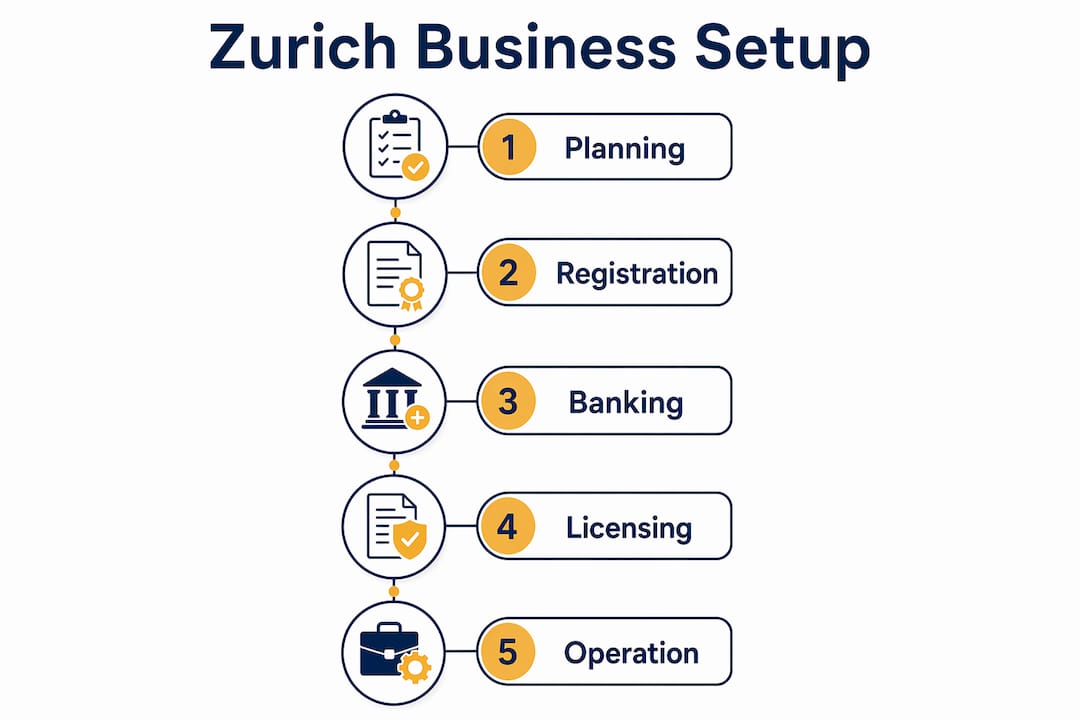
The GmbH and AG structures serve different strategic purposes. A GmbH offers simpler governance and greater privacy since shareholder details are not always publicly disclosed in full. An AG carries more prestige, suits companies planning to raise institutional capital or list publicly, and is the standard structure for holding companies. Foreign entrepreneurs who want to understand the full legal requirements for directors and residency obligations should address those before selecting an entity type.
The single most critical operational step is securing a Swiss banking relationship. Swiss banks require local substance proof beyond a P.O. Box, including a coworking space address and a local phone number, before approving a business account. A superficial registration almost always results in rejection. Banks also run a full KYC (Know Your Customer) process covering ultimate beneficial ownership (UBO) disclosure, source of funds, and business activity documentation.
The practical sequence for a foreign founder looks like this:
Select your entity type (GmbH or AG) based on capital, governance, and exit strategy.
Appoint at least one Swiss-resident director to satisfy local residency requirements.
Secure a registered business address in Zurich, not a P.O. Box.
Initiate the Swiss bank KYC process early, before finalizing your office lease, to avoid delays.
Deposit minimum share capital into a blocked account at your chosen bank.
Complete notarization and submit to the commercial register for formal incorporation.
Pro Tip: Start the banking application before you finalize any other setup step. Swiss banks can take four to eight weeks to approve a new business account. Founders who treat banking as an afterthought routinely delay their entire launch timeline.
What talent and infrastructure advantages does Zurich offer for growing businesses?
Zurich’s talent ecosystem is the strongest argument for the city beyond its tax and legal framework. ETH Zurich and the University of Zürich together produce thousands of graduates annually in engineering, computer science, finance, and life sciences. ETH Zurich consistently ranks among the top ten universities globally in technical disciplines, and its graduates are actively recruited by the more than 600 AI companies operating in the city.

Google’s main European engineering hub is located in Zurich, a fact that signals the city’s standing in the global technology hierarchy. That presence creates a self-reinforcing talent cycle. Senior engineers want to work where other senior engineers work, which draws more companies, which draws more talent. For a founder hiring their first ten technical employees, proximity to that ecosystem matters enormously.
The infrastructure supporting daily business operations matches the talent quality:
Zurich Airport connects to over 200 global destinations, making it one of the most connected hubs in Europe for business travel.
SBB rail network provides reliable connections to Geneva, Basel, Bern, and major German and French cities within two to three hours.
Digital infrastructure includes high-speed broadband coverage across the canton, supporting remote and hybrid work models.
Multilingual workforce with German, English, French, and Italian capabilities reduces friction for multinational teams.
Political neutrality and IP protection give international businesses a stable legal environment that many other European jurisdictions cannot match.
One nuance worth noting: Zurich’s insurance sector imports significant mid-career talent from London and Bermuda because the local pipeline is thin at that experience level. This reflects a broader pattern. Zurich excels at producing exceptional junior and senior talent but can be competitive and expensive at the mid-career tier across several industries. Founders should plan their hiring strategy with that gap in mind and budget for international recruitment where necessary.
How does Zurich compare to other Swiss business hubs and international cities?
Zurich is not the cheapest place to set up in Switzerland, and it does not try to be. Understanding where it sits relative to Zug, Geneva, and major European cities helps international investors make a genuinely informed decision.
Location | Corporate tax rate | Primary industry focus | Key advantage |
Zurich | ~19.7% | Finance, tech, insurance | Talent depth, banking access, reputation |
Zug | ~11.9% | Crypto, commodities, holding | Lowest tax rate in Switzerland |
Geneva | ~14% | NGOs, commodities, private banking | French-speaking market, UN proximity |
Frankfurt | ~30% | Banking, manufacturing | EU market access, large labor pool |
London | ~25% | Finance, tech, media | English-speaking, deep capital markets |
Geneva offers lower taxes at approximately 14%, but its industry focus skews toward commodity trading, NGOs, and private banking rather than technology or broad financial services. Zug is the obvious choice for crypto and blockchain businesses or pure holding structures where tax minimization is the primary objective. Zurich wins when a business needs to hire aggressively, access Swiss capital markets, and carry a brand name that signals credibility to global partners and clients.
Compared to Frankfurt or London, Zurich’s premium jurisdiction status and the intangible value of the “Swiss Made” label outweigh the higher rents and operating costs for most international companies in financial services, technology, and life sciences. The business climate in Zurich rewards long-term operational substance over short-term cost optimization.
Key takeaways
Zurich delivers its strongest value to international businesses that prioritize reputation, talent access, and financial market proximity over raw tax minimization.
Point | Details |
Corporate tax rate | Zurich’s combined rate of 19.7% is competitive for a premium European financial center. |
Capital gains advantage | Individual founders pay zero capital gains tax on privately held share exits in Switzerland. |
Banking is the critical path | Start the Swiss bank KYC process before any other setup step to avoid launch delays. |
Talent ecosystem depth | ETH Zurich, 600-plus AI companies, and Google’s EU hub create a self-reinforcing talent flywheel. |
Zurich vs. Zug vs. Geneva | Choose Zurich for reputation and talent; Zug for lowest taxes; Geneva for French-market or NGO focus. |
What I’ve learned advising founders on the Zurich decision
Most founders I work with arrive focused on the tax rate. That is the wrong starting point. The first question I ask is whether they have a plan for their Swiss banking relationship, because that single step determines whether everything else moves in weeks or stalls for months.
The second thing I tell them: Zurich is a long-term bet, not a short-term arbitrage. The Swiss political neutrality and IP protection that international businesses value so highly are not features you extract quickly. They compound over years as your company builds credibility in the market. Founders who set up in Zurich with a three-year horizon and genuine operational substance consistently outperform those who treat it as a registration exercise.
On talent, I have seen companies underestimate mid-career hiring costs repeatedly. The junior pipeline from ETH Zurich is exceptional. The senior network is deep. But if you need experienced professionals at the five-to-ten-year mark in insurance, asset management, or specialized engineering, budget for international recruitment from day one. Zurich imports that tier from London, New York, and Singapore, and the competition for those candidates is real.
My honest advice: if you are choosing between Zurich and Zug purely on tax, choose Zug. If you are building a company that needs to be taken seriously by Swiss banks, global clients, and top-tier engineers, Zurich is the only address that delivers all three simultaneously.
— Rolands
Set up your Zurich business with Rpcs
Rpcs specializes in Swiss company formation for international entrepreneurs and investors, covering GmbH and AG incorporation, notarization, commercial register filing, and full compliance support from day one.
Beyond incorporation, Rpcs handles the steps that trip up most foreign founders: securing a registered business address in Zurich, appointing a qualified Swiss resident director, and guiding you through the Swiss bank account opening process. The team also provides ongoing Swiss accounting services and bookkeeping tailored to local tax requirements. Whether you are forming a holding company, a tech startup, or a financial services firm, Rpcs gives you the local expertise to move fast and stay compliant.
FAQ
What is Zurich’s corporate tax rate in 2026?
Zurich’s combined corporate tax rate is approximately 19.7% as of 2026, covering federal, cantonal, and municipal taxes. This rate is higher than Zug but competitive relative to major European financial centers like Frankfurt or London.
How long does it take to register a company in Zurich?
Company registration in Zurich typically takes two to three weeks once all documents are submitted to the commercial register. The Swiss bank account opening process can add four to eight weeks, so starting KYC early is critical.
Do I need a Swiss resident director to set up in Zurich?
Yes. At least one director of a Swiss GmbH or AG must be a Swiss resident with signatory authority. Foreign founders without local residency typically engage a nominee resident director service, which costs approximately CHF 5,000 to CHF 10,000 per year.
Is Zurich better than Zug for international businesses?
Zurich offers superior talent access, banking relationships, and reputational capital, while Zug provides Switzerland’s lowest corporate tax rates. The right choice depends on whether your priority is cost minimization or building a credible, talent-rich operation.
Are capital gains taxed in Switzerland for entrepreneurs?
Capital gains realized on privately held shares are generally tax-free for individuals in Switzerland. This makes Zurich a particularly attractive location for founders planning a future exit or equity-based wealth creation strategy.
Recommended
Comments