
What Is Corporate Compliance? A Guide for Executives
- 20 hours ago
- 8 min read

TL;DR:
Corporate compliance involves an organization following all relevant laws, regulations, and internal policies. Effective programs include written standards, oversight, training, monitoring, enforcement, and responsive actions. Leaders must focus on behavior, outcomes, and continuous adaptation to ensure compliance becomes a business asset.
Corporate compliance is defined as an organization’s adherence to all applicable laws, regulations, ethical standards, and internal policies governing its operations. Every business operating across jurisdictions faces this obligation, whether it is a startup registering its first entity or a multinational managing operations across a dozen countries. The consequences of non-compliance are concrete: regulatory fines, criminal liability, reputational damage, and loss of operating licenses. Understanding what corporate compliance requires, and how to build a program that actually works, is one of the most practical skills an executive can develop.

What is corporate compliance and why does it matter?
Corporate compliance is the structured process by which a company identifies its legal and ethical obligations, then builds systems to meet them consistently. The corporate compliance definition extends beyond simply following rules. It includes written policies, employee training, internal monitoring, and a clear chain of accountability from the board level down to individual contributors.
The importance of corporate compliance shows up most clearly when it fails. Regulatory bodies including the U.S. Department of Justice and the Securities and Exchange Commission treat the absence of a functioning compliance program as an aggravating factor in enforcement decisions. A company with no documented compliance structure faces harsher penalties than one that demonstrates good-faith effort. That asymmetry alone justifies the investment.
For executives operating in Switzerland or structuring international entities, compliance obligations span corporate law, tax reporting, anti-money laundering rules, and data protection standards. The Swiss corporate compliance risks framework reflects this layered reality, where legal obligations interact with reputational and operational risk in ways that generic checklists cannot capture.
What are the core elements of a compliance program?
Effective compliance programs must include seven foundational elements per the Federal Sentencing Guidelines. These elements define the minimum structure regulators expect to see when evaluating whether a company made genuine efforts to prevent misconduct.
Element | What it requires |
Written standards | Codes of conduct, policies, and procedures documented and accessible to all staff |
High-level oversight | Board or senior leadership actively supervising the compliance function |
Due diligence in hiring | Screening processes that prevent placing high-risk individuals in sensitive roles |
Training and communication | Regular, role-specific education on compliance obligations and reporting channels |
Monitoring and auditing | Ongoing systems to detect violations before they escalate |
Consistent enforcement | Discipline applied uniformly regardless of seniority or business unit |
Response and prevention | Documented processes for investigating issues and preventing recurrence |
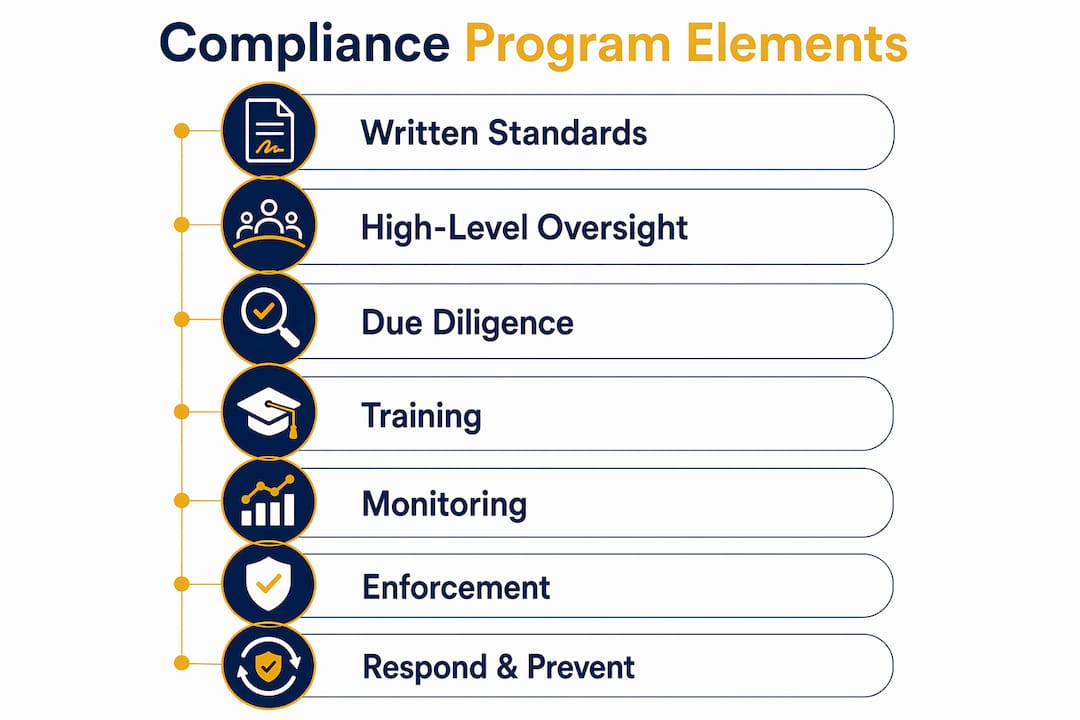
Each element reinforces the others. Strong written standards mean nothing without training. Monitoring without enforcement creates the appearance of oversight without the substance.
The DOJ evaluates compliance programs based on three core questions: Is the program well-designed? Is it applied in good faith? Does it work in practice? That third question is the one most programs fail. A policy manual sitting on a shared drive does not constitute a functioning program. Regulators look for evidence that the program shapes actual employee behavior.
Pro Tip: The most common design flaw is building a compliance program around documentation rather than behavior. Write your policies for the employee who will read them once, not the auditor who will review them later.
Why do compliance programs fail?
Common root causes of compliance failure include leadership gaps, poor risk assessments, unclear ownership, weak culture, and fragmented systems. Each of these is predictable and preventable.
Leadership gaps. When executives treat compliance as a legal department problem rather than a business priority, the rest of the organization follows their lead. Compliance teams without executive backing cannot enforce standards against senior managers.
Poor risk assessments. Programs built on generic risk frameworks miss the specific exposures that matter for a given industry, geography, or business model. A Swiss GmbH faces different anti-money laundering obligations than a U.S. publicly traded company.
Unclear ownership. When no one is explicitly responsible for a compliance obligation, it goes unmet. Ownership must be named, documented, and tied to performance accountability.
Weak culture. Rules without culture produce workarounds. Employees who do not believe leadership takes compliance seriously will not report concerns through internal channels.
Fragmented systems. Disjointed compliance tools force reliance on spreadsheets and email threads, creating audit gaps and operational friction that undermine the entire program.
The cultural dimension is the hardest to fix because it cannot be purchased or mandated. Culture changes when leadership behavior changes, not when a new policy is issued.
Pro Tip: If your compliance team spends more than 20% of its time reconciling data across disconnected systems, fragmentation is already costing you audit readiness. Consolidate workflows before adding new monitoring tools.
How do you build and maintain a compliance program?
Building a compliance program from scratch follows a phased 12-month cycle that moves from legal mapping through operational embedding. The sequence matters because each phase creates the foundation for the next.
Map legal obligations. Identify every law, regulation, and contractual requirement that applies to your business by jurisdiction, industry, and entity type. This is the foundation. Skipping it means building a program that addresses the wrong risks.
Conduct a risk assessment. Score each obligation by likelihood of violation and potential impact. Prioritize the highest-risk areas for immediate policy development.
Draft a code of conduct. Write a code that translates legal obligations into plain-language behavioral expectations. The code should be readable by every employee, not just legal counsel.
Build reporting channels. Create anonymous and named reporting mechanisms. Employees who cannot report concerns safely will not report them at all.
Design a training program. Develop role-specific training that addresses the actual risks each function faces. Finance teams need anti-bribery training. HR teams need data protection training. Generic annual training satisfies a checkbox but changes little.
Implement monitoring and auditing. Set up regular reviews of high-risk processes. Monitoring catches problems early. Auditing provides the documented evidence regulators expect.
Establish case management. Create a system for tracking reported concerns from intake through resolution. Every investigation should be documented, regardless of outcome.
Test audit readiness. Conduct internal mock audits before regulators do. Identify gaps and close them proactively.
For companies operating in Switzerland, the step-by-step compliance maintenance guide from Rpcs covers the ongoing obligations that follow initial program setup, including annual reporting, director duties, and accounting requirements under Swiss law.
The 12-month cycle does not end after year one. Corporate compliance regulations change, business models evolve, and new risks emerge. Effective programs treat the cycle as continuous, not a one-time project.
How do technology and leadership shape compliance outcomes?
Technology is a tool, not a solution. Compliance technology adoption fails mainly due to lack of cultural buy-in, not technical issues. A sophisticated case management platform deployed in an organization where employees distrust the compliance function will be underused and underreported.
Successful compliance functions position technology as a workflow enhancer rather than a surveillance mechanism. The distinction matters to employees. When compliance tools are introduced as ways to make reporting easier and investigations faster, adoption rates improve. When they are introduced as monitoring systems, resistance follows.
Leadership behavior determines which framing wins. Executives who visibly use compliance channels, who reference compliance metrics in business reviews, and who champion compliance through tone at the top create the conditions for genuine adoption. Those who delegate compliance entirely to a legal team signal that it is a peripheral concern.
Measurement also requires rethinking. Outcome metrics like issue resolution speed and investigation results matter more to regulators than input metrics like training hours completed. A program that logs 10,000 training hours but resolves investigations slowly and inconsistently will not impress a DOJ examiner. Executives should ask their compliance teams to report on outcomes, not just activity.
For executives building or restructuring compliance programs, understanding corporate governance principles provides the structural context that compliance programs operate within. Governance defines who has authority; compliance defines how that authority must be exercised.
Key Takeaways
Corporate compliance requires a structured, leadership-backed program built on the Federal Sentencing Guidelines’ seven elements, continuously adapted to reflect real risks and measured by outcomes rather than activity.
Point | Details |
Start with legal mapping | Identify every applicable law and regulation before drafting a single policy. |
Follow the seven elements | Federal Sentencing Guidelines define the minimum structure regulators expect. |
Culture drives adoption | Technology and policies fail without leadership behavior that models compliance. |
Measure outcomes, not inputs | Track issue resolution speed and investigation results, not just training hours. |
Treat compliance as continuous | Annual reviews are not enough; programs must adapt as regulations and risks evolve. |
Compliance is a business asset, not a legal obligation
I have worked with executives who treat compliance as a cost center and others who treat it as a competitive advantage. The difference in outcomes is not subtle. Companies that integrate compliance into their business planning catch problems before they become enforcement actions. Companies that treat it as a reporting exercise discover their exposure at the worst possible moment.
The most persistent misconception I encounter is that a well-written policy manual constitutes a compliance program. It does not. Regulators, particularly under the DOJ’s Evaluation of Corporate Compliance Programs framework, look for evidence that the program shapes behavior. That requires training people actually retain, reporting channels people actually use, and investigations that actually resolve.
The executives who get this right share one habit: they ask their compliance teams hard questions. Not “are we compliant?” but “how do we know?” That shift in framing changes what compliance teams measure, what they report, and ultimately what they build. Compliance treated as an evolving process, not a static checklist, is the only version that holds up under scrutiny. The 2026 Swiss compliance workflow guide reflects exactly this approach for companies operating under Swiss law.
— Rolands
Swiss company formation and compliance support from Rpcs
Setting up a compliant corporate structure from day one is far less costly than retrofitting compliance after the fact.

Rpcs supports international entrepreneurs and investors through every stage of Swiss company formation, from GmbH and AG registration through legal documentation, notarization, and banking setup. The platform covers ongoing compliance obligations including Swiss accounting services, annual reporting, and director duties, giving foreign clients the local expertise they need to operate legally and confidently in Switzerland. For executives who want a compliant structure without building local knowledge from scratch, Rpcs provides the framework that regulators and business partners expect to see.
FAQ
What is the corporate compliance definition?
Corporate compliance is an organization’s adherence to all applicable laws, regulations, ethical standards, and internal policies. It includes written standards, training, monitoring, enforcement, and documented response processes.
What are the seven elements of a compliance program?
The Federal Sentencing Guidelines require written standards, high-level oversight, due diligence in hiring, effective training, monitoring and auditing, consistent enforcement, and documented response to violations.
Why do corporate compliance programs fail?
The most common causes are leadership gaps, poor risk assessments, unclear ownership, weak organizational culture, and fragmented systems that prevent integrated oversight.
How does the DOJ evaluate a compliance program?
The DOJ asks three questions: Is the program well-designed? Is it applied in good faith? Does it work in practice? All three must be demonstrable, not just documented.
How often should a compliance program be updated?
A compliance program should be reviewed and updated continuously, not just annually. Regulatory changes, new business activities, and audit findings all require prompt program adjustments.
Recommended