
Multilingual Support in Swiss Business: 2026 Guide
- 3 days ago
- 9 min read

TL;DR:
Multilingual support in Swiss business improves market access, customer loyalty, and regulatory compliance across regions.
Investing in native-language skills and proper localization strategies is essential for long-term success and trust-building.
Multilingual support in Swiss business is defined as the deliberate use of German, French, Italian, and English across customer communications, internal operations, and regulatory compliance to serve Switzerland’s four-language market. The role of multilingual support in Swiss business goes far beyond translation. It determines which customers you reach, how much trust you build, and whether your company can operate across cantonal borders without friction. Switzerland’s language distribution breaks down as German at 62%, French at 23%, and Italian at 8% of the population. Ignoring French and Italian alone means cutting off nearly 40% of the domestic market before you make a single sale.
What are the key benefits of multilingual support for Swiss firms?
Language support in Switzerland produces measurable business outcomes, not just goodwill. The most direct benefit is market access. A company that publishes content only in German reaches the majority, but it leaves the French-speaking cantons of Geneva, Vaud, and Neuchâtel, plus the Italian-speaking Ticino, largely unserved. That gap is a real revenue loss, not a theoretical one.
Customer satisfaction follows closely behind market reach. Consumers across Switzerland consistently prefer to buy, complain, and renew contracts in their primary language. Native-language customer support builds the kind of trust that English-only service cannot replicate, particularly in sales and after-sales interactions where emotional stakes are higher.
The benefits extend inside the organization as well. Language training improves team performance, organizational competitiveness, and cohesion in multicultural Swiss companies. A multilingual workforce reduces miscommunication between regional offices and speeds up decision-making across language boundaries.
There is also a talent and compensation angle worth noting. Multilingual professionals in Europe earn up to 15% more than their monolingual counterparts. That premium reflects the real value employers place on language skills, and it signals that investing in staff language development pays back in retention and performance.
Market reach: German, French, and Italian coverage captures the full domestic consumer base.
Customer loyalty: Language-matched support reduces churn and increases repeat business.
Team cohesion: Shared language proficiency cuts internal friction in multicultural teams.
Talent value: Multilingual staff command higher salaries and deliver stronger cross-regional results.
Pro Tip: Start with German and French for your website and customer service. Add Italian content once you have a presence in Ticino or a product line targeting that region specifically.
How do linguistic dynamics impact Swiss business operations?
Switzerland’s linguistic geography is not a soft cultural detail. It is an operational constraint that shapes everything from contract drafting to marketing copy. German dominates the north and east, French anchors the west, and Italian defines the south. Each region carries distinct consumer expectations, regulatory norms, and professional communication styles.

English functions as the working language for multinational headquarters, cross-border deals, and international banking. It opens doors at the executive level. However, fluency in local national languages is crucial for progression and better collaboration with cantonal authorities and local stakeholders. A company that relies solely on English for client-facing work will hit a ceiling in local market penetration.
The compliance dimension is equally concrete. Swiss cantonal administrations often communicate in the regional language. Tax filings, labor authority correspondence, and commercial register submissions may require German, French, or Italian depending on the canton. A foreign company that cannot handle these documents internally faces delays and added costs.
Localization goes deeper than word-for-word translation. Swiss French consumers, for example, respond differently to promotional messaging than Swiss German consumers, even when the factual content is identical. Tone, formality, and cultural references all shift across language regions. Language proficiency reduces transaction costs by improving informational transparency and institutional compatibility, which means the investment in proper localization pays back in faster deal cycles and fewer misunderstandings.
Cantonal compliance: Regulatory filings must match the official language of the relevant canton.
Sales effectiveness: Regional language use in pitches and proposals increases close rates.
Partner relations: Local language fluency signals long-term commitment to Swiss partners.
Brand perception: Poorly adapted content reads as foreign and reduces credibility.
Pro Tip: Hire a native-speaking reviewer for each language region before publishing any customer-facing content. Machine translation catches words; a native speaker catches tone.
What effective multilingual strategies can Swiss companies implement?
Building multilingual capability requires a structured approach, not ad hoc translation requests. The most effective companies treat language as an operational system with defined processes, not a one-time project.
Hire multilingual staff from the start. Recruiting employees who speak German and French, or French and Italian, creates internal capacity that scales with the business. For Swiss branch office operations, having a local manager fluent in the regional language is often the single highest-impact hire.
Invest in professional localization, not just translation. Translation converts words. Localization adapts meaning, tone, and cultural context. Swiss brands must provide at least German and French content as a baseline; Italian is necessary for comprehensive national coverage. Partnering with a localization specialist for website content, product documentation, and marketing materials is a non-negotiable step for any company targeting the full Swiss market.
Use technology with human oversight. AI translation tools have improved dramatically and work well for internal drafts, high-volume content, and first-pass localization. They fail on nuance, legal language, and culturally specific references. The right model pairs AI speed with native-speaker review. Multilingual SEO content strategies that rank across German, French, and Italian search queries require this hybrid approach to perform consistently.
Segment marketing by language region. Swiss German consumers in Zurich and Swiss French consumers in Geneva do not respond to the same campaigns. Customize messaging, imagery, and channel selection by region. This is not a luxury for large enterprises. It is a baseline requirement for any company serious about Swiss market share.
Pro Tip: Build a language style guide for each region before you scale content production. Consistent tone across German, French, and Italian content is what separates credible Swiss brands from foreign companies that look like they used a translation app.
What challenges do Swiss businesses face in implementing multilingual support?
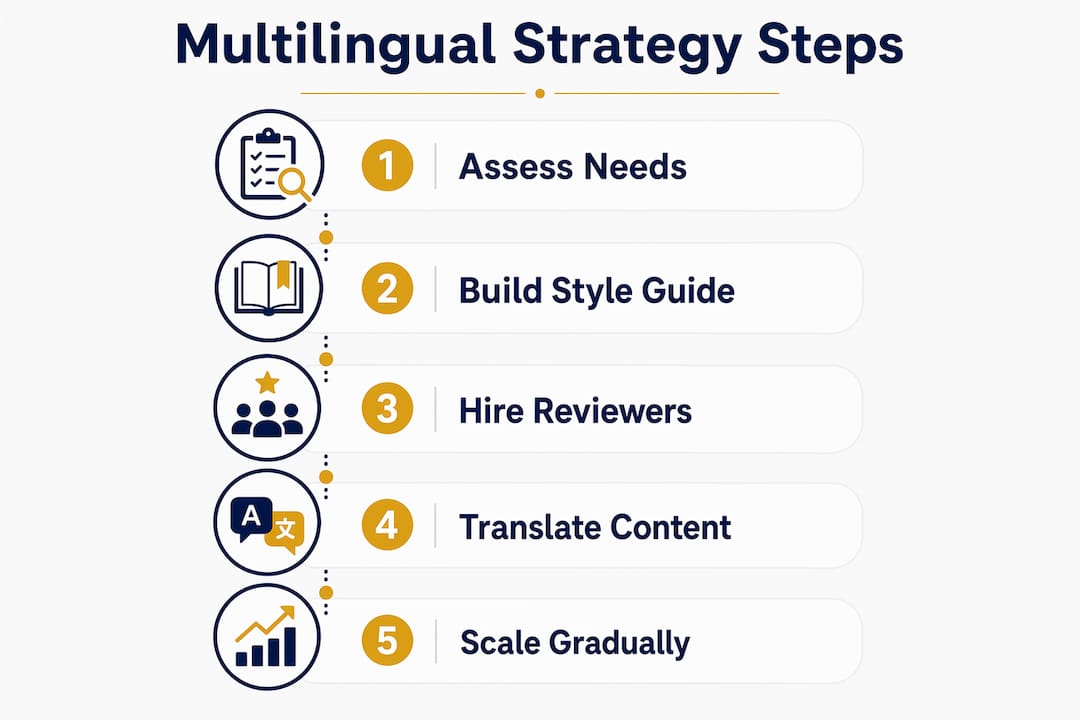
The primary challenge is cost. Professional localization, multilingual staff, and ongoing content adaptation all require sustained investment. High-quality localization requires ongoing investment and Swiss consumers will switch to competitors if primary language support is lacking. That customer loss is more expensive than the localization budget it replaces.
Scaling quality is the second major obstacle. A company can produce excellent German content and mediocre French content, and the gap will damage brand credibility in French-speaking cantons. Maintaining consistent quality across three or four languages requires dedicated workflows, not occasional spot checks.
Cultural missteps carry real reputational risk. A marketing campaign that works in Zurich can feel tone-deaf in Geneva. Swiss French and Swiss German audiences differ in formality preferences, humor, and sensitivity to direct sales language. Poor adaptation signals that a company does not understand its audience, which is a trust problem that takes time to repair.
Internal communication in multilingual workplaces adds another layer of complexity. Internal communication benefits significantly when staff have basic proficiency in local languages, improving career integration and social cohesion. Companies that default entirely to English for internal meetings risk excluding employees whose strongest working language is German or French.
Budget discipline: Treat localization as a recurring operational cost, not a one-time project expense.
Quality control: Assign a native-speaking editor for each language region to review all published content.
Cultural training: Brief marketing and sales teams on regional communication norms before launching campaigns.
Internal language policy: Establish a clear policy on which languages are used in which contexts to reduce confusion.
Pro Tip: Create a shared glossary of key business terms in German, French, and Italian. It takes one afternoon to build and saves hours of back-and-forth in cross-regional meetings.
How does multilingual support boost customer engagement in Switzerland?
Customer engagement in Switzerland is directly tied to language. A client who receives a proposal, invoice, or support response in their primary language is more likely to respond quickly, ask fewer clarifying questions, and renew the relationship. The effect is strongest in regulated industries like finance, insurance, and legal services, where clarity and trust are non-negotiable.
Brand reputation across linguistic regions depends on consistency. A company known for excellent German-language service but poor French-language support will struggle to grow in western Switzerland, regardless of product quality. Successful Swiss companies maintain native-language skills for sales and customer support to build trust and navigate cultural nuances effectively. That is the standard the market expects.
Cross-border partnership success also correlates with language capability. Swiss companies that operate across the German, French, and Italian borders of Germany, France, and Italy find that language acts as a trade-related asset reducing transaction costs by improving transparency and institutional compatibility. A Swiss firm that can negotiate in the partner’s language closes deals faster and builds longer-lasting relationships. For businesses exploring Swiss cross-border operations, language capability is one of the most underrated competitive advantages available.
Business outcome | Impact of multilingual support |
Customer retention | Higher in language-matched service interactions |
Sales cycle length | Shorter when proposals match the client’s primary language |
Regulatory compliance | Faster when filings match cantonal language requirements |
Partner trust | Stronger when negotiations occur in the partner’s language |
Key Takeaways
Multilingual support in Swiss business is a direct driver of market access, customer retention, and regulatory compliance across Germany, French, and Italian-speaking regions.
Point | Details |
Language coverage drives revenue | Covering German, French, and Italian reaches the full Swiss market and avoids losing 40% of potential customers. |
Localization beats translation | Adapting tone and cultural context for each region builds trust that word-for-word translation cannot achieve. |
Internal language skills matter | Staff with local language proficiency improve team cohesion and reduce communication friction across regional offices. |
Technology needs human oversight | AI translation tools work for volume and speed, but native-speaker review is required for quality and cultural accuracy. |
Early investment prevents costly fixes | Building multilingual capability at company formation is cheaper than retrofitting it after market entry. |
Why I think most companies get multilingual strategy backwards
Most business leaders I speak with treat multilingual support as a late-stage problem. They launch in German, gain traction, and then scramble to add French and Italian content when they realize the western and southern markets are not converting. By that point, they are retrofitting localization onto a brand architecture that was never designed for it. The cost is two to three times higher than building it in from the start.
The deeper issue is that companies confuse translation with strategy. Translation is a task. Multilingual strategy is a decision about which markets you are serious about and what it takes to earn trust there. Language fluency signals commitment and facilitates professional advancement beyond just initial employment. The same principle applies at the company level. A brand that communicates fluently in a customer’s language signals that it belongs in that market.
The future of multilingual support in Switzerland will be shaped by AI-assisted localization, but the human element will remain decisive. Cultural intelligence, the ability to read what a Swiss French client actually means versus what they literally say, cannot be automated. Companies that invest in both technology and culturally fluent people will outperform those that treat language as a cost to minimize.
My practical advice: treat your multilingual capability as a core business asset, the same way you treat your legal structure or your banking relationships. Build it deliberately, maintain it consistently, and review it annually as your markets evolve.
— Rolands
How Rpcs supports your Swiss business across language regions
Establishing a company in Switzerland’s multilingual environment requires more than a registered address. It requires partners who understand how language shapes compliance, client relationships, and operational credibility across cantons.
Rpcs provides Swiss company formation services for international entrepreneurs entering German, French, and Italian-speaking markets. The platform covers GmbH and AG structures, legal documentation, notarization, and commercial register filings in the relevant cantonal language. Rpcs also supports accounting services for Swiss companies with documentation adapted to cantonal requirements, and assists with Swiss bank account setup for companies that need multilingual banking relationships from day one. For entrepreneurs who need Swiss employment law guidance when hiring multilingual staff, Rpcs provides that support as part of its full-service offering.
FAQ
What languages does a Swiss business website need?
Swiss brands need at least German and French for national coverage, with Italian required for comprehensive reach across all major language regions.
How does multilingualism affect Swiss customer loyalty?
Swiss consumers switch to competitors when primary language support is absent. Native-language service in sales and support is the most direct driver of retention.
Does English replace local languages in Swiss business?
English works for multinational and cross-border executive dealings, but local language fluency is required for cantonal compliance, local sales, and long-term stakeholder relationships.
What is the salary impact of multilingualism for Swiss employees?
Multilingual professionals in Europe earn up to 15% more than monolingual peers, reflecting the premium Swiss employers place on language capability.
How does Rpcs help foreign companies navigate Swiss language requirements?
Rpcs handles company formation, accounting, and banking documentation in the relevant cantonal language, removing the compliance burden from international entrepreneurs entering the Swiss market.
Recommended