
Swiss Data Privacy Laws Explained for Businesses in 2026
- 4 days ago
- 9 min read

TL;DR:
Switzerland’s FADP law governs how companies handle personal data, with criminal fines applicable to responsible individuals. Enforcement focuses on intentional violations, and cross-border data transfers require specific safeguards. Businesses should update policies, assign accountability, and incorporate privacy measures from the start to ensure compliance.
The revised Federal Act on Data Protection, known as the FADP, is Switzerland’s primary legal framework governing how organizations collect, store, and process personal data. Swiss data privacy laws explained in plain terms: the FADP applies to virtually every company operating in Switzerland, including sole proprietorships with a website, with no turnover or employee thresholds. The Federal Data Protection and Information Commissioner, or FDPIC, enforces the law. Intentional violations carry criminal fines of up to CHF 250,000, imposed on the individual responsible, not the company. For entrepreneurs and businesses setting up or running Swiss operations, understanding these rules is not optional.
What are the core principles and obligations under the Swiss FADP?
The FADP operates on a permission principle subject to prohibition. Personal data processing is generally allowed unless it violates core data protection principles. This differs from the EU GDPR, which requires a specific legal basis for every processing activity. The FADP’s permission model means legal justifications like consent or overriding interests only come into play when a principle is breached.

The five core principles are lawfulness, proportionality, purpose limitation, accuracy, and data security. Lawfulness means you collect data through fair means. Proportionality means you collect only what you need. Purpose limitation means you use data only for the reason you collected it. Accuracy requires keeping records current. Data security means protecting information against unauthorized access or loss.
Transparency is a legal duty, not a best practice. Swiss law requires privacy policies to disclose controller identity, processing purpose, recipients, and any international data transfers with safeguards. Failure to accurately inform individuals is a punishable violation. If your website uses Google Analytics, your privacy policy must say so explicitly.
Data subjects hold four key rights under the FADP: the right to access their data, the right to correct inaccurate data, the right to data portability, and the right to object to certain processing. Businesses must have a process to respond to these requests within a reasonable timeframe. Ignoring a legitimate access request is not a minor oversight.
Breach notification works differently from the GDPR’s fixed 72-hour window. Controllers must notify the FDPIC as quickly as possible when a breach is likely to result in high risk to individuals. The FDPIC may then require the controller to inform affected individuals directly. Speed matters, but the law gives you flexibility to assess risk before notifying.
Privacy by design and privacy by default are also mandatory concepts. You must build data protection into your systems and processes from the start, not add it afterward. Default settings must protect privacy automatically, without requiring users to take action.
Pro Tip: Update your privacy policy before you launch any new tool or service that processes personal data. A policy that does not reflect your actual data processing tools is a direct compliance violation under the FADP.
How does Swiss data privacy law enforcement differ from the EU GDPR?
The enforcement model under the FADP is the single biggest surprise for businesses familiar with the GDPR. The EU GDPR imposes administrative fines on companies, sometimes reaching tens of millions of euros. The FADP takes a fundamentally different approach.
Under the revised FADP, criminal fines of up to CHF 250,000 are imposed on the natural person responsible for an intentional violation, not on the company itself. In most Swiss SMEs, that person is the managing director. This means personal criminal liability, not just a corporate penalty, is the real enforcement risk.
The law focuses on intentional violations. Accidental errors or good-faith mistakes are treated differently from deliberate non-compliance. This distinction matters enormously for how you structure your compliance program. Documented processes and staff training demonstrate good faith and reduce personal exposure.
Enforcement happens through criminal complaints, not administrative proceedings. The FDPIC can investigate and issue recommendations, but criminal prosecution requires a formal complaint. This creates a different risk profile than the GDPR’s proactive regulatory fines. The practical implication is that a disgruntled employee or customer who files a complaint can trigger criminal proceedings against a managing director personally.
For SME owners and managing directors, this is the most important aspect of Swiss legal compliance to internalize. You cannot hide behind the corporate structure. If you are the person responsible for data processing decisions, you carry the personal risk.
Pro Tip: Assign a named individual as the responsible person for data protection within your organization. Document that assignment in writing. This creates clarity about accountability and supports your defense in any criminal inquiry.
How do Swiss data privacy laws address cross-border data transfers?
Cross-border data transfers are one of the most operationally complex areas of Swiss data protection regulations. The FADP requires that any country receiving personal data from Switzerland provides adequate protection. The Swiss Federal Council maintains an official adequacy list of approved countries.
The Swiss adequacy list differs from the EU’s list in meaningful ways. Japan and South Korea, for example, are treated differently under Swiss and EU frameworks. This means GDPR compliance does not automatically satisfy Swiss transfer requirements. Organizations must check the Swiss Federal Council’s list independently.
When transferring data to a country not on the adequacy list, four safeguards are available:
Standard contractual clauses (SCCs): Pre-approved contract templates that bind the recipient to Swiss data protection standards.
Binding corporate rules (BCRs): Internal policies approved by the FDPIC for transfers within multinational corporate groups.
Transfer impact assessments: Evaluations of whether the recipient country’s laws undermine the contractual safeguards in practice.
Explicit consent: Informed consent from the data subject, though this is rarely practical as a primary safeguard for ongoing transfers.
The Swiss-US Data Privacy Framework became effective in september 2024. It provides a mechanism for transferring personal data from Switzerland to certified US organizations without additional safeguards. This is directly relevant for Swiss businesses using US-based cloud services, CRM platforms, or payroll software.
Transfer scenario | Required safeguard |
Transfer to EU/EEA country | Adequate protection recognized |
Transfer to US certified organization | Swiss-US Data Privacy Framework |
Transfer to non-adequate country | SCCs, BCRs, or explicit consent |
Transfer within corporate group | Binding corporate rules |
Pro Tip: Review your SaaS vendor contracts. If a US-based tool processes Swiss personal data, confirm the vendor is certified under the Swiss-US Data Privacy Framework or that your contract includes Swiss-compliant SCCs.
What practical steps should Swiss businesses take to comply with the FADP?
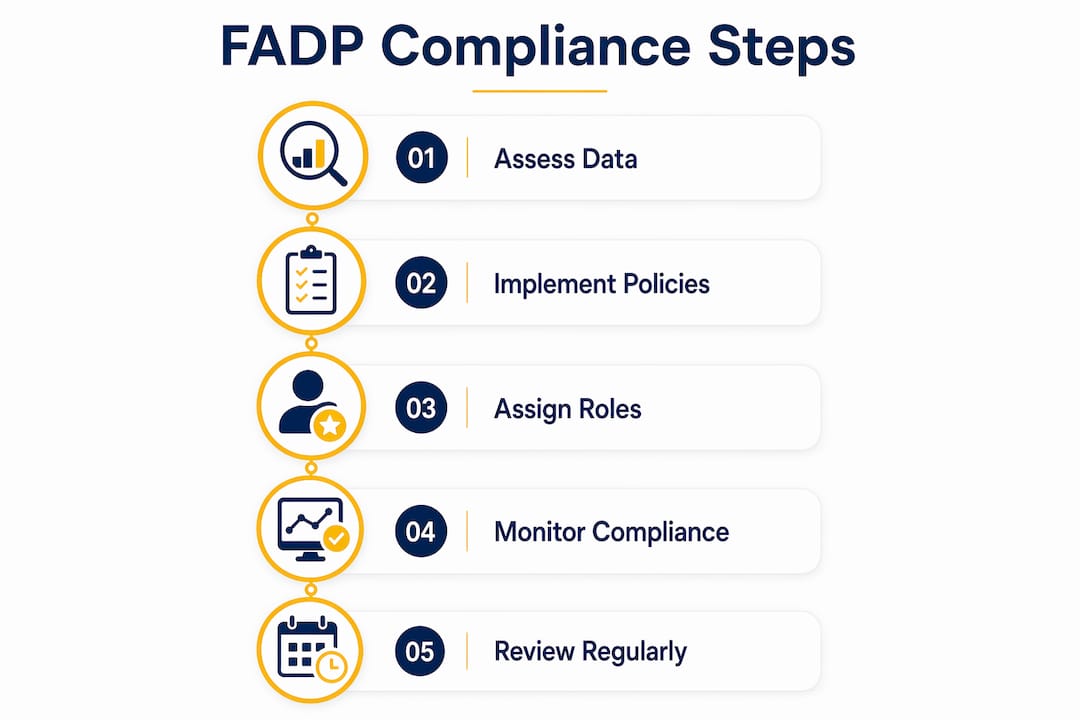
Compliance with Swiss privacy regulations is manageable when broken into concrete tasks. The following checklist covers the core obligations for most businesses:
Audit your data flows. Map every category of personal data you collect, where it is stored, who can access it, and whether it crosses borders.
Update your privacy policy. Reflect your actual processing activities, including every third-party tool you use.
Review your data subject rights process. Designate a person to handle access, correction, and portability requests.
Assess your breach response plan. Define who decides whether a breach creates high risk and who notifies the FDPIC.
Check your vendor contracts. Confirm data processing agreements are in place with all third-party processors.
Apply privacy by design. Before launching any new product, feature, or internal system, assess its data protection impact.
Records of processing activities deserve special attention. Under the FADP, mandatory records apply only to companies with 250 or more employees. Smaller companies have exemptions, unless they process sensitive data or conduct high-risk processing. This is a meaningful relief for most Swiss SMEs, but the exemption does not eliminate the need for basic documentation.
The FADP does not require a Data Protection Officer. However, voluntarily appointing an independent data protection advisor can yield real benefits. An advisor can help with data protection impact assessments, support FDPIC consultations, and demonstrate organizational commitment to compliance. This is far less costly than a full legal department.
For companies managing Swiss company registration and ongoing operations, integrating privacy compliance into standard onboarding and vendor management processes is the most efficient approach. Build it into your contracts, your HR processes, and your IT procurement checklist from day one.
Pro Tip: Conduct a data protection impact assessment for any processing that involves sensitive data categories, such as health information, financial records, or biometric data. Even if not legally required in your case, the assessment documents your good-faith effort.
What are common misconceptions Swiss SMEs face about data privacy?
The most damaging misconception is that GDPR compliance covers Swiss obligations. Experts confirm that GDPR compliance does not automatically fulfill Swiss FADP requirements. The frameworks share principles but differ on enforcement, legal bases, and adequacy lists. Organizations operating in both jurisdictions must conduct a gap analysis between the two.
The second major misconception is that compliance requires a large legal team. Core obligations are manageable using structured checklists and do not always require a legal department. Most SME managing directors can handle the fundamentals with proper guidance and documented processes.
Three other myths worth addressing directly:
“The FDPIC will come after us first.” Enforcement typically starts with a complaint. Proactive compliance dramatically reduces your exposure.
“We are too small to matter.” The FADP applies to sole proprietorships with websites. Size is not a shield.
“Accidental errors will result in prosecution.” The law targets intentional violations. Good-faith efforts and documented processes provide meaningful protection.
The goal is not perfection. The goal is a documented, consistent approach that shows you take data protection seriously. That posture is your best defense under a criminal enforcement model.
Key Takeaways
Swiss data privacy compliance under the revised FADP requires documented processes, accurate privacy policies, and personal accountability from managing directors, not just corporate-level policies.
Point | Details |
FADP scope is broad | The law applies to every company processing personal data in Switzerland, including sole proprietorships. |
Criminal liability is personal | Fines up to CHF 250,000 fall on the responsible individual, typically the managing director. |
GDPR compliance is not enough | Swiss and EU frameworks differ; organizations must conduct a gap analysis between both. |
Cross-border transfers need safeguards | Use SCCs, BCRs, or the Swiss-US Data Privacy Framework when transferring data outside Switzerland. |
SME exemptions exist | Companies with fewer than 250 employees are exempt from mandatory processing records unless handling sensitive data. |
Why I think most businesses get Swiss data privacy wrong from the start
Most entrepreneurs I work with arrive in Switzerland thinking data privacy is a checkbox exercise. They have a GDPR policy, they assume it transfers, and they move on. That assumption is the most expensive mistake you can make in Swiss compliance.
The criminal enforcement model changes everything. When the fine lands on you personally, not on your GmbH, the calculus shifts. I have seen managing directors genuinely shocked to learn they carry individual criminal exposure for data protection failures. That shock is avoidable with a single hour of proper onboarding.
My honest recommendation: appoint a data protection advisor before you launch, not after your first complaint. The advisor does not need to be a lawyer. A structured, documented compliance program run by a competent internal person is worth more than an expensive legal retainer that sits unused. The FDPIC is not hunting for small businesses. But a disgruntled employee or a competitor who files a complaint can trigger proceedings that are entirely preventable.
The businesses that handle this well treat privacy compliance the same way they treat accounting: as a recurring operational task with clear ownership, not a one-time legal project. That mindset is the difference between manageable compliance and a personal criminal risk.
— Rolands
How Rpcs supports Swiss company formation and compliance
Setting up a Swiss company means navigating legal, banking, and compliance requirements from day one. Rpcs specializes in Swiss company formation for international entrepreneurs, covering GmbH and AG structures, legal documentation, notarization, and registration. The platform also supports ongoing compliance, including accounting services that integrate data privacy standards into your financial reporting processes.
For managing directors concerned about personal liability under the FADP, Rpcs helps define clear operational structures and documented processes from the start. Whether you need a registered address, a Swiss bank account, or guidance on compliance obligations, Rpcs provides the operational foundation that lets you focus on building your business with confidence.
FAQ
What is the Swiss FADP and when did it take effect?
The Federal Act on Data Protection, or FADP, is Switzerland’s primary data privacy law. It entered into force on September 1, 2023, with no grace period, applying immediately to all companies processing personal data in Switzerland.
Does GDPR compliance satisfy Swiss data privacy requirements?
No. GDPR compliance does not automatically fulfill Swiss FADP obligations. The two frameworks differ on enforcement mechanisms, legal bases for processing, and adequacy lists for cross-border transfers.
Who enforces Swiss data privacy laws?
The Federal Data Protection and Information Commissioner, known as the FDPIC, oversees enforcement. Criminal prosecutions for intentional violations are handled through Switzerland’s criminal justice system, not administrative proceedings.
What are the fines for violating the Swiss FADP?
Intentional violations of key duties under the FADP can result in criminal fines of up to CHF 250,000. The fine is imposed on the responsible individual, typically the managing director, not the company.
Do small Swiss businesses need to keep records of processing activities?
Companies with fewer than 250 employees are generally exempt from mandatory records of processing activities, unless they process sensitive personal data or conduct high-risk processing operations.
Recommended
Comments