
What Is an International Business Company? 2026 Guide
- May 26
- 9 min read

TL;DR:
An international business company (IBC) is a legally incorporated entity outside the owner’s country designed for cross-border activities and limited liability. While offering tax neutrality and asset protection, IBCs require full compliance with global transparency regulations like CRS, FATCA, and beneficial ownership disclosures. Proper planning, legal advice, and understanding global and home country tax rules are essential for effectively leveraging an IBC.
Most entrepreneurs hear “international business company” and immediately picture a secretive offshore account in a tropical jurisdiction. That framing misses almost everything that actually matters. An international business company, or IBC, is a specialized legal entity incorporated outside the owner’s home country to conduct cross-border activities. It offers real structural advantages for global operations, from tax-neutral contracting to asset protection. But it also carries serious compliance obligations that most guides fail to explain honestly. This article covers everything you need to know before forming one.
Table of Contents
Key takeaways
Point | Details |
IBC defined | An IBC is a legal entity incorporated abroad, designed for cross-border operations with limited liability for shareholders. |
Tax-neutral, not tax-free | IBCs face no corporate tax in the incorporation jurisdiction, but your home country may still tax you under CFC rules. |
Compliance is non-negotiable | Global frameworks like CRS and FATCA require beneficial ownership disclosure, making full transparency mandatory. |
Multiple use cases | IBCs serve trading, holding, intellectual property management, and special purpose vehicle functions. |
Jurisdiction choice matters | Some popular IBC regimes have been replaced by new structures, so jurisdiction research in 2026 is critical. |
What is an international business company, legally speaking
An IBC is a specialized entity incorporated outside the owner’s home jurisdiction to conduct cross-border activities without maintaining substantive operations in the country of incorporation. That last part matters. The company exists on paper in one place and operates commercially everywhere else.
The core legal characteristics that define an IBC include:
Separate legal personality. The IBC can enter contracts, own assets, and sue or be sued in its own name, independent of its shareholders.
Limited liability. Shareholders are protected from personal liability beyond their invested capital.
International contractual capacity. The entity can operate across multiple jurisdictions simultaneously.
Restricted local activity. IBCs generally cannot conduct local business in their country of incorporation.
These features collectively make an IBC different from a standard domestic company. A regular LLC in the U.S. or a GmbH in Germany is built for domestic operations first. An IBC is built for the world by design.
Pro Tip: Before selecting a jurisdiction, confirm whether its IBC legislation is current. Some popular regimes, like the British Virgin Islands and Gibraltar, have repealed their original IBC laws in favor of updated corporate structures. Using an outdated framework creates unnecessary legal exposure.
Core benefits of forming an international business company
Understanding the benefits requires separating fact from marketing copy. Here is what the structural advantages of an IBC actually look like in practice.
Tax neutrality in the incorporation jurisdiction. IBCs typically face no corporate income tax in the jurisdiction where they are incorporated. Instead, companies pay small fixed annual fees. For a consulting firm contracting with clients in five countries, this avoids the complexity of calculating taxable income across multiple conflicting systems within a single entity.
Asset protection. An IBC creates legal separation between your personal assets and business liabilities. When paired with a jurisdiction that has strong creditor protection laws, this structure makes it significantly harder for litigation in one country to reach assets held elsewhere. You can read more about how Switzerland handles this in the context of secure wealth strategies.
Multi-currency operations. IBCs facilitate transactions across multiple currencies and jurisdictions efficiently. A technology company billing clients in USD, EUR, and GBP can manage all three through a single entity without the conversion friction and compliance complexity of maintaining separate domestic entities in each market.
Simplified setup and reduced regulatory burden. Forming an IBC typically involves lower documentation requirements and faster incorporation timelines than forming a domestic company in most high-regulation markets. Ongoing reporting obligations are also generally minimal.
Privacy features. Some jurisdictions allow nominee directors and shareholders, providing a layer of confidentiality around beneficial ownership within the bounds of applicable law.
Pro Tip: Tax neutrality within the incorporation jurisdiction does not mean tax-free globally. Account for your home country’s rules before treating IBC income as untaxed. Skipping this step is one of the most expensive mistakes new IBC owners make.
Regulatory environment and compliance requirements
This is the section most IBC guides either skip or soften. The regulatory picture has changed significantly over the past decade, and operating an IBC without understanding the current framework is genuinely risky.

Regulatory Framework | What It Requires | Who Is Affected |
CRS (Common Reporting Standard) | Automatic exchange of financial account data between participating countries | IBC owners in most major jurisdictions |
FATCA (Foreign Account Tax Compliance Act) | U.S. persons must report foreign financial accounts and assets | American IBC owners and foreign banks holding U.S. client accounts |
CFC Rules (Controlled Foreign Corporation) | Home country may tax undistributed IBC profits as personal income | IBC owners resident in countries with CFC legislation |
Beneficial Ownership Registries | Disclosure of real owners to national registries | Required in most reputable jurisdictions |
The key insight here is that IBCs must comply with global transparency initiatives that impose disclosure and reporting requirements. The era of anonymous offshore structures is over in any jurisdiction worth using.
Ignoring home country tax rules and international treaties can negate every legal and operational advantage an IBC offers, creating unexpected liabilities. A British entrepreneur incorporating an IBC in Seychelles while remaining tax-resident in the UK does not automatically remove UK tax obligations on that company’s profits. Controlled foreign corporation rules in the UK, Germany, the U.S., and many other countries exist specifically to address this scenario.
The concept of “glocal” compliance captures this well: IBC owners must harmonize global ambitions with localized legal requirements in every jurisdiction where they operate or reside. A cross-border compliance checklist is a useful starting point for mapping your specific obligations before formation.
Pro Tip: Work with a tax advisor in your country of residence before incorporating, not after. The structure you choose must account for your specific residency, not just the rules in the incorporation jurisdiction.
Common use cases and industry examples
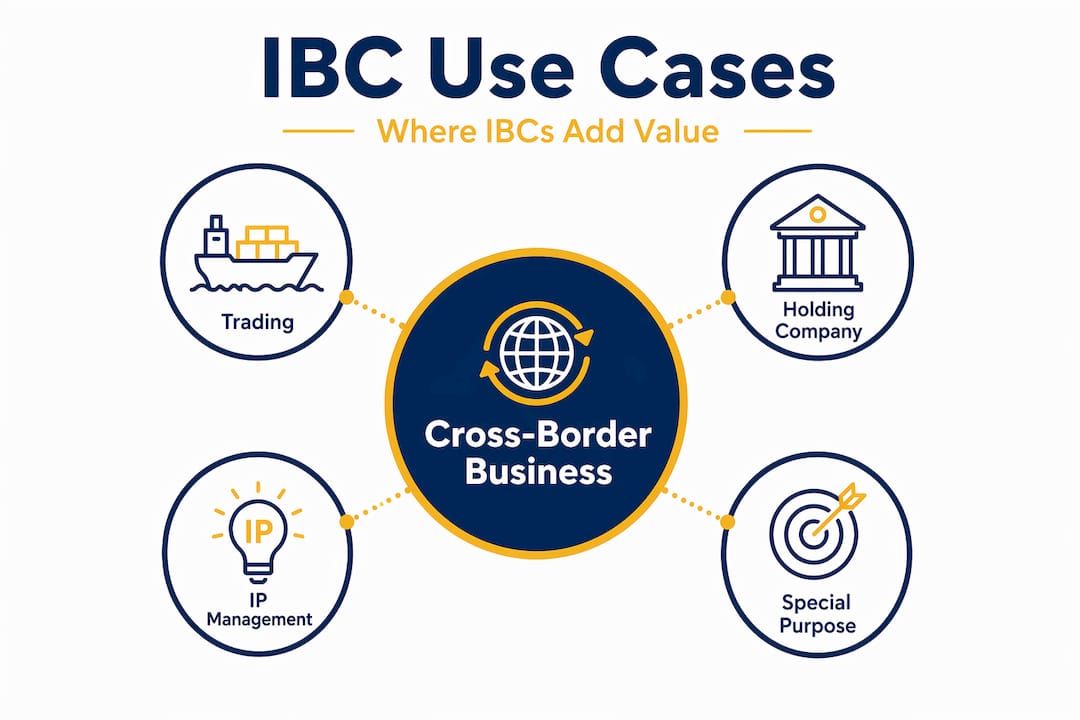
IBCs are not a single-use tool. The same legal structure serves meaningfully different purposes depending on the business model.
International trade companies. A manufacturer sourcing components from Asia and selling finished goods in Europe can route contracts through an IBC to centralize commercial risk and invoice from a single, tax-neutral entity.
Holding companies. IBCs serve varied international purposes, including holding shares in subsidiary companies, real estate, and other investment assets across jurisdictions. The IBC acts as a parent entity that consolidates ownership.
Intellectual property management. Technology companies and content creators use IBCs to hold patents, trademarks, and licensing rights. Royalties flow to the IBC rather than a high-tax domestic entity, a structure used by some of the world’s largest corporations at scale.
Special purpose vehicles. Private equity firms and joint venture partners create IBCs for single transactions. The SPV isolates risk, simplifies governance, and dissolves cleanly when the deal closes.
Professional service firms. Consultants, lawyers, and digital service providers billing multinational clients use IBCs as a neutral contracting platform. Successful entrepreneurs view the IBC as exactly this: a neutral platform for managing complex international trade contracts and intellectual property efficiently.
What these use cases share is a genuine cross-border business need. An IBC adds value when the underlying commercial activity is already international. If your business is primarily domestic, the compliance overhead outweighs any benefit.
How to start and manage an international business company
Knowing what an IBC is and actually forming one correctly are two different things. Here is a realistic breakdown of the process.
Define your business purpose clearly. Jurisdiction selection depends entirely on what the IBC will do. Trading companies, holding structures, and IP companies have different optimal jurisdictions. Selecting a jurisdiction before defining the purpose is working backwards.
Select the right jurisdiction. Evaluate political stability, treaty networks, banking access, reputation, and regulatory requirements. Switzerland, for example, offers strong corporate tax advantages alongside genuine banking infrastructure, political neutrality, and a reputation that supports serious business relationships rather than raising red flags.
Engage legal and financial advisors. This is not optional. The cost of getting it wrong through CFC exposure, FATCA non-compliance, or banking rejection far exceeds professional fees.
Prepare and file incorporation documents. Typical requirements include memorandum and articles of association, director and shareholder identification, proof of registered address, and beneficial ownership declarations.
Open a corporate bank account. Banking is the most common bottleneck. Reputable jurisdictions require full KYC documentation. Plan for this step to take longer than the incorporation itself.
Maintain ongoing compliance. File annual returns, keep accounting records, renew registrations, and stay current on any regulatory changes in your jurisdiction.
Pro Tip: Banking rejection is the most common reason IBC formations fail in practice. Before committing to a jurisdiction, confirm that its banks will open accounts for your business type and country of residence. The Swiss business tax guide covers both formation and banking compliance in detail.
My honest take on IBCs after working with global entrepreneurs
I’ve spent years helping entrepreneurs and investors think through international structures, and the single most consistent mistake I see is treating the IBC as the answer before defining the question.
The “tax haven” label bothers me because it frames a legitimate legal tool as inherently suspicious. IBCs are recognized structures with well-defined purposes. But the opposite error is just as common. I’ve watched founders incorporate offshore, face banking rejection, discover their home country taxes the entity anyway under CFC rules, and end up paying more in professional fees to unwind the structure than they would have saved in taxes over a decade.
What actually works is this: you use an IBC when the cross-border commercial logic is already there. The structure should match the reality of how your business operates, not the other way around. When the underlying business genuinely spans multiple jurisdictions, a well-structured IBC is a powerful platform. IBCs are not secret offshore entities. Reputable jurisdictions now require transparent beneficial ownership registries and anti-money laundering compliance. The days of secrecy are over, and honestly, that is good for everyone who uses these structures legitimately.
The entrepreneurs I’ve seen get the most value from IBCs are the ones who invest in understanding the compliance picture before they incorporate. They walk in knowing what their home country rules say, what the banking requirements are, and what the structure will cost to maintain annually. That preparation is what separates a structure that works from one that creates expensive problems.
— Rolands
How Rpcs can help you form and manage your company
If you’ve decided that Switzerland is the right jurisdiction for your international operations, the next step is working with professionals who understand both the Swiss system and the specific needs of foreign entrepreneurs.

Rpcs offers Swiss company formation services covering everything from legal documentation and notarization to registration and banking setup. Switzerland brings genuine advantages for IBC-style operations: a corporate tax rate starting at 11.9%, full political and monetary stability, and a reputation that opens doors with international counterparties. Beyond formation, Rpcs provides accounting services, registered business address solutions, and support for opening a Swiss bank account. Everything you need to operate compliantly from day one, handled by a team that works exclusively in this space.
FAQ
What is an international business company?
An international business company (IBC) is a legal entity incorporated outside its owner’s home country, designed for cross-border operations. It offers limited liability, separate legal personality, and tax-neutral status within the incorporation jurisdiction.
Are IBCs legal and legitimate?
Yes. IBCs are recognized legal structures in dozens of jurisdictions worldwide. Reputable IBC regimes now require beneficial ownership disclosure and anti-money laundering compliance, making them fully transparent within international regulatory frameworks.
Do I still owe taxes in my home country if I form an IBC?
Possibly. Many countries apply controlled foreign corporation (CFC) rules, which can tax undistributed IBC profits as personal income for the resident owner. You must consult a tax advisor in your country of residence before forming an IBC.
What are the most common uses for an IBC?
IBCs are commonly used for international trading, holding companies, intellectual property management, and special purpose vehicles in joint ventures. They work best when the underlying business genuinely operates across multiple jurisdictions.
How long does it take to form an IBC?
Formation timelines vary by jurisdiction but are generally faster than domestic incorporation in high-regulation markets. The most time-consuming step is typically opening a corporate bank account, which can take several weeks depending on jurisdiction and documentation quality.
Recommended