
What Is a Swiss Law Firm? Your 2026 Guide
- Jun 2
- 9 min read

TL;DR:
Swiss law firms are legally regulated practices where attorneys must be cantonal-registered and demonstrate independence to provide authorized representation in Switzerland. They range from small boutiques to large international partnerships and offer services including corporate law, M&A, compliance, litigation, and integrated legal-tax advice. The Swiss legal market is highly specialized, with firms often operating through structures like the verein, emphasizing documented independence and compliance for cross-border clients and arbitrations.
A Swiss law firm is a legal practice authorized to provide counsel and representation under Swiss federal and cantonal law, governed primarily by the Federal Law on the Free Movement of Lawyers, known as the LLCA. These firms operate under strict independence requirements and cantonal registration rules that distinguish them from legal practices in most other countries. For any entrepreneur, investor, or multinational considering Swiss company formation or cross-border operations, understanding how these firms work is not optional. It is the foundation of every sound legal and business decision you will make in Switzerland.
What is a Swiss law firm and how does it differ from other practices?
A Swiss law firm is a legally regulated practice where attorneys must be registered on a cantonal lawyers’ list and demonstrate independence to provide unrestricted legal representation. This is not a formality. The LLCA’s Articles 4 and 8 define exactly who qualifies to practice, and firms that fail to meet these standards cannot legally represent clients in Swiss courts or formal proceedings.

The independence requirement is the defining feature of Swiss legal practice. Unlike in some jurisdictions where lawyers routinely work as employees of corporations or non-legal entities, Swiss law presumes that a salaried lawyer lacks independence. That presumption can be rebutted with evidence, but the burden falls on the lawyer and the firm to prove it. This shapes how Swiss firms are structured, staffed, and managed at every level.
Swiss law firms range from single-practitioner offices to large international partnerships. The largest firms, such as Lenz & Staehelin, operate across multiple Swiss cities and serve multinationals, SMEs, and private clients across all major areas of business law and tax. Smaller boutique firms often specialize in one or two practice areas, such as IP law, employment law, or real estate.
What services do Swiss law firms offer to businesses and individuals?
Swiss law firms predominantly serve business clients, and their service offerings reflect that focus. The core practice areas you will encounter across most reputable firms include:
Corporate law and company formation: Advising on GmbH and AG structures, drafting articles of association, managing notarization, and handling Swiss company registration with the commercial registry.
Mergers and acquisitions: Conducting due diligence, structuring transactions, and negotiating purchase agreements under Swiss contract law.
Compliance and regulatory advice: Guiding companies through Swiss financial market regulations, data protection under the revised Federal Act on Data Protection (nFADP), and sector-specific licensing requirements.
Litigation and arbitration: Representing clients in Swiss courts and before arbitral tribunals, including drafting arbitration clauses and managing the full dispute process.
Tax advisory: Many Swiss firms integrate legal and tax expertise within the same team, which is a structural advantage for clients managing Swiss corporate tax rates, VAT, and transfer pricing simultaneously.
The integration of legal and tax services is not incidental. It reflects the reality that Swiss business mandates almost always require both regulatory and economic analysis at the same time. A company setting up a Swiss AG, for example, needs legal counsel on structure and tax counsel on the most favorable cantonal tax regime. Firms that provide both under one roof reduce the coordination cost and the risk of conflicting advice.
Pro Tip: When evaluating Swiss law firms for corporate work, ask specifically whether their tax advisors are legally qualified attorneys or external consultants. Integrated attorney-tax teams provide more consistent advice and clearer privilege protection.
How are Swiss law firms regulated under the LLCA and cantonal laws?
The LLCA creates a federal baseline, but implementation varies by canton. Here is how the regulatory framework operates in practice:
Cantonal registration: Every lawyer practicing legal representation in Switzerland must be entered on the lawyers’ list of the canton where they primarily practice. Geneva, Zurich, and Basel each maintain their own registers with slightly different procedural requirements.
Independence verification: The LLCA presumes lack of independence for salaried lawyers. A lawyer employed by a non-registered entity must actively demonstrate independence through contractual arrangements, financial autonomy, and professional conduct.
Employment restrictions: Lawyers may only be employed by other registered lawyers or recognized legal entities. Employment by a non-registered corporation or individual disqualifies a lawyer from unrestricted representation.
Disciplinary oversight: Cantonal bar associations and supervisory commissions handle complaints, sanctions, and disbarment proceedings. There is no single national bar in Switzerland.
The Swiss verein is a structural model worth understanding if you are dealing with large international firms. A verein is a Swiss legal entity that allows independent law firms from different countries to affiliate under a shared brand without merging their finances or liabilities. Several global law firms use this structure to operate in Switzerland while maintaining separate legal entities in other jurisdictions. For clients, this means you may be contracting with a Swiss-registered entity even when the firm’s brand is globally recognized.
“Verifying that a Swiss lawyer is registered and meets independence criteria protects clients from unauthorized representation risks.” — Espace Legal
Swiss legal compliance in 2026 increasingly requires firms to document their independence structures formally, particularly for cross-border mandates where foreign regulators may scrutinize the Swiss firm’s authorization.
What is the size and scope of the Swiss legal services market?
Switzerland’s legal services market comprises approximately 6,500 firms, 13,500 attorneys, and carries an estimated valuation of CHF 8.5 billion. That figure places Switzerland among the most lawyer-dense markets in Europe relative to its population, which reflects the country’s role as a global hub for finance, trade, and arbitration.
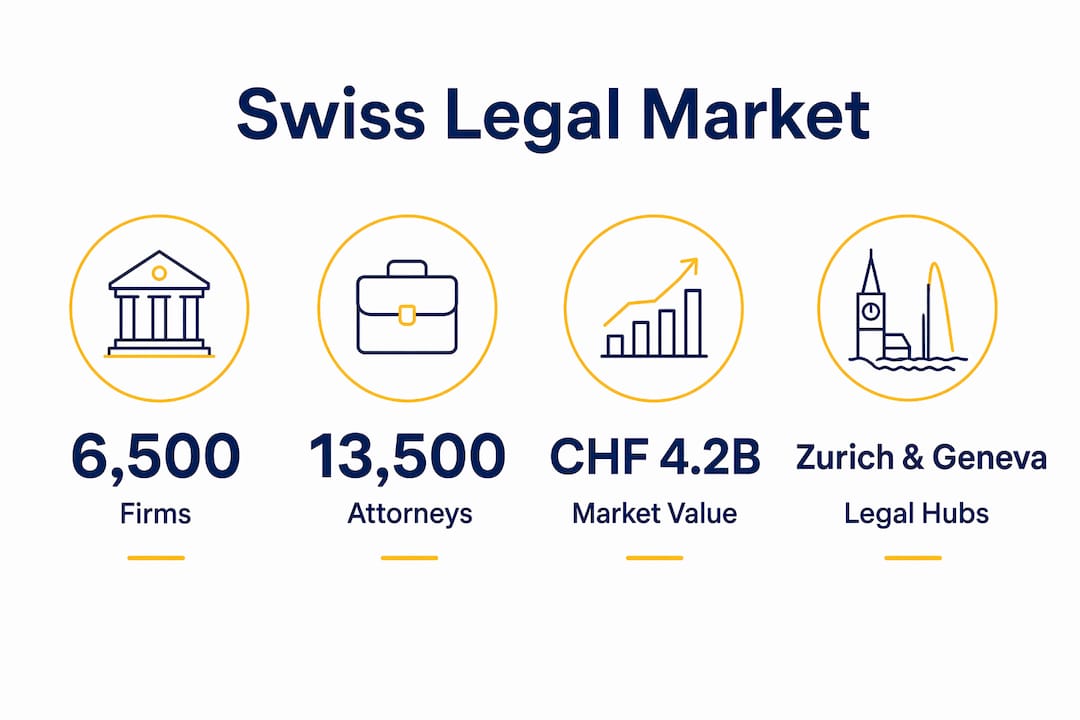
The market clusters around four main regions:
Region | Primary strengths |
Zurich | Corporate law, banking, capital markets, M&A |
Geneva | International arbitration, private wealth, UN-related work |
Basel | Pharmaceutical and life sciences law, cross-border EU matters |
Bern and Lugano | Public law, administrative proceedings, Italian-speaking clients |
Consolidation is an ongoing trend. Mid-size firms are merging or forming alliances to compete with larger practices on complex cross-border mandates. For business clients, this means the market is becoming more specialized. A firm that was a generalist five years ago may now position itself as a technology law boutique or a financial regulatory specialist.
When comparing firms for cross-border matters, prioritize specialization and compliance documentation over brand recognition alone. A firm with a clear audit trail of its regulatory workflows is more valuable for international transactions than a prestigious name without documented processes.
Pro Tip: Request a firm’s engagement letter template before signing anything. Swiss firms with strong compliance cultures will have detailed, well-structured engagement letters that clarify independence, fee structures, and conflict-of-interest checks. Vague or one-page engagement letters are a warning sign.
Why do international businesses choose Swiss law and arbitration for disputes?
Swiss law is chosen as the governing law for international contracts far more often than Switzerland’s economic size would suggest. The reason is specific: Swiss contract law offers broad contractual freedom and good faith principles that give parties flexibility while maintaining predictable enforcement. Courts and arbitral tribunals interpret Swiss contracts with a consistency that parties from civil law and common law backgrounds both find reliable.
The institutional framework supporting Swiss arbitration is deep and specialized:
The Swiss Arbitration Centre administers international commercial arbitrations under the Swiss Rules, which are widely regarded as procedurally efficient.
The Court of Arbitration for Sport (CAS) in Lausanne handles sports-related disputes for international federations and athletes.
The WIPO Arbitration and Mediation Center in Geneva specializes in intellectual property and domain name disputes.
ICC arbitration filings frequently select Swiss seats like Geneva or Zurich, reflecting the country’s reputation for neutrality and procedural reliability.
Swiss law firms play a direct role in this ecosystem. They draft the arbitration clauses that determine which institution governs a dispute, where it is seated, and under what procedural rules it proceeds. A poorly drafted clause can result in jurisdictional challenges that delay resolution by years. Firms with dedicated arbitration practices, particularly in Geneva and Zurich, bring the technical drafting precision that these clauses require.
Judicial review of Swiss arbitral awards is limited to narrow grounds, which means awards are rarely overturned on appeal. That finality is a major commercial advantage. Parties choosing Swiss arbitration can enforce awards in over 170 countries under the New York Convention with minimal procedural friction.
Corporate compliance guidance for companies operating in Switzerland should always include a review of dispute resolution clauses in key contracts, ideally with input from a Swiss-qualified attorney.
Key takeaways
Swiss law firms operate under one of the most clearly defined regulatory frameworks in Europe, making them reliable partners for business and legal matters when properly vetted.
Point | Details |
LLCA governs all Swiss lawyers | Every attorney must be cantonal-registered and meet independence criteria to practice legally. |
Market size signals depth | Switzerland’s CHF 8.5B legal market across 6,500 firms offers significant specialization options. |
Integration of tax and law matters | Firms combining legal and tax expertise reduce coordination risk for Swiss business clients. |
Arbitration is a strategic asset | Swiss arbitration seats offer finality, neutrality, and global enforceability under the New York Convention. |
Firm selection requires due diligence | Prioritize documented compliance workflows and specialization over brand name alone. |
What most clients get wrong about Swiss law firms
Most clients approach Swiss law firms the same way they approach firms in their home country. They look at the website, check the partner bios, and make a decision based on reputation. That approach misses the single most important factor in Swiss legal practice: verified independence.
I have seen situations where a business engaged a Swiss-based legal advisor who was technically employed by a non-registered entity. The advice was competent, but the representation was not legally authorized under the LLCA. When a dispute arose, the client discovered their legal position was weaker than expected because their representation did not meet the statutory requirements. Checking cantonal registration takes five minutes and costs nothing.
The second thing clients consistently undervalue is the integrated tax-legal model. Switzerland’s cantonal tax system is genuinely complex. Corporate tax rates vary significantly between Zug, Geneva, and Bern. A law firm that handles your company formation without also addressing the tax implications of your chosen canton is giving you half an answer. The best Swiss firms treat legal and tax advice as a single discipline, not two separate services you coordinate yourself.
Finally, the Swiss verein structure matters more than most clients realize. When you engage a global firm operating in Switzerland through a verein, you are contracting with a Swiss entity that may have different liability limits, staffing, and resources than the global brand implies. Always confirm which legal entity you are signing with and what that entity’s capitalization and insurance coverage looks like.
— Rolands
How Rpcs helps you work with Swiss legal and business services
Setting up a company in Switzerland involves legal documentation, notarization, cantonal registration, banking, and ongoing compliance. Rpcs coordinates all of these steps for international entrepreneurs and investors who need local expertise without building it from scratch.
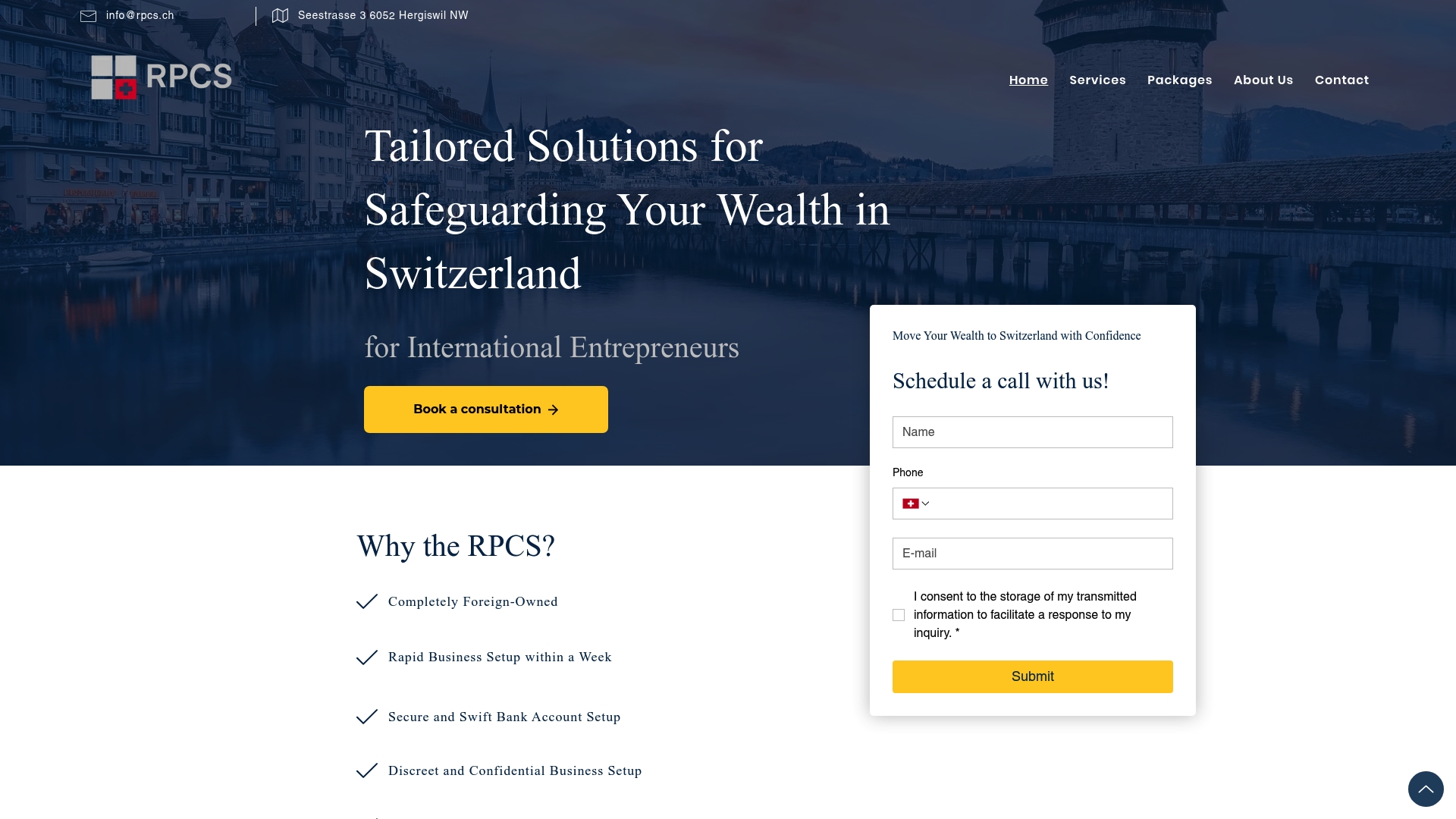
Rpcs provides Swiss company formation services covering GmbH and AG structures, with support for legal documentation, registered address in Switzerland, and banking setup including help to open a Swiss bank account. The platform is built specifically for foreign clients who need compliant, fast, and well-documented Swiss incorporation without navigating the system alone. If you are ready to establish your Swiss presence, Rpcs offers the local knowledge and administrative infrastructure to get it done correctly.
FAQ
What is a Swiss law firm under the LLCA?
A Swiss law firm is a legal practice where attorneys are registered on a cantonal lawyers’ list and meet independence requirements under the Federal Law on the Free Movement of Lawyers (LLCA). Only registered, independent lawyers may provide unrestricted legal representation in Switzerland.
How do I verify a Swiss lawyer’s registration?
Each Swiss canton maintains a public lawyers’ register. You can check a lawyer’s registration status directly through the relevant cantonal bar association or supervisory authority, which takes only a few minutes online.
What makes Switzerland attractive for international arbitration?
Switzerland offers broad contractual freedom, limited judicial review of arbitral awards, and institutional bodies like the Swiss Arbitration Centre, CAS, and WIPO Arbitration Center. Awards are enforceable in over 170 countries under the New York Convention.
How large is the Swiss legal services market?
Switzerland’s legal market includes approximately 6,500 firms and 13,500 attorneys, with a total estimated value of CHF 8.5 billion. The market clusters around Zurich, Geneva, Basel, and Bern, each with distinct practice strengths.
What is a Swiss verein in the context of law firms?
A Swiss verein is a legal entity that allows independent law firms from different countries to affiliate under a shared brand without merging their finances or liabilities. Several global firms use this structure to operate in Switzerland while keeping separate legal entities in other jurisdictions.
Recommended
Comments