
What Is a Registered Share? Ownership, Rights, and Benefits
- 1 day ago
- 8 min read

TL;DR:
A registered share is an equity security recorded in the company’s shareholder register, granting the owner legal recognition. Ownership rights include voting, dividends, and direct corporate communications, which are better protected with registered shares than with street-name holdings. Most jurisdictions are shifting from bearer to registered shares to comply with anti-money laundering and tax regulations.
A registered share is defined as an equity security where the owner’s name, address, and holding details are recorded on the official shareholder register, maintained by the issuing company or its transfer agent. This formal record creates legal recognition that bearer shares cannot match. For investors and businesses evaluating Swiss company formation or global equity structures, understanding how registered shares work is the foundation for making sound ownership decisions. This article covers the registered shares definition, how they function in practice, the shareholder rights they protect, and how they compare to bearer shares.
What is a registered share and how is it defined?
A registered share is an equity security tied to a named owner in a company’s official records. The issuing company or a transfer agent maintains this record, which includes the shareholder’s name, contact details, and the number of shares held. That record is the legal proof of ownership.
Most publicly traded stocks are registered shares. Apple, for example, uses a transfer agent to maintain its shareholder records and process dividend payments. This model is the global standard for public companies precisely because it creates a clear, auditable chain of ownership.
The shareholder register is not just an administrative file. It is the authoritative legal document that determines who can vote and who receives dividends. If a discrepancy exists between your personal records and the register, the register wins every time.
How do registered shares work and how are they maintained?
The registration process connects a shareholder’s identity to specific shares through a formal transfer system. Here is how it works in practice:
Purchase through a broker. Most investors initially hold shares in a broker’s nominee account, also called “street name.” The broker appears on the register, not the individual investor.
Request a direct registration transfer. To become a registered shareholder, you contact your broker and request a transfer to the company’s transfer agent via the Direct Registration System (DRS).
Transfer agent processes the request. Becoming a registered shareholder involves moving shares from a broker’s nominee account to the register, a process that typically takes several business days.
Confirmation and direct communication. Once registered, you receive dividends, proxy voting materials, and corporate communications directly from the issuer, not through a brokerage intermediary.
Ongoing maintenance. The transfer agent updates the register whenever shares change hands, ensuring the record stays current.
Registered shares tend to have slower transfer times compared to street-name shares because each transaction requires a formal ledger update. That trade-off favors long-term investors over active traders.
Pro Tip: If you hold shares through a brokerage and want direct issuer recognition, contact your broker about initiating a DRS transfer. Computershare handles this process for many major U.S.-listed companies.
What are the benefits and rights associated with owning registered shares?
Registered shareholders have legally recognized ownership and can vote, receive dividends, and attend shareholder meetings directly. That direct relationship with the issuer is the core advantage over street-name holdings.
The full set of shareholder rights that registered ownership protects includes:
Voting rights. Registered shareholders receive proxy materials and can vote on board elections, mergers, and major corporate decisions.
Dividend access. Payments go directly to the registered owner without passing through a brokerage account.
Meeting attendance. Registered shareholders receive formal invitations to annual and special meetings.
Legal protection. Ownership disputes are resolved by reference to the register, giving registered holders a clear legal standing.
Direct corporate communications. Earnings reports, rights offerings, and material disclosures reach registered shareholders first, without intermediary filtering.
Holding shares in registered form provides strategic advantages for investors who prioritize direct engagement and stability over the liquidity of street-name holdings. Registered shares also protect against risks tied to brokerage intermediation, such as a broker’s insolvency affecting access to corporate actions.
For investors focused on shareholder agreements and long-term governance, registered ownership is the structure that makes those agreements enforceable and meaningful.

Pro Tip: Long-term investors who want to participate in rights offerings or shareholder activism should hold shares in registered form. Brokerage-held shares sometimes miss time-sensitive corporate action deadlines.
How do registered shares differ from bearer shares?
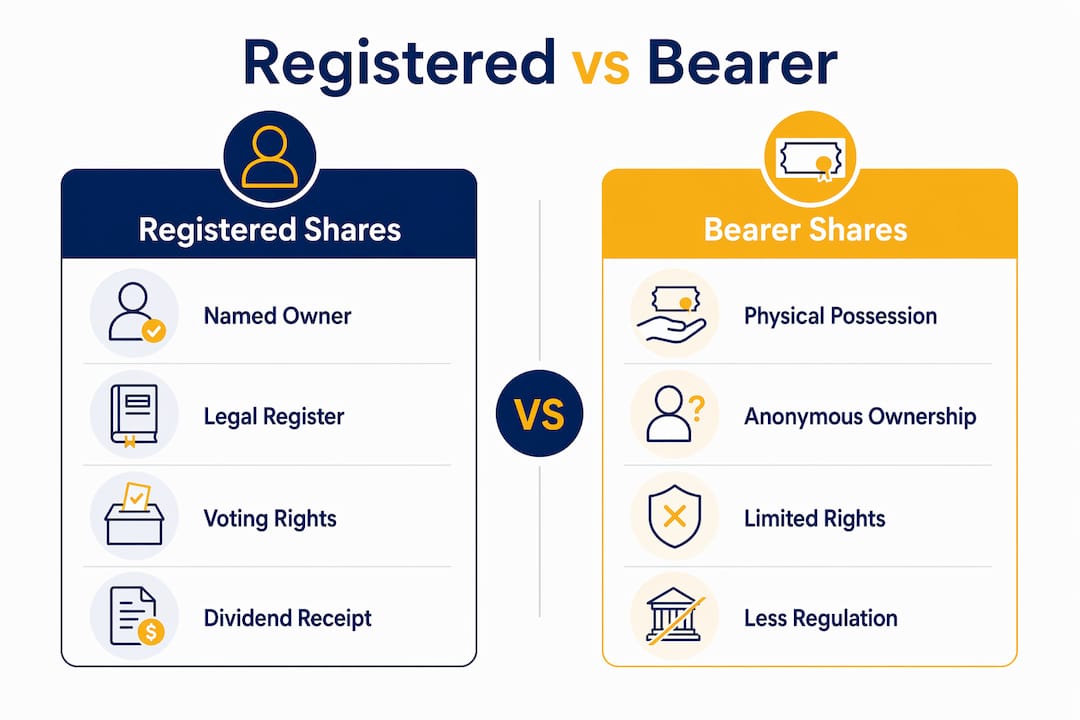
Bearer shares are unregistered, and ownership is determined solely by physical possession of the share certificate. Whoever holds the certificate is treated as the owner. Registered shares, by contrast, tie ownership to a named record regardless of who holds any physical document.
The practical implications of this difference are significant. Bearer shares offer anonymity, which historically attracted investors seeking privacy. That same anonymity, however, creates serious risks: lost or stolen certificates transfer ownership with no recourse, and regulators cannot identify beneficial owners for tax or compliance purposes.
Global anti-money laundering (AML) and Know Your Customer (KYC) regulations have driven the shift from bearer to registered shares to ensure investor identity and legal compliance. Many jurisdictions have banned bearer shares outright or require their conversion to registered form.
Feature | Registered shares | Bearer shares |
Ownership record | Named in official register | Determined by physical possession |
Transparency | High: issuer knows all owners | Low: anonymous by design |
Legal protection | Strong: register is binding | Weak: loss of certificate = loss of ownership |
Regulatory status | Standard globally | Restricted or banned in most jurisdictions |
Dividend payment | Direct to registered owner | Paid to whoever presents the certificate |
AML/KYC compliance | Fully compatible | Incompatible with modern standards |
Switzerland, for example, has moved decisively toward registered shares for AG (Aktiengesellschaft) companies. Swiss corporate law requires companies to maintain an accurate shareholder register, making registered shares the default structure for any credible Swiss company formation.
What are the corporate governance and regulatory implications of registered shares?
Registered shares are the backbone of modern corporate governance. The EU Shareholders Rights Directive mandates registered shares to enhance transparency and corporate communication obligations. That regulatory pressure reflects a global consensus: governance works best when ownership is known.
For companies, maintaining a registered share structure creates specific obligations and benefits:
Accurate register maintenance. Companies must keep the shareholder register current after every transfer. Errors in the register can invalidate votes or delay dividend payments.
AML and KYC compliance. Regulators require companies to identify beneficial owners. Registered shares make this straightforward; bearer shares make it nearly impossible.
Voting validity. Only shareholders on the register at the record date can vote. An outdated register directly undermines governance legitimacy.
Reporting duties. Registered shares require companies to maintain accurate ledgers and meet reporting obligations, balancing investor protection with administrative effort.
Shareholder communication. Companies can send notices, financial reports, and voting materials directly to registered owners, reducing the risk of miscommunication through intermediaries.
Corporate law experts highlight that registered shares provide investor protection but require issuers to maintain complex registration systems. For smaller companies, this administrative load is real. For any company operating in a regulated market, it is non-negotiable.
Understanding Swiss corporate governance basics is particularly relevant here. Swiss AG structures require a shareholder register by law, and failure to maintain it accurately can expose directors to legal liability. The register is not optional paperwork. It is a legal instrument.
Shareholders also benefit from understanding how share capital in Switzerland interacts with registered share structures, especially when planning equity distributions or capital increases.
Key Takeaways
Registered shares are the global standard for equity ownership because they combine legal recognition, direct shareholder rights, and regulatory compliance in a single structure.
Point | Details |
Legal ownership record | The shareholder register is the binding legal document for voting and dividend rights. |
Direct shareholder rights | Registered owners receive dividends, proxies, and communications directly from the issuer. |
Bearer shares are declining | AML and KYC regulations have restricted or banned bearer shares in most jurisdictions. |
Governance obligation | Companies must maintain accurate, up-to-date registers or risk invalidating votes and payments. |
Transfer speed trade-off | Registered shares transfer more slowly than street-name shares, favoring long-term holders. |
Why registered shares matter more than most investors realize
Most retail investors have never actually been registered shareholders. They hold shares in street name through a brokerage, which means the broker appears on the company’s register, not them. That is a meaningful distinction that gets overlooked until something goes wrong, such as a rights offering with a tight deadline or a proxy vote that requires direct registration.
The common misconception is that owning shares through a brokerage account makes you a registered shareholder. It does not. You are a beneficial owner, which carries most of the economic rights but fewer of the direct governance rights. The difference matters most during contested votes, corporate restructurings, or insolvency proceedings.
I have seen investors surprised to learn that their brokerage-held shares did not qualify them for a direct rights offering because they were not on the register at the record date. That kind of administrative gap costs real money. The fix is simple: request a DRS transfer before the record date. But you have to know the distinction exists first.
For companies, the administrative burden of maintaining a shareholder register is often cited as a reason to avoid registered share structures. That reasoning is short-sighted. The register is what makes your governance legitimate. A company that cannot tell you who its shareholders are is a company with a governance problem, not an administrative one. The compliance and trust benefits of a well-maintained register far outweigh the operational cost.
For investors who care about shareholder remuneration rights and direct dividend access, registered ownership is the structure that makes those rights enforceable without relying on a broker to pass them through correctly.
— Rolands
Swiss company formation and registered share services at Rpcs
Setting up a Swiss AG or GmbH requires a properly maintained shareholder register from day one. Swiss law mandates it, and regulators enforce it.

Rpcs supports international entrepreneurs and investors through the full Swiss company formation process, including shareholder register setup, legal documentation, notarization, and ongoing compliance. Whether you are establishing an AG with registered shares or managing an existing structure, Rpcs provides the administrative and legal support to keep your register accurate and your governance sound. Foreign founders who lack local knowledge of Swiss corporate law find particular value in having a dedicated team handle registration, banking setup, and reporting obligations from a single point of contact.
FAQ
What is a registered share in simple terms?
A registered share is a company share where the owner’s name is officially recorded in the shareholder register. That record gives the owner legal recognition and direct access to voting rights and dividends.
How do registered shares differ from bearer shares?
Registered shares have a named owner recorded in an official register, while bearer shares grant ownership to whoever physically holds the certificate. Bearer shares are now restricted or banned in most countries due to AML and KYC regulations.
What shareholder rights come with registered shares?
Registered shareholders can vote on corporate decisions, receive dividends directly, attend shareholder meetings, and receive corporate communications from the issuer without going through a broker.
Are brokerage-held shares the same as registered shares?
No. Most brokerage-held shares are in street name, meaning the broker appears on the register, not the individual investor. To become a registered shareholder, you must request a direct registration transfer through the company’s transfer agent.
Why do Swiss companies use registered shares?
Swiss corporate law requires AG and GmbH companies to maintain an official shareholder register. Registered shares are the legal standard for Swiss company formation and are fully compatible with AML, KYC, and EU transparency requirements.
Recommended
Comments