
Swiss Board Setup Best Practices for Executives in 2026
- 1 day ago
- 8 min read

TL;DR:
Effective Swiss board governance relies on proper composition, documented processes, and Swiss legal compliance.
Building a board of 3–5 directors with at least one Swiss-resident and maintaining signed minutes for 10 years ensures legal and operational stability.
Effective Swiss board governance is defined by three non-negotiable pillars: the right composition, documented processes, and legal compliance with the Swiss Code of Obligations. The best practices for Swiss board setup require a board of 3–5 directors, at least one Swiss-resident representative, and formal documentation retained for 10 years. These are not optional refinements. They are the baseline standards that protect your company from liability, satisfy institutional investors, and keep you compliant with Swiss corporate law. Whether you are forming a GmbH or an AG, getting the board structure right from day one saves significant legal and operational cost later.
What are the best practices for Swiss board setup?
Board governance in Switzerland follows the Swiss Code of Best Practice for Corporate Governance, a voluntary but widely adopted framework that sets clear expectations for board composition, independence, and oversight. Private companies are not legally required to follow every provision, but institutional investors and Swiss banks treat compliance as a signal of credibility.
The board’s legal duties include strategic oversight, financial supervision, and appointing executive management. These duties cannot be delegated away. The board remains legally responsible even when day-to-day operations are handed to a managing director.
Getting the governance framework right early prevents the costly restructuring that growing companies often face when they try to raise capital or bring in outside investors.
What is the ideal composition and size of a Swiss company board?
Board size typically ranges from 3 to 7 members for effective governance. A 3–5 member board is the practical target for most private Swiss companies, balancing decision-making speed with adequate oversight.
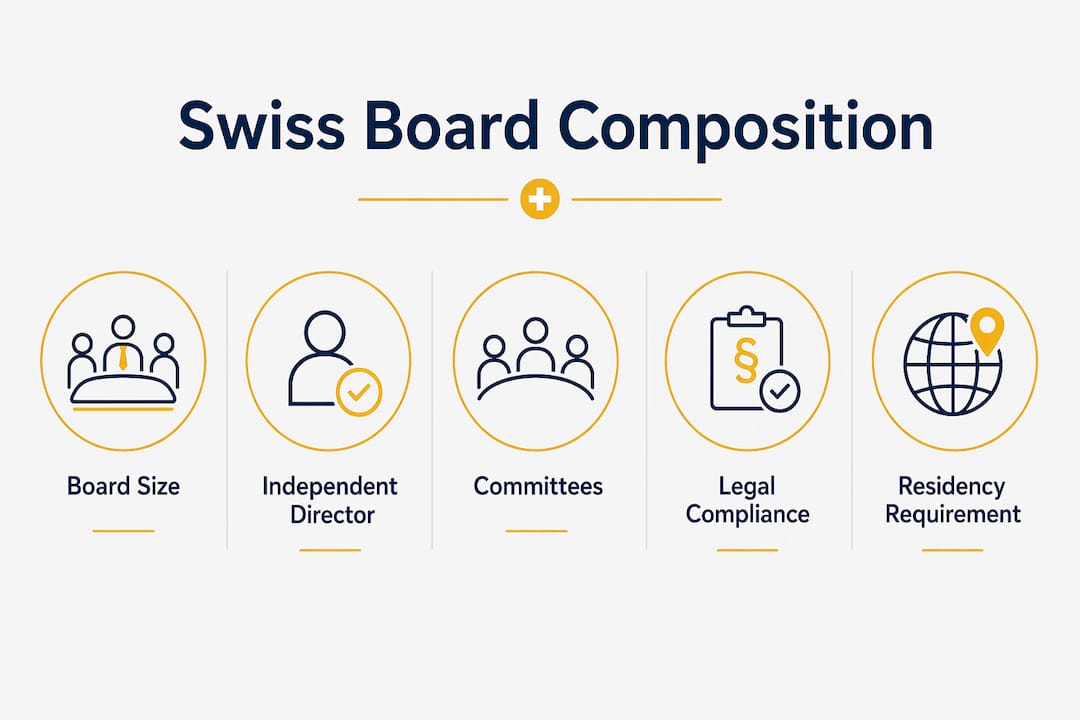
Swiss law permits a one-member board, but single-member boards are high-risk. A sole director cannot form a quorum for committees, has no peer check on decisions, and carries the full weight of personal liability. Practitioners universally recommend against this structure.
The right board includes these core profiles:
An independent director with no commercial ties to major shareholders. Independence prevents conflicts of interest from distorting board decisions.
A director with financial expertise. This person reviews financial statements, challenges management assumptions, and leads or supports the audit committee.
A Swiss-resident representative. Swiss law requires at least one person with authority to represent the company to be domiciled in Switzerland. This can be a board member or a managing director.
An industry specialist. For companies in regulated sectors such as fintech or pharmaceuticals, a director with sector knowledge adds material value to risk oversight.
Pro Tip: Appoint your independent director before you need one. Founders who wait until a funding round or audit to add independence often face pushback from investors who question the board’s objectivity.
The appointment process for Swiss directors involves formal shareholder resolutions and Commercial Register filings. Plan for a lead time of several weeks.
How should a Swiss board organize its meetings and documentation?
Meeting discipline is where governance either holds or collapses. The minimum standard is four board meetings per year, held quarterly. That cadence gives the board enough touchpoints to monitor financials, review risks, and respond to material changes in the business.

Minutes are not optional. Every meeting must produce signed minutes, authenticated by both the chairperson and the minute-taker. Those minutes must be stored for a minimum of 10 years. That retention requirement exists because Swiss courts treat board minutes as primary evidence in liability disputes.
A structured board reporting package should reach directors before each meeting. That package must include:
Financial statements for the period, compared against budget and prior year.
A management report covering operational performance and key risks.
A KPI dashboard with agreed metrics tracked consistently across meetings.
A compliance update noting any regulatory changes or pending legal matters.
Resolutions proposed for approval, with supporting documentation attached.
Written resolutions are permitted for non-contentious matters between meetings. They must be signed by all directors and filed with the board records. This mechanism keeps the company moving without requiring a full meeting for every administrative decision.
Statistic callout: Board minutes must be retained for 10 years under Swiss corporate law. That is not a best practice recommendation. It is a legal requirement that applies to every Swiss company regardless of size.
Rpcs provides accounting services that support the financial reporting component of board packages, giving directors accurate, timely data before each meeting.
What are the residency and representation requirements for Swiss boards?
Swiss law under Article 718 of the Code of Obligations requires that at least one person authorized to represent the company be domiciled in Switzerland. That person can be a board member or a managing director, but the requirement is absolute. No Swiss-resident representative means the company cannot be properly registered or operated.
The Swiss residency rules for directors carry practical implications beyond legal compliance:
A Swiss-resident director can sign documents locally, respond to Commercial Register requests, and interact with Swiss authorities without international delays.
The resident representative acts as the legal contact point for regulatory correspondence, tax authorities, and court notices.
For foreign founders who cannot personally fulfill this requirement, a nominee director service provides a compliant solution without requiring the founder to relocate.
The resident director’s role is distinct from executive management. Clarifying this distinction in the organizational regulation prevents role confusion and liability overlap.
Foreign entrepreneurs setting up Swiss companies frequently underestimate how quickly the residency requirement becomes a practical bottleneck. Identifying and appointing a qualified Swiss-resident representative before incorporation removes that risk entirely.
Which board committees are recommended for Swiss companies?
Committees are where governance becomes operational. The three committees that governance codes strongly recommend are the audit committee, the risk committee, and the compensation committee.
Committee | Primary function | Minimum composition |
Audit committee | Oversees financial statements, internal controls, and external audit | At least one member with financial expertise |
Risk committee | Monitors enterprise risks and regulatory developments | At least one independent member |
Compensation committee | Sets director and executive remuneration policies | Majority independent members |
Private companies are not legally required to establish formal committees. That said, institutional investors and Swiss banks expect them. A company that approaches a Series A or a Swiss bank relationship without an audit committee will face questions it could have avoided.
Pro Tip: For early-stage companies with boards of three or four members, a combined audit and risk committee is a practical starting point. Separate the functions as the board grows and complexity increases.
The committee structures for Swiss boards follow established frameworks that can be adapted to the size and risk profile of the company. Starting with a basic structure and expanding it is far easier than retrofitting governance after problems emerge.
How to implement internal regulations and conflict of interest policies?
The organizational regulation, known in Swiss practice as the Organisationsreglement, is the document that legally defines how authority flows from the board to executive management. Many founders treat the Articles of Association as sufficient and skip this document entirely. That is a significant governance gap.
The organizational regulation must cover:
The specific powers delegated to the CEO or managing director, including spending limits and contract authority.
Matters reserved exclusively for the board, such as acquisitions, major capital expenditure, and changes to company strategy.
The process for escalating decisions that exceed delegated authority.
Reporting lines between executive management and the board.
A formal conflict of interest policy sits alongside the organizational regulation. Directors must disclose conflicts and recuse themselves from related votes, with the disclosure and recusal documented in board minutes. This is not a formality. Swiss courts have held directors personally liable in cases where undisclosed conflicts influenced board decisions.
Both documents should be reviewed annually. As the company grows, the thresholds and delegations that made sense at founding will need updating to reflect new risk levels and organizational complexity. Documenting those reviews in board minutes creates a clear governance trail.
Rpcs supports clients in reviewing governance frameworks as their companies scale, ensuring that internal regulations stay current with both legal requirements and business reality.
Key Takeaways
Effective Swiss board governance requires a properly composed board, documented processes, and legal compliance with Swiss residency and record-keeping rules from the moment of incorporation.
Point | Details |
Optimal board size | Aim for 3–5 directors including at least one independent member and one with financial expertise. |
Swiss residency requirement | At least one board member or managing director must be domiciled in Switzerland under Art. 718 CO. |
Meeting and records discipline | Hold at least four board meetings per year and retain signed minutes for a minimum of 10 years. |
Committee structure | Establish audit, risk, and compensation committees early to meet investor and regulatory expectations. |
Organizational regulation | Draft and maintain an Organisationsreglement to legally define authority delegation and prevent governance disputes. |
What I have learned about Swiss board governance after years of working with founders
Most founders treat board setup as a legal checkbox. They appoint the minimum number of directors, file the paperwork, and move on. That approach works until it does not, and when it fails, it fails expensively.
The pattern I see repeatedly is this: a company grows, attracts outside interest, and then discovers that its governance structure cannot support due diligence. The board has no independent members. Minutes are incomplete or missing. There is no organizational regulation. The audit committee exists in name only. Fixing all of that under time pressure, while trying to close a deal, is a painful and avoidable situation.
My honest view is that governance should be built for where the company is going, not where it is today. A three-person board with a combined audit and risk committee, a proper organizational regulation, and quarterly meetings with structured reporting packages is not excessive for a startup. It is the minimum that serious investors expect.
The other mistake I see is treating the Swiss-resident director requirement as purely administrative. That person is your legal anchor in Switzerland. Choose someone who understands their responsibilities, not just someone willing to sign documents. The liability exposure for a Swiss-resident director is real, and the right person will ask the right questions before accepting the role.
Governance built correctly from the start does not slow companies down. It gives them the credibility to move faster when it matters.
— Rolands
How Rpcs supports your Swiss board setup and governance
Setting up a compliant Swiss board requires more than filing paperwork. It requires the right people, the right documents, and ongoing support as your company grows.

Rpcs provides Swiss company formation services that cover the full governance setup, from appointing Swiss-resident directors to drafting the organizational regulation and registering the board with the Commercial Register. For international founders who need a qualified local representative, Rpcs offers Swiss nominee director services that satisfy the Art. 718 CO residency requirement without requiring you to relocate. Ongoing accounting and registered office services keep your board reporting and compliance obligations on track. Contact Rpcs to build a governance structure that works from day one.
FAQ
What is the minimum board size for a Swiss company?
Swiss law allows a one-member board, but best practice is 3–5 directors. A larger board enables quorum, committee formation, and better risk oversight.
How often must a Swiss board meet?
The recommended minimum is four meetings per year, held quarterly. Minutes from each meeting must be signed and retained for 10 years.
Does a Swiss company need a Swiss-resident director?
Yes. Article 718 of the Swiss Code of Obligations requires at least one person authorized to represent the company to be domiciled in Switzerland. This can be a board member or a managing director.
What is an organizational regulation in Swiss corporate governance?
An organizational regulation, or Organisationsreglement, is a legal document that defines how authority is delegated from the board to executive management. It is distinct from the Articles of Association and is required for clear governance.
When should a Swiss company establish board committees?
Audit, risk, and compensation committees should be established as early as possible. Institutional investors and Swiss banks expect these structures, and building them early avoids costly restructuring during funding rounds or audits.
Recommended
Comments