
How to Manage Swiss Payroll: 2026 Compliance Guide
- 3 days ago
- 8 min read

TL;DR:
Swiss payroll management involves registering with authorities, applying canton-specific tax rates, and complying with annual reporting deadlines. Proper setup and ongoing compliance require early registration, accurate calculations, and record retention for ten years. Outsourcing to local providers simplifies Swiss payroll processes and reduces compliance risks for international companies.
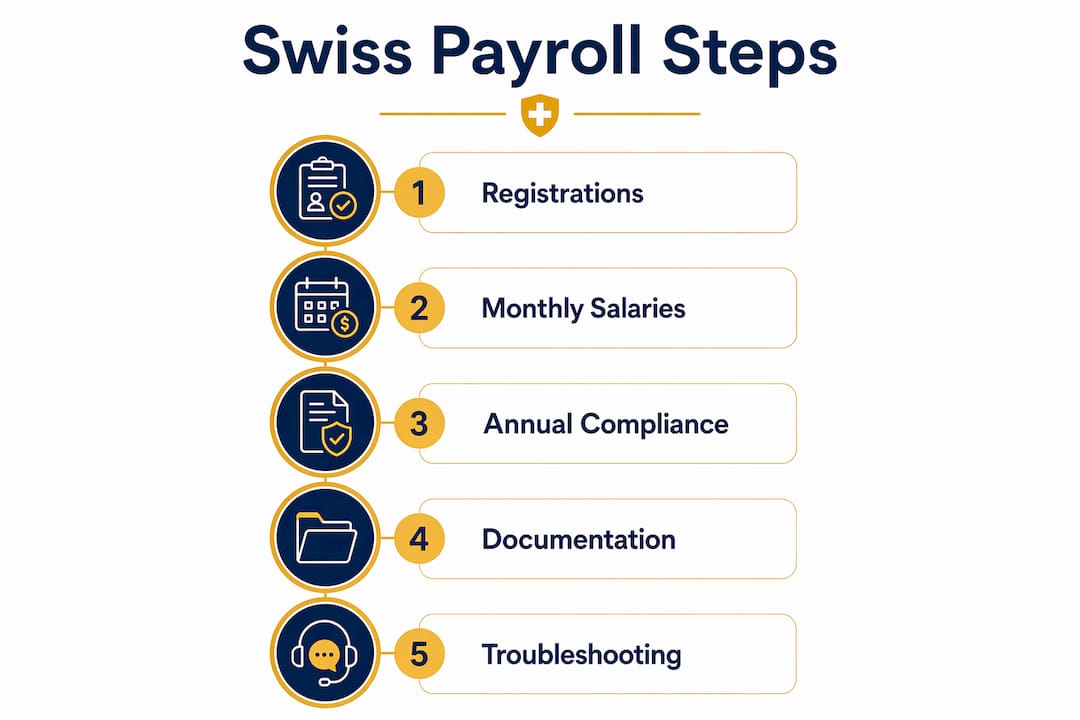
Swiss payroll management is the process of calculating employee salaries, deducting statutory contributions, applying cantonal tax withholding, and filing mandatory reports under Swiss federal and cantonal law. Knowing how to manage Swiss payroll correctly requires more than running numbers. You must register with the right authorities, apply the correct cantonal tax tariffs, enroll employees in pension and accident insurance schemes, and issue a standardized salary certificate by january 31 each year. This guide walks you through every step, from pre-payroll registration to annual compliance tasks, so you can pay your employees accurately and stay on the right side of Swiss law.
What prerequisites and registrations are required before running Swiss payroll?
Before you process a single salary, you must complete three mandatory registrations. Missing any one of them exposes your company to penalties and delays your entire payroll operation.
The three core registrations are:
Cantonal compensation office (Ausgleichskasse). Every employer must register with the cantonal Ausgleichskasse to collect and remit AHV (old-age insurance), IV (disability insurance), EO (income compensation), and ALV (unemployment insurance) contributions. The Ausgleichskasse assigns your company a contribution account and sets your monthly remittance schedule.
Pension fund (Pensionskasse). Swiss law under the BVG (occupational pension act) requires employers to enroll all employees earning above the entry threshold in a licensed Pensionskasse. You can join an industry collective foundation or select an independent pension fund.
Accident insurer under UVG/LAA. All employees must be covered for occupational and, for those working more than eight hours per week, non-occupational accidents. You register with SUVA (the national accident insurer) or an approved private insurer, depending on your industry.
Registration with these three bodies typically takes 4–8 weeks. Pension fund selection delays are the most common bottleneck, because comparing fund performance, contribution rates, and administrative fees takes time. Start this process at least two months before your intended first payroll date.
Pro Tip: Request written confirmation of your contribution account numbers from the Ausgleichskasse and your Pensionskasse before you run payroll. Without these numbers, your payroll software cannot generate compliant payslips or remittance orders.
Foreign-owned companies setting up a Swiss entity for the first time often underestimate how document-heavy the Pensionskasse enrollment is. The fund will ask for your company registration extract, employee data, and a signed affiliation agreement. Prepare these documents in advance to avoid a last-minute scramble.
How to calculate and process monthly Swiss salaries
Monthly payroll processing in Switzerland follows a fixed sequence. Each step builds on the last, and skipping one creates errors that compound over the year.
Determine gross salary. Start with the contractual base salary. Add any taxable benefits such as company car private use, meal allowances above the tax-free threshold, and bonus payments. Variable pay and expense reimbursements each follow separate tax treatment rules.
Calculate AHV/IV/EO contributions. The employee and employer each contribute equally. Deduct the employee share from gross salary. The employer remits both shares to the Ausgleichskasse.
Deduct ALV (unemployment insurance). Apply the statutory rate to gross salary up to the maximum insured earnings ceiling. Contributions above the ceiling follow a reduced solidarity rate.
Apply BVG pension contributions. Deduct the employee’s pension contribution as defined in your Pensionskasse’s plan. Employer contributions are paid on top and do not appear as a deduction on the payslip.
Deduct UVG accident insurance premiums. The occupational accident premium is fully employer-paid. The non-occupational accident premium is deducted from the employee’s salary.
Apply Quellensteuer (withholding tax) where applicable. Foreign employees without a permanent residence permit pay withholding tax instead of filing a standard tax return. You apply the correct cantonal tariff table based on the employee’s canton of residence, civil status, and number of children. Cantonal tariff tables are published annually and differ significantly between cantons such as Zug, Geneva, and Zurich.
Generate the payslip. Payslips must detail gross salary, each statutory deduction by name and amount, net salary, and supplementary information required under Swiss employment law. Employees use payslips to verify their payments and to support their own tax filings.
Remit contributions and withholding tax. Monthly remittance deadlines vary by canton but typically fall at the end of the month following the payroll period. Late remittances trigger interest charges.
Pro Tip: Use Swissdec-certified payroll software to automate tariff table updates and contribution rate changes. Swissdec certification confirms the software meets all Swiss tax and social security requirements, which reduces manual errors and simplifies your annual ELM (unified salary reporting) submission.
Handling bonuses and irregular payments deserves special attention. A year-end bonus is subject to all standard social security deductions and, for withholding tax employees, must be taxed in the month it is paid using the correct tariff. Expense reimbursements that follow your approved expense policy are generally tax-free, but you need a written policy on file to support that treatment during an audit.

What are the essential annual payroll compliance tasks in Switzerland?
Year-end payroll compliance in Switzerland centers on three deliverables: the Lohnausweis, social security reconciliation, and documentation archiving.
The Lohnausweis deadline
Employers must issue the standardized annual salary certificate, called the Lohnausweis, to every employee by january 31 following the payroll year. The Lohnausweis reports gross salary, all deductions, taxable benefits, and expense reimbursements in a format prescribed by the Swiss Tax Conference. You also file copies with the cantonal tax authority. Missing this deadline or submitting an incorrectly formatted certificate triggers correction requests and potential penalties.
Annual reconciliation tasks
Task | Deadline | Authority |
Issue Lohnausweis to employees | January 31 | Cantonal tax authority |
Submit AHV/IV/EO annual declaration | As specified by Ausgleichskasse | Cantonal Ausgleichskasse |
Pension fund annual data update | As specified by Pensionskasse | Pensionskasse |
UVG accident insurance annual statement | As specified by insurer | SUVA or private insurer |
ELM electronic salary reporting | January 31 | Swissdec / cantonal authorities |
Documentation retention
All payroll records, including payslips, contribution statements, and correspondence with authorities, must be retained for at least 10 years. This retention requirement applies to both monthly and annual payroll materials. Swiss tax authorities and social security auditors can request records going back a full decade, so a well-organized digital archive is not optional.
Common pitfalls at year-end include:
Forgetting to update BVG pension fund data when employee salaries change during the year
Applying the wrong Lohnausweis template version after the Swiss Tax Conference releases updates
Failing to reconcile monthly AHV remittances against the annual declaration, which creates discrepancies the Ausgleichskasse will flag
Missing the ELM electronic submission window, which delays tax processing for your employees
How to troubleshoot and avoid common Swiss payroll mistakes
Payroll errors in Switzerland are expensive. Late registrations, incorrect tax rate applications, and missing submissions result in penalties and ongoing compliance issues. The good news is that most errors follow predictable patterns and are preventable.
The most frequent mistakes are:
Registration gaps. Starting payroll before all three registrations are confirmed. Even one missing registration creates a chain of reporting failures.
Wrong cantonal withholding tax tariff. Applying the tariff for the wrong canton or the wrong civil status code. This is especially common when employees move cantons mid-year.
Missed contribution ceilings. Failing to stop ALV solidarity contributions at the correct earnings threshold, or applying BVG contributions to salary components that are legally excluded.
Late monthly remittances. Missing the cantonal deadline for AHV or withholding tax payments. Interest accrues immediately.
Incomplete payslips. Omitting a required deduction line or failing to show taxable benefits separately.
Regular monthly reconciliations between your payroll software output and your bank remittance records are the single most effective control you can put in place. Catching a CHF 50 discrepancy in month one prevents a CHF 600 audit finding at year-end.
Partnering with a local fiduciary or a Swissdec-certified payroll provider addresses most of these risks directly. A one-size-fits-all global payroll approach does not work in Switzerland because cantonal rules vary too significantly. Local expertise is not a luxury for Swiss payroll. It is a practical necessity, particularly for international companies managing Swiss HR processes for the first time.
Swiss payroll outsourcing is standard practice among SMEs precisely because it shifts the burden of tracking cantonal tariff updates, contribution rate changes, and reporting deadlines to a specialist. The cost of outsourcing is almost always lower than the cost of a single compliance penalty.
Key Takeaways
Managing Swiss payroll correctly requires completing all mandatory registrations before the first salary payment, applying canton-specific tax and contribution rules each month, and meeting strict annual reporting deadlines.
Point | Details |
Complete registrations first | Register with Ausgleichskasse, Pensionskasse, and UVG insurer before running any payroll. |
Allow 4–8 weeks for setup | Pension fund enrollment is the most common delay; start the process early. |
Apply cantonal tariffs correctly | Withholding tax rates differ by canton, civil status, and income level every year. |
Issue Lohnausweis by January 31 | The annual salary certificate is mandatory for every employee and must go to cantonal tax authorities. |
Retain records for 10 years | All payslips, contribution statements, and correspondence must be archived for a full decade. |
Swiss payroll: what I’ve learned from working with international employers
The biggest mistake I see international business owners make is treating Swiss payroll as a scaled-up version of payroll they already know. It is not. The cantonal layer is genuinely different from anything you encounter in most other countries. Zurich, Zug, and Geneva each publish their own withholding tax tariff tables, and the differences between them are large enough to materially affect net pay. An employee who moves from Zurich to Zug mid-year requires a tariff correction that many global payroll platforms simply do not handle automatically.
The second thing I have learned is that the Pensionskasse selection decision deserves far more attention than most employers give it. The fund you choose affects your employees’ retirement outcomes and your own contribution costs for years. Rushing this decision to meet a payroll start date is a false economy. I have seen companies spend months unwinding a poor fund selection because they did not compare conversion rates and administrative fees upfront.
My practical recommendation is to treat the Swiss payroll setup process as a project with a formal timeline, not an administrative task you fit around other priorities. Assign a single owner, build in buffer time for pension fund negotiations, and use Swissdec-certified software from day one. The companies that get this right in the first quarter rarely have compliance problems later. The ones that cut corners in setup spend years correcting the consequences.
— Rolands
Rpcs makes Swiss payroll compliance straightforward
Swiss payroll involves federal rules, cantonal variations, and multiple regulatory bodies. Getting all of it right from the start is much easier with a local partner who already knows the system.

Rpcs supports business owners and HR managers with Swiss company formation, payroll registration, and ongoing compliance. The team handles Ausgleichskasse and Pensionskasse enrollment, assists with Swissdec-compatible payroll setup, and manages Lohnausweis preparation and annual filings. For companies that need full-service support, Rpcs also provides Swiss accounting services that integrate payroll reporting with your broader financial obligations. If you are setting up payroll in Switzerland for the first time or need to bring an existing payroll into compliance, Rpcs offers the local expertise to do it correctly.
FAQ
What registrations are required before running Swiss payroll?
Employers must register with the cantonal Ausgleichskasse, enroll in a licensed Pensionskasse, and obtain UVG accident insurance coverage before processing the first salary. Registration typically takes 4–8 weeks, with pension fund selection being the most common delay.
When must the Lohnausweis be issued to employees?
The Lohnausweis must be issued to every employee by january 31 following the payroll year. Copies must also be filed with the cantonal tax authority by the same deadline.
What is Quellensteuer and who does it apply to?
Quellensteuer is Swiss withholding tax applied to foreign employees who do not hold a permanent residence permit. The employer deducts it directly from salary using the cantonal tariff table that corresponds to the employee’s canton of residence, civil status, and number of dependents.
How long must Swiss payroll records be retained?
All payroll records must be retained for at least 10 years. This includes monthly payslips, contribution statements, annual declarations, and all correspondence with tax and social security authorities.
Is outsourcing Swiss payroll a good option for small businesses?
Outsourcing is standard practice among Swiss SMEs because cantonal rules change regularly and errors carry financial penalties. A Swissdec-certified provider handles calculations, monthly remittances, and annual filings, which reduces administrative burden and compliance risk significantly.
Recommended
Comments