
Trademark Registration Switzerland: Why It Matters
- Feb 25
- 11 min read
Updated: Mar 2

Brand protection moves fast for global entrepreneurs in technology and finance. Without a Swiss trademark, your business risks losing exclusive identity and legal ground to competitors. Registering a trademark with the Swiss Federal Institute of Intellectual Property grants you exclusive rights to a distinctive mark for ten years and supports indefinite renewal. This article explains how Swiss registration secures your brand, prevents unauthorized use, and lays the foundation for confident expansion across Europe.
Table of Contents
Key Takeaways
Point | Details |
Trademark Registration in Switzerland | Secures exclusive rights for your brand, preventing competitors from using similar marks for ten years with the possibility of indefinite renewal. |
Importance of Registration | Protects your brand identity and prevents customer confusion, enhancing value and the ability to legally enforce your rights. |
Broad Types of Trademarks | Various types, including word, figurative, shape, and sound marks enable comprehensive protection of your brand assets. |
Active Use Requirement | Must actively use the trademark in commerce within five years of registration to maintain rights and avoid cancellation risks. |
What Trademark Registration Means in Switzerland
Trademark registration in Switzerland gives your brand legal protection. It prevents competitors from using similar marks on comparable goods or services. This formal process transforms your brand identity into an enforceable right.
The Swiss Federal Institute of Intellectual Property (IPI) manages all trademark registrations. When you register, you’re securing exclusive rights to a distinctive mark within Switzerland’s territory. This protection lasts for ten years and can be renewed indefinitely.
Why Registration Matters for Your Business
Without registration, your brand remains vulnerable. Competitors can adopt similar marks, confusing customers and diluting your reputation. Registration closes this gap.
Key protections include:
Exclusive use of your mark for registered goods or services
Legal enforcement power to prevent unauthorized use
Ten-year protection automatically renewable
Geographic scope covering all of Switzerland
Defense capability against confusingly similar marks
Registration also supports your company’s value. A protected trademark becomes an asset on your balance sheet, valuable if you ever sell your business or expand through licensing.

What Gets Protected
Your registered mark protects specific goods and services. A trademark must be distinctive and not merely descriptive of the products or services themselves. Registration covers the exact categories you specify—not your entire business.
For example, registering “TechVision” for software development doesn’t automatically protect it for retail clothing. You must list each category separately during application.
The Registration Process Basics
The process starts with filing an application to the IPI. You’ll specify:
Your mark (word, logo, or combination)
Goods and services it covers
Your business information
Note that prior use isn’t required. You can register a mark before launching it commercially, securing your brand position from day one.
Real-World Implications
Once registered, your trademark becomes a legal asset. It prevents others from registering identical or confusingly similar marks in Switzerland. This protection extends across all markets—from e-commerce to physical retail.
For international entrepreneurs in tech and finance, this matters enormously. Your Swiss trademark registration complements global protection strategies. It establishes Switzerland as a secured market for your operations.
Your trademark registration is only as strong as your ability to enforce it. Document usage, monitor competitors, and act quickly against infringement to maintain your rights.
Pro tip: Register your trademark before conducting major marketing campaigns or product launches in Switzerland to establish priority and prevent competitors from claiming similar marks in your category.
Types of Trademarks and National Scope
Swiss trademark law protects far more than just logos and company names. Various forms including word marks, logos, and sound marks can all receive registration. Understanding these categories helps you protect your brand comprehensively.
The type you choose depends on what actually distinguishes your business in the marketplace. A tech startup might need a distinctive word mark or logo, while a luxury brand could benefit from protecting a specific shape or sound.
Common Trademark Types in Switzerland
Swiss law recognizes multiple trademark categories:
Word marks - Text, names, slogans, or phrases
Figurative marks - Logos, symbols, or graphic designs
Shape marks - Three-dimensional product shapes or packaging
Sound marks - Distinctive audio signatures or jingles
Combination marks - Word and visual elements together
All types must meet one core requirement: they must be distinctive. A generic or purely descriptive mark won’t qualify. The Swiss Federal Institute of Intellectual Property (IPI) examines each application for originality and clarity.
Here’s how Switzerland’s trademark types differ in application and business value:
Trademark Type | Distinguishing Feature | Typical Use Case | Business Impact |
Word Mark | Protects brand names, slogans | SaaS product names | Builds name recognition |
Figurative Mark | Protects logos, graphic logos | Retail brand symbols | Enhances visual identity |
Shape Mark | Protects product design | Packaging for luxury goods | Prevents copying of packaging |
Sound Mark | Protects unique audio jingles | Financial service ads | Strengthens marketing campaigns |
Combination Mark | Protects word + visual combo | Tech startup branding | Secures full brand expression |
National Protection Scope
Here’s the critical limitation: Swiss trademark registration protects you only in Switzerland. This is pure territorial protection. If you register your mark here, it covers your goods and services exclusively within Swiss borders.
This matters tremendously for international entrepreneurs. Your protection doesn’t extend to Germany, France, or any other country automatically. However, protection can be extended through international treaties like the Madrid Protocol, which streamlines multi-country registration.
For tech and finance entrepreneurs planning European expansion, this distinction is crucial. You’ll need separate registrations or international applications to protect your brand across multiple jurisdictions.
Goods and Services Classification
Your trademark’s scope depends on which goods or services you specify during registration. The Nice Classification system categorizes all possible products and services into 45 distinct classes.
You must declare your exact classes during application:
Identify your primary business activities
Research relevant Nice Classification codes
List all classes where you’ll use the mark
Understand that protection is limited to these classes
Registering for Class 42 (software development) doesn’t protect your mark in Class 25 (clothing). Each class requires separate consideration and may involve additional fees.
Your national scope is your strength when protecting against local competitors, but it’s also your limitation when expanding internationally. Plan accordingly.
Pro tip: Consider your international growth plans before registering—apply for multiple Nice Classes covering your current and foreseeable business activities to maximize protection value and reduce future re-registration costs.
Swiss Legal Framework and Registration Requirements
Switzerland’s trademark protection operates under a strict legal framework designed to protect both business owners and consumers. The system is governed by the Federal Act on the Protection of Trade Marks and Indications of Source, which establishes clear rules for what can be registered and how.
Understanding these requirements upfront saves time and money. Filing an application that doesn’t meet legal standards results in rejection, forcing you to reapply and start the process over.
Core Legal Requirements
Your trademark must satisfy several fundamental criteria to qualify for registration:
Distinctiveness - The mark must clearly identify your goods or services from competitors
Non-deceptive nature - It cannot mislead consumers about the product or its origin
Graphical representation - The mark must be clearly depicted in written or visual form
Non-conflicting status - It cannot be identical or confusingly similar to existing marks
Distinctiveness is the highest bar. Generic terms, purely descriptive phrases, and common symbols rarely pass examination. A tech startup cannot register “Software Development” as a trademark because it’s purely descriptive of services, not distinctive.
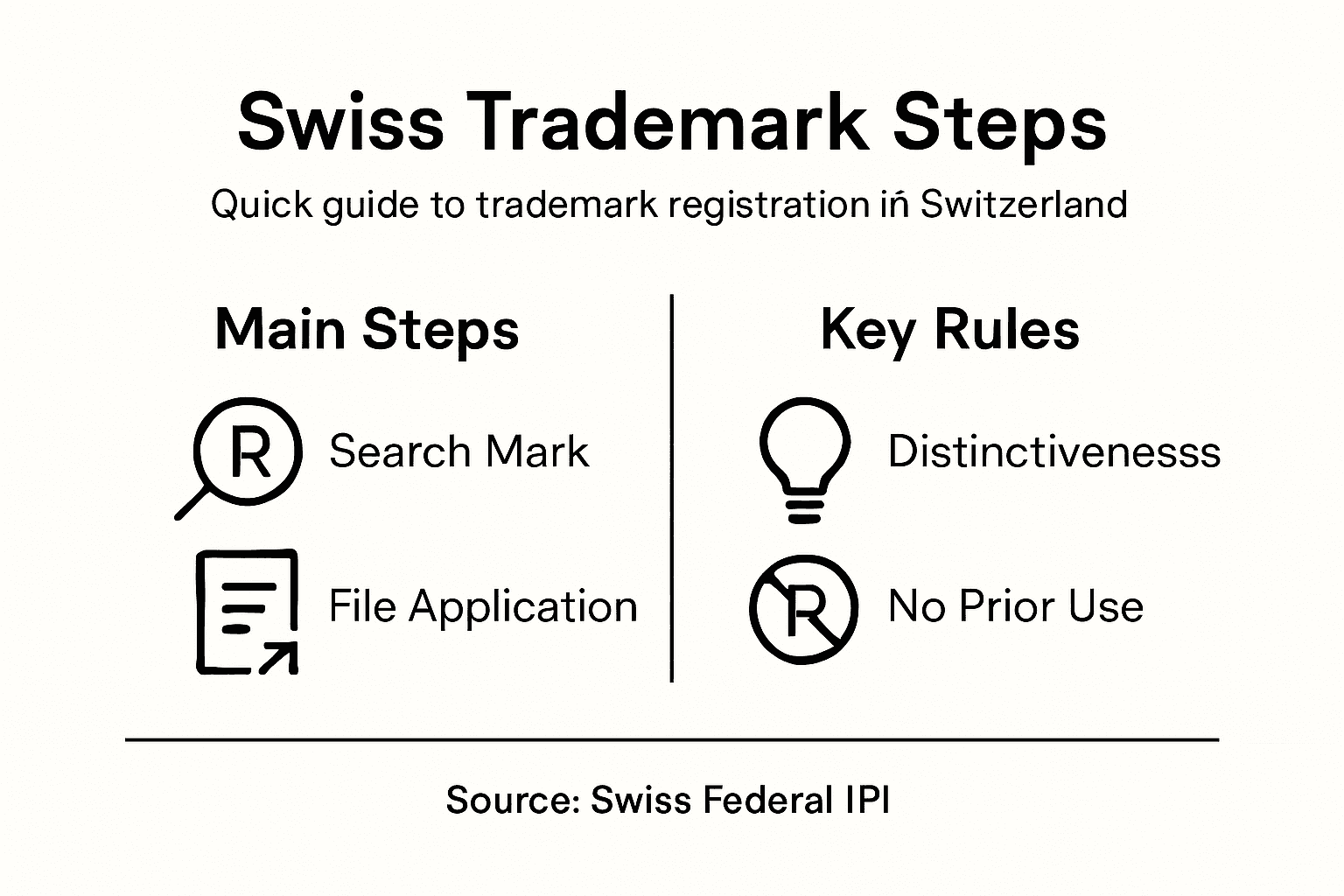
No Prior Use Requirement
Here’s a major advantage: Switzerland doesn’t require you to be using the mark commercially before registration. You can file for protection months or years before launching your product or service.
This is tremendously valuable for startups. Secure your brand identity early, before competitors claim similar marks. However, once registered, you must use the mark within five years or face cancellation challenges.
Foreign Applicant Requirements
If you’re based outside Switzerland, Swiss law requires you to appoint a local representative to handle your application and correspondence with the Swiss Federal Institute of Intellectual Property (IPI).
This is where professional company formation services become invaluable. A key part of establishing your Swiss business presence includes designating a local representative who can manage intellectual property matters alongside company registration.
The Formal Examination Process
The IPI conducts a thorough examination of every application. This involves:
Checking for absolute grounds for refusal (distinctiveness, deceptiveness)
Searching existing trademark registers for conflicts
Assessing similarity to prior marks in the same or related classes
Publishing your application for opposition periods
Granting registration if no oppositions are filed
The entire process typically takes 6-12 months, depending on examination complexity and opposition filings.
Registration is not automatic. The IPI’s examination is rigorous, and any defects in your application can result in rejection or refusal.
Pro tip: Conduct a preliminary trademark search before filing to identify potential conflicts early—this single step can save months of delays and costs if your preferred mark faces opposition.
Benefits for Technology and Finance Entrepreneurs
Technology and finance sectors operate in hyper-competitive markets where brand identity determines market survival. Your trademark becomes your competitive weapon, protecting what makes your business recognizable and valuable in crowded spaces.
For tech startups launching fintech platforms, blockchain solutions, or SaaS products, trademark registration isn’t optional—it’s existential. Without protection, competitors can adopt similar names, creating customer confusion and destroying your market differentiation.
Building Unshakeable Brand Recognition
Registered trademarks create strong brand identity and secure market differentiation. Your mark becomes legally defensible intellectual property. Customers recognize your brand, trust it, and choose it over competitors.
In finance, trust is everything. A registered trademark signals legitimacy and stability. It tells investors and clients you’re serious enough to protect your identity legally. This matters tremendously when raising capital or onboarding institutional clients.
Preventing Brand Dilution and Competitive Theft
Without trademark protection, competitors can use confusingly similar names on similar services. A fintech startup called “PaySecure” can’t prevent another company from launching “PaySecure Pro” or “SecurePay” without registered protection.
Registration gives you legal leverage. You gain exclusive rights to prevent unauthorized use:
Cease-and-desist authority - Stop competitors from using identical or confusingly similar marks
Litigation capability - Sue for damages and injunctive relief
Enforcement power - Block domain registrations and trademark applications by others
Market exclusivity - Control your brand identity completely
Adding Tangible Business Value
Trademarks are business assets. They appear on balance sheets, increase company valuation, and become negotiating leverage during acquisitions or partnerships. When venture capitalists evaluate tech companies, trademark portfolio strength influences investment decisions.
For finance entrepreneurs, protected trademarks streamline expansion. Switzerland’s tax advantages and business-friendly environment combine with strong trademark protection to create an ideal launch platform for European operations. Register your mark here, then expand internationally with established Swiss credibility backing you.
Supporting Growth and Investment
Investors want to back businesses with protected intellectual property. Strong trademark protection reduces acquisition risk and increases perceived company value. This is especially critical in tech, where brand names carry disproportionate value.
Registration also facilitates partnerships and licensing opportunities. Financial services companies can license their trademarks to partners, creating additional revenue streams and market reach without direct operational expansion.
Your trademark is worth protecting because it represents years of customer trust and market positioning. Once lost, rebuilding brand recognition costs exponentially more than registration.
Pro tip: Register your trademark simultaneously with establishing your Swiss company presence—combining trademark protection with formal business registration creates a cohesive, legally defensible brand foundation for international expansion.
Costs, Mistakes, and Long-Term Protection
Trademark registration requires upfront investment and ongoing commitment. Understanding costs and common pitfalls prevents expensive mistakes that could undermine your protection strategy. Smart management ensures your trademark remains valuable indefinitely.
Many entrepreneurs skip registration because they underestimate the long-term value it creates. This is a costly miscalculation. The price of registration is negligible compared to rebuilding brand reputation after losing trademark rights.
Understanding Registration Costs
Swiss trademark registration costs are surprisingly reasonable. The base filing fee is approximately CHF 550 for up to three classes of goods or services. Additional classes cost extra fees, typically CHF 150-200 per class.
Expect total costs for a straightforward application to fall between CHF 1,000 and 2,000 when you add:
Professional search fees (CHF 200-400)
Local representative fees if required (varies)
Application filing and processing
Renewal costs every ten years (similar to initial registration)
For tech startups and fintech companies, this investment is trivial compared to the value of brand protection. A single instance of trademark infringement could cost thousands in legal fees and brand damage.
Quick reference: Typical costs and timeline for Swiss trademark registration:
Cost Element | CHF Estimate | When Paid | Notes |
Application Fee | 550 (up to 3 classes) | On application | Additional class: CHF 150-200 |
Professional Search | 200-400 | Before application | Helps avoid conflict |
Local Rep Fees | Varies | At engagement | Only for foreign applicants |
Renewal Fee | 550 (up to 3 classes) | Every 10 years | Same structure as initial application |
Process Timeline | 6-12 months | From application | Includes examination and opposition |
Common Mistakes That Cost Time and Money
Poor planning multiplies costs exponentially. The biggest mistakes include:
Inadequate prior searches - Filing for a mark that conflicts with existing registrations results in rejection and reapplication
Vague goods/services descriptions - Ambiguous classification creates disputes during examination and reduces protection scope
Non-distinctive marks - Generic or descriptive terms fail examination immediately
Insufficient Nice Classification planning - Not registering in all relevant classes forces future applications
Wrong representative appointment - Choosing unqualified representatives causes application errors
These mistakes add months to the timeline and require additional fees to correct. One rejected application followed by reapplication can cost 50-100 percent more than getting it right initially.
The Five-Year Active Use Requirement
Registration alone doesn’t guarantee perpetual protection. You must actively use your trademark in commerce within five years of registration. Failure to use invites cancellation challenges from competitors.
“Active use” means genuine commercial activity. Selling products under the mark, offering services, or marketing substantially with the trademark counts. Occasional or token use may not satisfy this requirement.
Renewal Strategy for Indefinite Protection
Once registered, your trademark protection lasts ten years and renews indefinitely through fee payments. Renewal costs match initial registration expenses, approximately CHF 550 for three classes.
Establish a renewal schedule:
Document your trademark registration date and deadline
Set calendar reminders six months before expiration
Monitor your usage to ensure active commercial deployment
File renewal applications on time to avoid lapsed protection
Negligent entrepreneurs lose trademarks by missing renewal deadlines. This is entirely preventable with basic administrative discipline.
Long-term trademark protection requires active use and timely renewal. Neglect either responsibility and your investment becomes worthless.
Pro tip: Set up a trademark management system documenting registration dates, class assignments, and renewal deadlines—this simple administrative step prevents costly lapses and ensures continuous protection across your entire portfolio.
Secure Your Swiss Trademark and Business Identity Today
Navigating trademark registration in Switzerland can be complex, especially for international entrepreneurs and investors seeking to establish a strong and legally protected brand. This important step requires not only understanding the distinctions of Swiss trademark law but also aligning your business foundation with proper company formation and legal compliance. Challenges such as meeting distinctiveness requirements, selecting the correct Nice Classification classes, and ensuring timely renewal often delay or complicate your market entry.
At rpcs.ch, we specialize in simplifying this journey by offering comprehensive company formation services tailored for foreign clients. Our solutions help you establish GmbH or AG entities in Switzerland with full support on legal documentation, registration, banking setup, and local representation—crucial for handling your trademark filings effectively. Coupled with our ongoing administrative and legal guidance, you gain a seamless path to not only protect your trademark but also build enduring business value in a highly competitive technology or finance sector.
Don’t let trademark hurdles stall your Swiss market ambitions. Partner with us at rpcs.ch to secure your company setup, ensure compliance with Swiss regulations, and confidently register your trademark. Get started now to protect your brand from day one and unlock Switzerland’s renowned business advantages. Visit our company formation page today and take the first step toward unshakable brand protection and international growth.
Frequently Asked Questions
What is trademark registration in Switzerland?
Trademark registration in Switzerland provides legal protection for your brand, preventing competitors from using similar marks on comparable goods or services. It gives you exclusive rights to a distinctive mark within the territory.
How long does trademark protection last in Switzerland?
Trademark protection in Switzerland lasts for ten years and can be renewed indefinitely, keeping your brand secure as long as you adhere to renewal requirements.
What types of trademarks can be registered in Switzerland?
In Switzerland, various types of trademarks can be registered, including word marks, figurative marks (logos), shape marks, sound marks, and combination marks. All must be distinctive to qualify.
What are the steps involved in the trademark registration process?
The trademark registration process involves submitting an application to the Swiss Federal Institute of Intellectual Property, specifying the trademark, the goods and services it covers, and your business information. The IPI then examines the application for distinctiveness and conflicts with existing marks.
Recommended