
Swiss Accounting Setup Workflow: Step-by-Step Guide for Success
- Feb 22
- 9 min read
Updated: Mar 2

Setting up a new Swiss GmbH or AG brings strict documentation and compliance demands. For founders relocating from outside Switzerland, every detail matters. Swiss transparency laws require beneficial ownership registration and banks expect precise company documentation before account opening. This guide walks you through every practical step, helping you avoid delays and build an accounting foundation that supports growth across tech and finance sectors.
Table of Contents
Quick Summary
Key Insight | Explanation |
1. Prepare all necessary documents | Gather articles of association, identification, and proof of residency to avoid registration delays. |
2. Choose appropriate accounting software | Select software that meets Swiss regulations for real-time tracking and compliance with tax laws. |
3. Integrate banking with accounting | Connect your bank and accounting systems for efficient data flow and compliance, reducing errors. |
4. Conduct an internal compliance audit | Regularly review your accounting practices and documentation to ensure alignment with Swiss regulations. |
5. Create an annual compliance checklist | Develop a checklist for tax deadlines and filings specific to your company structure to stay organized. |
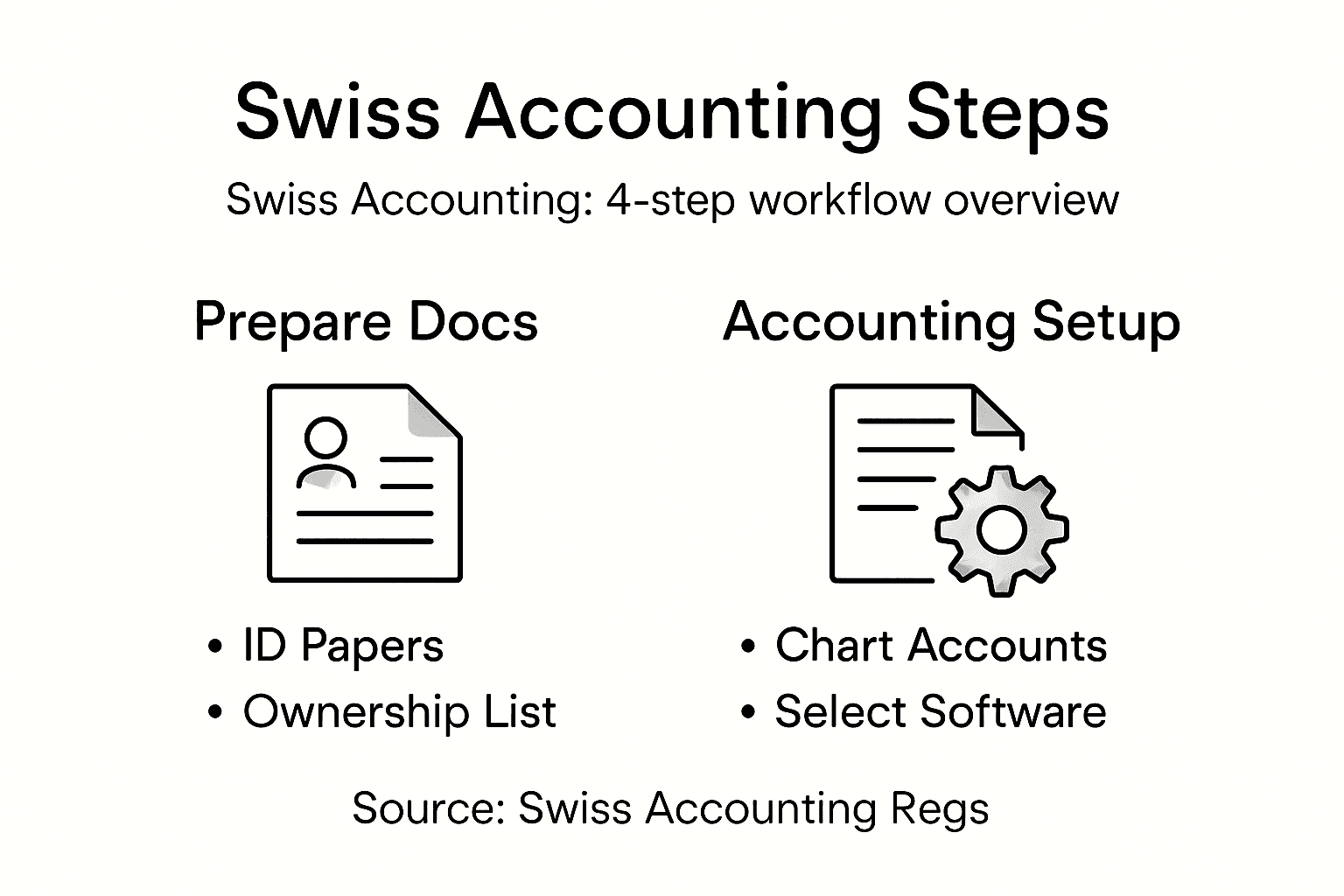
Step 1: Prepare essential documents and legal requirements
Before you can establish your Swiss company, you need to gather and prepare the right documentation. This step ensures compliance with Swiss law and speeds up your registration process significantly.
Start by compiling your corporate foundation documents. For a GmbH or AG, you’ll need articles of association that clearly outline your company’s structure, management, and shareholder rights. These documents must be in German, French, or Italian—English versions won’t be accepted by Swiss authorities.
Identification documents are non-negotiable. Gather valid passports or national ID cards for all founders and directors. If you’re appointing a Swiss Resident Director or using Swiss Nominee Director Services, their identification and proof of Swiss residency become essential. Authorities verify every identity thoroughly.
You’ll also need to address beneficial ownership reporting. Switzerland’s transparency law requires beneficial ownership registration for compliance with anti-money laundering standards. This affects nearly all GmbHs and AGs, so document your true beneficial owners from the start.
Here’s what to prepare in order:
Here’s a comparison of key differences between Swiss GmbH and AG company types for founders:
Aspect | GmbH (LLC) | AG (Corporation) |
Minimum Share Capital | CHF 20,000 | CHF 100,000 |
Shareholder Visibility | Publicly disclosed | Can be anonymous |
Management Structure | One director required | Board of Directors |
Typical Use Case | Small/mid-size firms | Larger enterprises |
Transfer of Shares | More restricted | Flexible |
Notarized articles of association in an official Swiss language
Identification documents for all founders and company directors
Proof of beneficial ownership and shareholder structure
Bank references or financial documentation
Proof of registered address in Switzerland or arrangement for one
You’ll also want to prepare banking requirements. Most Swiss financial institutions request documentation related to company structure before opening your Switzerland Bank Account. Have your corporate documentation ready to demonstrate legitimacy.
Address verification matters too. Whether you’re using a physical office or a virtual office in Switzerland, you need proof of your registered business address. Many international entrepreneurs use virtual office solutions to maintain a professional presence while keeping costs manageable.
Gathering documents before registration prevents costly delays later. Most companies that struggle with setup timing overlooked one document initially.
Pro tip: Create a document checklist specific to your business structure (GmbH vs AG) and have your accountant review all papers before submission to catch translation or formatting issues that Swiss authorities will reject.
Step 2: Establish accounting structure and select software
With your documents prepared, you now need to build your accounting foundation and choose the right tools. This step determines how efficiently you’ll manage finances and stay compliant with Swiss regulations.
Start by understanding your accounting structure. Swiss companies must follow double-entry bookkeeping principles, where every transaction affects two accounts. This system maintains accuracy and creates the financial records authorities require. Understanding double-entry bookkeeping is fundamental to any accounting setup, whether you handle it yourself or delegate to professionals.

Decide whether you’ll use computerized accounting software or work with an Accounting Services for Swiss Companies provider. Most international entrepreneurs prefer professional support since Swiss tax codes are complex and require expertise. However, if you manage internally, you’ll need robust software.
Here’s what to consider when selecting software:
Real-time financial reporting and transaction tracking
Automated invoicing and expense categorization
Multi-currency support for international transactions
Integration with Swiss tax and VAT requirements
Scalability as your business grows
User-friendly interface for your team
If you’re working with Accounting Services in Switzerland, your provider typically recommends compatible systems. Many professionals use specialized tools that integrate with Swiss banking systems and tax filing processes. This prevents manual data entry errors and speeds up compliance reporting.
For tech-focused founders in crypto or fintech, your accounting structure becomes even more critical. The system must track complex transactions, token movements, and regulatory requirements. Software should handle multi-wallet tracking and generate reports suitable for Swiss authorities.
You’ll also need to align your accounting structure with your chosen company type. A GmbH and AG have different Swiss accounting services requirements, so discuss this with your accountant before finalizing software choices.
Your accounting software is only as good as the data you feed it. Garbage in means garbage out, so establish clean data entry practices from day one.
Pro tip: Set up chart of accounts templates specific to your industry before your first transaction, preventing costly reorganization and ensuring consistent categorization from the start.
Step 3: Integrate banking and financial reporting systems
Connecting your bank accounts with your accounting software creates a seamless financial workflow. This integration ensures real-time transaction visibility and eliminates manual data entry errors that slow down reporting.
Start by opening your Switzerland Bank Account with a financial institution that supports API connections. Not all Swiss banks offer the same integration capabilities, so confirm this before finalizing your banking relationship. Banks like UBS, Credit Suisse, and regional institutions typically provide robust digital banking platforms suitable for business integration.
Most Swiss banks now participate in Switzerland’s central payment clearing system, which processes both large-value and retail transactions securely. This infrastructure ensures your transactions move smoothly between accounts and integrate with reporting systems.
Next, connect your accounting software to your bank accounts. This process typically involves:
Authorizing your software to access banking data securely
Mapping transaction categories automatically
Reconciling accounts weekly or monthly
Generating real-time financial reports
Your Open Swiss Bank Account should support multi-currency transactions if you operate internationally. Tech founders managing payments across multiple countries need systems that track foreign exchange movements and convert currencies automatically for reporting purposes.
Many Swiss banks are shifting toward digital ecosystem integration, where your bank connects with accounting tools, tax software, and payroll systems through standardized interfaces. This modular approach gives you flexibility to choose best-in-class solutions that work together seamlessly.
Configure your Accounting Services in Switzerland provider to access your bank feeds if you’re using professional support. This allows your accountant to monitor transactions, identify unusual activity, and prepare reports faster. Real-time visibility prevents surprises during tax season.
Set up automated reconciliation rules to match transactions with invoices and expenses. Swiss regulations require you to maintain detailed transaction records, and automation ensures accuracy while reducing manual work significantly.
Below is a summary of integration benefits for Swiss banking and accounting systems:
Integration Benefit | Business Impact |
Real-time transaction sync | Faster reporting, fewer errors |
Automated reconciliations | Saves time, ensures compliance |
Multi-currency functionality | Simplifies global transactions |
Secure API connections | Protects financial data |
Ecosystem compatibility | Easy expansion, scalable systems |
Integrated banking systems reduce accounting errors by up to 80 percent and cut monthly close time in half.
Pro tip: Test your bank integration with small transactions first, then scale up once you confirm transactions flow smoothly from your bank into accounting software without delays or data mismatches.
Step 4: Verify compliance and finalize accounting setup
Before you consider your accounting setup complete, you must verify that everything meets Swiss regulatory requirements. This final step protects your company from penalties and ensures smooth operations moving forward.
Start by conducting an internal compliance audit of your entire accounting structure. Review your chart of accounts, transaction categorization, bank reconciliations, and financial reports against Swiss accounting standards. Your Accounting Services in Switzerland provider should perform this verification if you’re using professional support.
Swiss companies must maintain written compliance policies and procedures that align with anti-money laundering regulations. Compliance program assessments verify that your financial controls meet international standards and protect against suspicious activity. Document your internal controls clearly and ensure your team understands them.
Verify these critical elements before finalizing:
All transactions properly categorized and documented
Bank reconciliations completed monthly without discrepancies
VAT calculations accurate and ready for quarterly filings
Financial statements prepared according to Swiss standards
Audit trails intact showing who entered each transaction
Multi-currency conversion rates documented appropriately
Schedule a compliance review meeting with your accountant or Company Director in Switzerland to discuss findings. They’ll identify any gaps in documentation or procedures that need correction before your fiscal year ends.
If you’ve appointed a Swiss Resident Director or used Swiss Nominee Director Services, confirm they’ve reviewed the accounting structure and approved it. Directors carry legal responsibility for accurate financial reporting, so their sign-off matters legally.
Document your accounting policies in writing. This becomes your standard operating procedures manual that guides staff and demonstrates due diligence to regulators. Include procedures for transaction approval, bank reconciliation timing, and exception handling.
Final verification includes testing your software integrations one more time. Run a test report from your accounting system and confirm it matches your bank statements and general ledger exactly.
Companies that document their compliance procedures experience 60 percent fewer audit findings than those without formal policies.
Pro tip: Create an annual compliance checklist covering tax deadlines, filing requirements, and documentation reviews specific to your company structure, then assign ownership to team members with reminders set three months before each deadline.
Simplify Your Swiss Accounting Setup with Expert Support
Navigating the complex Swiss accounting landscape outlined in the “Swiss Accounting Setup Workflow” article can feel overwhelming. From preparing notarized documentation and understanding double-entry bookkeeping to integrating banking systems and maintaining compliance every step demands precision and local expertise. Key challenges include meeting strict regulatory standards, managing multi-currency transactions, and ensuring seamless software and banking integration without errors or delays.

Unlock peace of mind and efficiency by partnering with RPCS, your trusted gateway for Swiss company formation and accounting services. Our professional team specializes in establishing GmbH and AG companies with full support on legal documentation, bank account setup, and ongoing Accounting Services in Switzerland. We relieve you from the burden of complex compliance and financial reporting requirements, so you can focus on growing your business. Start your journey today with comprehensive assistance designed for international entrepreneurs seeking a smooth and rapid Swiss incorporation experience.
Frequently Asked Questions
What essential documents do I need to prepare for setting up Swiss accounting?
To set up Swiss accounting, you need notarized articles of association, identification documents for all company founders and directors, proof of beneficial ownership, and a registered address in Switzerland. Gather these documents before starting the registration process to avoid delays.
How do I choose the right accounting software for my Swiss company?
Select accounting software that allows for real-time financial reporting, multi-currency support, and integration with Swiss tax requirements. Consider your company’s size and needs to ensure the software scales effectively as your business grows.
What is double-entry bookkeeping, and why is it important for Swiss companies?
Double-entry bookkeeping is an accounting system where every transaction affects two accounts, maintaining accuracy in financial records. Implement this system to ensure compliance with Swiss regulations and to simplify your financial reporting.
How can I integrate my bank account with accounting software to improve efficiency?
Open a Swiss bank account that offers API connections, then authorize your accounting software to access banking data. This integration allows for real-time transaction visibility and can reduce manual reconciliation errors by up to 80%.
What steps should I take to verify compliance before finalizing my Swiss accounting setup?
Conduct an internal compliance audit that reviews transactions, bank reconciliations, and financial statements against Swiss accounting standards. Document your compliance procedures and schedule a review meeting with your accountant to identify any gaps that need addressing before closing the fiscal year.
How can I ensure my financial reporting is accurate and timely in Switzerland?
Establish regular reconciliation practices and maintain detailed transaction records in your accounting software. Schedule monthly reviews of your financial statements to catch discrepancies early and prepare for quarterly tax filings.
Recommended
Comments