
The Role of HR Services in Switzerland: 2026 Guide
- Jun 3
- 8 min read

TL;DR:
HR services in Switzerland involve managing recruitment, payroll, and compliance within a complex multi-layered legal system. They have evolved beyond administrative tasks to becoming strategic partners focused on workforce planning, technology integration, and employee retention. Outsourcing these services offers cost and compliance advantages but requires careful selection and ongoing monitoring to address Switzerland’s cantonal variations and legal requirements.
HR services in Switzerland are defined as the integrated management of recruitment, payroll, compliance, employee development, and labor law adherence across Switzerland’s federal and cantonal regulatory systems. The role of HR services in Switzerland extends far beyond administrative support. Swiss companies face one of the world’s most layered employment frameworks, shaped by the Swiss Code of Obligations, the Labor Act, and 26 distinct cantonal tax and social insurance systems. For business professionals and HR managers operating here, understanding how HR functions intersect with legal compliance is not optional. It is the foundation of corporate stability.
How does Switzerland’s regulatory environment shape HR services?
Switzerland’s labor law operates on two levels simultaneously. Federal legislation, including the Swiss Code of Obligations and the Labor Act, sets baseline employment standards. Each of the 26 cantons then applies its own tax rates, social insurance rules, and administrative requirements on top of that foundation. The result is a compliance matrix that demands localized HR expertise rather than generic international solutions.
Payroll alone illustrates this complexity. Swiss payroll must account for AHV (old-age insurance), IV (disability insurance), ALV (unemployment insurance), and pension contributions under the BVG framework. Each of these calculations shifts depending on the employee’s canton of residence and the employer’s registered location. Cross-canton workforce management requires sophisticated payroll processing and legal compliance tools, which is a key driver behind the rapid adoption of integrated HR technology platforms.
Swissdec certification is another non-negotiable standard. Swissdec defines the technical specifications for electronic salary declarations to Swiss authorities, and any payroll system used by Swiss employers must conform to these standards. Companies that ignore Swissdec requirements face rejected filings and potential penalties.
Federal Labor Act governs working hours, rest periods, and health and safety obligations
Swiss Code of Obligations defines employment contract terms, notice periods, and termination rights
Cantonal tax authorities require separate payroll reporting for each employee’s home canton
AHV, IV, ALV, and BVG contributions must be calculated and remitted monthly or quarterly
Pro Tip: If your company employs staff across multiple cantons, map each employee’s canton of residence at onboarding. A single payroll error tied to the wrong cantonal rate can trigger audits that cover the previous five years.
What are the core HR service functions that support Swiss companies?
The role of HR in Swiss companies covers five interconnected functions. Each one carries compliance weight, not just operational value.
Recruitment and selection. Switzerland’s talent market is competitive. Recruitment difficulties for qualified workers stood at 34.3% in Q1 2026, a slight improvement from prior quarters but still significant. HR services must align job descriptions, compensation benchmarks, and work permit requirements with Swiss labor market conditions, particularly for international hires requiring B or L permits.
Payroll processing. Accurate payroll is the single most compliance-sensitive HR function in Switzerland. HR teams must calculate gross-to-net pay, apply the correct social security deductions, and submit salary declarations through Swissdec-certified systems. For a detailed breakdown of these requirements, the guide on Swiss payroll compliance covers the technical steps in full.
Employee benefits structuring. Swiss employees expect occupational pension coverage under BVG, accident insurance under UVG, and health insurance support. HR services design benefits packages that meet legal minimums while remaining competitive in a market where emotional security and trust now outrank salary perks as retention drivers, according to a 2026 Great Place to Work survey of over 51,000 respondents.
Performance management and retention. Swiss workplace culture values fairness, transparency, and long-term employment relationships. HR services build performance frameworks that reflect these expectations, including structured feedback cycles, clear promotion criteria, and documented disciplinary procedures aligned with the Swiss Code of Obligations.
Training and development. Switzerland’s multilingual environment, with German, French, Italian, and Romansh regions, means training programs must account for language and cultural differences. HR services that ignore regional variation produce lower engagement and higher turnover.
Pro Tip: Build your employment contracts in the language of the employee’s work location, not just the company’s headquarters language. A German-language contract for a Zurich-based employee carries more legal clarity and reduces dispute risk than an English-only version.
How have HR services evolved into strategic business partners?

The shift from administrative HR to strategic HR business partners is well documented in 2026 industry analysis. Swiss companies now expect HR to contribute directly to workforce planning, organizational design, and risk mitigation, not just process payroll and manage leave requests.
Several forces are driving this transformation:
Data-driven decision-making. HR teams now use workforce analytics to forecast turnover, identify skills gaps, and model the cost impact of hiring decisions before they are made.
HR technology integration. SaaS platforms like SAP SuccessFactors and Workday are widely deployed in Swiss enterprises to centralize employee data, automate compliance reporting, and support cross-canton payroll accuracy.
Employer of Record and outsourcing models. Companies entering Switzerland without a local legal entity use Employer of Record providers to hire staff legally while their own entity is being established. This model reduces setup time and transfers compliance liability to a specialist provider.
Employee experience focus. Modern HR services in Switzerland prioritize emotional security and transparent culture over traditional compensation models to retain talent. This is a measurable shift, not a soft trend.
Strategic HR profiles that combine regulatory knowledge, technology skills, and change management command premium salaries in 2026. This reflects how much Swiss companies now value HR professionals who can operate at the intersection of law, data, and people strategy.
What are the benefits and challenges of outsourcing HR services in Switzerland?
HR outsourcing in Switzerland is a CHF 2 to 3 billion sector with approximately 1,200 firms and 15,000 employees, growing at 7% annually. That growth rate reflects genuine demand, not hype. Companies outsource HR functions primarily to reduce fixed overhead, access specialized regulatory expertise, and scale workforce operations without building internal teams.
Model | Best for | Key advantage | Main risk |
In-house HR team | Large Swiss companies with 100+ employees | Full control over culture and compliance | High fixed cost and expertise gaps |
HR outsourcing partner | Mid-size companies needing specialist support | Local regulatory expertise and cost efficiency | Reduced day-to-day visibility |
Employer of Record | Foreign companies entering Switzerland | Fast legal hiring without a local entity | Less direct employer relationship |
Outsourcing HR services lowers costs, reduces administrative burden, and supports compliance with Switzerland’s complex regulatory framework. The risk, however, is real. Companies that outsource without maintaining internal oversight can lose cultural coherence and miss compliance updates that require internal policy changes.
Social security, tax compliance, and cantonal regulatory differences create high switching costs once an outsourcing relationship is established. Choosing the wrong provider early is expensive to correct. Vetting a provider’s Swissdec certification, cantonal coverage, and data privacy practices before signing any agreement is non-negotiable.
How can HR services support compliance and risk management in Swiss companies?
Compliance is not a one-time setup task in Switzerland. Cantonal regulations update regularly, and federal labor law amendments require HR teams to review employment contracts, payroll configurations, and benefit structures on an ongoing basis. Automation reduces demand for routine administrative HR roles, but transformation experts managing cross-border employment lifecycles and regulatory compliance are in high demand precisely because this work cannot be automated away.
Practical HR compliance in Switzerland covers several distinct areas:
Payroll accuracy. Every payroll run must reflect current AHV, IV, ALV, and BVG rates. A single miscalculation compounds across months and triggers back-payment obligations with interest.
Employment contract management. Swiss contracts must specify notice periods, probation terms, and non-compete clauses in line with the Code of Obligations. Verbal agreements carry legal weight but are nearly impossible to enforce.
Data privacy. Switzerland’s revised Federal Act on Data Protection (revFADP), which aligns closely with GDPR, governs how HR teams store, process, and share employee data. Personnel files must be secured and access-controlled.
Corporate restructuring compliance. When companies restructure, HR must manage consultation obligations, redundancy calculations, and social plan negotiations. The guide on Swiss corporate restructuring outlines what foreign investors must address during these processes.
Pro Tip: Conduct a compliance audit of your employment contracts every 12 months. Swiss labor law updates, cantonal tax changes, and BVG pension adjustments can render previously compliant contracts outdated within a single calendar year.
Key takeaways
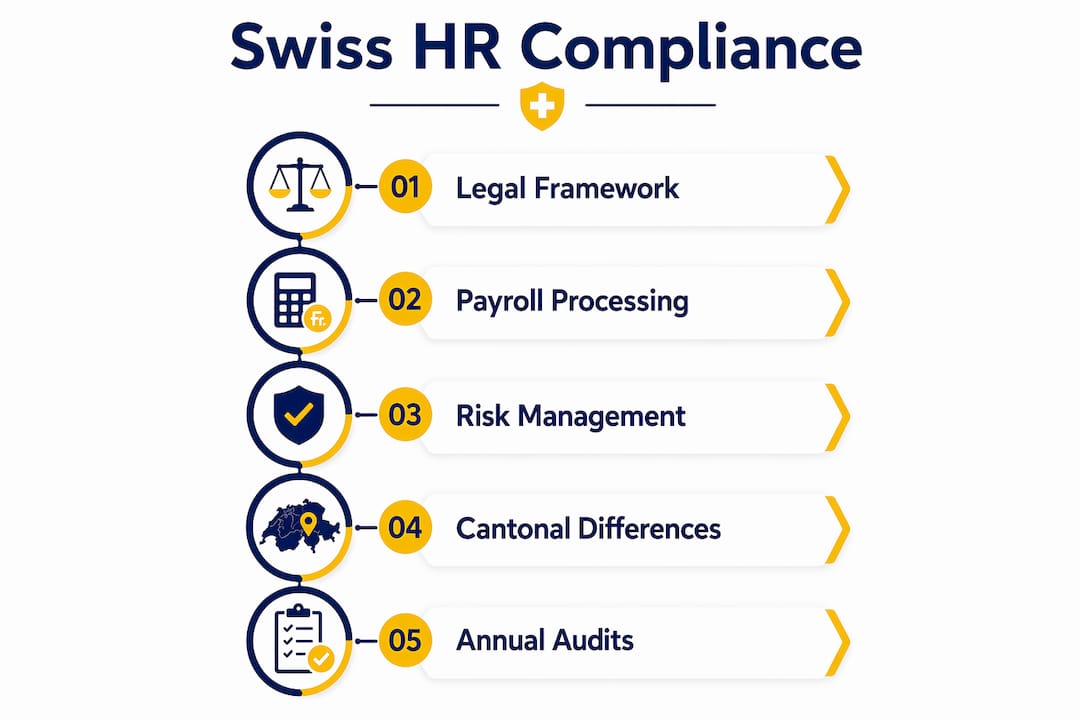
HR services in Switzerland require localized regulatory expertise, technology-supported payroll systems, and a strategic orientation that goes well beyond administrative task management.
Point | Details |
Regulatory complexity is the baseline | Switzerland’s 26 cantonal systems demand HR solutions built for local compliance, not generic international frameworks. |
Payroll is the highest-risk HR function | Swissdec certification, AHV/BVG accuracy, and cantonal reporting make payroll the most compliance-sensitive area of HR. |
Strategic HR drives retention | Swiss employees in 2026 prioritize emotional security and fairness over salary, requiring HR to lead culture and trust-building. |
Outsourcing offers real advantages | The CHF 2 to 3 billion HR outsourcing sector grows at 7% annually because specialist providers deliver compliance and cost efficiency. |
Compliance requires continuous monitoring | Annual contract audits, data privacy reviews, and payroll recalibrations are standard practice for compliant Swiss operations. |
Why most companies underestimate Swiss HR until it costs them
I have worked with dozens of international companies setting up Swiss operations, and the pattern is almost always the same. They invest heavily in legal entity formation, banking, and tax structuring. Then they treat HR as an afterthought, assuming it works like it does in Germany or the UK. It does not.
The cantonal layer is what catches people off guard. A company with employees in Zurich, Geneva, and Basel is effectively managing three different payroll environments simultaneously. The federal rules are the same, but the cantonal tax rates, social insurance nuances, and reporting deadlines diverge in ways that matter at year-end. I have seen companies face five-figure back-payment obligations simply because their payroll provider was not certified for all relevant cantons.
The other underestimated factor is employee expectations. Swiss workers do not respond well to HR practices imported wholesale from US or UK corporate culture. The 2026 Great Place to Work data showing that emotional security outranks salary is not surprising to anyone who has managed Swiss teams. Fairness, transparency, and long-term stability are what retain people here. HR services that fail to reflect those values produce turnover that is expensive and avoidable.
My honest assessment: companies that treat HR as a strategic function from day one in Switzerland outperform those that retrofit compliance later. The cost of getting it right upfront is a fraction of the cost of fixing it after an audit or a key employee departure.
— Rolands
Set up your Swiss company with integrated HR support from Rpcs

Rpcs combines Swiss company formation with the HR and payroll infrastructure your business needs from day one. Whether you are establishing a GmbH or AG structure, hiring your first Swiss employees, or managing cross-canton payroll compliance, Rpcs provides the local regulatory expertise and administrative support that international entrepreneurs and investors rely on. From legal documentation and banking setup to ongoing HR compliance and accounting services, Rpcs positions your Swiss operation for long-term stability. Foreign companies entering Switzerland do not need to learn the system from scratch. Rpcs already knows it.
FAQ
What is the role of HR services in Switzerland?
HR services in Switzerland manage recruitment, payroll, benefits, employee relations, and compliance with federal and cantonal labor laws. They function as both an operational and strategic function, ensuring companies meet Swiss Code of Obligations requirements while building effective workforces.
How does HR outsourcing work in Switzerland?
HR outsourcing in Switzerland transfers payroll processing, compliance management, and administrative HR functions to a specialist provider. Companies benefit from local regulatory expertise and reduced overhead, while the provider handles Swissdec-certified payroll and cantonal reporting obligations.
Why is Swiss HR compliance more complex than other countries?
Switzerland’s 26 cantons each apply distinct tax rates and social insurance rules on top of federal labor law, creating a multi-layer compliance environment. A company with employees in multiple cantons must manage separate payroll configurations and reporting requirements for each location.
What are the essential HR practices for Swiss companies in 2026?
Essential HR practices include Swissdec-compliant payroll processing, employment contracts aligned with the Swiss Code of Obligations, BVG pension structuring, and employee experience programs that prioritize fairness and emotional security over compensation alone.
When should a foreign company use an Employer of Record in Switzerland?
An Employer of Record is the right model when a foreign company needs to hire Swiss employees before its local legal entity is fully established. It provides immediate legal hiring capability and transfers compliance liability to a specialist provider during the setup period.
Recommended
Comments