
The Role of Fiduciary in Company Formation in Switzerland
- Jun 10
- 9 min read

TL;DR:
A fiduciary in Swiss company formation is legally responsible for acting with loyalty and care throughout the incorporation process, impacting every step from name verification to registration. Their early involvement reduces procedural errors, delays, and legal risks for foreign investors unfamiliar with local laws and regulations. Fiduciary duties attach from the moment authority is assumed, making professional guidance essential before or during initial decision-making stages.
A fiduciary in company formation is a legally designated party obligated to act with undivided loyalty and informed care on behalf of the company and its stakeholders throughout the incorporation process. In Switzerland, this role is not a formality. It carries direct legal weight across every stage of Swiss company formation, from verifying the business name in cantonal registers to coordinating notarization and opening a corporate bank account. For foreign investors and entrepreneurs who lack local knowledge, understanding the role of fiduciary in company formation is the difference between a smooth GmbH or AG registration and a process derailed by avoidable legal errors.
What fiduciary duties apply during company formation and incorporation?
Fiduciary duties in business are grounded in two core obligations: the duty of loyalty and the duty of care. Both apply from the moment a fiduciary assumes authority over incorporation decisions, regardless of whether a formal contract has been signed. Duties attach by authority level, not just paperwork. This means a founding director who begins making decisions on behalf of the company is already bound by fiduciary standards.
The duty of loyalty requires the fiduciary to place the company’s interests above personal gain. In practice, this means disclosing conflicts of interest, avoiding self-dealing transactions, and refusing to benefit from information obtained through the fiduciary role. The duty of loyalty violations like self-dealing are judged more severely than lapses in care. Swiss courts treat undisclosed conflicts during incorporation as grounds for personal liability and, in serious cases, removal from the directorship.
The duty of care requires fiduciaries to make decisions with the diligence of a reasonably informed person in the same position. During incorporation, this translates to reviewing all legal documents before signing, understanding the implications of the share structure, and confirming that the company’s registered address meets Swiss legal requirements. A fiduciary who rubber-stamps documents without review has breached this duty.
Key fiduciary responsibilities during Swiss incorporation include:
Conflict disclosure: Declaring any personal financial interest in suppliers, service providers, or co-founders involved in the setup
Informed consent: Reviewing and understanding articles of association, shareholder agreements, and notarial deeds before execution
Governance documentation: Maintaining records of decisions made during the formation phase, including board resolutions and capital contributions
Regulatory compliance: Confirming that the company structure satisfies Swiss Code of Obligations requirements for GmbH or AG formation
Pro Tip: Document every decision made during the pre-registration phase. Swiss courts treat undocumented founder decisions as potential breaches of the duty of care, especially in later disputes over share ownership or capital contributions.
How do fiduciaries facilitate the practical steps of Swiss company formation?
The practical value of a fiduciary during incorporation goes well beyond legal compliance. Early fiduciary involvement significantly reduces the risk of procedural errors and incorporation delays in Switzerland. For a foreign investor setting up a GmbH from abroad, a fiduciary manages the entire sequence of tasks that Swiss law requires before the company can be registered in the Commercial Register.
The incorporation sequence in Switzerland follows a specific order, and errors at any step require restarting from that point. A qualified fiduciary manages this sequence as follows:
Company name verification: The fiduciary checks the proposed name against both cantonal and federal commercial registers to confirm uniqueness and compliance with Swiss naming rules. Pre-incorporation name checks prevent registration rejection due to name conflicts or missing residency documents.
Tax residency validation: For foreign founders, the fiduciary verifies tax residency status to satisfy Swiss banking and regulatory requirements before the bank account is opened.
Notarization coordination: Swiss law requires a public notary to authenticate the articles of association and the founding declaration. The fiduciary prepares all documents to the notary’s specifications, reducing the risk of rejection.
Corporate bank account setup: A Swiss GmbH or AG requires a blocked capital account before registration can be completed. The fiduciary coordinates business bank account opening with a Swiss bank, submitting the required KYC documentation and company formation documents.
Commercial Register filing: After notarization and capital deposit confirmation, the fiduciary submits the registration application to the relevant cantonal Commercial Register office.
Post-registration compliance: The fiduciary confirms VAT registration obligations, social insurance enrollment, and initial accounting setup.
Fiduciary expertise reduces setup time and avoids legal pitfalls in complex regulatory environments like Switzerland’s. For a foreign investor unfamiliar with Swiss cantonal differences, this expertise is not optional. It is the mechanism that makes incorporation possible within a predictable timeframe.
Pro Tip: Ask your fiduciary to provide a written timeline with milestones before engagement begins. Swiss incorporation typically takes two to four weeks when all documents are in order. Any fiduciary who cannot give you a milestone schedule is a red flag.

What are common misconceptions about fiduciary roles in early formation stages?
The most costly misconception among startup founders is that fiduciary duties do not apply until the company is officially registered. Fiduciary obligations apply throughout startup growth, requiring governance diligence from the earliest stages. A founder who makes capital allocation decisions, recruits co-founders, or negotiates supplier contracts before registration is already operating under fiduciary standards in Swiss law.
A second misconception is that only formally appointed directors carry fiduciary exposure. In Switzerland, nominee directors, resident directors, and even de facto directors (individuals who act as directors without formal appointment) can be held to fiduciary standards. Disclosure failures, conflicts of interest, and lack of governance can stall deals and increase litigation risk, regardless of whether the person holds an official title.
Common misconceptions that create legal exposure include:
“Fiduciary duties start at signing.” Swiss courts have found fiduciary liability in pre-incorporation conduct, particularly where founders made binding commitments on behalf of the company before it existed legally.
“Nominee directors have no real liability.” A nominee director who signs documents without understanding their content can be personally liable for misrepresentation or regulatory non-compliance.
“Conflicts of interest only matter after funding.” Undisclosed conflicts during the formation phase, such as a founder directing incorporation work to a company they own, are treated as loyalty breaches from day one.
“The company secretary is just administrative.” In Switzerland, the company secretary carries fiduciary responsibilities for regulatory filings and record-keeping accuracy.
For foreign investors, the Swiss corporate governance framework adds another layer of complexity. Swiss law does not distinguish between resident and non-resident founders when assigning fiduciary liability. A foreign investor who appoints a local nominee director but retains operational control may be treated as a de facto director with full fiduciary exposure.
Comparing fiduciary roles: resident director, nominee director, and company secretary
Switzerland’s company formation framework recognizes three distinct fiduciary roles, each with different responsibilities, liabilities, and practical functions. Understanding the differences is critical before you decide which structure fits your situation.
The company secretary role in Switzerland is a fiduciary position focused on regulatory compliance, documentation accuracy, and filing deadlines. Secretaries do not make strategic decisions but carry liability for errors in official filings.
Role | Primary function | Liability exposure | Typical use case |
Swiss resident director | Legal signatory and compliance officer; must be Swiss-resident | High. Full personal liability for regulatory breaches | Foreign companies requiring a local director for GmbH or AG registration |
Nominee director | Provides name and signature for registration; minimal operational involvement | Moderate. Liable for documents signed without due diligence | Investors seeking privacy or simplified local representation |
Company secretary | Manages filings, minutes, and regulatory documentation | Lower but real. Liable for filing errors and missed deadlines | All Swiss companies requiring ongoing compliance management |
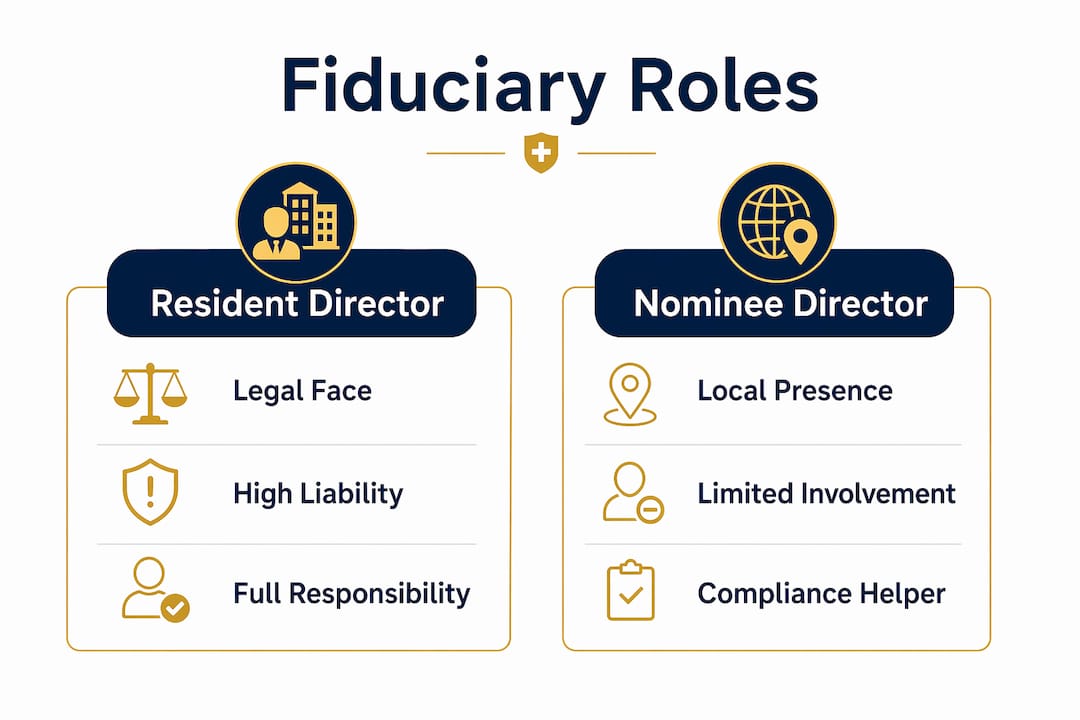
Swiss resident directors carry the heaviest fiduciary burden. They are the legal face of the company in Switzerland and are personally accountable to the Commercial Register, tax authorities, and social insurance bodies. A resident director who fails to file annual accounts or ignores a tax notice cannot claim ignorance as a defense.
Nominee directors serve a different purpose. They provide a local presence for registration without deep operational involvement. The critical risk is that a nominee who signs documents without reading them is not protected by their limited role. Swiss law holds signatories to the content of what they sign.
For foreign investors setting up a GmbH or AG, the most practical structure combines a Swiss resident director for legal compliance with a company secretary for ongoing documentation. This division of fiduciary labor reduces individual liability exposure while maintaining full regulatory compliance.
Key takeaways
Fiduciary duties in Swiss company formation are legally binding from the moment authority is assumed, not from the date of official registration, making early engagement with qualified fiduciaries the single most effective way to protect founders and investors.
Point | Details |
Duties begin before registration | Fiduciary obligations attach to authority and trust, not to signed contracts or formal appointments. |
Practical tasks require fiduciary expertise | Name checks, notarization, capital account setup, and Commercial Register filing all carry legal risk without professional oversight. |
Misconceptions create personal liability | Founders who believe duties start at signing expose themselves to pre-incorporation liability under Swiss law. |
Three roles carry distinct exposure | Resident directors, nominee directors, and company secretaries each carry different fiduciary liabilities requiring separate risk assessment. |
Early involvement shortens setup time | Fiduciaries who manage the full incorporation sequence reduce delays caused by document errors, name conflicts, and banking requirements. |
Why I tell every foreign founder to engage a fiduciary before they think they need one
Most founders I work with come to the fiduciary conversation too late. They have already chosen a company name without checking the federal register, made verbal commitments to co-founders, or signed a lease for office space in the company’s name before the company legally exists. Each of those actions creates fiduciary exposure they did not know they had.
The uncomfortable reality is that Swiss incorporation law does not reward good intentions. It rewards documented, compliant process. A founder who moves fast and fixes things later will find that Swiss courts and the Commercial Register do not accommodate retroactive corrections easily. I have seen incorporation processes delayed by six weeks because a company name was too similar to an existing entry, a problem a ten-minute pre-flight check would have caught.
The other thing I consistently observe is that entrepreneurs underestimate the value of the resident director role. Many foreign investors treat it as a bureaucratic checkbox. It is not. A qualified Swiss resident director who understands their fiduciary duties is your primary legal shield in Switzerland. They are the person whose name appears on official correspondence, whose signature validates regulatory submissions, and who absorbs personal liability if compliance fails. Choosing that person based on cost alone is one of the most expensive decisions a foreign founder can make.
My advice is direct: engage your fiduciary at the idea stage, not the paperwork stage. The cost of early involvement is a fraction of the cost of correcting a flawed incorporation. And in Switzerland, where the regulatory environment rewards precision, that difference matters more than in almost any other jurisdiction.
— Rolands
How Rpcs helps entrepreneurs get fiduciary support right from day one

Rpcs provides foreign entrepreneurs and investors with end-to-end support for Swiss company formation, including fiduciary management, resident and nominee director services, notarization coordination, and corporate bank account facilitation. The platform is built specifically for international clients who need Swiss legal compliance without the complexity of navigating cantonal regulations independently. Rpcs also covers ongoing fiduciary responsibilities through Swiss accounting services and registered address solutions, giving founders a single point of accountability from incorporation through ongoing operations. If you are forming a GmbH or AG in Switzerland and need qualified fiduciary support, Rpcs is structured to reduce your setup time and legal exposure from the first step.
FAQ
What is a fiduciary in company formation?
A fiduciary in company formation is a party legally obligated to act in the best interests of the company and its stakeholders during incorporation. This includes duties of loyalty and care covering decisions on share structure, notarization, and regulatory compliance.
When do fiduciary duties begin in a Swiss startup?
Fiduciary duties begin when a person assumes authority over company decisions, not when formal documents are signed. Swiss courts have found fiduciary liability in pre-incorporation conduct where founders made binding commitments before registration.
What is the difference between a nominee director and a resident director in Switzerland?
A Swiss resident director is a locally based signatory with full legal compliance responsibility and high personal liability. A nominee director provides a local presence for registration with limited operational involvement but remains liable for documents they sign.
Can a foreign investor be held to fiduciary standards in Switzerland?
Yes. Swiss law does not distinguish between resident and non-resident founders when assigning fiduciary liability. A foreign investor who retains operational control over a Swiss company may be treated as a de facto director with full fiduciary exposure.
How does a fiduciary speed up Swiss company registration?
A fiduciary manages the full incorporation sequence, including name verification, tax residency checks, notarization preparation, and bank account coordination. Managing these steps professionally typically saves weeks compared to founders navigating the process independently.
Recommended
Comments