
The Role of Due Diligence in Switzerland: 2026 Guide
- May 30
- 9 min read

TL;DR:
The 2026 Swiss Corporate Sustainability Act expands due diligence requirements beyond conflict minerals to include human rights and environmental risks. Companies exceeding specific size thresholds must implement ongoing risk management, reporting, and remediation processes to operate legally and competitively. Non-compliance risks severe fines, civil liability, reputational damage, and ripple effects across supply chains.
Most entrepreneurs entering Switzerland assume the role of due diligence in Switzerland is limited to a narrow checklist: conflict minerals, child labor, maybe some financial review. That assumption is now dangerously outdated. The 2026 Swiss Corporate Sustainability Act has fundamentally expanded what due diligence means for companies operating here, and the stakes for non-compliance have grown sharply. Whether you are forming a new Swiss company or managing an existing one, understanding what due diligence in Swiss business now requires is not optional. It is the foundation of operating legally and competitively in one of the world’s most demanding regulatory environments.
Table of Contents
Key Takeaways
Point | Details |
Due diligence scope expanded | The 2026 Swiss Corporate Sustainability Act extends obligations far beyond conflict minerals to human rights and environmental risks. |
Thresholds determine your exposure | Companies exceeding 5,000 employees or CHF 1.5 billion turnover face the strictest new obligations under the proposed law. |
Continuous monitoring is required | Swiss law treats due diligence as an ongoing compliance cycle, not a one-time assessment. |
EU alignment reduces complexity | The Swiss framework mirrors EU CSDDD and CSRD directives, easing compliance for internationally active businesses. |
Non-compliance carries real costs | Sanctions can reach 3% of global turnover, plus civil liability for parent companies and subsidiaries. |
The role of due diligence in Switzerland: what the law actually says
Most people’s understanding of Swiss due diligence starts and stops with a 2022 law. The Swiss Code of Obligations, specifically Articles 964j through 964l, introduced sector-specific requirements focused on conflict minerals and child labor. Those provisions require companies sourcing tin, tungsten, tantalum, gold, or similar materials from conflict-affected regions to conduct documented risk assessments and public reporting.
That initial framework was deliberately narrow. It came out of Switzerland’s political compromise following the failure of the Responsible Business Initiative, a 2020 referendum that would have imposed sweeping human rights and environmental obligations on Swiss companies worldwide. The counterproposal that passed instead created targeted rules rather than a broad liability regime. Sectors covered included:
Mineral and metal sourcing from conflict zones
Supply chains with credible risk of child labor
Companies above certain size thresholds in high-risk industries
The practical effect was that most Swiss companies, including many mid-size firms in finance, agriculture, and textiles, sat outside the compliance perimeter. That situation is changing fast.
What the 2026 Swiss Corporate Sustainability Act changes
The Federal Council launched consultation on the Swiss Corporate Sustainability Act on April 1, 2026, and the scope is substantially broader than anything in prior Swiss law. This is the most significant expansion of corporate due diligence obligations in Switzerland’s history.
Who falls under the new thresholds
The new act targets two distinct company categories:
Companies with more than 5,000 employees globally or CHF 1.5 billion in annual turnover are subject to full due diligence obligations covering systematic risk analysis, prevention, remediation, grievance mechanisms, and mandatory reporting.
Companies with more than 1,000 global employees and CHF 450 million in annual turnover face mandatory sustainability reporting with external audits, covering roughly 100 Swiss companies in initial estimates.
The Federal Council estimates the strictest tier applies to approximately 30 of Switzerland’s largest corporations. But sector-specific triggers mean the reach extends further. High-risk sectors including commodity trading, finance, textiles, and agriculture face due diligence scrutiny regardless of size, given Switzerland’s outsized global role in these industries.
What the obligations actually require
The due diligence process under the proposed Swiss law is not a single audit. It is a structured, repeating cycle that includes:
Risk identification. Map your entire value chain, including suppliers, subsidiaries, and business partners, to identify human rights and environmental risks.
Risk prioritization. Not all risks require equal attention. Companies must assess severity, likelihood, and their degree of contribution.
Prevention and remediation. Develop and implement concrete measures to prevent identified risks. Where harm has occurred, companies must remediate.
Grievance mechanisms. Establish accessible channels for employees, communities, and third parties to raise concerns.
Continuous monitoring. Verify that measures are working and update them as circumstances change.
Reporting. Publish annual due diligence reports subject to external audit, supervised by the Federal Audit and Sustainability Supervisory Authority (FASSA).
Obligation | Applies to (turnover/employees) | Deadline |
Full due diligence cycle | CHF 1.5B+ or 5,000+ employees | Under consultation 2026 |
Sustainability reporting + audit | CHF 450M+ or 1,000+ employees | Under consultation 2026 |
Conflict minerals/child labor rules | Sector-specific, any size | In force since 2022 |
Pro Tip: Don’t wait for the law to pass before building your compliance framework. Companies that start mapping supply chain risks now will be significantly better positioned when final thresholds are confirmed, and early documentation gives you a head start with FASSA auditors.
Swiss vs. EU frameworks: where they align and where they differ
The Swiss Corporate Sustainability Act is deliberately designed to track the EU’s two flagship sustainability directives: the Corporate Sustainability Due Diligence Directive (CSDDD) and the Corporate Sustainability Reporting Directive (CSRD). The Federal Council was explicit in its goal to achieve regulatory equivalence with the EU to reduce what critics call a “Swiss finish,” meaning stricter local rules that disadvantage Swiss companies against EU competitors.
Feature | Swiss CSA (proposed) | EU CSDDD |
Human rights scope | Yes, full value chain | Yes, full value chain |
Environmental scope | Yes | Yes |
Grievance mechanisms | Required | Required |
Civil liability | Yes, parent company | Yes |
Reporting obligation | Yes, external audit | CSRD handles reporting |
Supervisory authority | FASSA | Member state authorities |
For entrepreneurs and investors operating across borders, this alignment is genuinely good news. A company already compliant with CSDDD will find Swiss obligations largely familiar. The cross-jurisdictional compliance burden that has plagued internationally active businesses is reduced when frameworks converge rather than diverge.
That said, Switzerland’s approach retains some distinct features. The FASSA is a centralized federal authority with significant enforcement power, giving Swiss compliance a single point of accountability that the decentralized EU member-state approach lacks. For Swiss-based holding companies managing EU subsidiaries, understanding both frameworks simultaneously is now a practical necessity.
Practical steps for building your due diligence program
Getting this right requires more than good intentions. Here is how to build a program that actually holds up to regulatory scrutiny.

The first move is supply chain mapping. You cannot manage risks you have not identified. That means documenting every material supplier, subcontractor, and business partner connected to your Swiss entity. For commodity traders and manufacturers, this exercise often reveals exposure points that were invisible in prior years.
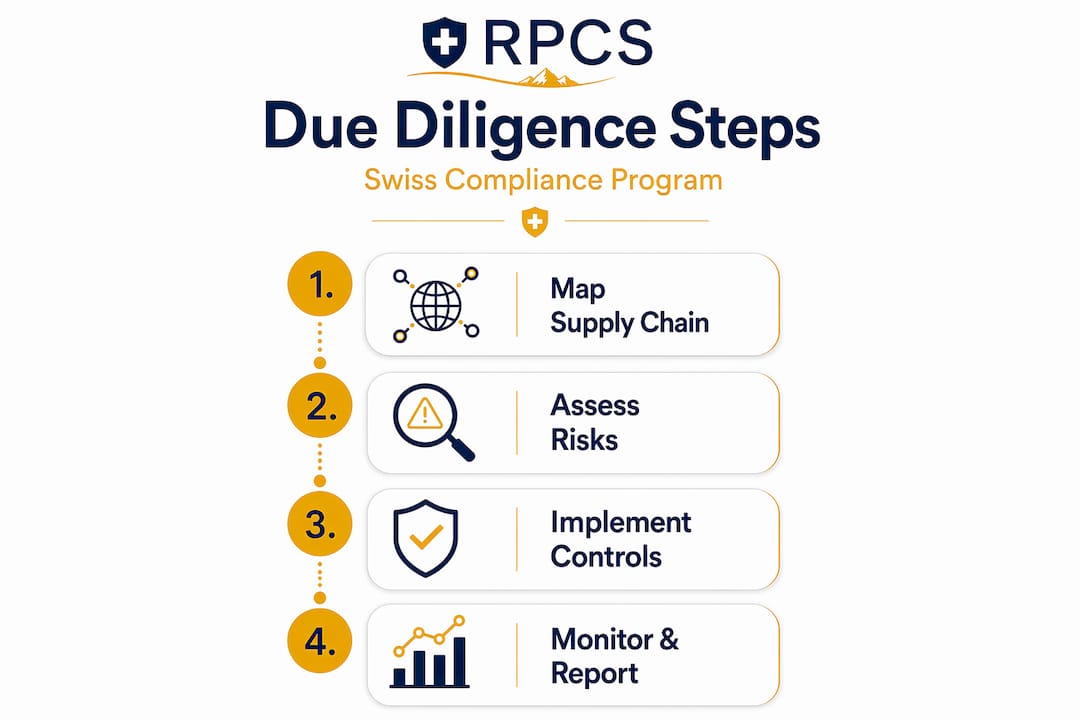
Second, develop a code of conduct for your supply chain partners. This is a contractual signal that your company takes human rights and environmental standards seriously, and it establishes a baseline for terminating relationships where partners refuse to comply.
Third, build grievance channels that are genuinely accessible. A complaints hotline buried in your website terms of service does not qualify. Effective mechanisms are multilingual, confidential, and actively communicated to workers and communities in affected regions.
Conduct risk assessments at regular intervals, not just once at contract signing
Document every finding, even risks you have decided are low priority, because FASSA auditors will look for evidence of deliberate prioritization
Assign internal ownership of due diligence functions to a named executive, not just a compliance team
Engage your legal counsel and accountants early, because financial due diligence investigations using forensic accounting can uncover hidden fraud patterns and corporate risks that standard reviews miss entirely
Review your Swiss corporate governance structure to confirm that parent company relationships are clearly documented, since liability can travel up the corporate chain
Pro Tip: Integrate due diligence into your existing enterprise risk management process rather than treating it as a separate compliance exercise. Companies that embed it into procurement, HR, and finance decisions respond to problems faster and produce better audit evidence.
Risks of getting it wrong
The importance of due diligence becomes very clear when you look at what non-compliance costs. The proposed Swiss law creates multiple liability channels that many entrepreneurs are not prepared for.
Under the new framework, parent companies can be held liable for damages caused by subsidiaries when those damages result from a failure to exercise proper due diligence. This reverses the traditional corporate veil logic that many holding structures were built around.
Financial sanctions. FASSA can impose fines reaching up to 3% of global annual turnover for serious violations. For a mid-size Swiss group with CHF 200 million in revenues, that is a CHF 6 million exposure.
Civil liability. Affected third parties can pursue damages in Swiss courts, with conciliation procedures required before litigation.
Audit failure consequences. Companies whose sustainability reports fail external audit by FASSA face corrective orders and potential public disclosure of non-compliance.
Reputational damage. Institutional investors, pension funds, and major corporate buyers now conduct ESG screening. A Swiss company on a public non-compliance register loses access to capital and partners.
Supply chain ripple effects. Larger in-scope companies will push due diligence obligations down to their suppliers. Even smaller Swiss firms outside the direct scope will face contractual pressure from their clients to demonstrate compliance.
The practical impact on Swiss corporate compliance planning cannot be overstated. A liability that reaches across corporate structures and national borders requires legal, financial, and operational attention simultaneously.
My perspective on Swiss due diligence
In my experience working with entrepreneurs entering Switzerland, the biggest compliance mistake I see is treating due diligence as a box to check before a deal closes rather than a living program. I have watched companies invest seriously in upfront assessments and then go silent for two years. By the time an issue surfaces, they have no documented evidence of monitoring, no remediation record, and no grievance logs. From a regulator’s perspective, that looks indistinguishable from doing nothing at all.
What I have learned is that the companies that come through due diligence reviews cleanly are not necessarily the ones with the most perfect supply chains. They are the ones that documented their thinking, showed evidence of continuous effort, and built governance structures where responsibility for risk sat with named people who could be held accountable.
My honest view on the 2026 expansion is that it is an opportunity, not just a burden. Early movers who build credible programs now will differentiate themselves to institutional investors, strategic partners, and regulators at the same time. Switzerland’s reputation as a stable, high-trust business environment is exactly the asset these companies can protect and profit from.
— Rolands
How Rpcs can support your Swiss compliance journey
Setting up a Swiss company with due diligence readiness built in from day one is far less costly than retrofitting compliance into an existing structure. Rpcs offers Swiss company formation services tailored for international entrepreneurs who need proper corporate structures, legal documentation, and governance frameworks aligned with Swiss regulatory expectations from the start. Beyond formation, Rpcs provides ongoing accounting and sustainability reporting support, giving you the financial documentation trail that FASSA auditors will expect. If you need to open a Swiss bank account that meets current AML and KYC standards, Rpcs handles the full setup process, including documentation and compliance verification. Whether you are entering Switzerland for the first time or tightening an existing structure, Rpcs brings the local expertise to protect your investment.
FAQ
What is due diligence in Switzerland?
Due diligence in Switzerland refers to the legal and corporate obligation to identify, prevent, and report on human rights and environmental risks across a company’s value chain. Since 2022, specific rules have applied to conflict minerals and child labor; broader obligations are now expanding under the 2026 Corporate Sustainability Act.
Which companies does the new Swiss due diligence law affect?
The proposed 2026 Swiss Corporate Sustainability Act applies full due diligence obligations to companies exceeding 5,000 employees or CHF 1.5 billion in turnover, with sustainability reporting requirements applying at 1,000 employees or CHF 450 million turnover. High-risk sector companies face additional scrutiny regardless of size.
What penalties apply for Swiss due diligence violations?
Non-compliant companies face fines up to 3% of global annual turnover, civil liability for damages caused by subsidiaries, mandatory corrective orders from FASSA, and potential public disclosure of violations, all of which carry serious reputational consequences.
How does Swiss due diligence align with EU rules?
The Swiss Corporate Sustainability Act is designed to align with the EU’s CSDDD and CSRD directives, covering the same core obligations on human rights and environmental due diligence. This alignment reduces the compliance burden for companies operating across both Swiss and EU jurisdictions simultaneously.
How often must Swiss companies conduct due diligence assessments?
Swiss law treats due diligence as a continuous cycle rather than an annual event. Companies must conduct ongoing risk identification, monitoring, and reporting throughout the year, with formal external audit of sustainability reports required for companies meeting the applicable thresholds.
Recommended
Comments