
Switzerland Crypto Incorporation Guide: Launch Seamlessly
- Rolands Plotnieks
- 7 hours ago
- 7 min read

Launching a crypto company in Switzerland means more than just embracing innovation. International crypto entrepreneurs face a maze of local legal requirements and shifting global standards that can quickly stall progress without the right guidance. Switzerland’s reputation for regulatory clarity and favorable tax conditions attracts ambitious founders, but success hinges on a clear understanding of compliance protocols and company structures that satisfy both Swiss and international authorities.
Table of Contents
Quick Summary
Key Point | Explanation |
1. Choose the Right Structure | Select between a Limited Liability Company or Stock Corporation for optimal compliance and funding options in Switzerland. |
2. Prepare Thorough Documentation | Ensure legal documents meet regulatory standards by including articles of incorporation and compliance policies critical for business protection. |
3. Navigate the Registration Process | Complete necessary submissions to the commercial registry and financial authorities; be prepared for detailed scrutiny especially for crypto firms. |
4. Understand Banking Requirements | Prepare extensive documentation for opening a bank account; Swiss banks will conduct rigorous compliance checks specifically for crypto businesses. |
5. Verify Compliance Before Launch | Conduct thorough reviews of compliance documentation and risk management strategies with regulatory authorities prior to business activation. |
Step 1: Assess crypto company requirements and structure
Assessing the right company structure is critical for successfully launching your Swiss crypto venture. Your goal in this stage is to strategically evaluate the legal and regulatory frameworks that best suit your specific blockchain or cryptocurrency business model.
Starting with regulatory considerations, the global crypto regulatory landscape demands careful navigation. Switzerland offers a progressive environment, but you must align your company structure with both local and international compliance requirements. Key factors include understanding authorization protocols, establishing robust governance structures, and ensuring your business meets financial regulatory standards.
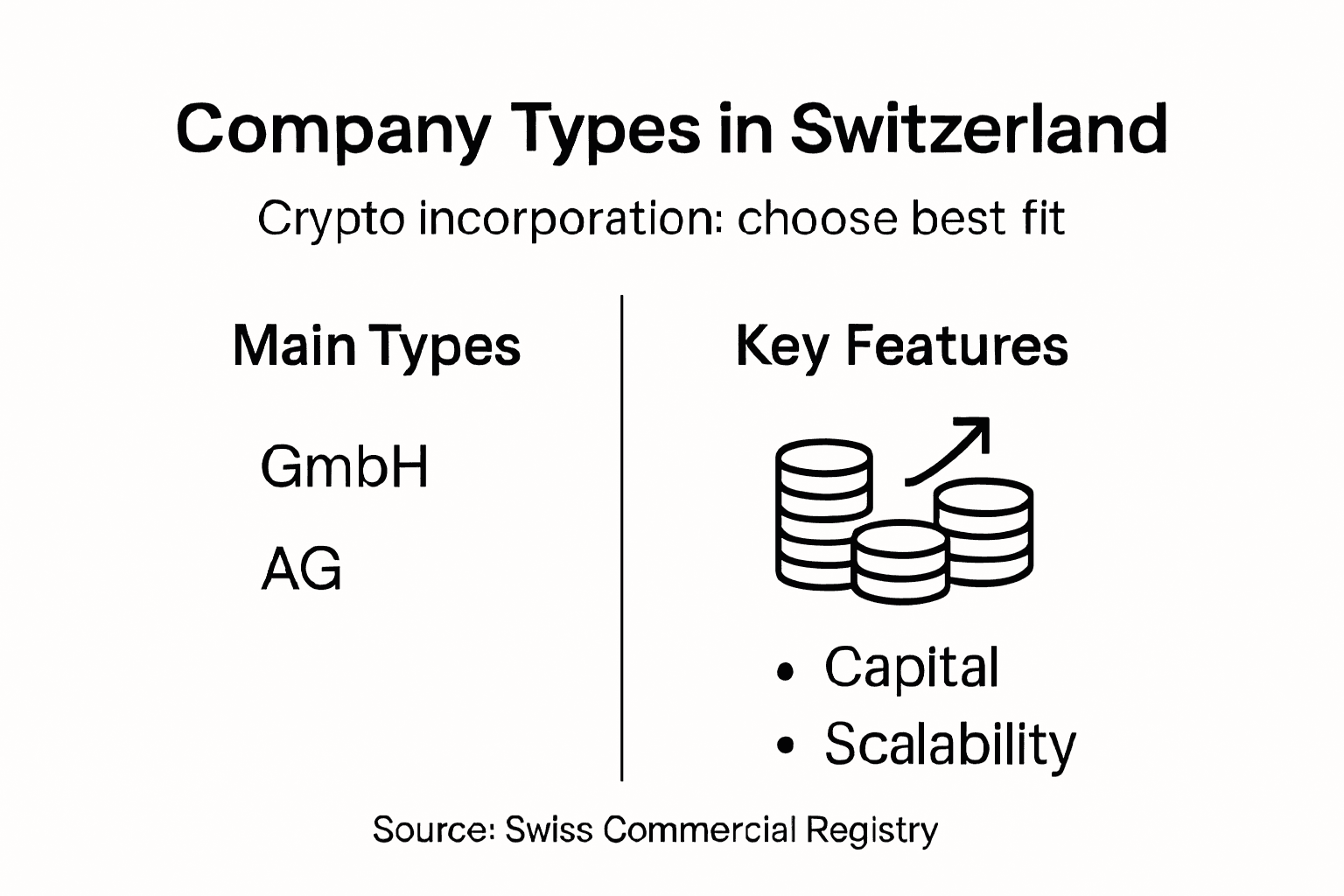
Typically, crypto companies in Switzerland can choose between two primary structures: a Limited Liability Company (GmbH) or a Stock Corporation (AG). Each has distinct advantages based on capital requirements, operational flexibility, and investor expectations. A GmbH works well for smaller teams with lower initial capital, while an AG provides more scalability and credibility for larger crypto projects seeking substantial investment.
Here’s a comparison of GmbH and AG company structures for Swiss crypto businesses:
Company Type | Minimum Capital Required | Investor Appeal | Scalability |
GmbH | CHF 20,000 | Moderate | Suitable for small teams |
AG | CHF 100,000 | High | Supports large projects |
Pro tip: Consider consulting a Swiss legal specialist who understands blockchain regulations to help you select the most appropriate company structure for your specific crypto business model.
Step 2: Prepare legal documents and compliance checks
Preparing legal documents and conducting thorough compliance checks are essential steps in establishing a legally sound crypto company in Switzerland. Your objective is to create a robust documentation framework that demonstrates regulatory adherence and protects your business interests.

The global regulatory framework for crypto assets requires comprehensive documentation that addresses governance, risk management, and transparency. This involves preparing key legal documents such as articles of incorporation, shareholder agreements, compliance policy manuals, and detailed risk assessment reports. You will need to demonstrate comprehensive disclosure and governance protocols that align with Swiss financial regulations and international standards.
Specifically, your documentation should cover areas like anti money laundering (AML) policies, know your customer (KYC) procedures, operational risk management strategies, and internal control mechanisms. Engage a Swiss legal professional specializing in blockchain and crypto regulations to review and validate your documentation to ensure it meets all regulatory requirements and provides a solid legal foundation for your business.
This table summarizes key compliance areas critical during Swiss crypto company setup:
Compliance Area | Importance | Type of Documentation |
Anti-Money Laundering | Ensures legal transactions | AML policies, audit reports |
Know Your Customer | Verifies client identity | KYC records, client ID checks |
Risk Management | Reduces operational risks | Risk assessments, internal controls |
Pro tip: Maintain digital and physical copies of all compliance documents in a secure, organized system and schedule regular reviews to ensure ongoing regulatory alignment.
Step 3: Register your Swiss crypto company successfully
Registering your Swiss crypto company requires careful navigation of regulatory requirements and precise documentation. Your primary goal is to transform your business concept into a legally recognized entity that meets all Swiss corporate and financial regulations.
The Swiss regulatory registration process involves comprehensive stakeholder assessments and detailed compliance evaluations. You will need to submit multiple documents to the commercial registry, including validated articles of incorporation, proof of initial capital, identification documents for directors, and a detailed business plan demonstrating your crypto venture’s operational strategy. Each document must precisely align with Swiss corporate law and reflect the global regulatory framework for crypto activities.
Specifically, your registration will require engagement with multiple government agencies including the commercial registry, financial market supervisory authority (FINMA), and local cantonal authorities. Prepare for potential additional scrutiny specific to crypto businesses, such as demonstrating robust anti money laundering protocols, transparent ownership structures, and clear risk management strategies. Working with a Swiss legal specialist who understands both corporate law and crypto regulations can significantly streamline this complex registration process.
Pro tip: Allocate additional time and resources for your crypto company registration, as regulatory requirements can be more intricate compared to traditional business structures.
Step 4: Open a Swiss bank account for crypto operations
Opening a Swiss bank account for your crypto operations requires strategic preparation and understanding of the complex regulatory landscape. Your objective is to establish a secure financial foundation that meets both Swiss banking standards and international crypto regulatory requirements.
The Swiss banking regulatory framework demands comprehensive documentation and rigorous compliance checks for crypto businesses. You will need to prepare an extensive application package including detailed business plans, proof of origin of funds, comprehensive KYC documentation, transparent ownership structures, and robust anti money laundering protocols. Swiss banks are particularly meticulous when evaluating crypto financial service providers, requiring demonstrable financial stability and clear operational transparency.
To successfully navigate this process, you must collaborate closely with a Swiss banking specialist who understands the nuanced requirements for crypto enterprises. Expect an intensive due diligence process that may include multiple rounds of interviews, financial audits, and detailed reviews of your company’s technological infrastructure and risk management strategies. Select a bank with proven experience in crypto and blockchain sectors to increase your chances of a smooth account opening.
Pro tip: Prepare a comprehensive digital and physical documentation portfolio in advance, and consider engaging a Swiss legal consultant to help streamline your banking application process.
Step 5: Verify legal compliance and activate your business
Verifying legal compliance represents the critical final stage of establishing your Swiss crypto enterprise. Your primary objective is to confirm that your business meets all regulatory requirements before officially launching operations and becoming fully functional.
The global regulatory framework for crypto activities demands rigorous verification processes that encompass comprehensive risk management and legal documentation reviews. You will need to submit detailed compliance documentation to relevant Swiss authorities including FINMA (Financial Market Supervisory Authority), demonstrating robust anti money laundering protocols, transparent ownership structures, and comprehensive operational risk mitigation strategies. Compliance verification processes will assess your company’s governance mechanisms, technological infrastructure, and ability to meet international financial regulatory standards.
This verification stage involves multiple potential interactions with regulatory bodies who will scrutinize your business model, financial projections, technological capabilities, and overall risk management approach. Expect thorough interviews, potential onsite inspections, and requests for additional documentation. Work closely with a Swiss legal expert specializing in crypto regulations to navigate this complex process and address any potential compliance gaps effectively.
Pro tip: Maintain extremely detailed and organized documentation throughout the verification process, and be prepared to provide immediate supplementary information to expedite your compliance review.
Launch Your Swiss Crypto Company with Confidence and Expert Support
Navigating the complex regulatory environment and detailed compliance requirements of Swiss crypto incorporation can feel overwhelming. From selecting the right company structure such as GmbH or AG to preparing all necessary legal documents and securing a Swiss bank account your challenges demand a trusted partner who understands every nuance of Swiss corporate law and crypto regulations. Avoid costly delays and regulatory pitfalls by leveraging professional guidance tailored to your unique cryptocurrency business model.

Discover how rpcs.ch simplifies your entire Swiss crypto company formation journey with comprehensive services spanning company setup, notarization, registration, and ongoing compliance management. Access expert legal support, seamless banking arrangements, and administrative solutions designed specifically for international crypto entrepreneurs. Take control of your venture now and benefit from Switzerland’s unmatched business stability and credibility. Learn more about launching your crypto venture with confidence at rpcs.ch and start your incorporation process today.
Frequently Asked Questions
What company structure should I choose for my crypto business in Switzerland?
Choosing the right company structure is crucial for your cryptocurrency venture. Typically, you can select between a Limited Liability Company (GmbH) with a minimum capital of CHF 20,000 or a Stock Corporation (AG) requiring CHF 100,000. Evaluate your capital needs and investor expectations to make an informed choice.
What legal documents are necessary to establish a crypto company in Switzerland?
To legally establish a crypto company, you will need several key documents, including articles of incorporation, compliance policy manuals, and risk assessment reports. Prepare these documents meticulously to demonstrate regulatory adherence and protect your business interests.
How do I register my crypto company in Switzerland?
Registering your crypto company involves submitting essential documents like articles of incorporation, proof of initial capital, and a detailed business plan to the commercial registry. Allocate sufficient time and resources to navigate regulatory requirements and ensure your application meets legal standards.
What steps are involved in opening a Swiss bank account for crypto operations?
Opening a Swiss bank account requires preparing a comprehensive application package that includes a detailed business plan, proof of origin of funds, and robust anti-money laundering protocols. Collaborate with a bank familiar with crypto enterprises to streamline the account opening process.
How can I verify my legal compliance before launching my crypto business?
Verifying your legal compliance involves submitting detailed documentation to Swiss authorities, such as FINMA, showcasing your anti-money laundering protocols and risk management strategies. Maintain organized records and be ready for potential regulatory inquiries to expedite your compliance verification.
What should I do if I encounter compliance gaps during the incorporation process?
If you find compliance gaps, work closely with a legal expert who specializes in crypto regulations. Address any deficiencies promptly to ensure that your business meets all regulatory requirements before launch.
Recommended