
Swiss Financial Reporting Explained: Key Compliance Insights
- Jan 19
- 8 min read

Setting up a business in Switzerland brings exciting prospects for international entrepreneurs, but managing Swiss financial reporting can quickly become a complex process without the right guidance. With distinct rules for GmbH and AG entities, business owners must choose between standards like Swiss GAAP FER and IFRS to achieve a true and fair view in their statements. Understanding these obligations helps you avoid compliance pitfalls and safeguard your company’s reputation from the very start.
Table of Contents
Key Takeaways
Point | Details |
Understanding Reporting Standards | Companies in Switzerland must choose between Swiss GAAP FER and IFRS based on their size and stakeholder needs. |
Annual Statement Preparation | Comprehensive annual statements must be submitted within specified timeframes, ensuring accurate financial representation. |
Audit Requirements | Audit obligations vary; smaller companies may be exempt while larger entities require rigorous external auditing. |
Compliance Best Practices | Engage a local Swiss accounting professional and maintain robust internal controls to mitigate compliance risks. |
Swiss Financial Reporting Basics for GmbH and AG
Swiss financial reporting for GmbH and AG companies requires understanding specific accounting standards and regulatory requirements. Companies must choose between Swiss GAAP FER and IFRS standards based on their organizational size and stakeholder needs, ensuring transparent and accurate financial documentation.
The two primary business structures in Switzerland - GmbH (Limited Liability Company) and AG (Stock Corporation) - have distinct financial reporting obligations. Annual financial statements must provide a comprehensive and true representation of the company’s financial position, including detailed balance sheets, income statements, and cash flow reports. These documents require precise preparation following Swiss accounting regulations, which prioritize accuracy and comprehensive disclosure.
For foreign entrepreneurs establishing Swiss companies, understanding compliance is critical. The reporting process involves preparing financial statements according to either Swiss GAAP FER (primarily used by smaller and medium enterprises) or International Financial Reporting Standards (IFRS) for larger, internationally oriented organizations. Key reporting requirements include maintaining accurate accounting records, preparing annual financial statements within six months of the fiscal year end, and ensuring independent auditing for certain company sizes and structures.
Pro tip: Engage a local Swiss accounting professional familiar with GmbH and AG reporting requirements to ensure full regulatory compliance and minimize potential reporting errors.
The following table summarizes key differences between Swiss GmbH and AG financial reporting requirements:
Aspect | GmbH (Limited Liability Company) | AG (Stock Corporation) |
Typical company size | Small to medium enterprises | Medium to large, including public |
Audit obligations | Often exempt if below thresholds | Mandatory for most, external audit |
Reporting standard | Usually Swiss GAAP FER | Swiss GAAP FER or IFRS (if large) |
Filing deadlines | 4-6 months after fiscal year end | 4-6 months after fiscal year end |
Stakeholder focus | Owners, local partners | Investors, international markets |
Legal Framework Governing Swiss Financial Reports
The legal framework for Swiss financial reporting is comprehensive and structured, primarily governed by Swiss GAAP FER standards which establish foundational accounting principles. These standards mandate that companies provide meaningful, transparent, and accurate financial documentation across various business structures, including GmbH and AG entities.

Under Swiss law, financial reporting must adhere to principle-based guidelines that ensure a true and fair view of a company’s financial position. The framework established by expert commissions defines specific requirements for preparing annual financial statements, including detailed disclosure rules, accounting recognition criteria, and valuation methods. Companies must follow precise regulations that support comparability and compliance with national accounting standards.
Foreign entrepreneurs must understand that the Swiss financial reporting legal framework is designed to protect stakeholder interests through rigorous documentation and transparency requirements. The reporting standards differ based on company size and type, with smaller enterprises typically following Swiss GAAP FER guidelines, while larger, internationally oriented organizations may utilize International Financial Reporting Standards (IFRS). Key legal considerations include maintaining accurate accounting records, preparing comprehensive annual reports, and submitting these documents within specified timeframes.
Pro tip: Consult with a Swiss accounting specialist to ensure your financial reporting fully complies with the nuanced legal requirements specific to your company’s structure and size.
Required Annual Statements and Filing Process
Swiss companies must prepare comprehensive annual statements according to strict regulations, which form the backbone of financial transparency and regulatory compliance. These mandatory documents include a detailed balance sheet, income statement, and accompanying explanatory notes that must be meticulously prepared and submitted within specified timeframes.
The filing process involves several critical steps for business entities. Companies must submit their annual financial statements to the commercial register, with specific requirements varying based on company size and structure. Smaller companies benefit from more relaxed audit thresholds, while larger organizations face more rigorous reporting standards. The documents must provide a comprehensive and accurate representation of the company’s financial health, including detailed breakdowns of assets, liabilities, revenues, and expenses.
For foreign entrepreneurs, understanding the nuanced filing requirements is crucial. Different company types (GmbH and AG) have varying reporting obligations, with timelines typically ranging from four to six months after the fiscal year end. Key considerations include maintaining precise accounting records, preparing comprehensive annual reports, and ensuring all documentation meets Swiss Code of Obligations standards. Failure to comply can result in significant penalties, including potential legal and financial repercussions.
Pro tip: Engage a local Swiss accounting professional well in advance of filing deadlines to ensure full compliance and avoid potential reporting complications.
Key Accounting Standards Used in Switzerland
Switzerland utilizes multiple accounting standards that provide comprehensive frameworks for financial reporting, with accounting standards for foreign entities playing a crucial role in international business compliance. The primary standards include Swiss GAAP FER (Fachempfehlungen zur Rechnungslegung) for domestic companies and International Financial Reporting Standards (IFRS) for larger, internationally oriented organizations.
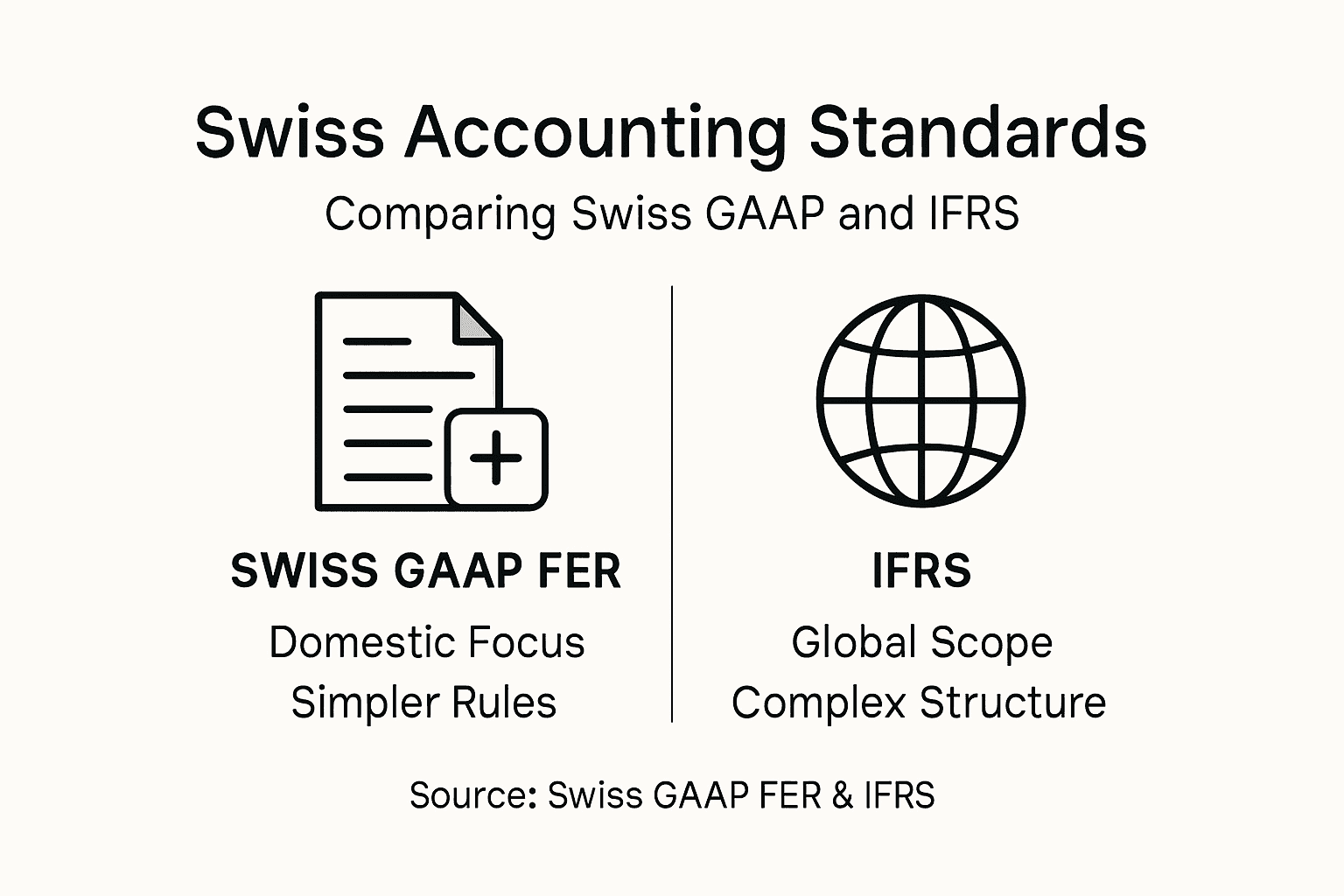
The Swiss GAAP FER represents the primary accounting standard for most Swiss companies, especially small and medium-sized enterprises. This framework provides principle-based guidelines that ensure transparent and accurate financial reporting. It focuses on delivering a true and fair view of a company’s financial position, with specific rules for recognition, measurement, and disclosure of financial information. Smaller GmbH and AG entities typically rely on these standards to meet local reporting requirements.
For multinational corporations and publicly traded companies, International Financial Reporting Standards (IFRS) offer a more comprehensive approach. These globally recognized standards provide a more complex and detailed framework for financial reporting, enabling better comparison across international markets. Swiss companies with significant international operations or those seeking to attract foreign investors often choose IFRS to demonstrate financial transparency and align with global accounting practices.
Pro tip: Consult with a Swiss accounting professional to determine the most appropriate accounting standard for your specific business structure and international reporting needs.
Below is a reference table comparing Swiss GAAP FER and IFRS standards for financial statements:
Criteria | Swiss GAAP FER | IFRS (International) |
Scope | Domestic, small/medium companies | Global, large and listed companies |
Complexity | Moderate, principle-based | High, detailed requirements |
Use for public filings | Sufficient for local compliance | Preferred for cross-border filings |
Disclosure detail | Essential, focused on clarity | Extensive, highly granular |
Audit, Disclosure, and Transparency Rules
Switzerland maintains rigorous auditing standards for corporate transparency, ensuring comprehensive financial oversight across different company structures. These rules mandate detailed financial reporting, independent verification, and strict disclosure requirements that apply differently to GmbH and AG entities based on their size, operational complexity, and stakeholder composition.
The audit requirements vary significantly depending on company classification. Smaller companies with limited annual revenues might be exempt from mandatory external audits, while larger organizations must undergo comprehensive financial examinations. Publicly traded companies and significant AG entities face the most stringent transparency rules, requiring detailed annual reports that provide comprehensive insights into financial performance, governance structures, and potential risk factors.
For foreign entrepreneurs, understanding these disclosure rules is critical. Swiss regulations emphasize substantial transparency, requiring companies to provide clear, accurate financial information that enables stakeholders to assess organizational health. Key disclosure requirements include publishing complete financial statements, providing detailed notes explaining accounting methods, and ensuring all financial documentation is prepared according to either Swiss GAAP FER or International Financial Reporting Standards (IFRS). Failure to comply can result in significant penalties, including potential legal actions and reputational damage.
Pro tip: Engage a Swiss legal and accounting professional early in your company formation process to develop a comprehensive compliance strategy that meets all audit and transparency requirements.
Common Pitfalls and Compliance Best Practices
Navigating Swiss financial reporting requires understanding critical compliance strategies, including implementing robust internal controls to mitigate potential regulatory risks. Foreign entrepreneurs often encounter complex challenges when adapting to Switzerland’s stringent financial reporting environment, which demands meticulous attention to detail and comprehensive documentation.
Common compliance pitfalls for international companies include inadequate record keeping, misunderstanding reporting thresholds, and failing to adapt to evolving Swiss accounting standards. Small and medium-sized enterprises frequently struggle with distinguishing between Swiss GAAP FER and IFRS requirements, potentially leading to inaccurate financial statements. Critical errors can result in significant penalties, including financial sanctions, potential legal complications, and reputational damage that could impede future business opportunities.
Best practices for maintaining compliance involve developing a proactive approach to financial reporting. This includes establishing comprehensive internal audit processes, investing in continuous staff training, maintaining updated accounting policies, and creating detailed documentation trails. Companies should prioritize working with local Swiss accounting professionals who understand the nuanced regulatory landscape, can interpret complex reporting requirements, and help develop tailored compliance strategies specific to their organizational structure and industry.
Pro tip: Create a dedicated compliance calendar that tracks reporting deadlines, regulatory updates, and internal audit schedules to ensure consistent and accurate financial documentation.
Take Control of Your Swiss Financial Reporting Compliance Today
Navigating the complex world of Swiss financial reporting for GmbH and AG companies can be overwhelming without local expertise. This article highlights critical challenges like understanding Swiss GAAP FER versus IFRS standards, meeting strict filing deadlines, and avoiding common compliance pitfalls. If you are a foreign entrepreneur or an international investor seeking transparent, accurate, and legally compliant financial statements, expert guidance is essential.
Discover how https://rpcs.ch simplifies Swiss company formation and ongoing financial management. Our professional service platform offers comprehensive support including accounting, legal compliance, and audit preparation tailored specifically for foreign clients establishing GmbH or AG entities in Switzerland. Act now to leverage our expertise for fast, confidential setup and reliable financial reporting that meets Swiss regulatory standards. Visit our website to take the first step toward stress-free Swiss incorporation and seamless financial compliance.
Frequently Asked Questions
What are the primary accounting standards for financial reporting in Switzerland?
The primary accounting standards in Switzerland include Swiss GAAP FER for most domestic companies and International Financial Reporting Standards (IFRS) for larger, internationally oriented organizations.
What is the deadline for submitting annual financial statements in Switzerland?
Swiss companies must file their annual financial statements within four to six months after the end of their fiscal year, depending on the company’s structure and size.
What are the audit obligations for GmbH and AG companies in Switzerland?
Audit obligations differ: GmbH companies may be exempt from audits if they fall below certain thresholds, while AG companies typically require external audits for compliance, particularly if they are publicly traded or have significant revenues.
How can foreign entrepreneurs ensure compliance with Swiss financial reporting regulations?
Foreign entrepreneurs should engage local Swiss accounting professionals familiar with GmbH and AG reporting requirements to navigate compliance, avoid potential errors, and develop a comprehensive financial reporting strategy.
Recommended
Comments