
How to Notarize Company Documents in Switzerland: 35% Faster
- Mar 3
- 10 min read

Up to 35% of Swiss company notarizations fail initially due to procedural mistakes. For international entrepreneurs, these delays can cost weeks and thousands of francs in legal complications. This guide walks you through preparing, notarizing, and complying with Swiss notarization requirements to avoid costly setbacks and secure timely company registration.
Table of Contents
Key Takeaways
Point | Details |
Understanding Swiss notarization requirements is essential for company formation | Only licensed Swiss notaries can authenticate incorporation documents for legal validity |
Remote notarization is increasingly available in select cantons | Video conferencing notarization now operates in 5+ Swiss cantons as of 2026 |
Proper preparation reduces notarization failures by up to 35% | Complete documentation and verified ID prevent common rejection causes |
Timely notarization ensures faster company registration | Correctly notarized documents enable registry acceptance within 1 to 3 business days |
Prerequisites Before Notarization
Before scheduling your notarization appointment, gather all required documentation to prevent rejections. Verified personal identification including passport or residency permit is required before notarization. Your notary will refuse to proceed without valid government-issued ID.
You need these essential items ready:
Articles of association drafted in your canton’s official language (German, French, or Italian)
Proof of company name approval from the cantonal commercial registry
Capital contribution confirmation showing minimum share capital deposit
Valid passport or Swiss residence permit for all founding shareholders and directors
Each canton maintains specific notarization protocols. Zurich and Geneva may require additional declarations compared to smaller cantons like Zug. Verify your canton’s exact requirements before your appointment to avoid rescheduling.
Pro Tip: Request a pre-notarization document review from your chosen notary. Many offer this service for a small fee, catching errors before the formal session and saving you from costly delays.
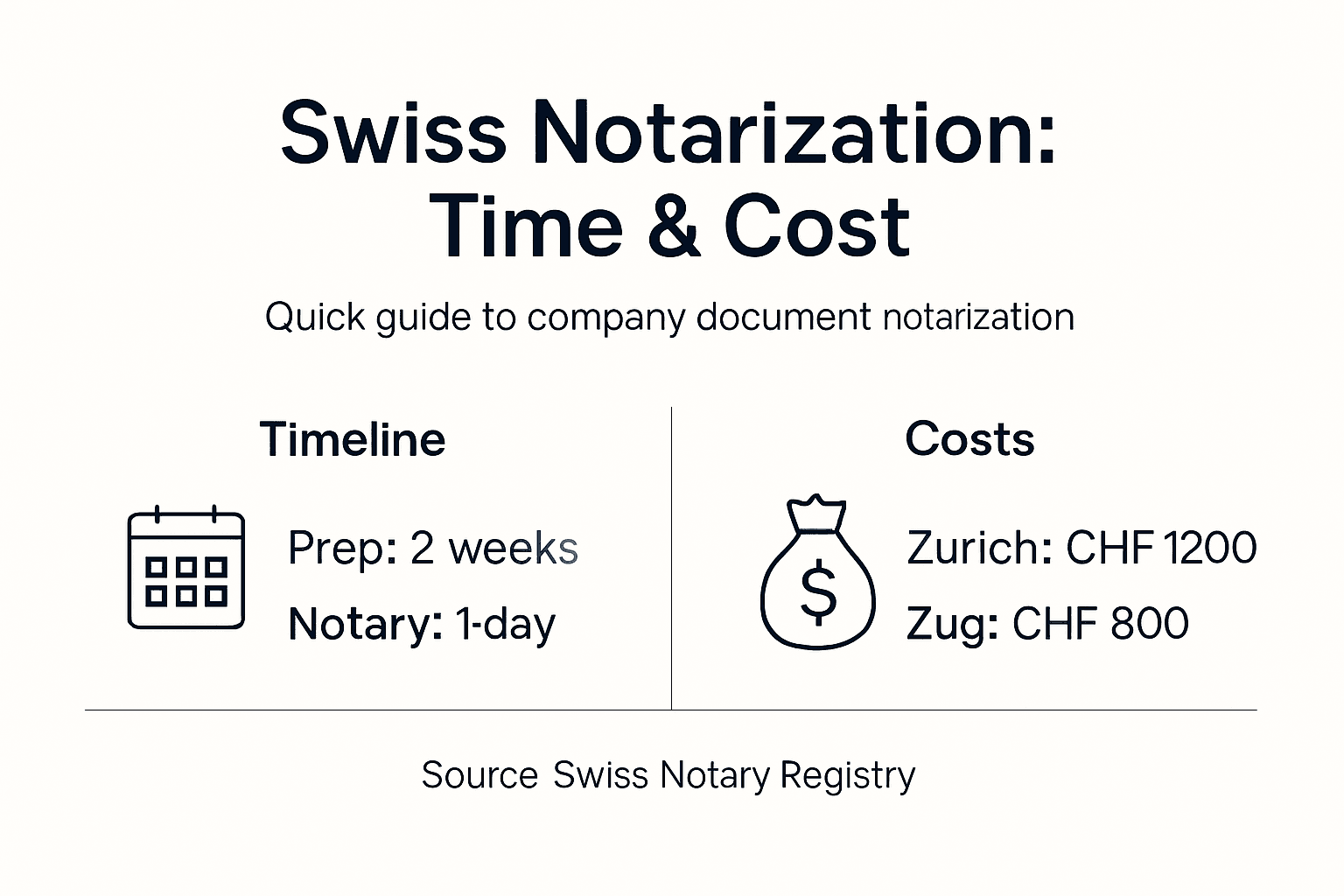
Timing matters significantly. Prepare Swiss company documents at least two weeks before your desired incorporation date. This buffer accounts for potential corrections and ensures your notarization appointment aligns with registry submission deadlines.
Swiss Legal Requirements for Notarization
Switzerland mandates strict notarization protocols for corporate formation. All Swiss company incorporation documents legally require notarization by licensed Swiss notaries to be valid. This requirement stems from federal commercial law protecting investors and ensuring corporate transparency.
Only officially licensed notaries registered in cantonal public registries can authenticate incorporation documents. Private notaries or foreign notarization services cannot substitute. The notary verifies signatory identities, confirms signing capacity, and authenticates document legitimacy before submission to the commercial registry.
Notarization serves critical legal functions:
Authenticates founder and director signatures under Swiss law
Validates share capital contributions and corporate structure compliance
Creates legally binding evidence for commercial registry acceptance
Protects against fraud by verifying signatory identities in person
Without proper notarization, the cantonal commercial registry will reject your incorporation application immediately. You cannot operate legally or open corporate bank accounts until valid notarized documents are accepted. Understanding Swiss legal notarization requirements prevents frustrating rejections and legal complications down the line.
The notary also advises on document compliance with current Swiss corporate law. They identify structural issues in articles of association before submission, potentially saving you from expensive legal amendments after incorporation.

Finding a Certified Swiss Notary
Selecting the right notary impacts your incorporation timeline significantly. Notaries must hold licenses registered in the specific canton where you plan to incorporate your company. Cross-cantonal notarization is generally not permitted, so verify your notary operates in your target canton.
Local in-canton notaries offer distinct advantages. Choosing local cantonal notaries can speed up processing by up to 30%; remote notarization is emerging but limited to certain cantons. They maintain established relationships with the cantonal commercial registry, facilitating faster document submission and follow-up.
Your notary selection options:
Traditional in-person notaries with physical offices in your incorporation canton
Bilingual notaries serving international clients in English, German, French, or Italian
Notaries offering remote video conferencing sessions in approved cantons
Specialized corporate notaries with extensive company formation experience
When choosing a Swiss notary, consider their experience with your company type. GmbH and AG structures involve different legal complexities. Notaries specializing in corporate formation anticipate common issues and streamline the process.
Notary Type | Processing Speed | Cost Range | Best For |
Local in-canton | 1 to 2 days | CHF 800 to 1200 | Standard incorporations |
Remote video session | 2 to 3 days | CHF 1000 to 1500 | International clients |
Specialized corporate | 1 to 2 days | CHF 1200 to 1800 | Complex structures |
Pro Tip: Schedule consultations with 2 to 3 notaries before committing. Compare their fee structures, availability, and communication responsiveness. The right notary becomes a valuable advisor throughout your Swiss business journey, not just a signature authenticator.
Verify notary credentials through your canton’s official public registry before engaging services. This confirmation ensures legal compliance and protects against fraudulent operators.
Step-by-Step Notarization Process
Executing notarization correctly the first time prevents weeks of delays. Follow this proven workflow to ensure smooth processing:
Prepare and verify all required documents. Double-check that articles of association, shareholder agreements, and capital contribution proofs are complete and accurate. Missing signatures or incorrect legal entity names trigger immediate rejections.
Schedule your notarization appointment. Confirm whether your session will be in-person at the notary’s office or via secure video conferencing if your canton permits remote options. Book at least one week in advance, as popular notaries fill quickly.
Attend the notarization session with valid identification. Bring your original passport or residence permit. Photocopies are never acceptable. All founding shareholders and appointed directors must attend or provide notarized powers of attorney.
Sign documents in the notary’s presence. The notary will review each document, explain legal implications, and witness your signatures. Never pre-sign documents, as this invalidates the notarization under Swiss law.
Notary authenticates and submits to commercial registry. After witnessing signatures, the notary officially notarizes the documents and electronically submits them to your cantonal commercial registry. A thorough stepwise notarization process and submission ensures registration within 1 to 3 business days.
Receive confirmation of registration. The commercial registry will email or mail official confirmation once your company is registered. This document includes your company registration number needed for tax registration and banking.
Key execution details:
Arrive 10 minutes early to review documents before formal signing
Ask questions about any unclear legal terms or obligations
Request copies of all notarized documents for your records
Confirm the notary’s timeline for registry submission
Pro Tip: Use a comprehensive company formation checklist to track each notarization step. This prevents overlooked requirements that cause processing delays and ensures you complete post-notarization tasks like tax registration on schedule.
Expected Timelines and Costs
Budgeting accurately for notarization prevents financial surprises during incorporation. Notarization fees vary by canton, document complexity, and service level. Understanding typical costs helps you plan your company formation budget effectively.
Standard notarization timelines:
Document preparation and notary scheduling: 3 to 5 business days
Notarization session itself: 1 to 2 hours
Commercial registry submission and processing: 1 to 3 business days
Total timeline from preparation to registration: 5 to 10 business days
Typical fee ranges across major cantons:
Basic GmbH notarization: CHF 800 to CHF 1200
AG company notarization: CHF 1000 to CHF 1500
Remote video notarization: CHF 1200 to CHF 1800
Complex multi-shareholder structures: CHF 1500 to CHF 2500
Additional costs to anticipate:
Express processing fees for urgent incorporations: CHF 300 to CHF 500 extra
Translation services for non-local language documents: CHF 150 to CHF 400
Commercial registry filing fees: CHF 600 for GmbH, CHF 800 for AG
Apostille certification for foreign use: CHF 100 to CHF 200 per document
Zurich and Geneva typically charge higher notarization fees than cantons like Zug or Schwyz. The premium reflects higher operational costs and notary demand in major business centers. Understanding notarization timelines and costs specific to your canton prevents budget overruns.
Payment methods vary by notary. Most accept bank transfers, while some require cash or credit cards. Clarify payment expectations when scheduling to avoid appointment complications.
Common Mistakes and Troubleshooting
Even experienced entrepreneurs make notarization errors that delay incorporation. Recognizing these pitfalls helps you avoid costly setbacks.
Incomplete documents cause roughly 30% of notarization delays; improper ID and unsupervised signing are also common issues. The most frequent mistakes include:
Submitting articles of association with missing required clauses like company purpose or share capital structure
Presenting expired passports or residence permits instead of current valid identification
Pre-signing documents before the notarization appointment, invalidating the authentication
Failing to bring all required shareholders or directors to the signing session
Using incorrect legal entity names that don’t match commercial registry approvals
When errors occur, quick action minimizes delays. Contact your notary immediately to understand required corrections. Most issues resolve within days if addressed promptly, but ignoring problems extends delays to 2 to 4 weeks.
Troubleshooting strategies:
Request expedited document amendments from your legal advisor if articles of association need corrections
Obtain emergency passport renewals from your consulate if identification expires before your appointment
Schedule a follow-up notarization session immediately after correcting document errors
Verify all shareholder and director attendance confirmations 48 hours before the appointment
Pro Tip: Many common notarization mistakes stem from rushing document preparation. Allocate two weeks minimum for drafting and reviewing incorporation documents. This buffer catches errors before notarization, not after.
“The single biggest notarization mistake I see is entrepreneurs treating it as a rubber stamp formality rather than a critical legal verification step. Prepare thoroughly, understand what you’re signing, and the process becomes straightforward.” – Swiss Corporate Notary, Zurich
Document rejections from the commercial registry require complete notarization repetition. You cannot simply amend and resubmit. This reality makes upfront accuracy essential for avoiding doubled costs and timeline extensions.
Alternative Approaches for Remote Notarization
Travel constraints no longer force international entrepreneurs to delay Swiss company formation. Remote notarization via secure video conferencing has expanded significantly across Swiss cantons since 2024.
Remote notarization via video conferencing is increasingly accepted in 5+ Swiss cantons as of 2026, providing flexibility to international entrepreneurs. This innovation allows you to complete notarization from anywhere globally while maintaining legal compliance.
Remote notarization requirements:
Verified identity through advanced digital ID verification protocols
Secure video conferencing platforms approved by cantonal authorities
Original signed documents couriered to the notary before or after the video session
High-quality video and audio connection for clear communication
Not all cantons permit remote notarization options equally. Zurich, Zug, Geneva, and Vaud lead in adoption, while more traditional cantons maintain in-person requirements. Always confirm with your selected notary whether remote sessions satisfy your canton’s legal standards.
Remote notarization benefits international clients significantly:
Eliminates travel costs and time for Switzerland visits
Enables incorporation from your home country during initial planning phases
Provides scheduling flexibility across time zones
Maintains full legal validity equivalent to in-person notarization
The process typically adds 1 to 2 business days compared to traditional in-person sessions due to identity verification protocols and document courier logistics. Factor this extended timeline into your incorporation schedule to avoid missing critical deadlines.
Expected Outcomes and Success Metrics
Proper notarization execution delivers tangible benefits beyond simply satisfying legal requirements. Understanding success indicators helps you measure your incorporation progress accurately.
Key success outcomes:
Commercial registry acceptance within 1 to 3 business days of notarization submission
Zero document rejections or requests for corrections from registry officials
Notarization fees falling within your budgeted CHF 800 to CHF 1500 range
Smooth progression to tax registration and corporate bank account opening
Successful notarization enables immediate next steps. You can apply for your company tax number, open corporate bank accounts, and begin hiring employees once the commercial registry confirms registration. Delays in notarization cascade through your entire incorporation timeline, postponing revenue generation and market entry.
Measure your notarization success against these benchmarks:
Document preparation completed 5+ business days before notarization appointment
Zero rescheduled appointments due to missing documents or invalid identification
Registry confirmation received within 3 business days of notarization
Total notarization costs within 10% of initial budget estimates
Properly notarized documents eliminate future legal and financial risks. Invalid or improperly authenticated incorporation documents expose you to contract disputes, banking complications, and potential personal liability for corporate obligations. The upfront investment in correct notarization protects your business foundation permanently.
Confirm receipt of your official company registration certificate before proceeding with operational activities. This document serves as legal proof of your company’s existence and legitimacy for all business transactions.
Streamline Your Swiss Company Incorporation with RPCS Solutions
Navigating Swiss notarization requirements becomes significantly easier with expert guidance. International entrepreneurs face unique challenges understanding cantonal variations, language requirements, and legal compliance standards.

RPCS offers comprehensive Swiss company formation services that eliminate notarization guesswork. Our team coordinates directly with licensed cantonal notaries, prepares all required documentation in proper legal language, and ensures your incorporation proceeds without delays or rejections. We’ve successfully guided hundreds of international entrepreneurs through Swiss company formation, maintaining a 98% first-time notarization success rate.
Our company formation checklist guide provides step-by-step tracking from initial planning through final registration. You’ll know exactly what to prepare, when to schedule notarization, and how to verify successful completion. This structured approach prevents the common mistakes causing 35% of notarization delays.
Trusted by entrepreneurs from over 40 countries, RPCS combines local Swiss expertise with international client understanding. We handle language barriers, coordinate time zones for remote notarization, and provide ongoing support beyond incorporation. Your Swiss business journey starts with solid legal foundations, and proper notarization forms the cornerstone of that success.
Frequently Asked Questions
What identification documents are accepted by Swiss notaries?
Swiss notaries accept valid passports from any country or Swiss residence permits as primary identification. The document must be current and not expired. Notaries will not accept driver’s licenses, birth certificates, or photocopies as valid identification for notarization purposes.
Can I notarize my company documents remotely from abroad?
Yes, remote notarization via secure video conferencing is available in several Swiss cantons including Zurich, Zug, Geneva, and Vaud as of 2026. You must verify with your chosen notary that your specific canton permits remote sessions and complete their identity verification protocols before scheduling.
How long after notarization is my company officially registered?
The cantonal commercial registry typically processes and confirms company registration within 1 to 3 business days after receiving properly notarized documents. You’ll receive official confirmation via email or postal mail including your company registration number needed for tax and banking registration.
What happens if my notarized documents are rejected by the registry?
Document rejections require complete re-notarization after corrections. You cannot simply amend and resubmit rejected documents. Contact your notary immediately to understand the rejection reasons, correct the errors in your incorporation documents, and schedule a new notarization appointment as quickly as possible.
Are notarization fees fixed or variable across cantons?
Notarization fees vary significantly by canton, document complexity, and notary experience. Expect CHF 800 to CHF 1500 for standard GmbH or AG incorporations, with higher fees in major business centers like Zurich and Geneva. Always request a detailed fee quote before scheduling your notarization appointment.
Do all shareholders need to attend the notarization session?
Yes, all founding shareholders and appointed directors must personally attend the notarization session or provide notarized powers of attorney authorizing a representative to sign on their behalf. Pre-signed documents without notary presence are legally invalid and will be rejected by the commercial registry.
Recommended
Comments