
Swiss Shareholder Agreements: A Guide for Global Entrepreneurs
- Apr 27
- 10 min read

TL;DR:
Shareholder agreements in Switzerland are private contracts that complement the public Articles of Association.
Proper drafting and continuous review of these agreements are essential to manage risks, liabilities, and investor onboarding efficiently.
Expert legal guidance is vital to ensure alignment with Swiss law, prevent disputes, and protect stakeholders’ interests.
Most international founders arrive in Switzerland assuming that once the Articles of Association are filed, the governance structure is complete. It isn’t. The Articles are public, legally required, and cover the basics, but they’re only part of the story. The real engine of shareholder relationships, covering voting power, exit rights, and what happens when founders disagree, lives in a separate, private document: the shareholder agreement. If you’re setting up or investing in a Swiss company, understanding this distinction isn’t optional. It could be the difference between a smooth partnership and an expensive legal dispute years down the road.
Table of Contents
Key Takeaways
Point | Details |
Confidential but crucial | Swiss shareholder agreements are private contracts that add important governance and exit protections for stakeholders. |
Key clauses matter | Critical provisions include governance, share transfers, dispute management, and investor onboarding mechanisms. |
Complement, not override | Shareholder agreements supplement Swiss Articles of Association but cannot replace their public, statutory framework. |
Avoid legal pitfalls | Explicit language and proper onboarding of new shareholders help prevent liability risks and enforceability gaps. |
What is a shareholder agreement in Switzerland?
A Swiss shareholder agreement is a private contract signed by the shareholders of a company, separate from the company itself as a legal entity. It governs the rights, responsibilities, and relationships between shareholders, covering things the Articles of Association either cannot or simply don’t address in detail. Think of it as the operating manual for your co-ownership structure, agreed upon between the people involved rather than registered with the state.
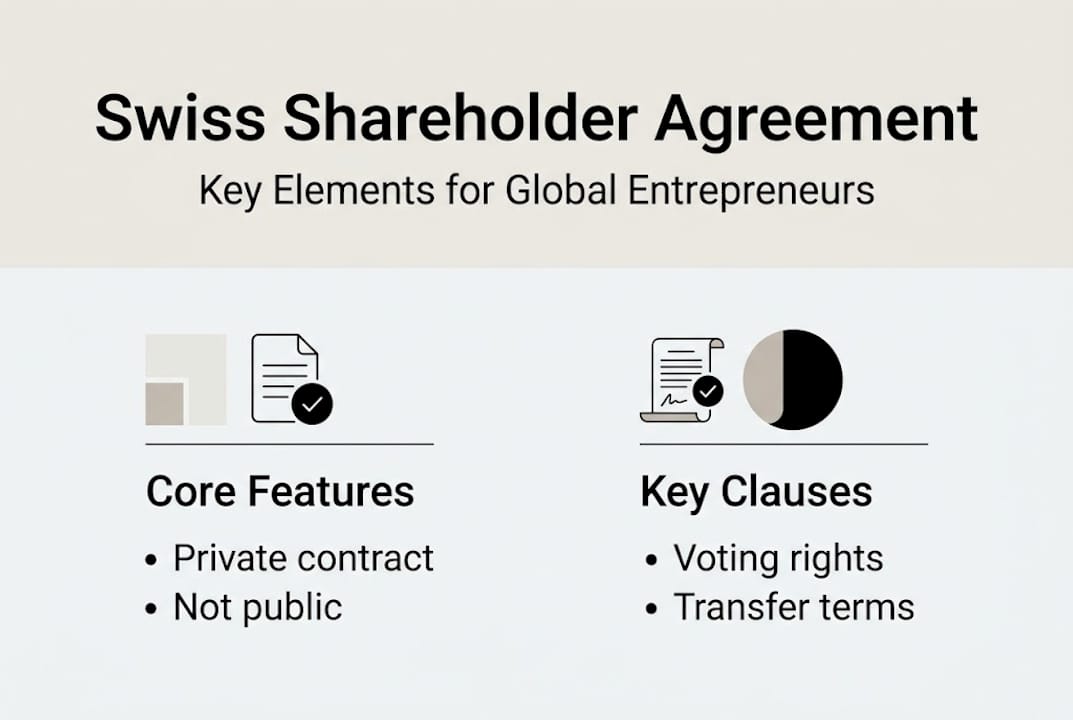
The most important distinction to understand is the difference between the Articles of Association and the shareholder agreement. The Articles (called Statuten in German) are a public document filed with the commercial register. Anyone can read them. They define the company’s legal structure, share capital, and basic governance rules. The shareholder agreement, by contrast, is private. Only the parties who sign it are bound by it, and it stays out of the public record.
As Swiss shareholders’ agreements work in practice, they are used alongside and must be aligned with the Articles of Association: the Articles provide the basic legal framework at company level, while the shareholders’ agreement is generally confidential and contractual between signatories. This means you can’t use the shareholder agreement to override what the Articles say, but you can use it to add layers of detail, protection, and flexibility that the Articles don’t provide.
A well-drafted shareholder agreement doesn’t compete with the Articles of Association. It fills in the gaps the Articles were never designed to cover.
Confidentiality is a real feature, not just a side benefit. Foreign investors often find this attractive because sensitive business arrangements, buy-sell terms, profit distribution nuances, and investor protections stay between the parties. However, confidentiality has limits. If the agreement conflicts with Swiss mandatory law or the Articles, it won’t hold up in court. That’s why alignment between the two documents is critical from day one.
Shareholder agreements are typically used in companies with two or more significant shareholders, joint ventures, startup funding rounds, and any situation where the default rules of Swiss corporate law don’t fully reflect what the parties actually agreed. You can read more about how Swiss business confidentiality works in practice and why it matters for foreign investors specifically.
For a side-by-side comparison, here’s how the two documents differ:
Feature | Articles of Association | Shareholder Agreement |
Public record | Yes | No |
Legally required | Yes | No |
Binding on company | Yes | No (binds signatories only) |
Covers share capital | Yes | Optional |
Governs private rights | Limited | Yes |
Customizable | Somewhat | Highly |
For reference, Swiss company statutes outline what must be included in the Articles. Everything beyond that is where the shareholder agreement steps in.
Note that the agreement is not mandatory under Swiss company law structure. It remains a contractual arrangement between the parties, not a statutory requirement. That said, skipping it is a risk most experienced founders wouldn’t take.
Key clauses found in Swiss shareholder agreements
Knowing that a shareholder agreement exists is one thing. Understanding what actually goes into it is where most foreign founders fall short. The clauses you include, or fail to include, determine how well your company survives conflict, growth, and change.
A well-structured shareholders’ agreement typically covers governance and voting, share transfer restrictions and pre-emption or right-of-first-refusal mechanics, exit provisions including drag-along and tag-along rights, and deadlock or other dispute management mechanisms. Each of these plays a specific role in protecting both founders and investors.

Here’s a breakdown of the most critical clauses and what they do:
Clause | Purpose |
Voting rights | Defines how decisions are made beyond standard statutory rules |
Pre-emption rights | Existing shareholders get first right to buy shares before outsiders |
Right of first refusal (ROFR) | Departing shareholder must offer shares to co-shareholders first |
Drag-along rights | Majority can force minority to sell in an acquisition |
Tag-along rights | Minority can join a sale on the same terms as the majority |
Deadlock mechanisms | Steps to take when shareholders can’t agree on a major decision |
Non-compete clauses | Prevents shareholders from starting competing businesses |
Dividend policy | Specifies how and when profits are distributed |
Let’s look at a few of these in more detail, because each one addresses a specific real-world risk.
Drag-along and tag-along rights are often misunderstood. Drag-along protects majority shareholders: if a buyer wants 100% of the company, the majority can drag the minority along into the deal. Tag-along protects minority shareholders: if the majority sells, the minority gets to join the sale at the same price and terms. Without both, acquisitions become messy and negotiations stall.
Deadlock mechanisms are especially critical for companies with equal ownership splits. If two 50% shareholders can’t agree on a major decision, the company can be paralyzed. Common solutions include a casting vote for the chairperson, a buyout trigger at a pre-agreed formula, or a neutral third-party mediator. Vague agreements on this point lead to costly disputes. The more specific you are upfront, the less it costs later.
Pre-emption rights ensure that existing shareholders maintain their proportional stake when new shares are issued. This matters enormously during funding rounds. Without pre-emption rights, a new investor could dilute your position significantly. You can also link this to restrictions on share transfers to prevent shares from reaching parties outside the original group without consent.
Pro Tip: When negotiating exit and deadlock provisions, resist the temptation to use vague language like “reasonable terms.” Define exact timelines, valuation formulas, and who initiates each step. Ambiguity in these clauses is where disputes are born.
For further context on how governance interacts with shareholder rights, the Swiss corporate governance rules provide a solid framework to reference when structuring these clauses.
How shareholder agreements interact with Swiss company law
Understanding the legal environment around shareholder agreements matters just as much as the content of the agreement itself. Switzerland operates under a civil law system, which means that company relationships are governed by specific codes, primarily the Swiss Code of Obligations. Shareholder agreements sit within this framework as private contracts, not statutory documents.
The key limitation is this: a shareholder agreement is not mandatory under Swiss company law and does not bind the company itself or third parties who haven’t signed it. If the Articles of Association and the shareholder agreement conflict, the Articles win. The shareholder agreement only creates enforceable obligations between the parties who signed it.
This creates a practical gap that many founders discover too late. Imagine a shareholder agreement that restricts share transfers, but the Articles are silent on the matter. A shareholder who ignores the restriction and sells their shares to an outsider may face a breach of contract claim, but the company cannot automatically undo the transfer. The buyer might still legally own the shares, even if the seller broke the agreement.
Here’s what this means in practice:
Obligations in the shareholder agreement bind only the signatories
Remedies for breach are typically contractual, not corporate (so enforcement may require litigation)
Swiss courts will generally uphold shareholder agreements that don’t violate mandatory law
Clauses that conflict with mandatory provisions of the Code of Obligations or the company’s statutory rules are void
The shareholder agreement is a powerful tool, but it works within the law, not above it. Understanding where its authority ends is just as important as knowing what it covers.
For foreign founders, this is where local expertise becomes essential. The corporate governance basics that apply to Swiss GmbH and AG structures shape what you can and cannot include in your agreement. Mandatory rules around shareholder meetings, voting thresholds, and board authority cannot be contracted away, even privately.
Another risk area is dispute resolution. If the agreement doesn’t specify a governing law, a dispute venue, or an arbitration clause, shareholder disputes may end up in Swiss cantonal courts, which can be slow and expensive. Many international shareholders prefer arbitration under Swiss rules, which offers more privacy and flexibility.
Pro Tip: Align your shareholder agreement and Articles of Association from the start. Have the same legal advisor review both documents together. This prevents gaps and contradictions that cost far more to fix after a dispute has started. Review company statutes Switzerland requirements before drafting either document.
Practical issues for founders and foreign investors
Even a technically sound shareholder agreement can create serious problems if the drafting is careless in specific areas. Two issues stand out as particularly relevant for international founders: unintended liability exposure and the challenge of bringing new investors into an existing agreement.
On the liability front, the structure of a shareholders’ agreement matters more than most people realize. Swiss law recognizes the concept of a simple partnership (Einfache Gesellschaft), and if the relationship between shareholders is characterized this way, all parties could face joint-and-several liability depending on how obligations and definitions are worded. A Swiss Federal Supreme Court decision has confirmed this risk, and legal experts now recommend including explicit waiver or clarification language in the agreement to reduce it. This isn’t theoretical. Foreign investors who don’t understand Swiss contract law may inadvertently sign agreements that expose them to liabilities far beyond their shareholding.
The second major issue is onboarding new shareholders. Because the shareholder agreement is private and not automatically binding on future shareholders, incoming investors and new shareholders often need accession or sign-up mechanics, or parallel documentation, so that transfer and governance promises become enforceable against them. Without this, a new shareholder who didn’t sign the original agreement isn’t bound by it at all. They could vote however they like, transfer shares without restriction, and ignore exit provisions entirely.
Here’s a step-by-step approach for foreign founders managing new investor onboarding:
Include an accession clause in the original agreement requiring all future shareholders to sign on before receiving shares
Prepare a standard accession letter that new investors sign, formally agreeing to all existing terms
Update the shareholder agreement when material changes occur, such as a new funding round or a change in governance structure
Ensure the Articles of Association reference share transfer restrictions that mirror the agreement’s terms, giving them a statutory foundation
Have all onboarding documents reviewed by a Swiss legal professional to confirm they’re enforceable under local law
For founders working with founder shares in Switzerland, these steps are especially important during early funding stages when ownership structures are most likely to shift.
Pro Tip: Don’t treat onboarding as an afterthought. The moment a new investor expresses interest is the right time to have your accession mechanics ready. Waiting until after a deal is signed creates legal uncertainty that no one wants to deal with mid-negotiation.
What most articles miss about Swiss shareholder agreements
Most guides on Swiss shareholder agreements stop at explaining what the clauses mean. Few address the real operational risks that come from treating these agreements as one-time boilerplate documents rather than living governance tools.
We’ve worked with international founders who downloaded generic shareholder agreement templates, translated them, and assumed the job was done. It rarely is. Swiss law has specific nuances around liability characterization, governance alignment, and contract enforceability that generic templates simply don’t account for. An agreement drafted without local Swiss legal input may look professional while leaving significant gaps.
The onboarding issue is particularly underestimated. Building compliance and trust in a Swiss company is an ongoing process. Founders bring in investors at different stages, and each time that happens, the shareholder agreement needs to be reviewed, updated, and properly signed. Many companies skip this step during the excitement of closing a round and discover the problem only when a dispute arises.
The most important insight we can offer: treat your shareholder agreement as a dynamic document, not a static one. Review it annually or whenever the shareholder structure changes. Engage a Swiss-qualified advisor to align it with any updates to the Articles of Association. This isn’t excessive caution. It’s the standard that experienced Swiss founders follow from day one.
Get expert help with Swiss shareholder agreements
Navigating Swiss shareholder agreements requires more than reading guides online. The alignment between private contractual terms and public statutory documents, the risks around liability exposure, and the mechanics of proper investor onboarding all demand qualified, Switzerland-specific expertise.

At RPCS, we support international entrepreneurs and foreign investors through every stage of Swiss company formation, including structuring governance documents that actually protect your interests. Whether you’re exploring Swiss company formation services for a new GmbH or AG, or need help setting up the right banking foundation and want to open a Swiss bank account alongside your legal setup, our team delivers tailored support with speed and confidentiality. Don’t leave your shareholder structure to chance.
Frequently asked questions
Is a shareholder agreement required when setting up a Swiss company?
No, a shareholder agreement is not mandatory in Switzerland, but it is widely used, especially for companies with multiple shareholders, to govern private arrangements beyond the Articles of Association.
Are shareholder agreements in Switzerland confidential?
Yes, shareholder agreements are private contracts and are not on public record. Unlike the Articles of Association, confidential and contractual terms remain between the signatories only.
What happens if a new shareholder joins the company?
New shareholders usually need to formally sign the existing shareholder agreement through accession mechanics or parallel documentation to make the agreement’s governance and transfer terms enforceable against them.
Can a Swiss shareholder agreement override the Articles of Association?
No, the public Articles of Association prevail in case of conflict. Shareholder agreements must be aligned with the Articles and complement, but cannot override, the statutory company rules.
What is a common risk in poorly drafted Swiss shareholder agreements?
If not worded carefully, parties might face unexpected joint-and-several liability, similar to a simple partnership under Swiss law, which extends liability well beyond a shareholder’s intended exposure.
Recommended
Comments